Notes On Two Early Films by Masaki Kobayashi

Fabrizio del Wrongo writes:

kobyashi

“A Sincere Heart,” from 1953, demonstrates that Masaki Kobayashi’s gift for staging was evident very early on. In particular, his ability to invest spaces with emotional meanings, and to link them to other spaces via subtle visual cues, is sharp enough to recall Griffith. The plot concerns a carefree youth, named Hiroshi, whose life takes on new meaning when a dying girl moves in next door. Though the two never speak, they glimpse each other through their bedroom windows; like Fabrizio and Clelia in “The Charterhouse of Parma,” the intensity of their connection is inseparable from the teasing impossibility of their closeness (physical proximity aside, they’re from radically different social spheres). Kobayashi directs the hell out of the movie; there’s not a shot that feels out of place. That tightness of control extends to the score, which features a lot of Western-style music, some of it diegetic, and which is used both to link up the movie’s characters and evoke unseen wells of feeling (one tune continually evokes a dead family member). On some level the movie seems intended as Westernizing propaganda — it’s so thoroughly American in tone and decor that it often feels like part of the Andy Hardy series. It’s odd to see the great Kinuyo Tanaka in a rather small role as the boy’s mother. She’s terrific. So is Yuzo Ariga as the stern business-man father. Most of the movie’s problems cluster around Akira Ishihama, the actor who plays Hiroshi. He lacks the subtlety and depth to make the boy’s transformation understandable in emotional terms; Hiroshi starts out callow and mostly stays that way. Kobayashi also might be at fault — he seems unable to get into the young man’s perceptions and feelings, and so he contents himself with festooning the character with signifiers of angst (there’s a lot of boohooing). It’s not enough: Hiroshi’s love comes out of nowhere, and it remains thin in a way that defeats the movie’s theme of carelessness grown into soul. Is it possible that Kobayashi’s sensibilities were too self-consciously noble? A similar flatness of character dogged his epically scaled “The Human Condition,” which has Nakadai playing a man whose basic decency is never really challenged or expanded on.

Made the following year, “Somewhere Under the Broad Sky” corrects some of the problems which plagued “A Sincere Heart.” Akira Ishihama is again present, though here he’s not asked to shoulder the full weight of the movie’s emotional content; he blends happily into his surroundings. The milieu is that of a working-class Japanese family. It’s real slice-of-life stuff, substantially scrubbier than what’s depicted in “Heart,” and definitely more downbeat — it’s a snapshot of a country working its way through a fog of post-war bitterness.  At the center of that bitterness is Hideko Takamine, possibly Japan’s greatest film actress, playing a single woman on the cusp of spinsterhood. Crippled during a bombing raid, she’s damaged goods, but she’s too proud to accept a similarly damaged husband; she spends her days limping about Tokyo’s pleasure sector, gambling on bicycle races and dwelling on ruined possibility. Like Gish and Loy, Takamine is one of those performers whose talent seems to manifest on a plane apart from mere acting; her performance here is like an emanation of being, and she often wrings the subtlest of effects from simple byproducts of posture — her slump-shouldered limp is enough to carry the movie’s pathos. Offsetting Takamine’s sullenness are Keiji Sada and Yoshiko Kuga as the brother and his newly minted wife. Their relationship is a bit rocky — Kuga doesn’t feel accepted by the family — yet they embody a cautious optimism, a symbolic role which Kobayashi and writer Yoshiko Kusuda occasionally push too far, as when they have the couple stand on a rooftop and jabber stuff about hope and love. But they have some touching moments as well: when Kuga’s old beau shows up, it catalyzes their marital problems in a way that barely disturbs the surface calm which successful couples are so effective at maintaining. This lovely sequence, shaped by the simplest of gestures, is characteristic of Japanese social dramas of this period. It’s a reminder that “Sky” is part of one of the great movie traditions, a tradition whose main practitioners include Ozu and Naruse, and which has few equivalents in the arts (the work of Jane Austen is about the best comparison I can muster). There’s no denying that “Sky” is a bit wobbly, and it overstays its welcome by about fifteen minutes. (Ozu, by contrast, always knows precisely where to end a movie.) But during its best moments it’s a pleasure.

Both movies are available to stream via the Criterion Collection channel on Hulu+. Criterion has also just released a set of four early Kobayashi works on its Eclipse label. Worth checking out.
Posted in Movies, Performers | Tagged , , , , , , , , , | 2 Comments

Notes on Los Angeles, Part II: Mostly Architecture

Sir Barken Hyena writes:

The L.A. visit continued with a walking tour of glorious, or at least much photographed, Downtown Los Angeles. We had some highs and some lows with this one.

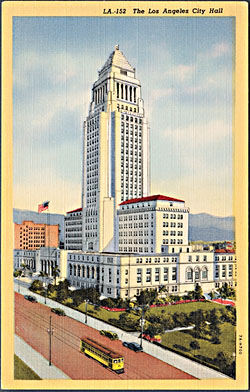
One “high” was certainly the LA City Hall, a 1928 Art Deco skyscraper that rates only lower than the Empire State and Chrysler buildings for instant recognition. Though for different reasons: it’s had many TV and movie appearances, the advantage of the home team I suppose. Still, nothing becomes iconic from mere exposure, it must have that memorable quality, and the LA City Hall certainly has that:

blog_los_angeles_city_hall

Yep, Sgt Friday and Martian invaders spring to mind, right? But when you get beyond that in the presence of the real building you see a monument that perfectly encapsulates a moment in California’s history. Part of this is in obvious ways, such as the tile mosaics celebrating the young city’s industries: film, oil, aviation, agriculture. This is standard civic architecture stuff, though the vaguely Moorish style is interesting. Part of it is a more subtle symbolism: it’s an Egyptian obelisk topped by a Babylonian ziggurat supported by Greek columns, a kind of sampler of symbols of muscular state power and legitimacy. Modernist architects (we still call them that 100 years later!) would certainly connect that statement with Fascism, and maybe they have a point in a way. As pure art it doesn’t rate with the masterpieces of the style but it’s as expressive as a building can be. It radiates confidence, optimism, power, and most of all, the future.

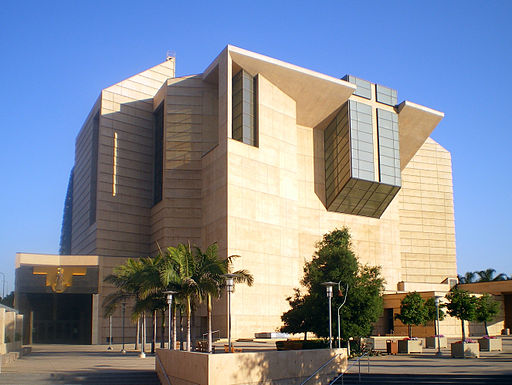
What a gulf that separates this proud optimism from the cynical doubt that is Our Lady Catholic Cathedral just a few blocks and worlds away.

Cathedral_of_Our_Lady_of_Angels_(from_plaza),_Los_Angeles

This building expresses, well, not much really besides confusion and a pathetic “me too-ism”. It’s as though the church leaders who green-lighted this impressionistic fertilizer factory were trying to keep up with the hip and in crowd. Never mind that that crowd stands for the opposite of everything that’s central to the religion. Never mind that there’s a 2500 year history of sacred building design that’s at the center of Western culture. Never mind that a building that celebrates timeless truths has no need for innovation. Never mind that the people who are actually supposed to be served by this building have no clue about architecture, or modernism and probably wouldn’t care any way. This building was made for everyone who never will go there. It projects not optimism but a crushing lack of faith, in a building that exists to support faith.

Some redemption is found by entering the building. The space is still dominated by Brutal concrete but manages a semblance of the feeling of a true cathedral. But mostly it’s the tapestries that redeem. These depict a procession of saints portrayed with great realism, all facing to the central crucifix. Here’s one sample:

tn2

There are about 20 of these, each face has a very distinct personality to it, and a unique expression of reverence. It’s a much needed human touch, perhaps made more powerful by the concrete horror that surrounds, though I doubt that was the intent. Other artworks, particularly the magnificent Italian carved altar and a powerful statue of Mary, only serve to embarrass our modern attempts at sacred art.

Just as futuristic as the City Hall but for different reasons is the Bradbury Building, fixture of Science Fiction. It’s two most famous uses were in Blade Runner as the home of J.F. Sebastian and his toys, and in the Outer Limits episode Demon With the Glass Hand, where Robert Culp hunts aliens in it’s cavernous atrium. In the flesh it’s more gay 90s than LA 2019 but no less spectacular for all that, with the iron work, carved filigree and glazed brick really dominating the space. We could only hang around the ground floor atrium because the building has actual tenants, so we couldn’t go hunting for Pris. Probably better that way…

Sir Barken on his way to retiring a few replicants

Sir Barken on his way to retiring a few replicants

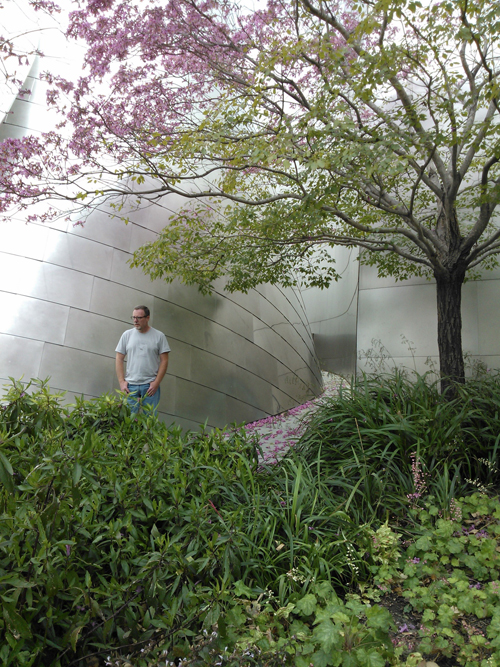
Last on the list was the Walt Disney Concert Hall, by Starchitect Frank Gehry. Blowhard, Esq. advised that we see it in spite of my disparaging remarks from having seen it from a distance, and recommended taking the tour. Sadly we were too late for that but did walk around the building and to my surprise I found it quite a different thing when seen that way. It lost all of it’s “sheet metal shop floor” look and became a kind of trippy funhouse in chrome. Particularly nice was the rooftop garden featuring lots of exotic plants and trees, the colors of the vegetation glowing against the chrome. Here was a fitting contrast: organic against artificial, but also with an odd unity because the Gehry’s artificial shapes defied the grid and t-square for a kind of echo of the organic.

Sir Barken contemplates mortality and evanescence after icing a few miscreant replicants

Sir Barken contemplates mortality and evanescence after icing a few miscreant replicants

Related

  • Notes on Los Angeles, Part I is here.
Posted in Architecture, Travel | 12 Comments

Quote of the Day

Blowhard, Esq. writes:

beowulf“A few miles from here
a frost-stiffened wood waits and keeps watch
above a mere; the overhanging bank
is a maze of tree-roots mirrored in its surface.
At night there, something uncanny happens:
the water burns. And the mere bottom
has never been sounded by the sons of men.
On its bank, the heather-stepper halts:
the hart in flight from pursuing hounds
will turn to face them with firm-set horns
and die in the wood rather than dive
beneath its surface. That is no good place.

When the wind blows up and stormy weather
makes clouds scud and the skies weep,
out of its depths a dirty surge
is pitched towards the heavens. Now help depends
again on you and on you alone.
The gap of danger where the demon waits
is still unknown to you. Seek it if you dare.
I will compensate you for settling the feud
as I did the last time with lavish wealth,
coffers of coiled gold, if you come back.”

Beowulf, translated by Seamus Heaney

Posted in Books Publishing and Writing | Tagged , , | 1 Comment

Immigration, Legal and Illegal

Paleo Retiree writes:

I don’t normally have much time for Anne Coulter, but this strikes me as a terrific column. Fact Du Jour: “During the three years from 2010 through 2012, immigrants have committed about a dozen mass murders in this country.”

Posted in Politics and Economics | Tagged , , | 6 Comments

Quote of the Day

Blowhard, Esq. writes:

fallofconstantinople1204

With the rise of the state all of this [economic and political freedom] was swept away. For the past five or six millennia, nine-tenths of all people who ever lived did so as peasants or as members of some other servile caste or class. With the rise of the state, ordinary men seeking to use nature’s bounty had to get someone else’s permission and had to pay for it with taxes, tribute, or extra labor. The weapons and techniques of war and organized aggression were taken away from them and turned over to specialist-soldiers and policemen controlled by military, religious, and civil bureaucrats. For the first time there appeared on earth kings, dictators, high priests, emperors, prime ministers, presidents, governors, mayors, generals, admirals, police chiefs, judges, lawyers, and jailers, along with dungeons, jails, penitentiaries, and concentration camps. Under the tutelage of the state, human beings learned for the first time how to bow, grovel, kneel, and kowtow. In many ways the rise of the state was the descent of the world from freedom to slavery.

— Marvin Harris, Cannibals and Kings: Origins of Culture

Posted in Politics and Economics | Tagged , , | 5 Comments

Linkage

Fabrizio del Wrongo writes:

  • Foseti shares his heretical views on the defeat of communism. Or perhaps we should put scare quotes around defeat? I’ve often asked myself the same question: If it’s true that communism was defeated, how is it that the West keeps getting more communist-y?
  • “As I’ve occasionally noted, marketing is the dominant type of work in 21st Century America, and journalism is slowly turning into marketing criticism.” — Steve Sailer
  • Speaking of marketing, I’m consistently amazed by the names our overlords give to the imperial decrees bills they put forward. “The Marketplace Fairness Act” is a good one. Allow me to suggest a more appropriate name: “The Pay More for the Stuff You Buy Act.”
  • Rupert Everett is feelin’ the years.
  • As a lot of people have noticed, the Boston Marathon bombers are pretty sexy. Have any recent female criminals qualified as hotties? Amanda Knox and Casey Anthony spring to mind — or do they not qualify as criminals? Whatever they qualify as, I’d like to have a no-holds-barred, this-might-be-illegal threesome with the two of them. And how about that sexy Russian spy from a few years back?
  • Crisis averted? (H/T Glynn Marshes)
  • How do I get to be a member of a protected minority group? Hey, maybe my being shut out of protected minority groups constitutes its own sort of discrimination. Any enterprising lawyers out there want to take up my cause?
  • Not “The Onion.”
  • Dudes: How concerned are you about your “scrotal environment“?
  • More subversive animation from White Rabbit Radio. Great “performance” by “Hitler.”
  • Visualization of the Dark Enlightenment blogosphere.
Posted in Linkathons | Tagged , , , , , | 14 Comments

Shakin’: An Interview With De De Mollner

Paleo Retiree writes:

Yesterday I expressed my enthusiasm for ’60s go-go dancing, which I consider to be a majorly underappreciated popular artform. Who doesn’t love the girls who dance behind rock acts? But how much do you know about them? And where are the books and documentaries about them?

Today I have a special treat in store: an interview with De De Mollner, the unofficial leader of the great Gazzarri Dancers, to my mind the best, sexiest and most inspiring of all the go-go troupes of a great era. (The Gazzarri Dancers performed on the show Hollywood A Go Go in 1964 and 1965.) I think you’ll really enjoy meeting De De and hearing her story, which is fascinating both in its own right and for the snapshots it offers of American youth and popular art (LA division) in the early ’60s. De De was very generous with her time and her tales, so — drumroll — without further ado …

Continue reading →

Posted in Interviews, Music, Performers | Tagged , , , , | 40 Comments

Go-Go Dancing

Paleo Retiree writes:

As far as giddy, pure-pleasure culture-activities go, there hasn’t been much that’s given me more pleasure over the years than watching go-go dancers. They’re a lot more than just cute, skillful and energizing eye candy — although, god bless them, they’re all that too. They wiggle; they project feeling and personality; they wear costumes and hairdos with enthusiasm … They enhance shows, they keep energy levels up, and they contribute a lot of sex appeal.

Primarily go-go dancers serve decorative and background purposes, of course, but oftentimes (and in effect) they’re more than just decor — in fact, sometimes they’re more worth watching than the featured performers are. In a lot of ways go-go dancers represent the spirit of popular culture itself, and maybe even of the performing arts generally. They’re full of the love of showing off, pitching in, and contributing to fun experiences, and they work hard to deliver blasts of hope, silliness and joy.

I’ve enjoyed the work of a good number of go-go dancers live, but in recent years, thanks to the miracle of YouTube, I’ve also been able to revisit the go-go dancing from my youth and early youth, the real glory days of the form. One of my main responses has been to wonder: “Why on earth doesn’t someone make a documentary about go-go dancers, and about the go-go dancing era more generally? Where’s the priceless, moving, funny, gorgeous, nostalgic movie about them, something along the lines of ‘Standing in the Shadows of Motown,’ Paul Justman’s wonderful 2002 documentary about the musicians in Motown’s house band?”

In the case of go-go dancers: A lot of video footage exists, and many of the people who were participants in the scene are still around and in good shape. The materials are there. Plus: As far as I can tell, today’s world is nothing if not teeming with wannabe filmmakers in search of excuses to start shooting and editing. So: get cracking, filmmakers. It’s a great, not just a good, subject, and it’s ripe for the picking.

A little more discerning now than I was as a kid, as I’ve stared at my computer screen I’ve  been able to distinguish one go-go dancing troupe from another. And over and over again, one go-go troupe in particular has stood out: the girls on the TV show Hollywood A Go Go. A little time with Google has revealed that they were known as the Gazzarri Dancers. With their fluidity and their sophisticated sex appeal, they make most of the other pop-music dance troupes of the era look clunky, square and earthbound — more like hard-working girls still earnestly shaking off the ‘40s than young women helping usher in the freedom of the late ‘60s and the experimentation of the ‘70s.

Here’s a number from Shindig …

Cute and fun as can be — no disrespect meant! Still, compare the girls and the dancing in it to this number from Hollywood A Go Go:

The Shindig number: bright and brassy, almost like an early ’60s version of “Boogie Woogie Bugle Boy.” The HAGG number: all cashmere and daring, and reminiscent of the movies of Roger Vadim. Each and every one of the Gazzarri girls strikes me as tigerish — as too much woman, and in the best possible way.

I’m a little wary of rhapsodizing too much, let alone sounding like too much of an old fart. But for me the HAGG numbers aren’t just ‘way more sophisticated than almost anything else from the TV of the era, they’re also much more truly-deeply erotic than contempo pop numbers are. This despite the fact that they’re far less explicit (and, god knows, they’re far less aggressive and polished) than a lot of contemporary pop-music performances. On the one hand they’re as all-American as high school and Playboy magazine; on the other they have some of the assertive-yet-sultry allure of many of the European art movies of that era. In any case, I consider them little jewels of pop poetry.

One of my favorite hobbies on Facebook has been linking to a lot of the Hollywood A Go Go videos and introducing my Friends to the Gazzarri girls. Since many people — even many who have extensive pop-music knowledge banks — seem completely unaware of the various go-go troupes, I see sharing my knowledge and links as doing a major public service.

Snooping around one day on Facebook I was tickled to see that Deanna (De De) Mollner, the best-known of the Gazzarri Dancers, is a FB member. (De De is the knockout blonde behind the singer in the Hollywood A Go Go number above.) I sent De De a Friend request, she Friended me back — yay — and she’s been an online acquaintance ever since. A tall blonde dynamo, De De in the Hollywood A Go Go numbers embodies a bit of Tuesday Weld and a bit of Brigitte Bardot, and the Facebook-offered glimpses I’ve had of her suggest a life very well, indeed exuberantly, lived.

Recently I was ranting to The Question Lady about the above question — Why hasn’t a documentary about go-go dancing been made? She put up a hand and told me I should stop being an idiot and man up. “But I’m not a filmmaker,” I protested. “No, but you’re in touch with De De Mollner,” she said. “You’ve got a blog, and you’re a good interviewer.”

I took her point. So come back tomorrow to enjoy a treat. You’ll have the chance to meet a special person, and you’ll be able to learn a bit about a special time, the glory days of American go-go dancing.

Posted in Music, Performers | Tagged , , , | 7 Comments

Notes on Los Angeles, Part I

Sir Barken Hyena writes:

Lady Hyena has been getting restless lately, never a good thing, so I took her and myself for a few days in the Big City: The City of Angels in this case, a place we’ve only seen from the speeding window of the car before. Now, having been up close and personal I can make a surprising admission:

We love L.A.! Yes, the city everybody loves to rag on, butt of endless jokes and object of contempt for every New Yorker. As usual the conventional wisdom is only conventional. Here are a few high points from our trip:

The Museum of Jurassic Technology

What we have here is actually a work of art in the form of a museum. Some paint canvases, others write poems, David Hildebrand Wilson, the museum’s creator, makes fictional (or are they?) exhibits of curiosities, historical figures, social phenomenon and incredible animals.  Most of which never existed but if they did you’d want to know about it. Some of the exhibits are: the Deprong Mori, an Amazonian bat that uses radar, a history of the self-built travel trailer, a scientist’s long battle with Mt Wilson observatory, an innovative Armenian violinist, and folk cures treated as objectively verified scientific phenomena.

MJT is part homage to the menageries and Cabinets of Wonders that were the precursors of today’s museum, part sly joke about the nature of knowledge, part indulgence in the mystery of it all (the “jurassic” in the name is never explained), part nothing else you’ve seen. A must see for all fans of the bizarre.

http://mjt.org/

animal

Next up was dinner with the blogging sensation Blowhard, Esq. This was to be our second “Brush With Greatness” in Tinseltown – we had bumped into Ron Perlman in a kabob restaurant earlier that day. We asked him to pick a place to “wow” the ignorant hayseed in us with Big City sophistication. We got it.

animal

First of all there’s no sign on this restaurant, which I think is hilarious. Atmosphere wise it’s a typical trendoid place, with the usual suspects in place, but thankfully it’s also just too fun to be pretentious. In any case the conversation was too good to notice – highlights were some great stories Blowhard, Esq. shared about writer and raconteur Lloyd Fonvielle.

The food was spectacular, kind of a fusion-tapas thing where you order a bunch of smaller entrees. The stars, we all agreed, were the rabbit-shrimp sausage spring rolls in green curry, the yellowfin sushi tostada, and the black bean ribs. Only the kale was just OK but what do you expect from kale?

Desert was also amazing though the tres leches was a bit too sweet. All in all a spectacular meal and a great time. Highly recommended.

http://animalrestaurant.com/

Up Next: Brutal Churches & Martian Invasions

Posted in The Good Life, Travel | 4 Comments

Quote of the Day

Blowhard, Esq. writes:

suttonhoohelmetSometimes at pagan shrines they vowed
offerings to idols, swore oaths
that the killer of souls might come to their aid
and save the people. That was their way,
their heathenish hope; deep in their hearts
they remembered hell.

Beowulf, translated by Seamus Heaney

Posted in Books Publishing and Writing | Tagged , , , , | 2 Comments