
Blowhard, Esq. writes:
Blowhard, Esq. writes:
Fenster writes:
That ol’ vampire squid, Goldman Sachs, has for a while been running an ad campaign that attempts to put the firm’s accomplishments in the best possible light. To paraphrase Dr. Johnson on the subject of a dog walking on two legs, what’s remarkable here is not that it is done well, but that it is done at all.
Goldman has long had a media arm, to be sure (full disclosure: in the 1980s, I was the “talent” on a video produced by Goldman highlighting its international communications capabilities). But it didn’t really have much in the way of a face to the public at large–there, it was as rarely seen as, well, a giant squid.
At one level, the new ad campaign seems to simply aim at a broader set of insiders. By stressing things like job creation they are doubtless looking to cast a wider net in search of new kinds of opinion leaders. But the ads are also crafted to make them look friendly and nice to average Americans–not a bad goal given the heat it has been under. Will it work? Who knows–for one, the fabled Jerry Della Femina thinks the approach is laughable, and that no one will really buy the notion that Goldman is suddenly a nice place.
Here’s what I find odd though. Perhaps it is because I read about finance, but I regularly get Goldman ads looking out from me from various websites that I visit. You’d think that with all the money they have, they would be attentive to things like visual quality. Yet a number of their website ads are built around poor quality images. Why would they do that?
Here is an ad touting their redevelopment expertise. This is from Goldman’s own website and so it is a good quality image. This ad is also one that appeared in a lot of print ads, and Goldman probably got mileage out of the fact that the model they used came across as cute and wholesome.

But this is how it shows up on a web page.

The logo is clear enough but the picture stinks. Is this a technical thing or are they just being clueless?
Blowhard, Esq. writes:
Seth Roberts, formerly of Berkeley and now professor at Tsinghua University in Beijing, decided to stop grading his students. He writes:
The more freedom I gave my students, the more difficult it became to grade them. At Tsinghua I teach a required class for freshman psychology majors called Frontiers of Psychology. There are 20-30 students. It covers recent research. For the first few years, I had students write comments on the reading. “Write something only you could write,” I said. The students struggled to figure out what that meant. I struggled to grade their answers.
Before last semester began, I had an idea: no grading. Maybe other sources of motivation, would be enough.
So what were the results?
It was the most pleasant teaching experience of my life. It was also the easiest by far, in contrast to my Berkeley colleagues’ claim that my ideas led to “too much work.” The hours I had spent every week grading homework in previous versions of the course — the part of the course I liked least — was gone. At the end of the class, I spent many hours discussing the student projects, but I enjoyed these discussions. They didn’t feel like work. The students had chosen topics they wanted to study and seemed happy to talk about what they had done. Unlike an oral exam, almost nothing was riding on what they told me and they could be proud of what they were talking about, since it was almost entirely their idea.
The students’s work was the highest quality I have ever seen. Two of their final projects might be publishable. (And these are first-semester freshmen.) It’s not my field, so I can’t be sure, but they have great inherent interest and no obvious flaws. The students seemed to like the class, too. On the final day, which happened to be Christmas, they gave me a Christmas card signed by everyone in the class. One student gave me a card separately. “Thank you,” I said. “Why did you give me this?” Among other things, she said I had high standards. Given the absence of grades, that was interesting. Maybe it came from the fact that after every presentation, I would point out something I liked and something I thought could be better. I tried to do that with all of my feedback. Another student told me, after the final class, that what I had said about “the best way to learn is to do” was, in her case, very true. She said she had learned more in my class than in all her other classes put together.
Students who are respected and trusted enough to pursue their own projects, lines of inquiry, and curiosities? A very Montaignian method of education.
Do people give you their best when they’re given the most freedom, at least within certain bounds? In a subsequent post, Seth shared this excerpt from an interview with Steven Soderbergh:
INTERVIEWER You’ve talked at length about giving actors as much freedom as possible. That’s resulted in a number of performances that have launched, revived, and revitalized careers. In the case of Jennifer Lopez in Out of Sight, you’re responsible for her only good film performance.
SODERBERGH It’s not that I never say no; I’m just not trying to control them. I’m looking to amplify and showcase whatever it is about them that I find compelling.
On the other hand, after reading those posts, I came across this interview with Kevin Spacey talking about being directed by David Fincher:
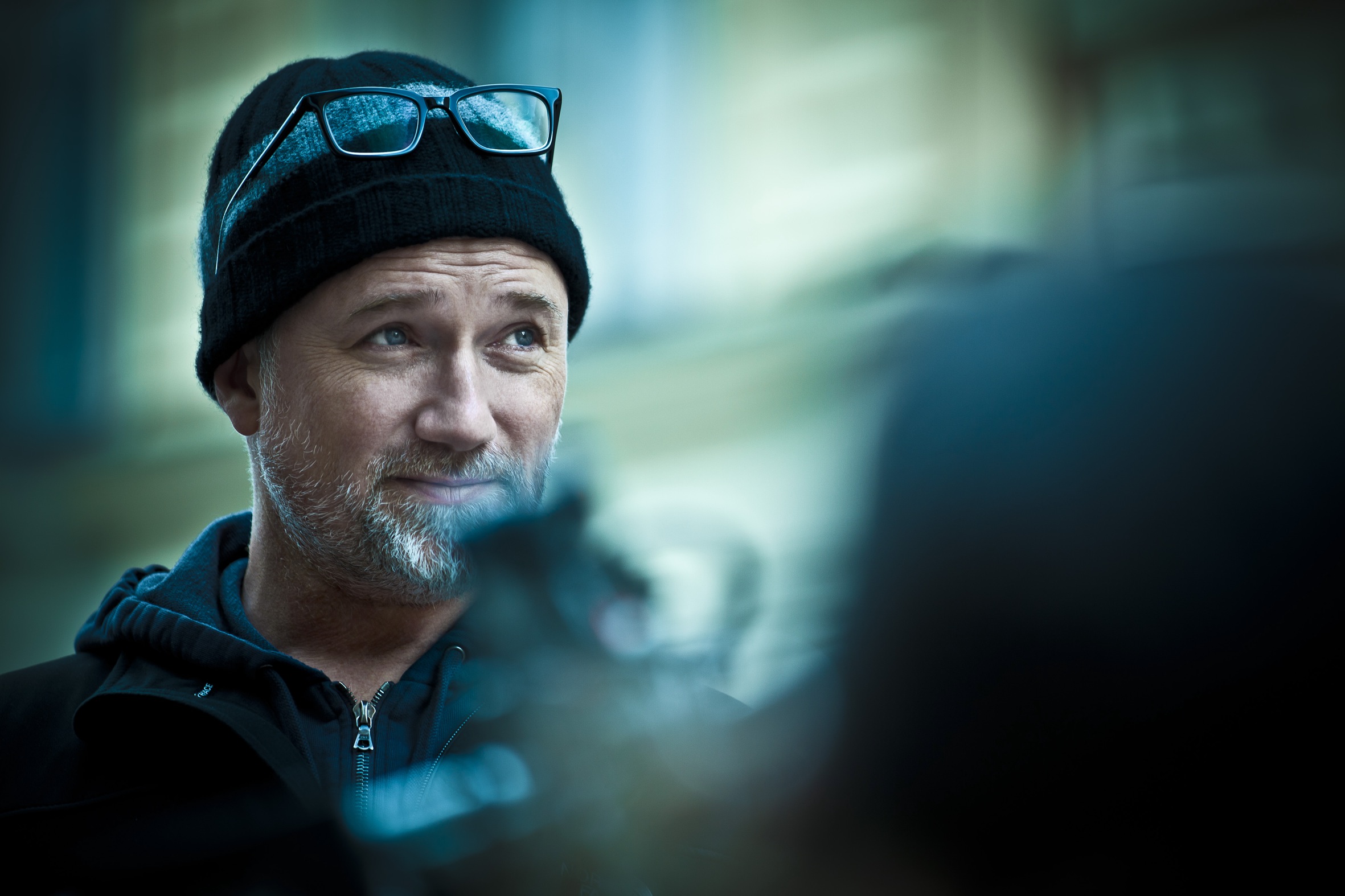
“Part of what I feel when he’s doing that — and I like working this way — is that, you know, he’s pushing you in a certain direction. He’s having you go in a different direction this way; he’s having you try a new meaning, a new approach to a line of dialogue in this way; and, frankly, the other truth is actors bring a lot of complicated accessories to the set. And some of those accessories are gestures, and some of those accessories are, ‘Oh, I found a kind of cute way of saying a line,’ or ‘I like the way my voice does this,’ or ‘I’m going to use this Coke can to do this.’ And I think sometimes, with David, it feels like [what] he’s looking for is the cleanest, streamlined version of the idea that the character’s trying to express. … And he’s just simply, at a certain point, beating the acting out of you. And I’m quite grateful for that.”
Thoughts? Reactions?
Fenster writes:
Here are the headline and subhead from a recent article at Information Week.
Should there be any surprise that faculty would voice skepticism about the possibly disruptive role of technology? They are after all steel drivin’ men (and women) and in the end the machine can always be beat. Right?
It depends on what machine. Some of the faculty quoted in the article seemed content to take potshots at what passed for educational hi-tech maybe a decade or so ago, without giving any particular thought to what is happening today. Here’s a passage:
“I went to [a course management software workshop] and came away with the idea that the greatest thing you could do with that is put your syllabus on the Web and that’s an awful lot of technology to hand the students a piece of paper at the start of the semester and say keep track of it,” said one.
What’s wrong with this picture? For one, the faculty member discusses course management software as though that’s the cutting edge today. But programs like Blackboard, which are now ubiquitous and commonplace, have been around for well over a decade. They can do a lot more than house a syllabus, as the faculty member seems to suggest, but no one would mistake course management software for major disruption going forward. It’s already been mainstreamed. It’s like arguing in the 1990s that PCs won’t change much since the Commodore 64 isn’t that powerful.
But the next guy quoted is the one who really doesn’t get it.
“What are the gains for students by bringing IT into the class? There isn’t any. You could teach all of chemistry with a whiteboard. I really don’t think you need IT or anything beyond a pencil and a paper,” said another (emphasis mine).
You can, he argues, teach all of chemistry with a whiteboard, and that there is no further need for IT. But that mistakes some of the more revolutionary aspects of tech in education. Salman Khan would agree that you don’t need much beyond a whiteboard to teach math, geometry, trig, calculus and a host of other subjects. And he does, too, online, for free.
Let’s stipulate that if professors could be graded Khan would be an A. He is certainly gifted as a teacher, perhaps singularly so. He is a superlative explainer, clear as a bell, and funny to boot. And that’s just the point. For classes all about the whiteboard, wouldn’t students prefer Khan’s A performance to one by Professor X that is likely to be inferior? And wouldn’t administrators prefer using Khan’s free content over the expensive, boots on the ground, whiteboard approach of Professor X, if only they could find a way to make that happen?
“High” technology is causing only some of the disruption in higher education. A good deal of it, though, is being caused by low tech. Tape a class. Show the whiteboard. Deliver the content.
Fabrizio del Wrongo writes:
![Premium-Rush[1]](https://uncouthreflections.com/wp-content/uploads/2013/02/premium-rush1.jpg)
“Premium Rush” is a shallow chase movie that, for the most part, doesn’t ask us to make too much of it. Its plot concerns a New York bike messenger (the ubiquitous Joseph Gordon-Levitt) who is tasked with carrying a valuable MacGuffin; a crooked cop (the wonderfully weird-looking Michael Shannon) tries to stop him. Director David Koepp doesn’t have the poeticizing instincts of a Spielberg or a Peckinpah, nor does he have the talent for exaggeration that can make the action work of a Zemeckis or a Peter Jackson so pleasurably funny. But he has a feeling for space, movement, and pacing, and he gets the enervated, over-burdened aspects of Manhattan in a way that many filmmakers don’t (he doesn’t direct like a tourist). DP Mitchell Amundsen’s camera zips around the jumbled, cacophonous streets, always changing angles and levels, in an effort to bring us into the mindset of the messengers, whose kamikaze daring and live-for-the-moment ethos set them apart from the city’s more rooted rat racers. At select moments Koepp interrupts the flow of the movie to insert temporal switchbacks, Google Mappish representations of Manhattan’s layout, even slowed-down approximations of Gordon-Levitt’s split-second navigation decisions; this keeps us oriented both narratively and geographically, but it also mimics the heightened state of perception enabled and required by contemporary life. (In some ways, the movie’s bike messengers are proxies for today’s young people, who often seem most comfortable when darting through a Manhattan-like maze of mental-technological gewgawry.) As the principal messenger Gordon-Levitt is admirably sleek (he’s about as arrow-straight as Keanu’s buzzed gum chewer from “Speed”), but the picture really belongs to Shannon: his blundering, car-bound frustration in the face of urban chaos in general, and gnatty bikeriders in particular, will seem familiar to anyone who isn’t naturally attuned to the city’s pell mell rhythms. A couple of nitpicks: I wish Koepp had treated the romantic material with a bit more brass (Gordon-Levitt is too eager to win back his fickle girlfriend), and I wish he hadn’t leaned so hard on the MacGuffin’s back story, which involves the efforts of a Chinese immigrant to bring her too-adorable child to America. This tendency towards squishiness, however slight, takes something off the movie’s spin. It’s a spoonful of medicine after the sugar’s already gone down.
Blowhard, Esq. writes:
Enjoy this montage from my days as a ranch hand visit to see The Question Lady perform her new show.


This gallery contains 4 photos.
Blowhard, Esq. writes: Back here, Paleo Retiree wondered if pop culture wasn’t getting a little too coarse. Here’s the latest example: I’ll bet these are just rebranded baby wipes, too. Here’s the press release for the campaign from the advertising … Continue reading
Fenster writes:
You can forget a lot about a film in 35+ years, and I forgot a good deal about Claude Sautet’s Mado, which I saw when it came out in 1976 and only saw again recently.
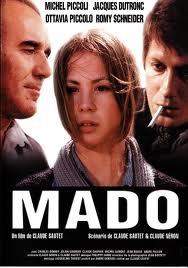
In fact, I had forgotten most of the plot and even the title, which made it hard to track down when I wanted to see it again from time to time over the years. I remembered a nuanced performance by Michel Piccoli and that the plot revolved around real estate development, the details of which were provided in luxurious detail unusual in film. That was striking.
I lost track of it until IMDB made it easier to identify films. The increased availability of otherwise obscure offerings brought it to my DVD player last week, where I was able to compare notes with my selective and shoddy memory.
The two aspects of the film that I recalled vividly remained striking. Piccoli’s performance is nuanced, and really interesting. And the film portrays aspects of business, finance and real estate development in a lot more detail than is normally the case, where they are typically treated superficially and as the occasion for hot action of one sort or another. Here, the details are afforded real respect.
But real estate development? 1976? Oddly, I suspect I was especially fascinated by that world in 1976. As I wrote at 2Blowhards some time ago:
Generationally speaking, while my dad’s formative years were molded by depression and war, mine were molded by two bookends separated by less than a decade: the cultural shifts of the late 1960s (made manifest most clearly by Woodstock) and the return-to-reality shocks of the mid-1970s. The latter was made manifest in my life via a series of awakenings that reminded me that, irrespective of many deeply satisfying Aquarian yearnings, the world-as-it-is is also important. And that world consists of many seemingly prosaic things, like municipal water systems and debt burdens. Thus it was that I was greatly influenced by everything from Polanski’s Chinatown to Caro’s The Power Broker in an end-of-an-era kind of way.
Mado was, I think, a similar slap in the face–a preview, if you will, of what adult life, and my life, might shape up to be like. Indeed, while I was never a real estate developer I did spend a number of years doing bond financings, so the preview element of the film was for me quite real.
And there are aspects to the film that mirror my 1976 perspective, and touch directly on the issue of young/old, business/pleasure, work/play and conventional/unconventional.
So with that, here’s the plot, including spoilers.
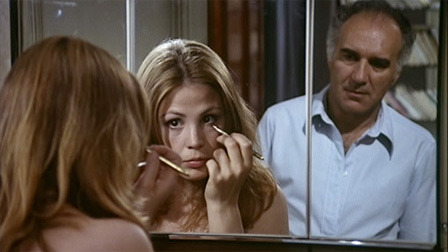
Léotard (Piccoli) is the head of a real estate development firm competing to do business on large projects in the Paris area. He is separated from his struggling and substance abusing wife and has taken up with a beautiful young woman named Mado (Ottavia Piccolo) , whom he pays for sex and companionship.
I don’t call Mado a prostitute since she would bridle at the term and I would like to stay on her good side. Rather, she’s something between a prostitute and a sixties/seventies free spirit, doing what she feels OK about doing.
Léotard is smitten and would like nothing better than to wean Mado of her other paying customers, some of whom don’t even pay, with the result that he is suspicious that she may actually be more attached to other men than she is to him, and it is starting to drive him quietly crazy.
Mado and Léotard are at the centers of two interrelated groups: a team of older, male real estate types working with Léotard and a group of younger men and women in their twenties who give off faintly countercultural vibes. The latter group doesn’t seem too concerned about work, though the old crowd and young crowd often inexplicably hang out together.
Now, the French they did anarchist and they did situationist, but they never really did hippie, so it would be unfair to call the youngsters that. But they have those tendencies in French form, and are even making a move to “get back to the land”, setting up an unresolved and unremarked-upon tension with their elders over respect for the land.
Léotard finds that the financial misdealings of a business associate have put his firm in serious jeopardy. The trail leads to another big developer, Lépidon, whose success as a developer comes from his corrupt political connections. Lépidon’s intention was to bring financial ruin for his own gain, and he appears to have succeeded.
Léotard hatches a scheme involving Mado. With Mado’s help, Léotard enlists the help of Manecca, of one of her “real” lovers. Manecca is another shady developer, but he’s got the goods on a politician tied to Lépidon. Léotard, who is jealous of Manecca and fancies himself a cut above, nonetheless uses his information to blackmail the politician in cahoots with Lépidon, in the process securing the rights to Lépidon’s project for a pittance. Lépidon is angry.
In the last act, the film looks to resolve several tensions: Mado and Léotard (love), Lépidor and Léotard (war) and the old/young thing (culture).
The young/old dichotomy resolves itself, after a fashion, when both groups pile into three small French cars, six to a car, and visit the countryside, where the development is to be located and also where the young crowd has acquired a farm that it intends to bring back.
So here we have two different responses by the urban crowd to the thinning out of the pastoral countryside: build or bring back. Interestingly, Sautet seems not to take a position, and is happy letting his ragtag group of eighteen drive around, Keystone Kops style, in three small cars investigating the countryside’s potential for redevelopment and/or renewal.
Indeed, this strange voyage provides the backdrop for the last act of the film, and for the resolutions of the other tensions. It is an oddly compelling ending.
We see Lépidor realizing that he’s been had, and sending his tough henchmen out to do damage to someone. At the same time we are tracing the voyage of the eighteen through the countryside, like the crowd of mimes in Blow Up. They drive through a punishing rainstorm and crash a lively party at a village tavern. They leave the party half-drunk with the rain coming down and quickly get lost. After several wrong terms in the rain and the dark they eventually all get stuck in deep mud in (wouldn’t you know) a construction site. The mood is still light but you begin to feel its potential to quickly turn dark, ominous.
Movie conventions are weighty things, and so you are primed as a viewer at this point to start dreading . . . the bad guy’s henchmen on the prowl, the gang of eighteen stuck in the mud, in the middle of a construction site, in a blinding rainstorm at night. It’s all very Hitchcockian, and you can’t help but think the plot will bring violence to Léotard’s happy crowd.
But no. Lépidor’s henchmen do away with Manecca, reasoning that he was the leak, and appear to leave it at that. Meanwhile, back at the construction site, the crowd is making lemons of lemonade. It’s nostalgie de la boue all the way, with the older real estate crowd and the young hipsters reveling in the rain and the mud, in the kind of Bacchanal you might expect from the erotic but still ever-composed French.

Morning comes as well as a tractor to save the day, and the celebrants begin to dry out in both senses of the term. But the news also arrives of Manecca’s death. Mado, already in emotional retreat from Léotard, retreats further. But this time, and for now, Léotard seems to let go his obsession.
So the film resolves itself relative to its business side via Léotard’s tainted victory. And the personal drama is resolved as Léotard finally lets go of Mado, returning to his wife and helping her to seek treatment.
There is a lot going on in the movie, a fair amount of which is under the surface. The unusual business detail underscores the factual, the prosaic, the no-nonsense. But that sits in nice contrast with the affairs of the heart and of culture that the film explores.
Fabrizio del Wrongo writes:

Many of the reviews featured on Rotten Tomatoes brand “Taken 2” with words like “sloppy” and “lazy.” I thought it was about as lean and mean and intelligent as the other recent action movies from Chez Besson. While it’s not as well shaped or as shockingly reactionary as the first “Taken,” released back in 2008, it’s refreshingly sleek and no-nonsense, and it’s pretty darn satisfying as a piece of action movie craftsmanship. Director Olivier Megaton (“Transporter 3,” “Columbiana”) continues to refine his incisive action style, which works by forcing your brain to fill in the chunks that are missing between his blink-and-you’ll-miss-it shots of elbows, fists, and fenders (he’s a bit like a cubist William Friedkin). A set piece which cross-cuts between the predicaments of Liam Neeson’s beefy ex-spy, his wife, and his daughter, and which ends with a clever melding of new technology (cell phones, GPS) and old (triangulation, smoke signals), is particularly satisfying: it’s like a souped-up reworking of a finale from some old two-reeler. The screenplay perhaps errs by having Neeson rescue his daughter with half an hour left in the movie, but that’s a relatively minor quibble.
Written and directed by John Hyams, “Universal Soldier: Day of Reckoning” is an interesting, ballsy piece of filmmaking. It boasts a sordid, strip-clubby look, a buggy, subversive vibe, and some of the best-edited (and goriest) fight sequences in recent memory. Unfortunately, the narrative is so damn gnomic that it’s just about impossible to read any motivation into the characters. This combined with the logy mood and somnambulant pacing work to weigh the movie down; what starts out feeling novel becomes rather numbing. As near as I can tell the story concerns an army of bio-engineered killers, led by series regulars Jean-Claude Van Damme and Dolph Lundgren, who have rebelled against the government that created them (they’re steroided Tea Partiers). Scott Adkins, the British martial artist who suggests an everyman Chuck Norris, attempts to put a stop to their plans. But when it turns out that he, too, may be a fed-programmed killbot, Adkins begins to question his motives. It’s an ingenious, Chinese-box concept: a guy wakes up from his comfy suburban life to discover that he’s actually a super-potent killing machine . . . only to wake up yet again, this time to discover that he’s merely a patsy. And in some ways the movie seems intended as an “open your eyes” parable along the lines of “Total Recall,” “The Matrix,” and “Fight Club.” But its impact is dulled by its shortcomings as a narrative-emotional experience.
Paleo Retiree writes:
Another in my ongoing series of snapz of the absurd places Americans see fit to place (and tolerate) advertising.

Explanation: That’s a photo of an ad at the bottom of one of those plastic trays into which you dump your carry-on items in order to go through TSA screening before getting on an airplane. A few questions I find myself pondering:
Keep it classy, America. Why do more Americans not protest the kinds of small insults that we’re routinely subjected to?
Previously. And before that.

 Blowhard, Esq.
 Callowman
 Sherbrooke
 Eddie Pensier
 Enzo Nakamura
 Epaminondas
 Fabrizio del Wrongo
 Fenster
 Brundle Guy
 Glynn Marshes
 Paleo Retiree
 Atypical Neurotic
 Question Lady
 Sax von Stroheim
 Sir Barken Hyena
 The Mistaken
