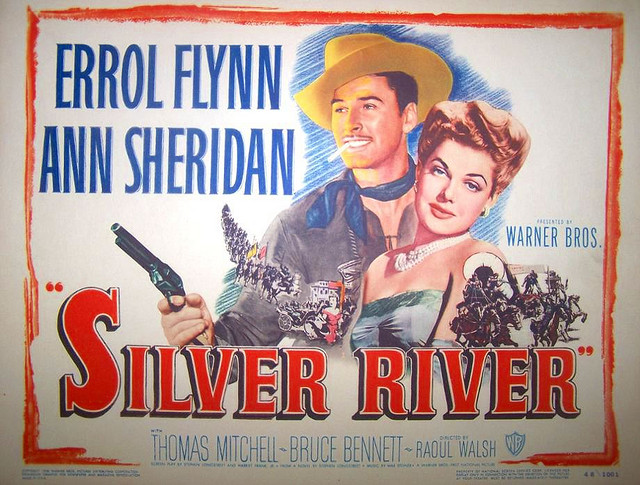
“Silver River”

Fabrizio del Wrongo writes:

silver

I watched this mid-period Raoul Walsh western a while back on the recommendation of co-blogger Sax von Stroheim. It stars Errol Flynn as a disgraced Union officer who’s decided to live in a purely selfish manner. In doing so he becomes the hub of a mining town, the center of its thriving economy. He founds the saloons, becomes the largest shareholder in each of the local silver mines, even opens a bank when it becomes clear that he controls all the cash in the area. Fittingly, Walsh shoots the early war and pioneer material in his ’30s freeform style, with a lot of camera movement and action staged throughout the frame. Later, once Flynn and his town have become established, the movie becomes more visually staid, more like a conventional ’40s product. It’s an effective visual strategy, one which ushers the viewer through the movie’s basic themes in an organic, unfussy way. But what I found most fascinating about “Silver River” was its manner of condensing and dramatizing basic economic relationships – the movie is like a miniature representation of American capitalism, with all its benefits and drawbacks highlighted. Flynn is pretty fascinating too; he allows his natural roguishness to suggest a deeper amorality, with slyly subversive results. (The performance makes you wish he’d played more villains.) Unfortunately, “Silver River” loses something when it allows the Thomas Mitchell character, Flynn’s lawyer, to become its moral center (he preaches to the audience). And a subplot implicating Flynn in a murder is never fully developed. But for much of its running time this western makes good use of moral ambiguity.

Posted in Movies, Performers, Politics and Economics | Tagged , , , , | Leave a comment

David Chase’s Small Movie for the Big Screen

Sax von Stroheim writes:

Not Fade Away (David Chase, 2012)

This is kind of a generic poster, unfortunately

This is kind of a generic poster, unfortunately

A few different ways into talking about this movie:

  • As you probably notice, I pay a bit of attention to current movies, but, even so, I completely missed that this had opened in New York City (and was already on its way out) until early last week when I was looking up showtimes for Life of Pi. I would have thought that the first feature film from the creator of The Sopranos would be a bigger deal, but I guess the dark side of being in this so-called Golden Age of Television is that people would rather see filmmakers migrate to the small screen than for them to go in the other direction.
  • It was bittersweet to see this movie on the same day as the Oscar nomination were announced, because it is a very lovely movie, but one that really had no chance of making a splash as an “Awards contender”. It’s too comfortably small scale, it looks much more conventional than it is, and it doesn’t have any show-offy performances (or show-offy set-pieces, for that matter). So, I’m a bit bummed that the movie didn’t seem to find an audience, and I blame the whole marketing/PR/journalism industry for that failure. I think the movie would have appealed to Chase’s fans and to fans of the television shows he influenced (in some ways the movie is an “answer record” to Mad Men), if those fans had really known about it.
  • The film itself – about a couple of guys in New Jersey who half-heartedly try to make it as a rock band – really gets at the way time seems to slip through your fingers. The way you can look up and realize two years have passed since you said you were going to do that thing you said you were just about to get around to doing. But it does all this without ever making a big deal in it. There’s no scene where they say, like, “Man, I can’t believe time has slipped through our fingers like that”, which is probably a strike against it for people looking for the movie’s theme. (Its “theme song” is “Time Is On My Side”, though, so maybe they’ll pick up on that).  It’s a bit like John Milius’ masterpiece Big Wednesday in the way that its rhythms feel like how life really moves and less like how screenplays are usually structured.
  • James Gandolfini, playing an angry New Jersey dad, is really great. He was also really great as an alcoholic hitman in Killing Them Softly, another Awards-season movie that didn’t find an audience. I suspect that loading all of the movies-for-grown-ups into the last two months of the year, in the hopes that they’ll win awards, is a really terrible idea, because then they’re all fighting over the same tiny sliver of an audience that’s left for these kinds of movies.
  • Had this movie come out back when I was in college, it would have been my favorite movie ever for at least a week or so.
  • Coincidentally, I’ve been listening to this collection of rock music put out by Elektra from 1963-1973, and it makes a great companion to the movie. Chase and his music supervisor – Little Stevie Van Zandt – nail the sounds of the era.
Posted in Movies | Tagged , , , | 5 Comments

Montaigne Unchained!

Fenster quotes Montaigne:

sword

“The weakness of our condition makes it impossible for things to come into our experience in their natural simplicity and purity.  The elements we enjoy are corrupted, and the metals likewise; the gold must be debased by some other material to fit it for our service . . . Of the pleasures and the good things we have, there is not one exempt from some mixture of pain and discomfort . . . Toil and pleasure, very unlike in nature, are nevertheless joined by I know not what natural association.  Socrates says that some god tried to lump together and confuse pain and pleasure, but that, not being able to come out successful, he decided to couple them, at least by the tail . . . When I confess myself religiously to myself, I find that the best virtue has some tincture of vice . . . Man, in all things and throughout, is but patchwork and motley.”

From We Taste Nothing Pure

His ideas in action here.

Posted in Philosophy and Religion | 2 Comments

“Django Unchained”

Blowhard, Esq. writes:

Django Unchained movie stillThe latest in Tarantino’s Minorities Get Revenge on White People Series, the director said on Fresh Air that if the audience doesn’t cheer Django at the end, he’s failed. Well, the audience I saw it with didn’t cheer. [I’m hiding the rest below the fold as it contains spoilers.]

Continue reading →

Posted in Movies | Tagged , , , , , | 23 Comments

A Reprobate Ancestor

Fenster writes:

Alternative living arrangements now have a somewhat chic air about them.

There’s cohousing, latter-day countercultural and perennially about to bloom as the boomers retire.

A Brooklyn Cohousing Project

A Brooklyn Cohousing Project

There’s the micro-apartment option, the fun new craze for urban-bound but poor youth in high rent areas.

$1500/mo

$1500/mo.  This comes with tiny galley kitchen but not all micros do.

And there’s even AirBnB, a nifty device that cannot just snag a villa in Tuscany but a shared room in Brooklyn.

Just $749 a month

Just $749 a month.

All very up-and-up, neat, clean and middle-class, and all of the above in Brooklyn even.

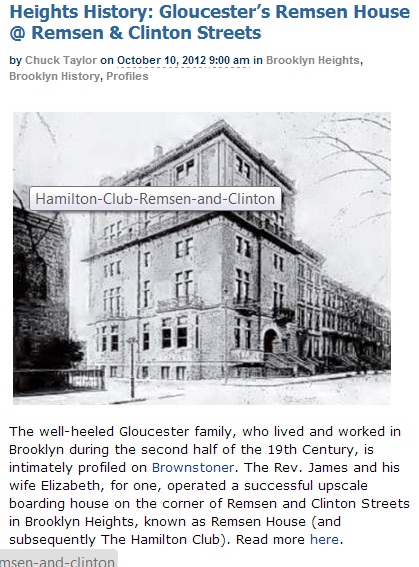
Here’s an interesting article outlining the lineage that runs back from these three nice alternatives to a slightly more reprobate ancestor: the boarding house.

brooklyn boarding
While boarding houses had their middle-class and upscale examples (see the upscale Brooklyn boarding house above), over time they became associated with low-life issues, and more or less petered out (survived also by SROs and half-way houses) in the early 20th century.  Some of the old-fashioned low-end types survive, including in Brooklyn,

Somewhere near the last exit . . .

Somewhere near the last exit . . .

but they tend to operate at the fringe of legality.  Over time, the idea settled in that people and families ought to be separately quartered, or else run the risk of bad living habits, or worse.

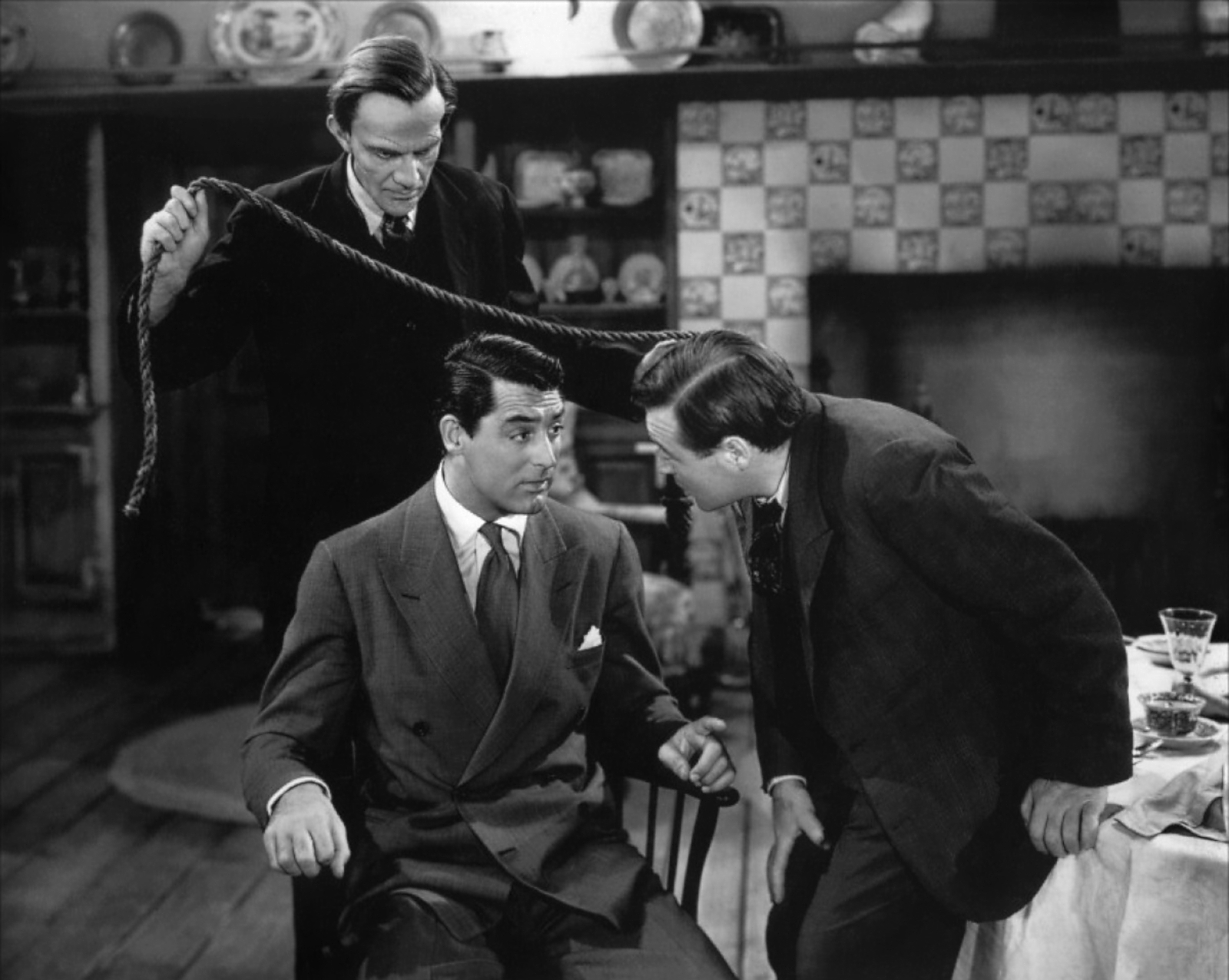
Recall the comic premise of Arsenic and Old Lace–that murderous goings-on were possible in Brooklyn boarding houses.

Image

Romance (vice?) was possible, too, in Brooklyn boarding houses.

Image

Anyway, the article is worth reading.  The effect of historical change is often, and inevitably, to stash memory away in the basement, along with the 13 bodies.  It is often amazing to me to consider how different things were within living memory, and how we are so often invited by the present to picture the past as just a younger version of the self.

Posted in Architecture, Personal reflections | Tagged | Leave a comment

Juxtaposin’: Fantasies of the Internet Relationship Seeker

Fabrizio del Wrongo writes:
Posted in Sex, Technology, Television | Tagged , , , | 4 Comments

Quote of the Day

Blowhard, Esq. writes:

Because they’re paid to read, the aspect of books which literary critics forget to focus on is whether or not they’re boring.

— Alain de Botton, via his Twitter feed.

Posted in Books Publishing and Writing | Tagged , | 1 Comment

“She reaped almost none of the profits . . .”

Glynn Marshes writes:

Before 1820 American readers and publishers preferred to import or pirate their books from England, because English texts were at once less expensive and more fashionable. For want of copyright protection for imported works, it was cheaper for American publishers to reprint English works than to pay native authors. Indeed, although Susanna Rowson’s Charlotte Temple (1791) sold phenomenally well, she reaped almost none of the profits, because it was originally published in London and then pirated in America. Moreover, English novels offered more romantic characters and exotic settings — lord and ladies in castles or grand estates — than seemed possible in common and commercial America. Professing themselves a people of equality and common sense, Americans doubted that their society could ever inspire a novelist. So doubting, they continued to read the imports. Consequently, the most promising American novelist of the previous generation, Charles Brockden Brown, had failed to support or sustain himself.

— Alan Taylor, in William Cooper’s Town, explaining why it would never have occurred to James Fenimore Cooper (William’s son) that he could make a living by writing novels.

Posted in Books Publishing and Writing | Leave a comment

Ads Everywhere

Paleo Retiree writes:

America — the country that never met a surface it didn’t want to adorn with an ad:

ads_everywhere_hertz_neverlost_service

Posted in Commercial art | Tagged , , , | 11 Comments

Monetary Reform, Again

Paleo Retiree writes:

The monetary-reform case in a 3 minute nutshell:

Bonus links

Posted in Politics and Economics | Tagged , | Leave a comment