Linkathon

Paleo Retiree writes:

Posted in Computers, Food and health, Linkathons, Movies, Politics and Economics, Sex | Tagged , , , , , , , , | 3 Comments

Letter from China: Amateur Anthropology

Fenster writes:

It is hard for the mind to grasp itself since it is inside looking out.  Consider the case of that poor neuroscientist I wrote about here, who had to reason through that he was a sociopath on the basis of data about his own mind.

Sometimes, though, you can have an experience that suggests something of how the gears work.  Like when you have a name on the tip of your tongue.  Who was that actor in the remake of 3:10 to Yuma?

Aussie Aussie Aussie Aussie.

R. R. R. R. Raymond?

Richard? Robert? Russell?  Russell?!

C. C.

Crowe!
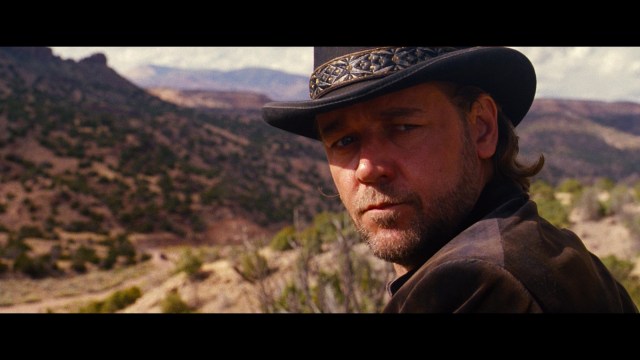
Why does the R seem right somehow, and how does it head you to the name?

Better yet, consider the experience of apprehending a visual illusion, like the famous one of the old crone and the young woman.
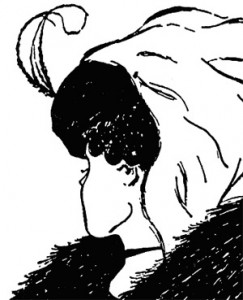
Here, there’s a flickering that goes on as your mind shifts perspectives.  Flick.  Crone.  Flick.  Young woman.  You can feel it.

Something very similar happens in the process of cultural immersion—amateur anthropology, if you will.

My entire gestalt since arrival in China has been that of a stranger in a strange land.  Yes the people smile and carry themselves in recognizable ways.  Yes there are buildings with windows and doors and rooms, and the rooms have furniture like chairs and couches.  But everything is different—that is, it is the differences that come to the front of mind, and dominate.

It doesn’t help that the Chinese style of interior decoration seems derived from David Lynch—no conversation pits, just chairs and couches pushed back as far as possible to the walls, leaving an existential open space that is faintly threatening.

without the zig zag rug of course

I am in China at a meeting with university officials discussing higher education research in China.  I’ve been here for over a week now, in constant communication with the Chinese and only the Chinese, and still am the stranger in  a strange land.  The room has the David Lynch look.

As always, I have my translator with me, who doubles as guide and, increasingly, friend.  We are conversing through the translator, back and forth when . . .

Flick.

These are just people that I know.

The feeling is as palpable as the shift from crone to woman with hat.  Cool!  Then . . .

Flick.

Stranger in a strange land.

Flick.

Friends talking.

Flick.

Stranger in strange land.

I think this means I am in the “no mountain” stage I discussed here.

The experience of perspective shifting is pleasurable in its own right.  And it also suggests something interesting about how the mind works, the importance of perspective in understanding and how experience works in tandem with learning and growth.

I can feel it, Dave.  It is rather satisfying.

Posted in Travel | Leave a comment

That Video on r/gonewild or PornHub Yet?

Blowhard, Esq. writes:

From what I can tell, the great thing about this technology is the ease with which you can share data. So do you wanna remind people that with a simple tap their homemade porn will be all over the Internet?

Posted in Technology | Tagged , , | 3 Comments

Camille Paglia’s “Glittering Images”

Blowhard, Esq. writes:

Camille Paglia — professor, provocateur, scourge of leftist academics and feminists — has a new book on visual art and was in town recently to lecture on it.

I trekked over to the Skirball Cultural Center on the westside.

Us fancy L.A. intellectuals milled about the lobby before the show.

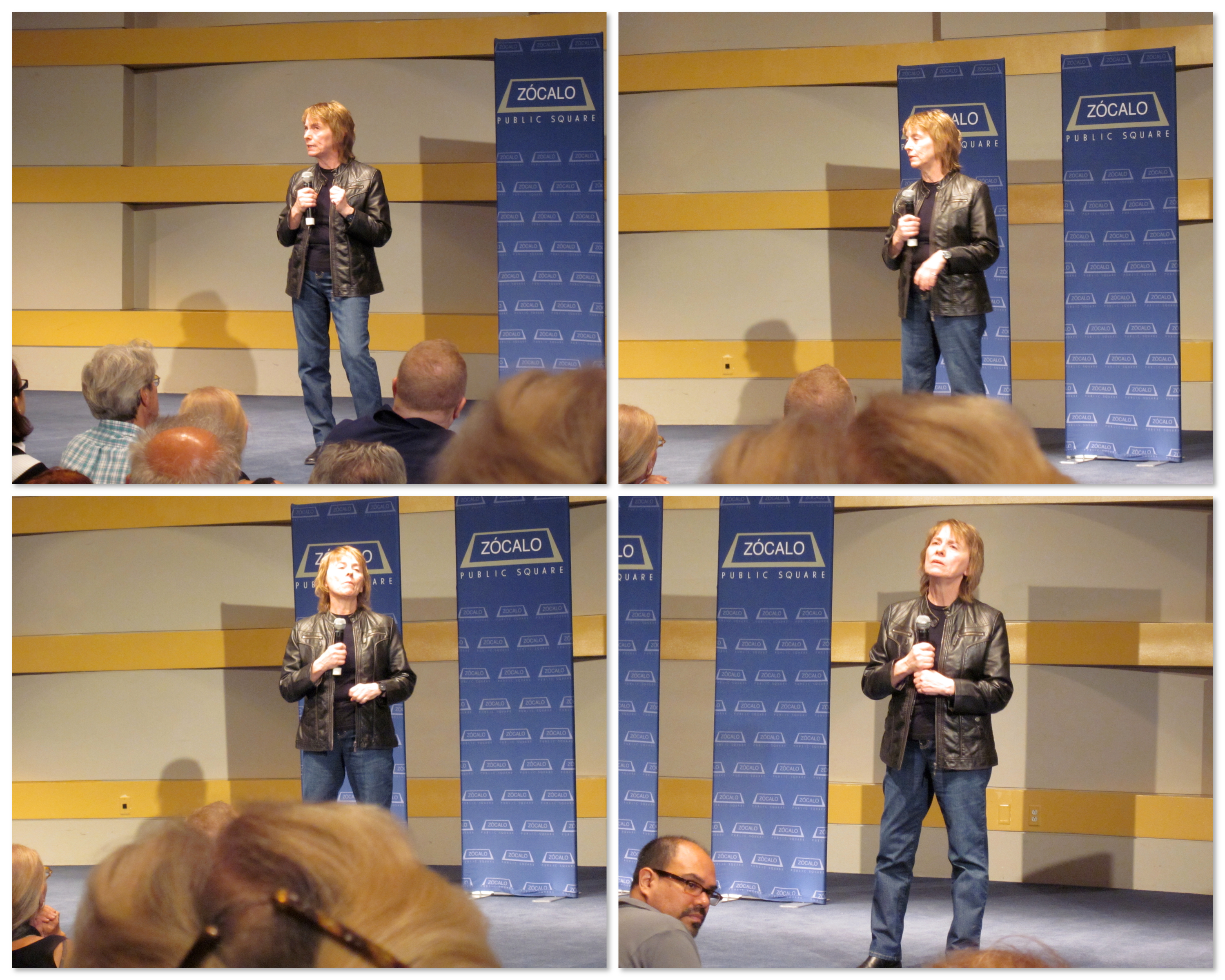
La Paglia was 15 minutes late. She came out — black shirt, jeans, black boots, and black leather jacket — and said, “I wrote this book because…” and proceeded to talk for about 40 minutes straight with hardly a breath.

Her lecture was basically all the main points from the book’s  and a healthy mix of shots at her favorite targets, like a rock band plugging the new album while also including a few greatest hits. As predictable as the jabs at academe, Gloria Steinem, and French poststructuralists may have been, the crowd (including your humble correspondent) ate it up, hooting along as she delivered her barbs. But hey, don’t take my word for it, you can watch the lecture here. And here’s some more photos of the event.

As for the book itself, I finished it today and enjoyed it quite a bit. Paglia would probably chafe at this characterization but her book felt like a series of blog posts. Each chapter begins with an image and is followed by a 3-5 page essay that weaves together the work’s history, context, and her own interpretation. Because one of her explicit aims is to show people that art belongs to everyone, her writing is clear, accessible, and jargon-free. I don’t know about you, but my visual art eduction from K-12 was nonexistent. We’re schooled in literature and exposed to a wide range of classics, but visual art and music fall by the wayside. I’m guessing this is at least partly explained by our Protestant tradition that reveres the written word but is suspicious of images. It wasn’t until I took an elective survey course in college that the worlds of sculpture, painting, and architecture were opened up to me.

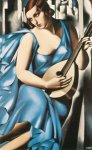
One of the stand-out chapters for me was of an artist I had never heard of previously, Tamara de Lempicka.

Not only did Limpicka work in one of my favorite styles, Art Deco, she had a hell of an interesting life:

With her haute couture and Garbo cheekbones, Lempicka did not disguise her naked ambition for social prestige as well as commercial success. Her sophisticated persona was the antithesis of scrabbling bohemian mythos. She attended and threw lavish, risqué parties in Paris and expertly manipulated the media for maximum publicity. Arrogant and opinionated, she never deferred to men in the art world or courted romances with male artists. As detailed in Laura Claridge’s riveting 1999 biography, Lempicka was a liberated new woman with her own agenda, which included cocaine-fueled bisexual adventures in seedy riverside bars.

Art deco and cocaine-fueled bisexual adventures? I almost broke the Internet, I hit that Amazon 1-Click button so hard.

By the way, if any of these works or style looks familiar, you’ve likely seen them before.

Posted in Art, Books Publishing and Writing, Education | Tagged , , , , , , , | 16 Comments

Fenster Endorses!

Fenster writes:

The last thing this blog should be is a political one.  Little danger of that actually, considering the readership and writership.  And while I am a political junkie I have been careful not to use this as a platform to spout.  I get enough of that from Facebook friends.

But there comes a time to stand and deliver and this is about time.

Fenster endorses (drumroll) . . . . . ummm . . . .

Hold on! Hold on!  Not so fast!  Let me kind of duck that question and refer you to a most superlative Economist endorsement, out today.

It is as nearly perfect an account of the way I see the race–and the issues that are truly important animating the race–as I can imagine.  I urge you to incorporate its reasoning into your thinking in its entirety.

It’s all there.

Romney more serious on deficit: check.

But Romney stuck with no-tax approach to same: check

Obama’s foreign policy record better than the right says: check

But Obama is “aloof and disengaged” and “no master diplomat”: check

Romney may actually be a moderate and may govern accordingly: check

But Romney’s right flank is downright scary, way scarier than Obama’s left, and may drag Romney where it wants him: check.

Obamacare coverage of uninsured a good thing: check

But Obamacare’s ducking of medical costs a bad thing: check.

It is equally important what is left out of this endorsement.  I yield to no man in my appreciation of issues such as women’s rights, the pill, abortion and gay marriage.  But for me at least they are down, down, down the list of truly important issues for the nation, especially in a presidential race.

The Economist ends up endorsing Obama, but by the razor thinnest of margins.  Indeed, it would do no injustice to the logic of the article if it concluded in its final paragraph to endorse Romney.

As to Fenster, he cannot quite summon it up to endorse Obama.  But he endorses The Economist.  This post is about politics, so it can be as ambiguous as it likes.

Posted in Politics and Economics | 5 Comments

Return On Investment

Fabrizio del Wrongo writes:


Pop culture can be stultifying. It grinds us down, appeals to our lowest impulses, sometimes sells us out. But every once in a while it manages to harness the full weight of its resonances, to sort of trade in on what it’s deposited in our imaginations. And when it does that it can hit us right where we live. A moment like this makes all of “Star Trek” worthwhile. It even manages to redeem that dopey “live long and prosper” thing.

Posted in Movies | Tagged , , , , | 9 Comments

Sic Transit Gloria Mundi, OR Simiae est Insanissimae Populos

Fenster writes:

Fame is fleeting.

You remember newsreels, like actually remember them?  Mebbe mebbe not.  Depends on age mostly.

They were really the only way to disseminate the news visually in a pre-internet and pre-TV era.  TV in fact pretty much put an end to them, starting with how that medium woke up to its news possibilities at the time of the Kennedy assassination.  I myself vaguely remember newsreels, and the stentorian tones of Lowell Thomas, growing up.  Vanished now.

Vanished, too, are some of the people from that world, down the memory hole at the same time.

How many people know Lew Lehr nowadays? (Bonus points for Uncouthers who do–surely there are some in our small but idiosyncratic crowd who do).

Lehr was best known for humorous commentaries inserted into the harder news in the newsreels of the day.  You see him pictured with a monkey because of one of his trademarked lines, which you may recall even if you do not recall Lehr: “monkeys is the cwaziest peoples!”

According to a long New Yorker profile from 1939 (excerpt and link for subscribers here), other stock phrases included “Look who’s shpoking!” and “Sometimes your eyes can’t believe your pupils.” “Dribble Puss” is another, and his humorous inserts into Movietown newsreels were known as the Dribble Puss (or Dribblepuss) Parade.

By the way, be careful Google Imaging “Dribble Puss” with safe search off.

According to the 1939 New Yorker profile, Lehr figured he had about 57,000,000 listeners; 45,000,00 movie and 12,000,000 radio fans–quite an accomplishment considering the population of the nation was a little over 130,000,000.

Yet it is kind of hard to find much on the guy nowadays.  YouTube has a short video showcasing his inspired silliness–or just plain silliness if you don’t find it amusing.

His fans at the time seemed to have found it inspired.  According to The New Yorker, “some of his more ardent devotees are moved to hysteria by the mere sight of his face.”  It is quite a face.

An interesting accent, too.  It’s exaggerated German, not the more common exaggerated Yiddish done for fun. You hear German accents still in the current day media, but it is usually mouthed by a German character, not an  ostensible American.  And it typically denotes bad things, and is not played for laughs (Arte Johnson a more recent exception).

To some extent the dying out of the accent in America is a function of the integration of the very large German immigrant population (as with the dying out of of the German restaurant in America).  It is probably related, too, the the progressive de-Germanification and suspicion of Germans that started during World War I and continued through World War II.

Anyway, it is hard to find much about Lehr online.  I finally found one video of him using monkeys line here.

48050266_1200.do?keywords=lehr%2Cmonkeys

It is sad that fame is fleeting, and that in another few decades not that many will even recall Uncouth Reflections.

Posted in Humor, Movies, Performers | 6 Comments

Not a Letter from China

Fenster writes:

I was going to write about urbanism and bikes in Beijing but it’s been done before.

The New Urbanism Blog has a short piece, and a nice picture, of group dancing in front of St. Joseph’s Wangfujing Church, in downtown Beijing quite near the Forbidden City.

That was exactly the scene as I walked by last week, so it is a regular thing.  And, as the blog points out, it’s a nice urban thing, too. Check it out.

Meanwhile, I was also going to write about bikes and e-bikes, but it turns out that this guy Eric Osnos at The New Yorker has done so, and done it quite well.

The nerve of that guy Osnos, though.  He obviously copied me by entitling his series of articles “Letter from China”, and to make things worse, he got them into print before
I got mine online.  Sheesh.

But take a look at his e-bike piece.  This article and the blog piece suggest that, despite China’s overall seeming indifference to urban values in its headlong development spree, such values continue to have a place there, at least in Beijing.  Hutongs, bike lanes, a busy streetside retail scene and density that does not allow for hiding out.

So this will not be a letter from China.

But let’s consider the e-bike phenomenon while we are on the subject.

E-bikes have exploded in popularity in the past few years in China.  In 2009 China had 25 million cars but four times as many e-bikes.  That proportion has probably grown further in favor of e-bikes.

A Goggling of the topic reveals that just in the past several years there has been a similar explosion in Europe, Canada, Australia and other parts of the world.  The explosion is not as big as China’s–how could it be otherwise?–but it has been remarkable nonetheless.  Further, Googling also reveals scads of links dealing with e-bikes in other parts of the world but almost none dealing with e-bikes in the US.  That’s because, in effect, no one is interested in buying them stateside, though they are available.

Much is made of the car culture being the reason for this.  I buy that, but it can hardly be the only factor.  It is probably also the case that the bike culture resists as well.

I am myself much in favor of promoting cycling in the US and for a while commuted about 15 miles each way to work in Boston and Providence.  But bike culture, while a lot more than an affectation, is still an upper-middle class thing, and a statement about values as much as a means to keep fit and save money.  Looked at from that perspective, e-bikes are a fairly reprobate phenomenon.  A schlub in Beijing looking for a cheap and easy way to get to work is likely to have no such reservations.  So while I suspect e-bikes will take off here at some point in the not-distant future, they still has something of an image problem for being neither fish nor fowl.

Here’s one on the way from Germany.

Would you consider one?

Posted in Travel | 7 Comments

Jazz: Dead or Alive?

Fenster writes:

Here’s a link to an article by Benjamin Schwartz in The Atlantic on whether jazz remains a vital art form or not.  It takes the form of a review of the book The Jazz Standards, by Ted Gioia.

Schwartz admires a lot about Gioia’s book.  And along the way he makes some interesting points.  He quotes approvingly of one reviewer on Billy Strayhorn’s masterpiece that “it’s hard to think of another piece of music that has anything at all in common with ‘Lush Life‘”.  Nicely put.

But that’s not the main point of Schwartz’s book review.  His main game is to take issue with Gioia’s contention–after Gioia’s own acknowledgement that his book mostly enshrines old classics–that jazz remains a “vibrant present day endeavor”.  Schwartz riffs it the other way, arguing that jazz is a relic.

His argument is based on the nature of the relationship between jazz and the Great American Songbook, “a body of refined, complex work that stands at the apogee of this country’s civilization, mostly written for the musical theater from roughly the 1920s to the 1950s by such composers and lyricists as Porter, Rodgers and Hart, Jerome Kern and Dorothy Fields, Irving Berlin, George and Ira Gershwin, Harold Arlen and Yip Harburg, Vincent Youmans, and Arthur Schwartz and Howard Dietz.”

Jazz’s high point in Gioia’s account is roughly coterminous with the Songbook.  What does this mean?  According the Schwartz, Gioia steps back from drawing from this overlap the correct conclusion: that the relationship between jazz and the Songbook goes beyond the fact that many of the jazz greats improvised on Songbook material, and that the relationship between the two genres was fundamentally symbiotic.  Put in the words of Cahn and van Heusen:

You can’t have one,

you can’t have none,

you can’t have one without the other!

And along with the drying up of the Songbook comes the inevitable atrophying of the jazz that was intertwined with it.

Schwartz’s argument is to me persuasive.  He doesn’t just toss the idea out but makes a good effort to back it up with specifics about artist attitudes and song structure.  And the argument resonates with me since I often find current jazz wanting and have not been sure why.  Artists who continue to mine the Songbook seem like they have overstayed their welcome.  And works that riff on more modern material end up unsatisfying in their own way.  As much as I love the Beatles, hearing their work done by Blue Note artists or Brad Mehldau only serves to underscore the fundamental difference between the pop song structure in the Songbook and more recent pop-rock song structure.  The former for some reason seems to fit jazz like a glove.  The latter not so much.

Any thoughts?  Do you find current jazz wanting?  Has jazz inevitably reached the canon stage?  And can you have one without the other?

N.B.  None of this applies to Thelonius Monk.  He’s not joined at the hip to the Songbook as much as he is to Stravinsky.

Posted in Music | 10 Comments

Those Nameless Naked Girls

Fabrizio del Wrongo writes:

Who do you think is the most photographed nude model of all time? I’ve often heard it claimed that Bettie Page holds that title. As much as I love Bettie, I’m not so sure that’s accurate. It seems to me the most photographed nude model of all time pretty much has to be a lass of more recent vintage. After all, in the internet age, photographs are everywhere — or at least the digital descendents of photographs are. I mean, think about it: the average young girl is photographed nearly every single day; sometimes she even has her clothes on. And then there’s the ease with which digital technology allows for thousands of images to be captured, processed, and instaneously shotgunned throughout the matrix. It’s a far cry from the old days when you had to trap the images on film and then develop ’em on paper. Given of all this, isn’t it safe to assume that the “most photographed model” is actually someone still very much alive? I’m guessing that a model from the ’50s has little chance of competing against the women of the age of duckface, cell phones, and internet porn.

Which leads me to my next musing: is it fair to assume that, someday, perhaps not too far in the future, some internet model will be regarded with the same degree of fondness that we today reserve for Bettie Page?

Continue reading →

Posted in Commercial art, Personal reflections, Photography, Sex | Tagged , , , , , , , , , , , , , , , , , , , , , , , , , | 23 Comments