
Psst . . . . Wanna Buy a Stinkin’ Badge?

Fenster writes:

Sir Barken Hyena’s post on the subject of a video game company hiring without need for candidates to provide resumes is suggestive of some broader themes at play (or at work?) in the world of credentialing.

Credentials come in many shapes and sizes, and are issued by lots of different institutions.  But higher education is a key actor in the credentialing game.  Indeed, credentialing is the better part of what higher education is about nowadays, though many institutions are loath to admit it.

True, many colleges aspire to the old model of character building, good citizenship and absorbing the best civilization has on offer.  But that was only partly true in the good old days when colleges were for an elite.  Now that higher education has been massified, there’s just no way the old model suffices as a guide or even a simple description.

Institutions stamp their graduates in ways that employers are supposed to find helpful.  That stamp may signify intrinsic intellectual firepower irrespective of what is actually learned.  That’s the message sent by the high end universities–“believe you me, this guy is really smart elsewise we would not have accepted him.”  Or the stamp may signify specific skills have been learned, as with a business or engineering degree.  Either way, the credential consists of two things committed to parchment: the name of the degree (e.g., Bachelor’s, Master’s) and the name of the institution (e.g., Harvard, University of Phoenix).

Why does this have to be so?  Other than convention, accreditation rules and sixteen tons of institutional inertia, why is it that institutions are the ones that magically confer the credential?  And for that matter, what is the magic of the degree itself?

If employers could find out what they wanted to find out about prospective employees without the need for an institution to confer a degree, would that not put a crimp in the leverage institutions hold in establishing credentials?

Here is a link to Mozilla’s Open Badge Project.  The idea here is that as technology puts increasing pressure on higher education, one of the results will be an unbundling of services, including those related to reputation and credentialing.I think you can see the logic here.  Skills can be unbundled and expressed via a vehicle like a badge, which is discrete, portable, understandable and able to be picked up at any place good at giving them out.  Under this model, there is no huge need for either of the current givens: one institution and a degree.  Students can pick up badges where they will, and whether they cohere into something called a degree fades in importance.
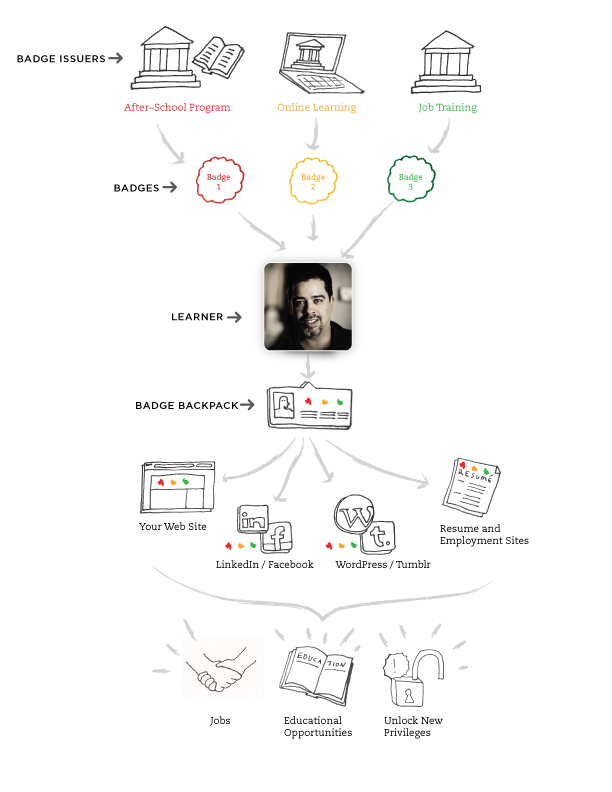
As Sir BH’s post might suggest, this kind of thing can work quite effectively in areas like software engineering, where unbundled descriptions–if reliable–can be helpful to employers is assessing a candidate’s qualifications.  Yeah yeah it doesn’t work as well in the liberal arts.  We have heard that all-purpose caveat before–e.g., “college is more than skill transfer; it is the whole experience.”  That is true enough, but only for the students for whom the whole experience is suitable and/or affordable.

Posted in Education | 5 Comments

Question Lady Question

The Question Lady writes:

When the temperature is soaring, what do you like to cook — or find you can cook for dinner?

Posted in Personal reflections | 6 Comments

City Sights: Arbor Gate to a Community Garden

Blowhard, Esq. writes:

An impressive specimen that I had to pass along.

Posted in Architecture, Photography | Tagged , | 4 Comments

Vacation, all I ever wanted…

Brundle Guy writes:

First of all, I must apologize. When I was asked to join this ragtag group of misfits and ne’er-do-wells I was frothing at the mouth to get some posts going, make a bunch of comments, start a few polite dust-ups and generally mix it up with you laudable lot. However, you’ll notice that after a couple of weeks being an active member, this is my first post. “What gives?” you may rightly be asking.

You must forgive me. I have sinned. I committed one of the most heinous and unforgivable acts a modern working man can. It shames me so much I can barely type out the words. I… I…

I went on vacation.

Brundle Gal and I spent four days, only two off from work, to go down to New Orleans, indulge in some hot, sticky weather, delectable food, amazing architecture, incredible jazz and generally have ourselves a time. Adding to our horrific societal crimes, we didn’t even bring a computer. There was nary a remote log-in or work email to be had. It was just the two of us, getting away from it all for a few days.

But don’t worry, I’m paying for these transgressions. I’ve had to work even longer and later upon my return, take more home and indulge in that only-half-joking office banter wherein coworkers say, through rictus grins, “Hope you had a good time, we missed you, it was so busy you can NEVER GO ON VACATION AGAIN.” In this world where everyone seems to be overworked, understaffed and pushed to extremes, taking a vacation can make a person feel like the imprisoned revolutionary who becomes the hangman’s assistant for an extra serving of gruel.

I’d like to know, when did “vacation” become a dirty word?

There’s a number of related topics I’d love to get into soon about the rise of management, real versus perceived work, and one of my biggest bugaboos of late, the inability people seem to have regarding assessing the actual value of things. But this post is already going to be WAY too long, and it’s getting late, so what I’d like to do now is put forth some of my own recent brushes with the demonization and eradication of personal time:

Brundle Gal got a promotion very recently, which is exciting and well-deserved. Part of that promotion, however, will be an official, company-issued i-phone so that she can NEVER EVER BE OUT OF REACH EVER. Not only that, it’s international travel capable, so she won’t even be able to duck away from work by escaping the country. She hasn’t been harnessed by that particular corporate yolk yet, but it looms, it looms.

My boss, a man at the top of his admittedly fairly marginalized field, just went on his first week-long vacation in ages a bit ago. We received emails from him every day. Another coworker who has been in the game for a couple decades now talks about vacation like it’s some kind of trap. “You go on vacation for too long, they realize they don’t need you.” And this guy has a kid. That kid may never get to take some awesome, week-long vacation with his dad because the old man is scared out of his mind that he may appear to be a bad worker.

Many of my coworkers get to the end of the year and find they have vacation days to burn, and for some of them that’s exactly what happens. Those days just burn away. They don’t get taken because everyone’s too busy, you can only carry over five days, and they’re certainly not going to put any additional unused days towards any bonuses or incentives. Just burned.

Finally, Fridays are our big work days, and the Friday my boss was on his vacation my coworker and I stayed very late. We put out the work fires that had to be completed, but continued to stay at work a couple hours longer to clean up a few other dilemmas and do some prep work for next week. While we were still there, well into the evening, our boss wrote us an email saying he’d been watching the work flow from his vacation spot. Our big work for the week was completed, he saw, so what were we doing still working in the office that late on a Friday night?

The irony, apparently, was entirely lost on him.

Posted in Personal reflections, Politics and Economics, The Good Life | Tagged , , | 2 Comments

No Resumes Allowed!

Sir Barken Hyena writes:

Media company IGN has a novel hiring practice: they take candidates without looking their resumes at all. This is the second year in a row that they’ve done this.

“The average age someone learns to code is 13.4, so why should we care what credentials they have?  We want to find people who are passionate about us, and look at their actual work – not their resume,” said Roy Bahat, President of IGN.

Many programmers coming straight out of college are surprisingly unready to do productive work. I’ve watched some struggle their first year of employment doing what are pretty simple projects. They get there usually, but one wonders what they did for 4 years getting their degree. You could argue that we need changes in the way it’s taught, but why not just go around the whole system?

IGN kicks off second year of successful Code-Foo Program

Posted in Personal reflections | Tagged | 6 Comments

Quote of the Day

Blowhard, Esq. writes:

Ira Glass on why he hates dream sequences: “I hate symbolism…I’m against symbolism…I feel like symbolism comes out of English-class thinking that has no place in our entertainment.”

Interview is here. Glass’s comments are around the 33:00 mark.

Posted in Movies | Tagged , , | 9 Comments

Question Lady Question

The Question Lady writes:

How do you decide what charity/Kickstarter project/social cause to donate to?

Posted in Personal reflections | 2 Comments

NPR: All The News You Can Lose

Sir Barken Hyena writes:

I heard this report this morning, about statistics for charitable giving derived from IRS filings. The finding is the religious give more than the non-religious. Utah is the most giving state, New Hampshire the least.

But also well established is that Republicans give many times more then Democrats. The NPR story makes no mention at all of the political dimension. The words “Democrat” & “Republican” do not appear in the story. But why should they? Because the study’s author addresses this in the study. So the NPR reporters knew about it, and left it out. I’m going to go out on a limb and suggest this was done for reasons of political bias. All the news you can lose!

Study Reveals The Geography of Charitable Giving

Huffington Post is more honest, at least mentioning this angle before sweeping it under the rug. Huff Post sez:

“The study also found that patterns of charitable giving are colored in political reds and blues.

Of the 10 least generous states, nine voted for Democrat Barack Obama for president in the last election. By contrast, of the 10 most generous states, eight voted for Republican John McCain.”

Religion And Giving: More Religious States Give More To Charity

George Will wrote about it years ago: Conservatives More Liberal Givers

Posted in Politics and Economics | 2 Comments

Nassim Taleb and The Black Swan

Sir Barken Hyena writes:

Dear Blowhard, Esq.,

I see from your reading list that you read The Black Swan. Interesting book, to say the least. It’s a bit of a mess too. The second, more involved section could have used some pruning. Also, it’s a literary book, as he states, rather than an analytical one, a difference that seems to have tripped up a lot of readers. In this respect it’s also only partly successful, but never mind. He pulls some mighty fat and original rabbits out of his hat, for which I can forgive a lot. So I’d measure it by the areas of the mind it opens up rather than the answers he has.

His overarching points converge on my favorite subject: the increasing harm of technocratic approaches to solving the problems of the world. This is such a broad phenomenon, touching all phases of culture, society and government that it’s importance can hardly be overstated in my mind. Taleb focuses on Finance and Academia but I found resonance with what he said in the arts as well. Technocracy has become a roadblock between us and our future, whatever that might be. Let’s say it together: the world is not a machine!

I’m curious to hear what your thoughts on the book.

Posted in Philosophy and Religion | Tagged | 4 Comments

Question Lady Question

The Question Lady writes:

What’s the worst public behavior you’ve recently witnessed?

Posted in Personal reflections | 12 Comments