A great visit with Anthony Bourdain. As far as I’m concerned, Bourdain’s TV shows are 1) the closest thing we have these days to ’60s Gonzo journalism, as well as 2) better examples of balls-out ’70s-style filmmaking than anything Hollywood is currently turning out. I’m thinking of you, QT, David O. Russell and Paul Thomas Anderson.
I loved this 1973 anti-feminist book by Esther Vilar. It’s a little out of date but it’s no period piece; there are good reasons why it’s become an underground classic as well as a livre maudit. It’s pretty damned daring. Most of what Vilar peddles as eternal truths about men and women hold up really well. And Vilar is scarily shrewd (as well as much more needlingly, scathingly insightful than a man could ever be) about the ways men let themselves be taken advantage of by the ladies, as well as the ways we deceive ourselves about them. The Kindle version is a bargain at $4.99.
“Dublin or Nothing” (Jameson, benedictine, peach, pineapple, ginger) and “Annabel Lee Martini” (raisin-infused gin, spiced maple syrup, orange, lemon) at the Baxter Inn, located in the same dingy central Sydney alleyway as The Barber Shop and certainly one of the finest cocktail establishments I’ve had the good fortune to patronize.
“Bon Vivant Milk Punch” (cognac, spice, vanilla, nutmeg, milk), served in a milk bottle.
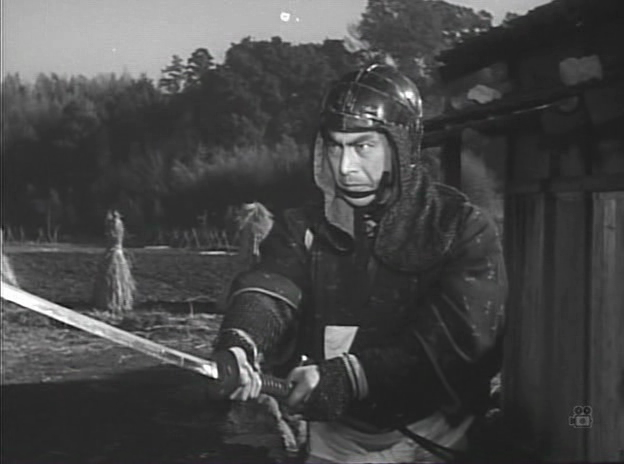
Kazuo Mori’s semi-satirical action flick pops the bubble of valor surrounding the samurai genre. Toshiro Mifune and Takashi Shimura – they’d later be featured in “The Seven Samurai” – play best friends who find themselves on opposite sides of a feudal spat. Their missions aren’t appealing: both are sworn to protect young men who are not worth protecting. The situation anticipates Peckinpah, but where Bloody Sam might have emphasized its romantic fatalism, Mori highlights the absurdity of its wastefulness. Still, like Peckinpah, Mori has a soft spot for the trappings of male camaraderie: The scenes between the sympathetic adversaries, while not belabored, are touching and heartfelt. (When the pair discuss their predicament over tea, their communication is largely subverbal. Beneath the pleasantries they’re sizing each other up; they’re also exchanging condolences.) Most of the picture occurs in individualized flashback, like “Citizen Kane,” as the members of Mifune’s team reflect on the five-year period during which they’ve pursued their quarry. In place of dissolves Mori uses hard cuts to transition into and out of these sequences. Though the editing is deft, and sound is used to help bridge the gaps, there’s no denying the temporal confusion this generates. I suspect that confusion is intentional: It’s Mori’s way of evoking the mindset of his warriors, who exist in a timeless state defined by fear and anticipation. This is an action movie in which the dead moments surrounding battles are more important than the battles themselves. In fact, I can’t think of a picture that works harder to undermine its action sequences. Most are cut so that they play out in isolated segments, devoid of momentum and the suspense generated by clearly delineated cause and effect. The movie’s one semi-traditional action bit occurs right at its start. It’s a fictionalized premonition of the sloppy, somewhat ignoble fight between Mifune and Shimura that closes the picture. In it we see Mifune slaughter 30 enemies in slapstick double-time. Intentionally overblown, it’s meant to reflect how history regards the battle — that is, as a grandiose spectacle rather than a descent into baseness. Akira Kurosawa wrote the screenplay. It’s available on Hulu Plus.
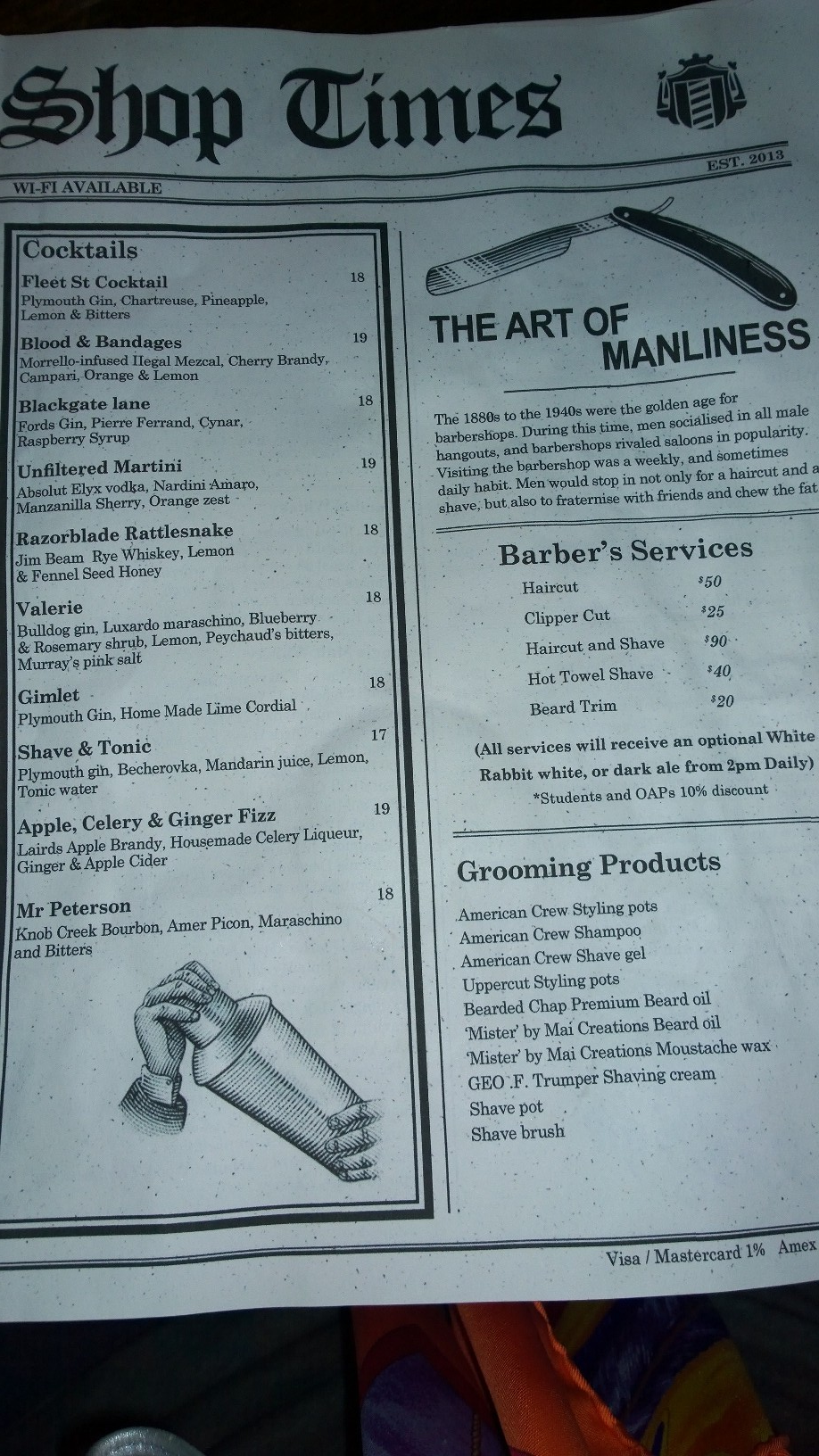
“Valerie” (gin, maraschino liqueur, blueberry/rosemary shrub, lemon, Peychaud’s bitters, and pink salt) and “Shave & Tonic” (gin, Becherovka bitters, mandarin juice, lemon, and tonic) at The Barber Shop, a Sydney bar which is also (you guessed it) a barber shop.
Keen eyes will notice that all grooming services come with a free beer, a practice that should be instituted posthaste at all barber shops worldwide.
The history of adobe building in New Mexico has its roots in a period (AD 700-1500) when the Anasazi peoples, who had previously been living in semi underground pit houses, began building single-story houses on the ground, using layers of dried mud or of stones laid in adobe mortar, without windows and with flat roofs. From these simple structures, their culture and architectural skill developed…
…A simple adobe pueblo consisted of a long-frame building to which the adobe compound was applied as mortar. Later, the Pueblo Indians would be introduced by the Spanish to a method of shaping the adobe into bricks. Producing adobe bricks is simple. Mud (or a mud mixture) is carefully poured into a wood mold, which is lifted off when the newly formed brick is dry enough. When ready, the bricks are turned on their edges to complete drying.
Frank (John Garfield), an affable drifter, ambles into a lunchroom on the outskirts of Los Angeles. Surrounded by fragrant orange groves, the place is quiet and isolated. There’s a “Man Wanted” sign outside, so he approaches the owner, Nick (Cecil Kellaway), about the job. After some pleasant chitchat — the boss seems like a nice guy — the drifter is left alone at the counter. A second later, out of the corner of his eye he sees a woman’s lipstick* rolling towards him.
The camera tracks along the floor, ending at Cora’s legs (Lana Turner), her foot making the slightest movement as she fully presents herself. We cut to him, astonished at her beauty, so moved his breath is visibly taken away. She frames herself in a doorway, like a queen in her turban, but there’s a note of hesitation, of neediness.
He walks over, picks up her bait, “You drop this?”
“Mmm-mmm, thanks,” she says, turning away from him, smiling vapidly, and holding out her hand. You’re coming to me, buddy.
Not taking his eyes off of her, he slouches back on the counter. Sure, he’s never seen a dame like her in his life, but he’ll be damned if he’s gonna do some broad’s bidding. No, sweetheart, you’re coming to me.
She’s taken aback. She’s used to pushing her sweet, doddering husband around.
He’s still standing there, waiting.
So far, director Tay Garnett has photographed the actors in medium shot so we can take in their full body language, so we can observe Cora’s imperiousness and Frank’s stubborn confidence. Now, he cuts to Turner’s first close-up as her facade of indifference melts, her determination and lust inflamed. It’s been a while since a man could handle her, since she’s had a real challenge.
Cut back to a long shot, Frank still holding out his hand, still waiting for her. With a smirk she concedes defeat and walks over to him. “Thanks,” she says dismissively, while taking her lipstick and immediately turning away from him.
She walks back to the doorway, primps herself, and gives him another look. She glances over her shoulder, her eyes flashing with contempt. You may have won this round buddy, but we’ve only just started. She shuts the door in his face.
He knows he’s cooked.
Related
The DVD I watched only had one extra, “The John Garfield Story,” a one-hour TCM documentary that I enjoyed. Fun facts: Garfield was Elia Kazan’s first choice for the stage production of A Streetcar Named Desire (Garfield turned him down) and, according to Patricia Neal, Hemingway’s favorite movie adaptation of any of his works was THE BREAKING POINT.
*According to Wikipedia, when Cain’s novel was first published in 1934 its lurid depiction of rough sex between Frank and Cora caused a bit of a scandal, resulting in the book being banned in Boston. In the novel the first meeting between Frank and Cora is uneventful. However, here’s what happens when they have sex for the first time:
I took her in my arms and mashed my mouth up against hers…”Bite me! Bite me!”
I bit her. I sunk my teeth into her lips so deep I could feel the blood spurt into my mouth. It was running down her neck when I carried her upstairs.
Hemmed in by the Hays Code, there was no way screenwriters Harry Ruskin and Niven Busch could get such a scene into the film. I wonder, though, if Cain’s scene, with Cora’s red lips, was the inspiration for the lipstick business in the movie.
It ain’t necessarily so
It ain’t necessarily so
The things that you’re liable
To read in the Bible,
It ain’t necessarily so.
Li’l David was small, but oh my!
Li’l David was small, but oh my!
He fought Big Goliath
Who lay down and dieth!
Li’l David was small, but oh my!
Oh Jonah, he lived in the whale,
Oh Jonah, he lived in the whale,
For he made his home in
That fish’s abdomen.
Oh Jonah, he lived in de whale.
Li’l Moses was found in a stream.
Li’l Moses was found in a stream.
He floated on water
Till Ol’ Pharaoh’s daughter,
She fished him, she said, from that stream.
Well, it ain’t necessarily so
Well, it ain’t necessarily so
They tells all you chillen
The devil’s a villain,
But it ain’t necessarily so!
To get into Heaven
Don’t snap for a second,
Live clean, don’t have no fault,
Oh, I takes dat gospel
Whenever it’s possible,
But… with a grain of salt.
Methuselah lived nine hundred years,
Methuselah lived nine hundred years,
But who calls that livin’
When no gal will give in
To no man what’s nine hundred years?
—Porgy and Bess (1935), music by George Gershwin, lyrics by DuBose Heyward and Ira Gershwin
Sammy Davis Jr in the 1959 Otto Preminger film:
Aretha Franklin at 18 in one of her first Columbia recordings from 1961:






 Blowhard, Esq.
 Callowman
 Sherbrooke
 Eddie Pensier
 Enzo Nakamura
 Epaminondas
 Fabrizio del Wrongo
 Fenster
 Brundle Guy
 Glynn Marshes
 Paleo Retiree
 Atypical Neurotic
 Question Lady
 Sax von Stroheim
 Sir Barken Hyena
 The Mistaken
