Three Waffles In Three Days

Eddie Pensier writes:

(with apologies to Neil Finn)

Three waffles in three days
So indulgent, breakfast, dinner, either works well
Sweet above and crisp below
Syrup dribbles in the pockets sitting on my plate,
Even if it’s getting cold
Gorgeous in so many ways
Like three waffles in three days.

This happened purely by coincidence. On our last day in New York, we had what we thought would be our final lunch out, and then by chance happened upon the Wafels & Dinges truck, an eatery fine enough to have made it to #83 on Yelp’s Top 100 Places To Eat list.

Continue reading →

Posted in Food and health, Personal reflections, The Good Life, Travel | Tagged , , , , , , | 6 Comments

Fritz Wunderlich, Five Ways

Eddie Pensier writes:

Don’t get me started on the subject of tenors. I have so many favorites it’s ridiculous. Some days it’s the peerless elegance and linguistic versatility of Nicolai Gedda. Some days it’s the ringing heroism and pure Italian squillo of Franco Corelli. The faultless technique of Pavarotti, the masculine almost baritonal luster of Jonas Kaufmann, the lyric and agile sweetness of Frank Lopardo, the straightforward brilliant tone of Jussi Björling, all appeal to me for different reasons.

But put a gun to my head, and I’ll tell you that my favorite tenor of all time is Fritz Wunderlich, hands down.

fritz-wunderlich

Continue reading →

Posted in Music, Performers | Tagged , , , , , , , , , | 10 Comments

“Tim’s Vermeer”

Paleo Retiree writes:

tim

The biggest surprise for me about this documentary was how un-tricky, un-conceptual, and un-meta it was. Co-produced and hosted by Penn Jillette and directed by his partner-in-po-mo-magic Teller, it’s a straightforward account of their friend Tim Jenison, a very successful engineer and entrepreneur (software for movie visuals, mainly), who, fascinated by Vermeer and convinced that Vermeer used optical gizmos to help him make his paintings, sets out to deduce what those gizmos might have been, and then to paint a picture in Vermeer’s style.

Continue reading →

Posted in Uncategorized | Tagged , , , , , , , , , , | 9 Comments

Solidarity in the Locker Room?

Fenster writes:

There has been a lot of ink spilled over the NLRB decision that seems to be opening a door for unionization of college athletics.

There are many general summaries of the decision out there.  Here’s one.

It’s the analysis that is now coming in hot and heavy, and they are all over the place.  Interesting to ask why.

Here’s Forbes on some overlooked aspects of the ruling.

Here’s Reason Magazine, correctly pointing out the relative ease by which public programs could be spared by legislation, and the political reasons for doing so.  Especially the cross-subsidy from revenue to non-reveune sports, the latter of which would be under pressure the more the ante is upped financially on the revenue side.

And here’s John Kass in the Chicago Tribune, arguing that in the long run the only good solution is the one John Maynard Hutchins came to at the University of Chicago last century: get out of the big time stuff altogether.  Chicago returned to football in time, but only to Division III.

And a Bloomberg piece arguing the whole issue would go away if universities only were to grant full four-year scholarships to athletes.

The list of analyses goes on.  We are into speculative territory here, and for several reasons.  One is the nature of the ruling itself: it’s only the decision of a regional director, Washington has yet to weigh in, etc.  And it’s not as though this resolves an outstanding issue that was already ripe–it only opens to the door, possibly, on a series of events that have yet to develop and mature.

But another big reason for the speculative quality is the relatively high degree of disagreement over how all the pieces fit together in the first place.  The precise nature of the financial relationship between higher education (the weakened parent) and college athletics (the overgrown and headstrong child) has long been shrouded in mystery.  Even today, there is significant disagreement over how the pieces actually fit together.  It’s hard to predict the future if you don’t understand the present all that well.

I’ll venture this, however.

Most all the analyses out there look at the issue through the lens of athletics.  Which makes some sense.  Athletics may be the child, but it does get most of the attention.  Mention big time university X to someone in the general public, or a legislator, or someone in the press and what image is summoned up?  Sports, mostly.  We know intellectually universtities are supposed to be about something else but we can’t help it in our culture of entertainment and spectacle–universities in our collective gut are more about big time sports than anything else.

Which explains the odd nature of most of the press coverage.  The issue is handled for the most part in the press as though it all needs to get played out as one of athletics.  But meantime . . . ummm . . . what of the higher education parent?

It should not escape scrutiny that this series of events is happening at a time of relative crisis in higher education.  True, that crisis will affect Franklin Pierce College before it does Ohio State, but there is a generalized crisis brewing nonetheless.  So the idea that “we’ll make it through this fight–we always have before” is losing traction as a general matter in higher education, and that may well have implications for how the athletics issue is played out.

Now, I have great faith in the resilience of big time athletics.  Athletics programs may not have the full support of internal constituencies in higher education, like the faculty, but they have lots and lots of external support.  And the flow of money buys a lot of influence.  Even if, like me, you believe that most big time programs lose money and require essentially secret subsidies from students and parents, the big money goes somewhere, and it has been very effective in building bases of power–bases of power that will hold on to what privilege they have and will look to export the shock of any new costs onto weaker actors.

So we have a kind of conundrum here.  On the one hand, most universities are already on the hook to subsidize big programs but they resist coming clean about it.  Since the institutions of higher education are already the political weak link, and quietly go about eating financial losses and forcing students to pony up for them, the most likely effect of new costs for athlete pay is for them to increase their level of subsidy.  That is simply more likely, politically, than cutting coach salaries or reducing the lavish nature of athletic facilities.  But there is a storm brewing on the cost side of higher education as well, one that has been a long time coming and that is not easily resisted.  It could be a fun fight.

Posted in Education, Sports | Tagged , | 1 Comment

More Fake Jazz

Fenster writes:

My contribution to Fake Jazz Sunday: New York by the jazz-rock outfit Dreams, starring the Brecker Brothers and Billy Cobham (1970).

If you like, and have the time, below is most of the album side that New York closes.  It loosely strings together a couple of songs the group called Dream Suite–you’ll note that it ends with Cobham’s drum work that opens New York.

This is pretty early jazz-rock.  Al Kooper/Blood Sweat & Tears had come at it from the rock side a little earlier and Miles Davis Bitches Brew, released about the same time as Dreams, came at it harder from the jazz side.  Dreams split the difference nicely, IMHO.

Posted in Music, Uncategorized | Tagged , , , , , , | Leave a comment

Music Du Jour: Van Morrison in 1980

Paleo Retiree writes:

The Irish folk/blues/roots bard Van Morrison has long been a notoriously un-count-upon-able live performer. A huge fan of his back in the day — he meant to me what Bob Dylan meant to tons of other people — I tried seeing him live twice; both shows were disasters. I’ve been in the presence of very few performers who radiated such a lot of unease on stage. He didn’t seem to like being up there, the band never found a groove … Flopperoo. Whatever their nerves and anxieties, most performers adore being in front of a crowd. They live for it; our feeling as an audience that the people on stage (or on the screen) before us are coming into their own by virtue of being up there is generally part of our enjoyment in watching performers. They seem to soar, both as talents and people. For Van, being on stage seemed to be genuinely agonizing, and the shows of his that I saw left me feeling very dispirited.

FWIW: Based only on seeing him a few times, reading a bit about him and my own imagination, I diagnose his case this way: he’s the rare performer/Aspie — an artist with a big drive to put his work in front of people who is nonetheless a genuine introvert. He’s a man whose inner nature is divided equally between a talent (an immense talent) that really needs to express itself and an unstoppable drive to keep the world at arm’s length. But do take my hunches with a huge grain of salt, please.

All the above noted, it’s also part of the Van legend that occasionally he delivers a great show. Why wouldn’t he? He adores music and reveres musicians — he’s been said to be at his happiest when alone with his record collection — and he regularly attracts top-flight musicians to work with him. When they’re speaking frankly they say that putting up with Van — his penny-pinching, his peevishness and crankiness, his ego — is worth it because the music-making can be so fulfilling. Van will evidently never be someone who’s going to establish and enjoy a warm, avid relationship with an audience. But when the phase of the moon is right, the music can transport him and his collaborators, and can take a sizable audience along for the ride.

The show I’m linking to here strikes me as very transporting indeed: mystical yet rootsy, folksy yet funky. It soars, dammit. Play the clip all the way through and let yourself really give over to the mood shifts, the pacing and the highs; if you’re like me you’ll feel that you’ve been taken to some pretty far-off places. There’s huge big-band sound coming from a small ensemble; lots of genius soloing from saxophonist Pee-Wee Ellis (who’d worked with Sonny Rollins and James Brown, and who did most of the horn arrangements for this show); numerous displays of scorching brilliance from the rest of the band; and heart-stoppingly precise yet rough-edged backup stuff throughout. It’s Van’s show, but what a first-class team this is. (On trumpet is Mark Isham, who went on in the ’80s and ’90s to become a prolific composer of movie scores.)

The show is raucous and exuberant in the let’s-burn-it-all-up-now style of the Stones circa “Exile on Main Street,” yet it’s also tender and poetic, full of heartbreak, loss and visions, and reaching far outside pop culture — to fairy tales, gospel, poetry, legends — for its musical and literary language, as well as for its daredevil effects. (A friend who dislikes Morrison dismisses his work as “fake jazz.” Yes! But it’s great fake jazz!!!) This may be just me, but I find the show’s musical/emotional impact to be almost too much, careening along with so much talent, imagination and feeling that it’s a little anxiety-making, even exhausting. Even at their slowest and most melancholy, the music and performing are on a wild high, walking along a razor’s edge, losing control entirely before circling back to the beat. The music’s an exultant, catchy, unlikely mix of folk, funk and Celtic broken up by extended detours into a variety of personal musical cosmoses; the lyrics remind me of Dylan Thomas, bursting to the point of nonsensicality with awareness of pain and beauty. It’s real modern-troubador stuff, with Van playing his voice like a blues/jazz instrument. “It’s boozy r&b trance music,” said the Question Lady. Yes! It’s all about the experience and the rhythms of sex — but sex in its broadest sense, an artistic/poetic/mystical one (think Tanizaki, Bataille, Henry Miller) that seems to have been forgotten these days. There’s little in the sphere of the arts that I find more moving than that.

Related

Posted in Music | Tagged , , | 13 Comments

A Day in the Life of an Ancient Athenian Citizen

Blowhard, Esq. writes:

ancientgreece

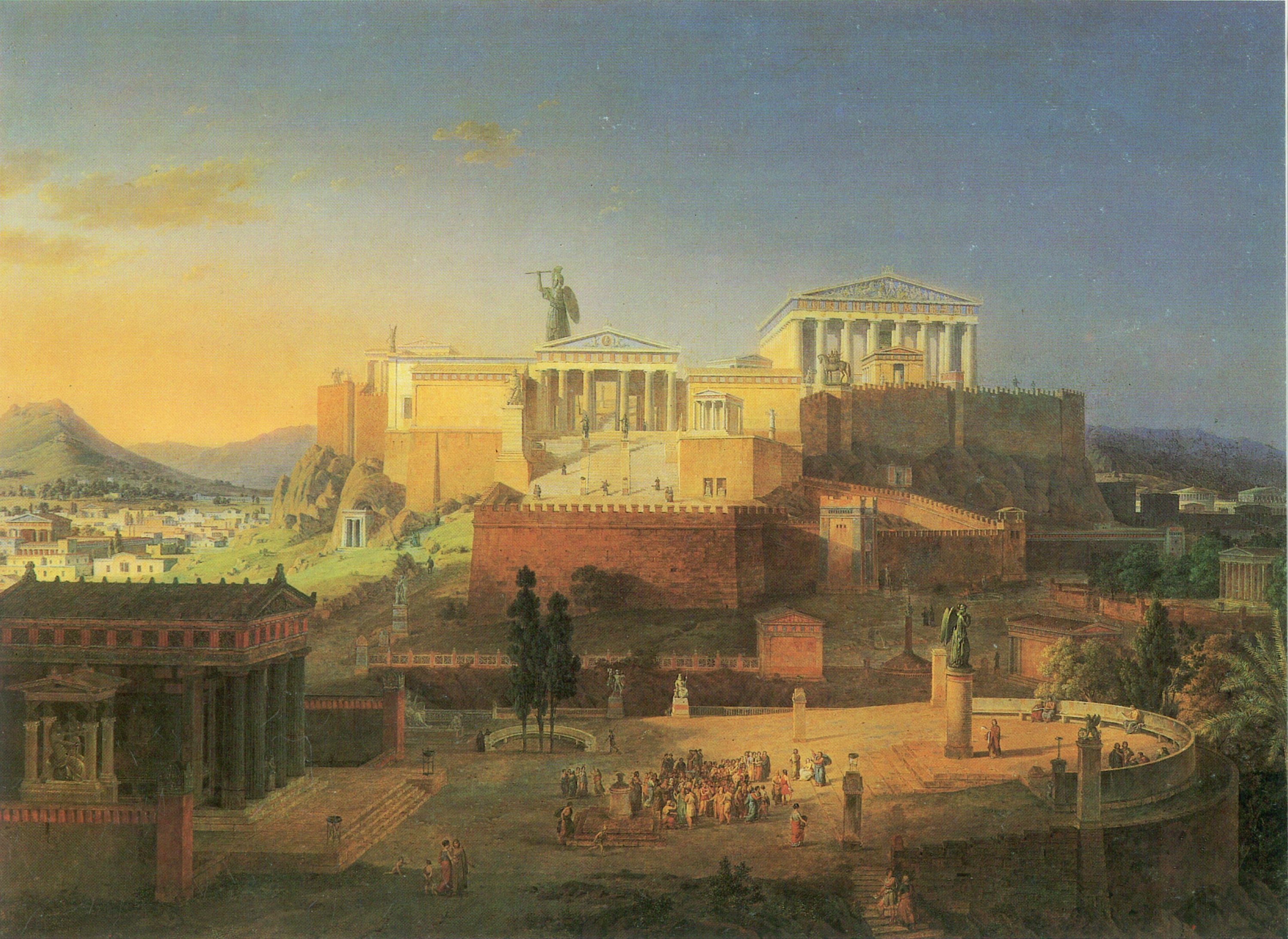
It’s the 5th century BC. Because Athens’s allies pay the city tribute (i.e. protection money in exchange for Athens shielding them from the Persians), you are sufficiently wealthy that you don’t need to work for a living. You are a man of leisure, so most of your days are spent relaxing.

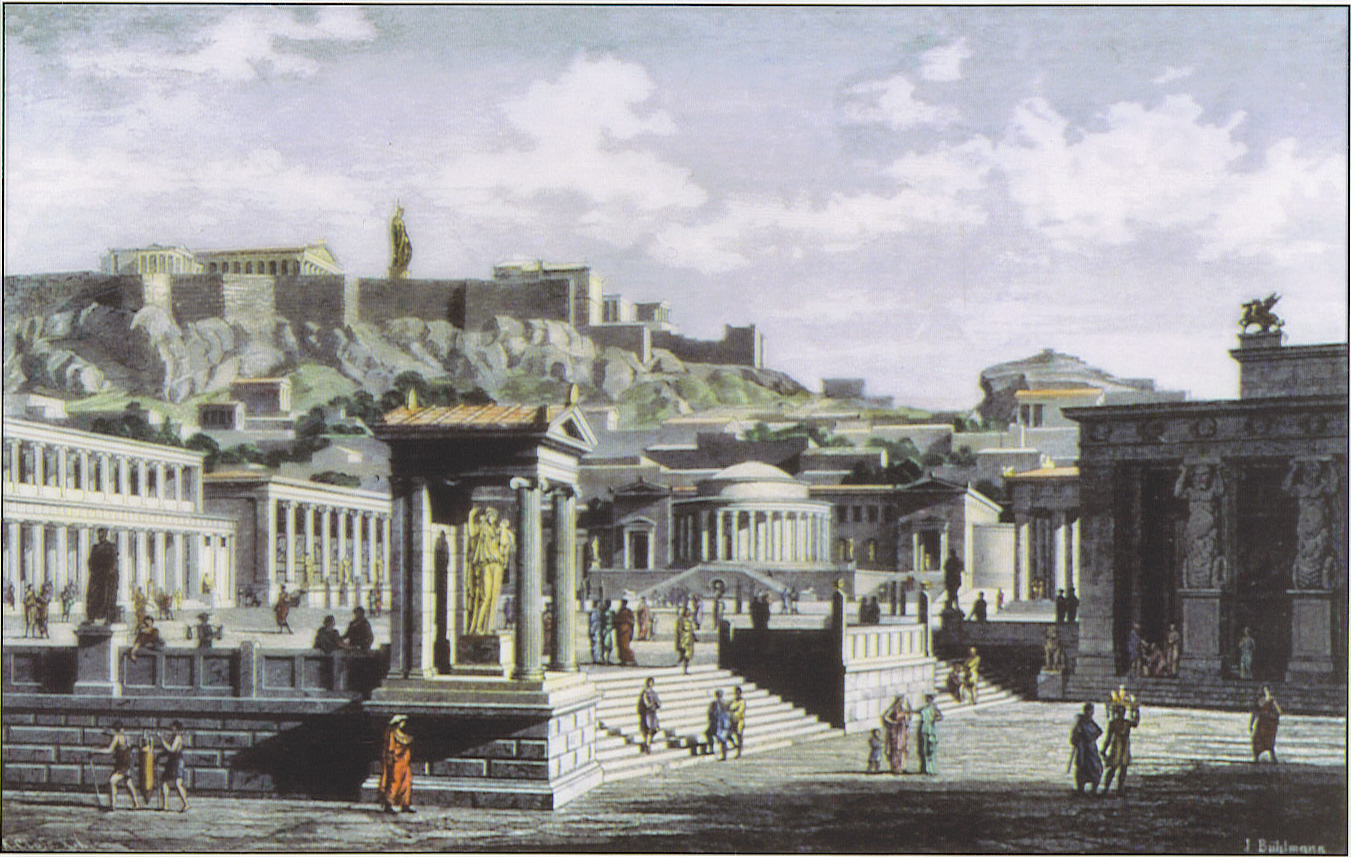
You rise before dawn and walk down to the agora north of the Acropolis. Your slave accompanies you. The agora is the civic, legal, religious, commercial, and social hub of Athens. It’s a level, open space, but a number of buildings surround it on all four sides. The agora is the location of much of the city’s official and unofficial business, as well as a place to merely hang out. At the center of the agora is the Monument of Eponymous Heroes, erected in honor of the men who gave their names to the ten tribes of Athens. On this morning there is a large group gathered around the monument looking at various documents — the agenda giving details of the next Assembly, a list of lawsuits, and another document listing the tribes being called for military service. You avoid the crowd and head over the philosophers’ area, perhaps join in the conversation for a little while. Everyone knows the Athenians love to argue. Socrates can be spotted here most days. Perhaps after that you go to the market stalls to shop for a while. Your slave will carry your purchases.

the-agora-in-ancient-athens

Next, you go to the gymnasium, literally “place of nakedness.” The gymnasium is a pleasure center — it has a wrestling ground, running track, bath, and lecture room for education. The most famous gymnasia of the classical period were Plato’s Academy and Aristotle’s Lyceum. The gymnasia are mainly patronized by young men, but elderly Greek men are known to hang out there too. You’d probably spend a few hours here.

Plato's_Academy_mosaic_from_Pompeii

At midday you head home for lunch, visit with your kids for a while. If you’re tired, you take a nap. Or, if you’re feeling more energetic, you might go hunting or go to the cockfights.

Cockfight_Santangelo

By now it’s evening time. You could head down to the local tavern for a few jars of wine, but taverns are for the lower classes, not your sort of crowd. You prefer to drink at home or at a friend’s home in a semi-form setting, an activity known as a symposium, literally “drinking together.” Plutarch described a symposium as a “passing of time over wine which, guided by gracious behavior, ends in friendship.”

At the symposium you don’t sit, you recline on a couch that you share with two other men. You prop yourself up on your left elbow so can eat and drink with your right hand. A table was placed in front of you with food. Although drinking was the primary reason for the gathering, a full meal was served first. After dinner religious libations were poured and a hymn was song to the gods, usually Dionysus. The symposium proper began with a sip of neat wine to consecrate the proceedings. Just a sip, though. The wine served to the guests was diluted with water as no sophisticated Greek would ever consume wine neat because it was thought to make one go insane. Only barbarians drank wine straight.

There were different kinds of symposia. Perhaps the host would hire a flute-girl to entertain his guests. Perhaps, as famously documented by Plato, the guests would philosophize. Or, the host might hire some hetaira, female courtesans, usually ex-slaves, skilled in the arts of music, conversation, and sex. If Greek vases are to be believed, symposia frequently turned into orgies.

Symposia were also important transmitters of culture. The “capping game” was a popular activity: one person would quote a line of poetry, the next person would quote the next line, etc. Or, the first person would quote a line of poetry and the next person would quote a line that began with the the last letter of the line previously quoted. When guests got drunk, they played the decidedly more lowbrow kottabos, in which participants flung drops of wine at targets.

cottabos_player_louvre

Classical Greek culture was heavily male-centered. Respectable Greek women were not only barred from symposia, they were excluded from most of public life. They spent most of their time at home tending to the children and domestic duties. Women in public were chaperoned at all times. As for relaxing, Greek women were permitted to host or visit other female friends, attend certain religious festivals, or spend time with their husbands.

greekwomen

Related

Posted in History, The Good Life | Tagged , , , , , , | 7 Comments

Sunday Tune

Fabrizio del Wrongo writes:

Posted in Music | Tagged , | Leave a comment

Village Du Jour

Blowhard, Esq. writes:

greece

Molyvos, Lesbos, Greece. Source.

Click on the image to enlarge.

Posted in Architecture, The Good Life, Travel | Tagged , , | Leave a comment

Movie Poster Du Jour: “A Married Woman”

Fabrizio del Wrongo writes:

100_8802

Posted in Commercial art, Movies | Tagged , , , , , , | Leave a comment