Scott, née Laura Bambrough, may not be remembered in the long run as a groundbreaker or even much of a trendsetter in the world of fashion design. But one talent she indubitably possessed in spades, and it’s one that is ironically overlooked in the perpetually speeded-up world of fashion. One might even call it politically incorrect.
She knew how to make women look beautiful.
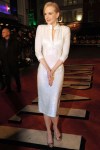
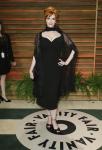
Scott, who took her own life earlier this month, designed dresses that flattered their wearers (no small thing: suggesting that women buy well-fitting clothes can get you fired these days). They were feminine, appealing, and sexy without being sluttish. The simplicity of their design was a virtue: they all spoke of a sleek understated elegance with no gimmickry. Possibly due to her background as both a model and a stylist, she understood the importance of dresses that fit a variety of female bodies: two of her best-known fans were the lithe Nicole Kidman and the ultra-voluptuous Christina Hendricks. (Scott herself was 6’3″, which is why she appears to tower over partner Mick Jagger in photos. Legs for days!)
We here at UR like beautiful women: be they naked or stylishly dressed. Scott did her part in making womankind a little more chic and lovely, and for that, she has earned my sincerest gratitude. RIP Ms. Scott.
The ex-Cheers star and perenially overweight/overwrought actress is back in the news, this time making claims that the overweight/overwrought New Jersey Governor knew about the lane closures at the GW Bridge.
That’s what the headline says, anyway, though I could find no mention of Cheers in the article. Odd.
It would be hard to imagine a more recognizable third place than a French bistro. Traditional third places tend to have physical features that unmistakably indicate what they are — these are sometimes called signal fittings. Thus, the American saloon had its swinging doors and brass spittoons, the English pub its beer pump handles and dart boards, and so on. The equipment that makes le bistro unmistakable consists of its outdoor wicker chairs, its small, marble-topped tables (about eighteen inches in diameter and pedestal based), and an overhead awning rolled up or down according to the angle and intensity of the sun’s rays. As these key visual elements protrude into the street, they as clearly bid the passerby welcome as they proclaim the place’s identity. Most of its customers do not really enter a bistro. By taking the preferred seating on the sidewalk, one remains as much out as in.
Bistros normally have no signs outside indicating their names, and for the best reason — most have no names. Naming something is the first step toward advertising it, and the French have always been admirably suspicious of advertising – only in recent years have they permitted it on television. But the major reason for not naming a bistro is simply that the neighborhood café doesn’t need a name. Its patron has filled a local niche and is content with his small, steady business. He has little interest in making his place a port of call to outsiders. The bistro belongs to everyone who lives in or happens by the neighborhood. It is as familiar to its regulars as one of the rooms of their apartments; its unmistakable and protruding presence into the street provides all the advertising that another enterprise might need. The no-name bistro also attests to the intense loyalty of its regular customers. The French are not pub crawlers or bar-hoppers, as are their English and American counterparts. A Frenchman has his place, and he confines himself almost exclusively to it. His place is referred to merely as le bistro, and when he tells his wife that he’s going to the café, she knows exactly where he may be found.
Post-Kraftwerk, I dragged my ragged soul up the coast for some renewal in Santa Barbara, prettiest goldang place this side of the nape of Scarlett Johansson’s neck. My awesome hosts, Paleo Retiree and Question Lady, kept me busy with food, cocktails and camaraderie while walking the streets of this stunning town. Here are some snaps.
Instapundit’s Glenn Reynolds on prosecutorial reform. Money quote: “The ‘nuclear option’ of prosecutorial accountability would involve banning plea bargains. An understanding that every criminal charge filed would have to be either backed up in open court or ignominiously dropped would significantly reduce the incentive to overcharge. It would also drastically reduce the number of criminal convictions achieved by our justice system. But given that America is a world leader in incarceration, it is fair to suggest that this might be not a bug, but a feature. Our criminal justice system, as presently practiced, is basically a plea bargain system with actual trials of guilt or innocence a bit of showy froth floating on top.“
Have you checked out our mega-NSFW Tumblr yet? If you haven’t, don’t bother. It’s lewd, degrading, obscene, vulgar, and morally corrupting. I showed it to Monica Bellucci and she was rendered speechless.
A few weeks back in my Vinyl Review I mentioned the upcoming Kraftwerk show, which I was graciously invited to attend by Blowhard, Esq and his entourage of colorful weirdos. (One of whom, a certain Miss Berry, gave me some real juicy dirt on Mr Blowhard, Esq. that I would love to share here, but – so far at least – decency has forbidden me).
It was a splendid evening of louder-than-fuck pumping beats, shiny electronic soundscapes, melodies cute and tinkly, and sweeping and grand. The Kraftwerk aesthetic is a one of kind thing, which they’ve pursued with a focused vengeance since the Radio-Activity album (1975). Man, did they ever stand out in the shaggy, hairy mid-1970s.
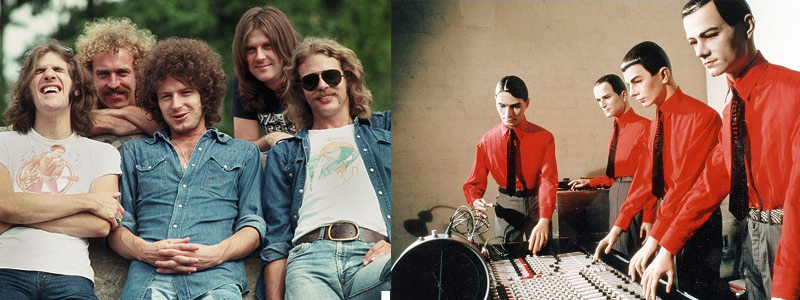
The Eagles vs Kraftwerk
Well, we all know who won that particular Kulturkampf.
My artist friend Gareth Kaple calls them “the most important band since the Beatles”, which, big a fan as I am took me aback. But it’s hard to debunk. They have no where near the fame of course, but their influence is similarly vast, running from Bowie to Punk to Dance to Electronica to Techno Pop and more, lots more. Daft Punk to Depeche Mode, thousands of bands just wouldn’t have happened without them.
We are the 8-bit robots
What’s the secret? They’ve made this modern life, dominated by electricity at a distance, the primary subject of their art. Now, that electric world is the basis for virtually all of our art and culture, most of which is distanced from the feel and tenor of atoms and electrons. Let’s look at our friends the Eagles again for a minute. Redolent of the past aren’t they (and weed and underarm sweat too, I bet)? They could be a bunch of 19th-century longshoreman, except they use hair conditioner and blow dryers. This is a band every last bit as dependent on modern electronics as Kraftwerk, but they use it to mostly hide that fact and present a down home and natural image that is anything but. Yeah, I kind of hate The Eagles.
But Kraftwerk embraced electricity with no apology, front and center. The discord and alienation is exposed, not at all hidden, but so is the wonder and glee. The surfaces are entirely modern, a glass and chrome world but with the darkness and danger intact (“radioactivity, it’s in the air, for you and me”). They aren’t trying to put a gloss on our life today, they simply build the world of their art from the true stuff of today. I think everybody feels like Kraftwerk these days, some of the time.
And we are dancing mechanik
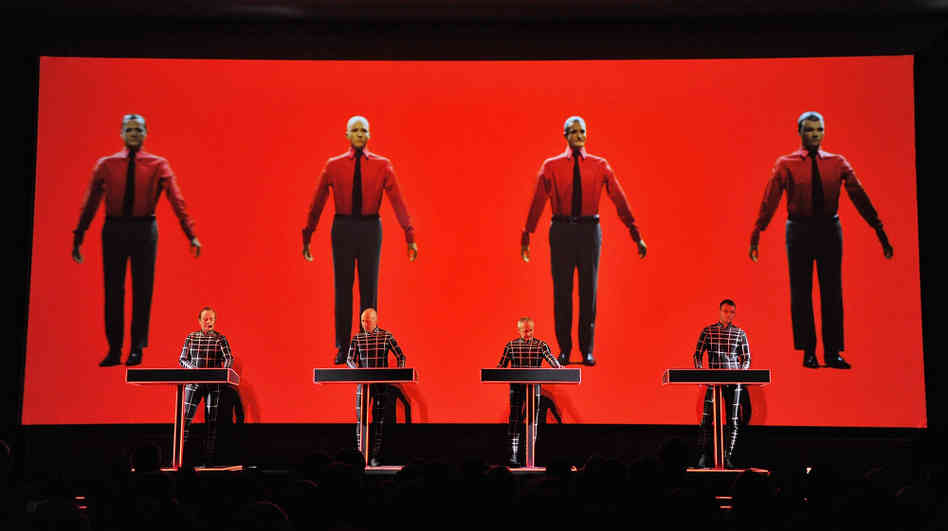
Frank Gehry’s playful and ugly Walt Disney Concert Hall might have been the perfect place to see them, because of a somewhat similar conceptual basis. Kraftwerk apparently agreed, since they integrated 3D models of the concert hall into the (also 3D) multimedia presentation. (I wrote a bit about my reactions to the hall earlier.) And the acoustics were stunning, you could feel the bass in your spine yet it was clear and pure. Simply the best sounding high volume concert I have ever attended.
A word about electronic performances. In this day and age of super powered laptops, it’s possible to automate an entire electronic music show, just hitting “play” and letting it run. The running joke has been that laptop performers are actually checking their email and surfing porn on stage. And some of them probably are. As you can see from the above image, we couldn’t really see what they were doing. But rather than trying to counter that impression, they used it. It was quite clear they were doing *something* up there, we could see their hands and feet moving around and clicking or tapping to the music, but what exactly were they doing? What kind of odd devices were under their hands? It left a real sense of mystery about just what these Machine Men were doing up there. In fact, improvisation is a significant part of their performance, which accounts for the sheer pumping drama and excitement of it all. I wasn’t sitting still for one moment.
A fine evening spent with good friends and consummate artists, what more could you ask for?
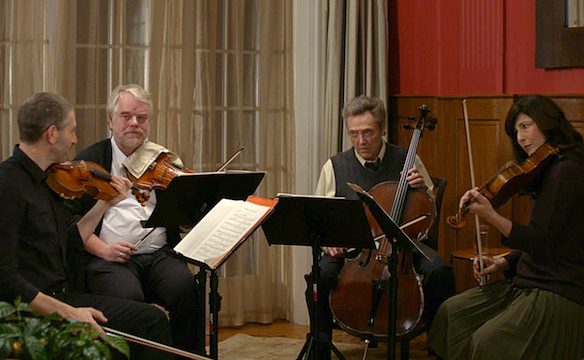
The 2012 film A Late Quartet concerns a series of events that threatens the stability of a world-renowned string quartet, a group that has been together for 25 years.
Events are set in motion when the group’s cellist (Christopher Walken) is diagnosed with a debilitiating illness. When he announces his decision to play one final concert and then retire, the cohesion of the group is shattered as the other members react to the news in different ways, each evidencing issues that had been held in check by the stability that the group work afforded.
The film is a lot of things, including, per the above, a wonderful study in both individual psychology and group dynamics. The script is literate and powerful, and it takes seriously not only the music itself but the choices the characters make as musicians. That is, their work and their art are treated with a respect that is not common in many films, where such details are often treated as grist for the melodramatic mill. I wrote about Mado that it was uncommon in how it took the details of real estate seriously. The same thing is true here with respect to being an artist in a string quartet for a quarter of a century.
The acting is wonderful, too. You have Walken and Philip Seymour Hoffman as two of the leads and that would be more than enough. But the first violinist is also played impeccably by a guy named Mark Ivanir, who I know I have seen before but could not really place. The quartet is rounded out by Catherine Keener on viola. Keener has long been one of my favorite actresses since she is so damn good at comedy played with fingernails running down a blackboard in the background. But here she’s more than just good at mining murky places for laughs. Here it is murky all the way down, and that is true of all four. In the end, it’s mostly a tragedy.
The tension between tragedy and comedy got played out in an interesting way for me in this film.
We tend to think of the relationship between tragedy and comedy in terms of a strict polarity
like yin and yang.
The yin-yang formulation invites us to think of polarities as equal-but-opposite but it is not clear to me that this is the actual relationship between comedy and tragedy. Consider how often we come to tragedy through comedy: the laughing through pain, the funny moment that disturbs. But is it as common to come to comedy through tragedy? It seems to me that that is harder to do.
I think you find some of that counterintuitive approach in this film. By the end you cannot help but see what fools those mortals be. It didn’t cause a chuckle, exactly, but there was some dark comedy lurking in there somewhere.
























 Blowhard, Esq.
 Callowman
 Sherbrooke
 Eddie Pensier
 Enzo Nakamura
 Epaminondas
 Fabrizio del Wrongo
 Fenster
 Brundle Guy
 Glynn Marshes
 Paleo Retiree
 Atypical Neurotic
 Question Lady
 Sax von Stroheim
 Sir Barken Hyena
 The Mistaken

