I have a visceral reaction to “awareness” campaigns, which strike me as bullshit-heavy displays of toadying PC acquiesence. Grown men especially should not stand for such things. Matt Lauer and Al Roker are not saving anyone’s life by having their assholes probed on television. They’re just humiliating themselves. Besides, how many men watch Today?
What if you received time in a bottle? You open the bottle and you get to see something from your distant past that you only had memories of. But now, you get to see it unfold in front of you again. One man had this experience…
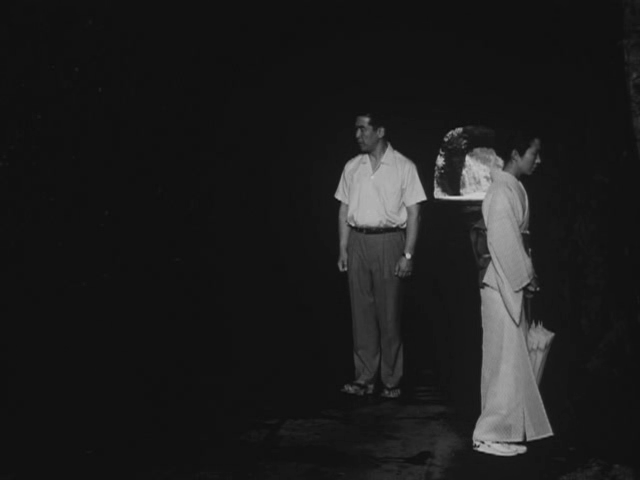
“The Stranger Within a Woman,” from 1966, is an unsettling late Naruse that feels a bit like one of Bergman’s ’50s films, especially in its use of the flashback as a structuring device. The plot concerns a middle-class man who inadvertently kills his friend’s wife during a bout of kinky sex. Predictably, this strains the relationships between him, his wife, and the friend. Naruse downplays the thriller aspects of the story in favor of emphasizing the way in which the event galvanizes the instincts — both moral and practical — of each involved character. Nothing ends up being resolved, yet it’s fascinating to watch Naruse shift point of view and force story elements to collide in evocative, unexpected ways. More than once it reminded me of one of Hitchcock’s most underrated films, the 1929 “The Manxman.” I’m not sure what was going on in Naruse’s life during this period, but the movie he made right after this one, “Hit and Run,” is another quasi-thriller with macabre overtones.
The 1960 “Autumn Has Already Started” has an Ozu-esque title but the pessimism and focus on money are typical Naruse. In it, a widow and her son move from the country to live with their relatives in Tokyo. The mother is forced to take work as a geisha while the son develops a friendship with a girl who performs chores in the mother’s workplace. This leads to problems, as the boy’s play activities begin to overlap with the mother’s very adult occupation. As the movie progresses we see less of the mother; she gets into a relationship with a patron, and he wisks her away. The boy compensates by spending time with an older male relative, who is kind but ultimately more interested in carousing with friends. The scenes between the children are sweet without being maudlin. In the movie’s most memorable bit they go to the waterfront in a taxi, then get lost on the desolate, desert-like beaches. In another bit the boy rushes to the home of the girl to impress her with his pet rhinoceros beetle. Upon arriving he discovers that her family, like his mother, has packed up and moved. Heartbreaking. These scenes have a tenderness and a respect for youthful POVs that recalls “The 400 Blows” — though Naruse is free of Truffaut’s mythologizing tendencies. The movie makes good use of the Tokyo locations. You really get a sense of the city and its surroundings. It’s notable that the opening and closing shots involve busy city streets; images of the characters carefully picking their way through traffic sensitize you to the danger inherent in urban locations. Perhaps these shots are also premonitions of Oshima’s 1969 “Boy,” a movie with a similar — and a more firmly hammered down — set of themes.
Related
Dan Sallitt discovers a connection between “The Stranger Within a Woman” and Chabrol.
I am not sure I fully buy the notion of memes as self-replicating counterparts of self-interested genes. At least I would want to understand better the means by which those presumably selfish little idea critters hop from host to host looking for an angry fix.
If there is a kind of idea out there that persuades me there is something to the meme meme, it is the earworm idea. You know, those songs, or snippets of songs, or hooks, or phrases, or whatever that get lodged in your head. And you can’t seem to get “them” out.
Now I may not always have a song in my heart but I always, always have one rattling around in my brain. And they most often take the form of earworms, little pieces of music picked up somewhere along the way that just come and go as they please.
The more we understand the brain, the more it appears that the unconscious parts of our brain make a lot more of our decisions than we think. Relevant synapses flash not when we decide in favor of the Philly Cheesesteak, but, suspiciously, right before. Memes, you say?
So with earworms. The things I think I like may never make the playlist.
What does gets stuck there? Well, here’s a recent example.
Aaarrrgghhh! I object! I hate Debbie Boone, and I despise that sappy song. Yet ever since her commercials for Lifestyle Lift, You Light Up My Life wafts in and out of my mind whenever it damn well wants, and “it” seems to want to be there a lot recently.
So does this mean “I” really like Debbie Boone? Or maybe that a rogue Boone-meme has taken up shop in my brain and is barking out orders?
And then Scheherazade snuck in somehow. That Rimsky-Korsakov chestnut was one of the first classical pieces I listened to, and I’ll grant it is nothing if not memorable. But if Strauss referred to himself as a first-rate second rate composer, my conscious mind has always thought of Scheherezade as second-rate second-rate music.
There’s theme one:
And theme two:
And theme three:
All introduced in the first three minutes, all recycled endlessly endlessly in every possible variation in tone, over and over. If nothing else, it is sticky. I guess I must actually love it, deep down?
It’s not always this bad. Actually, much of the time I end up liking what makes the playlist.
For instance, this wah-wahish lick from Steely Dan recently took up residence for several weeks. Not the whole song, just the lick. My conscious mind approves.
Or this sprightly introduction to Belbeukus, by the somewhat obscure 60s band Rhinoceros. Aw, heck, the whole song is less than two and a half minutes–if you’ve gotten this far, listen to the whole thing.
My conscious mind approves. Another area of agreement between my meme master and me.
From time to time, scifi writer Sarah Hoyt blogs about The Collapse.
I find her perspective interesting. Hoyt was born and grew up in Portugal; she’s experienced first-hand what it’s like to live in a country in Western-style decline. “I have some experience with revolutions,” she writes in a post titled Sweet Liberty,
I get PTSD at the sound of Green Acres because Porto had one reel in its local broadcast station. Green Acres. When Lisbon got cut off, they played it back to back. This meant that someone had taken over the main broadcasting station in Lisbon.
When I first heard of this on Monday evening, I was in very little doubt about what had happened, especially about the likely identity of the perpetrator and the reason for the crime. This is also the second time in ten years the same thing happened in the same part of the country. People are hopping mad.
This is yet another case where tragedy and farce need to by plied apart by Occam’s crowbar. But of course they won’t be.
In this particular instance, a South Sudanese national whose application for asylum had been rejected this summer was relocated to a refugee center in the western fjords pending being returned to Spain. Spain was his point of entry into the Schengen Area and where he had first applied for asylum. Under the Dublin II rules, he was required to return to Spain to await the outcome of the application process there. Instead, like so many others, he decided to go “asylum shopping”. What he did not know is that there was virtually no chance that his application for asylum in Norway would be accepted. According to this morning’s Aftenposten, no South Sudanese national has been granted asylum in Norway either this year or in 2012. However, now that this man has been charged with three homicides, he may get to stay indefinitely.
While ordinary Norwegians seethe (just read the comments on the newspaper websites – the ones that still dare to allow people to vent their anger), the usual suspects among the great and good are positioning themselves to declare their unwavering support for the institution of asylum while asking the rhetorical question “How could this happen?” But these days, asylum seekers are not what they used to be.
Marie Simonsen, the political editor of Dagbladet had an op-ed piece in today’s paper that contained a lot of good sense. However, one of her conclusions got stuck in my craw:
Da bør det være statens oppgave å sikre en forsvarlig helsetjeneste av hensyn til pasienten, familien og samfunnet. Regjeringens satsing på psykiatri må også komme denne gruppen til gode. Kunnskapen og forskningen finnes. Det er spørsmål om å ta den i bruk.
Then it should be the government’s task to guarantee a decent health service in the interest of the patient, the family and society. Government initiatives in the area of psychiatry must also benefit this group [war-traumatized asylum seekers]. The knowledge and the research exists. It is a question of putting it to use.
Is it? Is Ms Simonsen aware of the resources that will have to be diverted from an already starving mental health service, which with notable (and wonderful) exceptions, has been “escalated” to the familiar treatment-in-the-community model that focuses on meds instead of beds? Who will have the linguistic and cultural qualifications to screen asylum applicants for trauma and other mental illness? What support networks can the mental health service offer? And, more to the point, who will not be receiving care because resources are being diverted to people who might not even have the right to remain permanently in the country? The Russian émigrés fleeing from the Bolsheviks and the Cold War refugees from Hungary, Czechoslovakia and other former East Bloc countries were never this much of a burden.
I suspect that despite the rational nature of his act (he gets to stay, after all), the perp will be declared mentally ill just like the one in 2003 and sentenced to “treatment” for an indefinite period. The more he protests that he is not crazy, the higher the dose of meds they will insist on giving him. The combination of, say, 40 mg of olanzapine and its metabolic side effects, with the sequelae of vitamin D deficiency will mean that as a sub-Saharan African at 60-odd degrees north, he is not likely to live past 50 (he is in his 30s now). He will no doubt linger as a zombified and diabetic ward of the state for the rest of his life. And if he was not mentally ill when he hijacked that bus and killed the driver and the other passengers, he will be soon. That’s the beauty part of meds. How can you tell the difference between the underlying disease and the side effects? If only he had simply lammed to Oslo, he could have set up shop with his fellow African refuseniks as a “freelance pharmacist“.







 Blowhard, Esq.
 Callowman
 Sherbrooke
 Eddie Pensier
 Enzo Nakamura
 Epaminondas
 Fabrizio del Wrongo
 Fenster
 Brundle Guy
 Glynn Marshes
 Paleo Retiree
 Atypical Neurotic
 Question Lady
 Sax von Stroheim
 Sir Barken Hyena
 The Mistaken
