The Law Rock

Blowhard, Esq. writes:
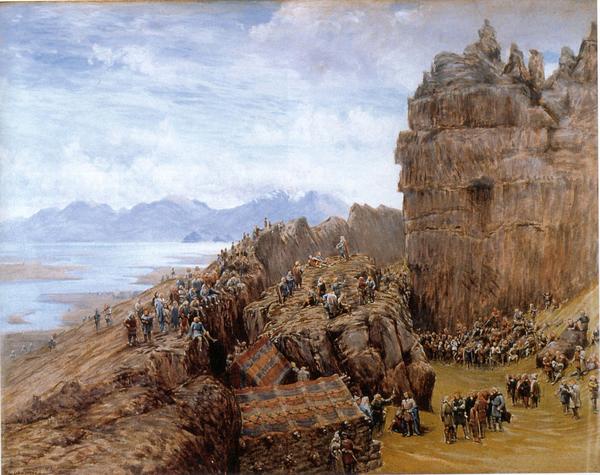
Lögberg-Collingwoods

From 930 until 1262, medieval Icelanders lived in a society with no national government — no king, no army, no taxes. Hell, there wasn’t much local government either. The basic unit of organization was the family farmstead. There were no cities or towns. It was a harsh frontier society with population topping out at about 70,000 around the year 1000.

The land was divided into quarters, each with its own thing, a local assembly to mediate disputes and conduct business. The thing was presided over by a godi. Professor Kenneth Harl writes that the godi was:

a district leader who, by his reputation, his knowledge of the law, and his generosity to family and neighbors, was known as a figure to whom others could appeal to settle disputes, mediate blood feuds, and so on.

The godi knew customary law and attended the things and the Althing. The position of godi could be shared simultaneously among several men and was not hereditary. If a godi performed inadequately, he could lose his dependents and thingmenn. Hence, he had to be vigilant in imposing the law equitably and maintaining order in the society.

Each local thing sent representatives to the national Althing. There was no formal structure to the meetings. At the Althing was the Law Rock where the law speaker, who was elected to a three-year term, recited the law from memory, a third each year. Other godi listened carefully to make sure the speaker didn’t make any mistakes.

Anyone could speak at the Law Rock. It was the site of any major announcements and also served as the court of last resort where people would bring prosecutions against others for various criminal and civil matters. Mediation would then ensue according to customary law. Medieval Icelandic society was remarkably self-regulating and fiercely proud of its independence such that “the Icelanders saw no real need to set up anything like an army or a fleet,” Harl says.

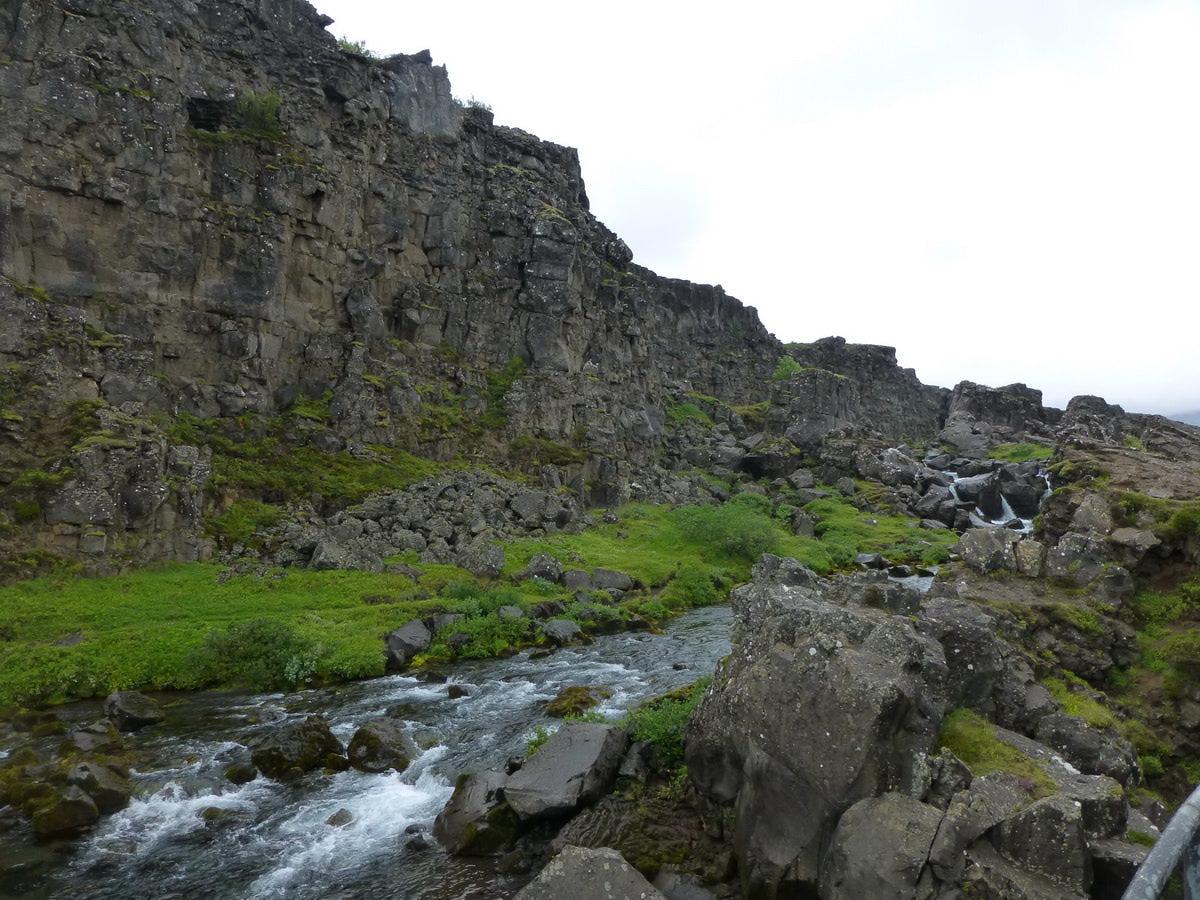
The site of the Althing is now a national park. Due to changes in the geography over the last millenium, no one is quite such where the Law Rock was located.
Iceland-541

More

Posted in History, Law, Politics and Economics | Tagged , , , , , , , , , | 10 Comments

Linkage

Paleo Retiree writes:

  • Secrets of Princeton. As a PU grad, I’ll vouch for the accuracy of this one.
  • Lloyd Fonvielle is inspired by a book about the West by Frederick Law Olmstead, a great American artist best-known as the co-designer of NYC’s Central Park.
  • Primal/Paleo guru Mark Sisson responds to some good questions, as well as to a critique of the Paleo movement.
  • Rant Du Jour. Link tks to Malcolm Ryder.
  • Really looking forward to William Friedkin’s memoir. I wrote about “Killer Joe” here.
  • Martha Esersky Lorden recalls the cake-mix desserts of the 1950s.
  • What’s it like to revisit an Israeli commune where you once spent an idealistic summer?
  • Photos from inside Cass Gilbert’s great Woolworth Building.
  • This fun interview with the guy behind the hot Manhattan cocktail place Pouring Ribbons (which I teased here) offers an interesting snapshot of life in the artisanal food world.
  • Steve Sailer wonders why Mark Zuckerberg has gotten behind the legalize-all-immigrants campaign.
  • Netflix Instant Choice: “Lord Love a Duck.” A black-comedy/satire of teen America (as well as a spoof of American teen movies) circa the early ’60s — think “Dr. Strangelove” meets “How to Stuff a Wild Bikini” — George Axelrod’s comedy holds a special place in many viewers’ hearts.  At its worst, it’s frenetic and scattershot; at its nutty best it’s high comedy of a very dizzy sort. Tuesday Weld is perfectly amazing as the sexy-banal girl at its center.
Posted in Architecture, Books Publishing and Writing, Food and health, Linkathons, Movies, Politics and Economics | Tagged , , , , , , , , , , | 4 Comments

“El Bulli”

Paleo Retiree writes:

elbulli1

A German hagiography-documentary about the last season of creating-and-serving at El Bulli, the famous restaurant on the Costa Brava (outside of Barcelona) that was sometimes said to have been the world’s greatest. The movie is an impressively somber, narration-free art-thing in its own right, designed, machined and tooled to a deep, dark Euro-polish. It’s in the reserved, reverential style of a Mercedes ad. The high-end hush is meant to suggest that we’re in the presence of genius — it’s like an official visit to Pierre Boulez at IRCAM. The genius the film is enshrining is the restaurant’s chef, Ferran Adrià, and as slick as it is, the film is mainly of interest for its subject matter: its look at his innovative approach to food, its exploration of how his restaurant worked, and the glimpses it offers of Adrià himself.

Continue reading →

Posted in Food and health, Movies, The Good Life | Tagged , , , , , , , , | 11 Comments

At Least the Two Parties Work Well Together on Some Things

epiminondas writes:

The bipartisan effort to bankrupt our nation.

Posted in Politics and Economics | 2 Comments

Notes on Two Early Films by William Wyler

Fabrizio del Wrongo writes:

hellsheroes

In 1929 William Wyler directed a treatment of Peter B. Kyne’s “Three Godfathers,” a Western story of redemption which has been filmed several times, notably by John Ford in the 1940s. Where Ford emphasizes the spiritual aspects of the material, Wyler focuses on the external ones: his Old West is a land of dust, desperation, and rotgut criminality — the sort of place where even the local preacher is packing a six-shooter. There’s a real bleakness here, one that is matched by the blasted-granite features of head bandit Charles Bickford, and Wyler uses that to bolster his theme of decency sprouting from degeneracy. There’s nothing surprising about the final scene, and yet it feels like an epiphany, perhaps because we sense that the intentions behind it might evaporate at any moment. It’s a shame that most of Wyler’s early work in the Western genre is either lost or unavailable. “Hell’s Heroes” suggests it might be of interest.

Released in 1935, “The Gay Deception” is a pleasant, innocuous romantic comedy that plays like an inversion of Wyler’s later “Roman Holiday.” Wide-eyed working girl Frances Dee wins a $5000 prize; she then rushes to New York to spend it. (The premise looks forward to “Nothing Sacred.”) While staying at the chic Waldorf Plaza she meets Francis Lederer, a European prince hiding out as a bellhop. And as a waiter. And as an elevator operator. (His omnipresence is a joke that quickly wears thin.) Several elements are redolent of Billy Wilder’s signature cuteness; in particular, a trio of silly foreigners seem like cousins of the Soviet emissaries who squire Garbo in the 1939 “Ninotchka.” Nevertheless, Wyler does a clean, efficient job of directing, and there are a few nice bits, including some impressive moving shots through the expansive hotel lobby and a charming scene involving breadsticks in an Italian restaurant (being unable to decipher the menu, Dee orders the headwaiter). Lederer perhaps lacks the magnetism to adequately function as the male half of a romantic comedy duo; his prince is only a step above the second bananas played by Erik Rhodes in the Astaire-Rogers pictures — and he’s not nearly as amusing as the Great Beddini. (The movie could use less of Lederer’s dampness and more of the tonic cynicism that Alan Mowbray brings to his brief turn as a playboy aristocrat.) Wyler tried his hand at a few romantic comedies during this period: 1935 also saw the release of “The Good Fairy,” an impressive screwball contraption starring  Margaret Sullavan, and in 1929 he helped forge the style with the very interesting “The Love Trap.” But I’ve always thought his talents ill-suited to the genre — his tendency to visually and dramatically isolate characters, and to methodically exert pressure on their fault lines, is at odds with the harmonious submission that is so often the animating force of romantic comedy. “Dodsworth” and “These Three” — two major Wyler films of this period — are more amenable to his sensibilities. Keep an eye out for some of the most distinctive character actors of the era, including bugle-voiced Al Bridge, Lionel Stander, Robert Greig, and Akim Tamiroff.

“Hell’s Heroes” is available — along with the Richard Boleslawski-directed version of “Three Godfathers” — on Warner’s Archive Collection series of burn-on-demand DVDs. Buyable here. “The Gay Deception” doesn’t seem to be readily available on video. But if you’re a degenerate with no respect for our legal institutions, you might be able to find a bootleg DVD of it online. Not saying I’ve actually looked for such things, of course.

Posted in Movies, Performers | Tagged , , , , , , , , , , , , | 1 Comment

The L.A. Conservancy’s Art Deco Walking Tour

Blowhard, Esq. writes:

Recently, I attended a walking tour offered by the Los Angeles Conservancy, a charitable organization tasked with “preserving and revitalizing greater Los Angeles’ architectural heritage.” (Don’t laugh.) These tours are offered every weekend of such places as the Victorian homes of Angelino Heights, Union Station, and the Biltmore Hotel. Noir fan that I am, I opted for the Art Deco tour.

Continue reading →

Posted in Architecture, Food and health, Photography, Travel | Tagged , , , , , , , , , , , , , , , , , , , , , , , , | 18 Comments

Food Jargon

Paleo Retiree writes:

Although I do love it when my food is “artisanal” and “locally-sourced,” I’m at my happiest when my charcuterie has been “curated”:

curated01What’s your favorite contempo pretentious food term?

Posted in Food and health, Humor | Tagged , , , , , | 12 Comments

Linkage

Fabrizio del Wrongo writes:

  • I’m not particularly interested in debating the pros and cons of climate science, but this piece by Ross McKitrick provides for an interesting poke around some of the stuff that appeares to go on behind the scenes in academia and at scientific journals. It also shows how new media (in this case, bloggers) have succeeded in undermining the illusion of we’ve-got-it-all-figured-out, our-way-is-the-best-way correctness being promoted by our elite class. Stephen McIntyre of climateaudit.org is hated by climate scientists, and with good reason, but it really looks like he’s doing a better job of turning over rocks and asking hard questions than anyone in the dinosaur media. But isn’t that the case in general these days?
  • Related. (H/T Glynn Marshes)
  • Kicks just keep getting harder to find. (H/T Advocatus Diaboli)
  • RIP Bigas Luna. I’ve admired a lot of things about the Luna-directed films I’ve seen. (Spanish filmmakers are often really cheeky, clever, and wild, aren’t they?) Luna’s 1987 “Anguish” is a really smart riff on the experience of watching movies, and it strikes me as a work that deserves to have a devoted cult following. It’s available on DVD.
  • “Good evening.”
  • Movie blogger Jeffrey Wells on his experience dating actresses.
  • I’ve been saying for years that Warner Brothers, which has the deepest and best film catalog around, should start a streaming service. Glad to see they’ve finally done it. The list of available titles is still sparse, but there are some good ones in there. Off the top of my head, I’ll recommend the beautifully shot women-in-prison drama “Caged,” Ford’s “Wagon Master,” and Sjostrom’s great “The Scarlet Letter.” The last stars Lillian Gish in one of her greatest roles, and I don’t think it’s ever been available on DVD.
  • I guess this isn’t surprising. But if you’re anything like me, you saw it and wondered how common this sort of thing is. Surely, a lot of politicos are doing similar things and simply not getting caught. Right? Right?
  • Go here in order to embarrass yourself make a big show of your support of women. I’m sure it will get you laid.
  • Science proves that chicks dig big wangs.
  • Foseti links to some heretical thoughts on democracy. Some good comments too, especially those by Handle.
  • Related.
Posted in Linkathons, Movies, Politics and Economics, Science | Tagged , , , , , , , | 13 Comments

Does This Avatar Make Me Look Fat?

Glynn Marshes writes:

Riffing on comments I exchanged with Paleo Retiree after my last post, one of the cool things about fiction — and one of the reasons I don’t think the novel, as an art/entertainment form, is quite dead, yet — is that reading takes over our brains.

avatar

From a NY Times article published about a year ago:

[W]hen subjects in their laboratory read a metaphor involving texture, the sensory cortex, responsible for perceiving texture through touch, became active . . . Continue reading →

Posted in Books Publishing and Writing, Science | 7 Comments

Municipal Design

Fenster writes:

Even in buildings that have deteriorated to Kojak quality, you can find some nice reminders.

knob

Posted in Architecture, Art | 3 Comments