Welcome, Hypocrisy!

Fenster writes:

There is a new line of thinking developing from anti-Trumpers on immigration.  You hear if from people like David Frum and Damon Linker. It goes like this: Trump is a cruel xenophobe but Democrats need to be wary of playing into his small, clever hands by overdoing it on the open borders business.  Ixnay on the atch-and-release-kay!

Linker:

If you wanted to ensure the eventual triumph of immigration restrictionism in the United States, you couldn’t devise a surer path to that goal than getting the Democratic Party to explicitly embrace a policy of de facto open borders.

Unfortunately, this is precisely where the liberal reaction to President Trump’s viciously harsh immigration policies is headed.

Frum:

(O)utrage is the mood of the moment, perhaps more than at any time since the immediate aftermath of the 2016 election.

The Trump administration’s border policies and his dehumanizing rhetoric about immigrants have triggered this incandescent reaction.  . . .Trump and his brutish methods are radicalizing his opponents. But those opponents still retain the choice not to be radicalized.

Translation: we cannot let stand the lie that Trump is the true nationalist here.  We must reclaim that for the anti-Trumpers.

Linker:

The human longing for communal solidarity — and its corollary, the love of and privileging of one’s own above others — cannot simply be wished or legislated away. No matter how much moral discomfort it causes.

Frum:

The spreading view that immigration is a civil right and that immigration enforcement is totalitarian is an attack on democratic legality. It subordinates rules and norms to desires and passions. It is also a corrosion of the ideal of a constitutional state.

Linker’s answer:

(I)t’s crucially important for voters to know that, wherever we ultimately choose to set the annual rate of immigration and whatever admissions criteria we use, we will enforce it, by taking firm control of the border and continuing to uphold the politically crucial distinction between who is and who is not a citizen.

Sounds kind of Trumpian but of course it is not.  It sounds . . . nicer . . .  and of course it is being articulated by a Trump opponent.

For his part Frum concludes by trying to talk the Democrats off the ledge from which they are about to jump.  And he does so cannily, in the manner of that good cop by the window,  by flattering their refined sensibilities:

It’s not easy to decide what to do about the accelerating surge of illegal immigration from Central America—or about the surges that will soon follow from the rest of the planet if the present surge is not checked. But the decision will surely be better made by means of rational discussion than in response to emotive images. You want to be different from Donald Trump? Fine. Do what he does not do: Think.

Hilarious.  He frankly acknowledges the seriousness and scale of the problem but refuses to concede an inch on Trump’s efforts to do something about it.  Hey liberals, think!  If only you would do that all would be well.  But please please please don’t jump!

Francis Wilkinson in Bloomberg takes a similar tack.  Writing of Trump’s zero tolerance border policy Wilkinson argues that “the cruelty, accompanied by the lies deployed to excuse it, further inflamed political passions and sharpened the divide between Republicans, who support the president, and Democrats, who detest him.”  As a result not only are we already in a soft civil war but if the Democrats do not regain control of Congress:

(h)ere’s an easy prediction. Democrats will then experience rage — at Tea-Party levels or worse.

Of course Democrats have no agency here.  They will have been driven to war by the evil genius Trump.  Moreover, what is really tragic is that while the Democrats may erupt in fury it will only reflect a sad souring of their most noble impulses:

Democrats won’t give up on democracy. It’s too central to their identity, and their commitment to democratic norms and processes is also their point of greatest contrast with Trumpism.

So it is possible that while the Democrats will never give up their inflated self-esteem and virtuous self-image they may be willing to get somewhat more realistic about the challenges of unlimited and uncontrolled immigration.  They may need to do that only if they can simultaneously hold on to the belief that Trump is the villain of the piece. But, hey, as I have always said, hypocrisy is the handmaiden of all great things.

POSTSCRIPT:

Peter Beinart sketched all of this out with a lot more honesty last year in The Atlantic.  Beinart freely acknowledges that the shift by Democrats to open borders goes back before Trump and is essentially self-inflicted.

Beinart also comes closer to real solutions, though as he admits it ain’t an easy problem to solve.

He is an honest liberal on the issue and happens to believe that more unskilled immigration can be a good thing.  He first develops an economic argument: if immigration adds to overall economic growth but disadvantages some then why not devise ways of tapping into the increment of growth created to offset the losses where they occur?  But he notes this kind of distributive policy is hard to pull off politically.

More importantly he sees that it is not simply an economic argument.  He is open about questions of culture and cohesion that mere economic redistribution cannot readily resolve.  People resist “the other”–or at least too much of the other, applied with too heavy a hand and with no ability to influence or control the cultural consequences.  His answer: a return to the value of assimilation.

In theory this could work of course.  But can it work in practice?  It is easy to say we will return to assimilation but is such a thing even possible?  Whatever assimilation we promote in this day and age is likely to be a soft and gauzy thing, in keeping with liberal values.  But assimilation in practice had, and must have, a hard edge.  Are Democrats even close to taking on the cultural demons that would have to be tamed in order to create a serious approach to assimilation?

It’s political, of course.  The more people who live in the United States and are not interested in assimilating the harder it will be to adopt that approach as policy.

It may well be that our last anti-Trumper of the day, Andrew Sullivan, is right:  to end the border crisis give Trump his friggin’ wall. If we could only find a way to do it without giving that jerk the credit . . . .

worried-man-350

Posted in Uncategorized | Leave a comment

Full Circle

Fenster writes:

It only takes a couple of generations for social things to come full circle, with that generation’s victims this generation’s bullies, and so on.

Here is a photo of Amsterdam’s “white bicycle” program, a free bicycle share idea pushed by the anarchist-influenced Provos in the mid-sixties.  Witte Fietsen for all!

b24-706

And here is how the current generation of anarchists have chosen to respond to bicycle sharing in Portland, Oregon.

vandal-biketownsign

Stations trashed; bikes vandalized.  “Our city is not a corporate amusement park.”

It is tempting to say that the anarchist spirit has stayed the same and that what has changed is the Establishment, which finds ever new ways to commodify desire.  Some truth in that I am sure.  But there is also a big difference between the playfulness of the earlier anarchist vision and today’s sour, angry and bleak version.  No one escapes the merry-go-round.


Posted in Uncategorized | 2 Comments

Border Wars

Fenster writes:

The mainstream (i.e., anti-Trump) position on family separation is at least as disingenuous that of the Administration.  Much of the grandstanding in Congress relates to whether Trump can stop separation “with a phone call”.  Further, the mainstream press supports that view, arguing that the Flores consent agreement does not “require separation” and that Trump can stop the process on his own. That is true but misleading.

When someone is detained for federal criminal proceedings they are given over to US Marshalls.  It is never the case that children are permitted to accompany parents who are so accused. So the initial separation arises inevitably (in the case of illegal border crossings) from the decision to prosecute entry at the border rather than waving people through.

Most often the proceedings are quick and if the accused is found guilty of entering on an unauthorized basis they are sentenced to time served, generally days, are reunited quickly with family, and all are deported.  If all that can be done in under 20 days the Flores tripwire (no detention of children after 20 days) is not triggered.  But during that period of up to 20 days separation is unavoidable once the approach taken is the swift resolution of the legal matter.

But let’s say someone who is caught entering illegally not at a border crossing asks for asylum after being caught. Perhaps they ought to have presented themselves at the border (or to Mexican authorities, or to an American embassy–these are for the moment but trifling points).  But they are free to assert a claim for asylum even if they are brought in by traffickers not at a border crossing and subsequently apprehended. Such individuals may still have the charge of illegal entry to deal with but the asylum process beyond that can take a longer time.

Alas, under a 9th Circuit ruling dealing with Flores handed down a few years ago children cannot be detained for more than 20 days even if they are with their parents. So the government is prohibited from moving the asylum seeker to detention with their children awaiting an asylum hearing; even that situation is not permitted under Flores.

It is for this reason that the Administration favors a quick law change that would get rid of Flores restrictions on length of stay and permit families to be together. Who could oppose that?

Well, the Dems appear to be opposed, arguing that Trump doesn’t need the legislation.  Since Flores does not “require separation” the argument is that he can reunite families without a law change, with a phone call.

Sure but it appears that the only way to do that would be to just let the families go entirely. If it is objectionable to separate a child from a parent who crossed illegally, even for a matter of days, they can always be released, right?  Same with asylum seekers.

It sounds easy enough but I do not see any way the Administration’s approach to prosecution and asylum can be easily squared with keeping families together.

Now, there are of course different views on the wisdom of the Trump approach to the border. Migrants, their advocates and large chunks of the liberal electorate are fine with catch and release. They want the migrants in the country. If you like more immigration you will presumably like releasing families whether or not they have requested asylum.  Better to finesse the law than insist on its enforcement.

It is OK to have that opinion, but it is quite a different thing from saying Trump is free to end the separation policy with a phone call–not if he wishes to continue his current approach to entry and asylum.

That is the disingenuous part—what is not stated by the Dems is that in order for him to end separation without a change to Flores he would have to drop the current approach to the border, and revert to the prior practice of waving families through.

Why is this aspect not highlighted by Trump’s opponents?  The Dems know that the American public does not like family separation but they also know that the public does not favor the lax approach elites have taken to the border in the past, and just do not understand why someone who walks across the border should not simply be denied entry.

Is there a good case to be made by Dems for ignoring the law and letting people through given the complex nest of restrictions and laws in place at the time of entry? Something that will resonate with the public?  I doubt it.

Meanwhile Trump’s polling continues to improve.


Posted in Uncategorized | 6 Comments

Couldn’t Do It Today

Fabrizio del Wrongo writes:

Posted in Movies, Sex | Tagged , , , , , , | 3 Comments

Design for Educating

Fenster writes:

Design is the new IP

Design is the new marketing

Design is the new currency

Design is the new engineering

Design is the new green

Design is the new black

Design, it seems, has some powerful mojo.

Yet with all things mojo how much is real?

Buckminster Fuller put the essence of design into two pithy sentences at the beginning of Operating Manual for Spaceship Earth.

If you are in a shipwreck and all the boats are gone, a piano top buoyant enough to keep you afloat makes a fortuitous life preserver.  But that is not to say the best way to design a life preserver is in the form of a piano top.

Not much arguing with that.  At base design expresses a few key concepts:

–Intentionality

–about solving a problem

–taking account of context and systems

–with a goal in mind.

So far so good and pretty straightforward.  Now, it is not clear that Fuller’s Dymaxion Car. . .

dymaxion-yando

. . . springs from this idea fully formed, like Athena from the head of Zeus.  But this conception of design does partake of the positive tradition of American pragmatism.  Things can always be made better.

There is something off, though, about the way Fuller frames the issue.  Note that he puts design on the one side and, for want of a better word, serendipity on the other.  But is that a fair fight?

What Fuller elides past in this metaphor is another venerable tradition: tradition.  Many of the answers we accept as worthwhile do not just come floating by us in the open ocean after a shipwreck as flotsam and jetsam.  No, these answers are often themselves designed in a sense but not in the highly intentional manner that Fuller would favor.  Rather, they arise more via human choice, experimentation, and trial and error, and the Darwinian process of winnowing down that follows.

So in a sense Fuller unfairly sets his notion of intentionality against mere chance.  Design can beat mere chance on a one for one basis much of the time: a life preserver designed to save lives at sea will generally best a piano top.  But in the real world a designed concept is up against many shipwrecks over many years, and it is quite possible–indeed inevitable–that the collective “design” that results from seeming chance will best the best of intentional design.  Gee-whiz pragmatism is a wonderful thing and is to be celebrated but let’s make it a fair fight and let’s make sure Burkean conservatism is taken account of.

These ideas were much on my mind when I read a recent (paywalled) article in the Chronicle of Higher Education on whether design concepts need to play a larger role in higher education.  And not just in the pedagogy–there is plenty of that–but relative to the institutions themselves, and to how they are structured, managed and financed.

There has been a lot of breathless talk about redesigning higher education, disruption and dramatic change.  Clayton Christensen, the Guru of Disruption, speaks about altering higher education’s “DNA”–eugenics for the organization.

The author of the Chronicle article, Lee Vinsel, will have none of that.  To him design thinking in higher education amounts to a “boondoggle”.

(F)addists and cult-followers are pushing the DTs as a reform for all of higher education. In the last couple of years, The Chronicle has published articles with titles like “Can Design Thinking Redesign Higher Ed?” and “Is ‘Design Thinking’ the New Liberal Arts?” The only reasonable answer to these questions is “Oh hell no.” . . . 

You likely can’t get to the article because of the Chronicle’s paywall.  But you can probably guess the line of the argument.

–Design thinking is a fad, like the human potential movement that was in part responsible for its development and growth.

–People who preach the application of “design principles” in higher education are just using the same old consultant-speak, gussied up for a new era.

–There is no real track record of success in applying so-called design principles to higher education anyway.

I suspect there might be a lot of debate about the first two propositions above, with advocates taking issue with whether “design” is a valued added way of looking at things.  I suspect less disagreement with the third proposition.  Despite hand-wringing galore over the past decades higher education has not much changed.  Some institutions can’t turn on a dime.  Colleges can’t turn on a million dollars.

Some will defend that, pointing to the resilience of the odd structure, and that it has proven adaptive over time.  Others will say time is up.

Now, it is true that whatever cannot bend can only break, and if conditions will no longer permit higher education to continue past practices change will come one way or another.  But to what extent will such change truly represent design and to what extent is it likely to be a form of what Charles Lindblom famously called, in only a slightly different context, “the science of muddling through“?

Vinsel is no doubt correct in asserting design has not amounted to much relative to reforming higher education.  But that may say more about just how hidebound the institution is in its conservatism than it does about the inadequacies of design thinking.

So let’s give a cheer for design thinking. . .  and one cheer in this complicated situation, not three.

Of course design works–except when it doesn’t.  Context and history matter.  The highest form of pragmatism is skeptical of doctrine of any type and will look first at the Law of the Situation.  What are we dealing with here?

Colleges are just too plural from the get-go to expect a brilliant designer to come up with A PLAN that will cause the institution to turn.  Too many cats, not enough dogs.

Yes it is possible that design itself can be a plural enterprise.  And that is probably the best that can be hoped for–that as the place really starts to crash enough people on the inside will get religion and pitch in on new approaches.  But even then the line between  “design” in a Bucky Fuller sense and muddling through gets kind of muddied.

An approach designed from the top is bound to fail due to excess authority.  An approach too willing to indulge higher education’s characteristic chaos is bound to fail due to inertia in the face of crisis.  Will splitting the difference work?  Maybe, but that could fail too if the crisis is deep enough, and if it continually outraces efforts to keep up with it.  That’s what is called a predicament.

——-

Fenster on Christensen here.


Posted in Uncategorized | Leave a comment

Democracy & Politics

Blowhard, Esq. writes:

Say the word democracy.  Notice how good it sounds.  Everything democratic is good.  A democratic meeting, a democratic policy, a democratic giraffe… if the adjective fits the noun at all, anything you paint with it comes out shiny and bright.

Now say the word politics.  Notice how bad it sounds.  This person is a politician.  She’s being so political.  These dangerous proposals would politicize US foreign policy.  Every use of the word is negative.  Everything you paint with it comes out sordid and mean.

But… what is democracy without politics?  Is there any such thing?  If there is, doesn’t it sound like something North Korea would come up with?  Our higher form of democracy has transcended mere politics.  Uh huh.  Sure.  I know where you’re going with that.

As objective realities — structures of governance — aren’t democracy and politics in fact… synonyms?  But if they’re the same word, how can they have opposite connotations?  How can it be that everyone knows, obviously, of course, democracy is a good thing, but politics is a bad thing?

— Moldbug

Posted in Politics and Economics | Tagged , , , | 1 Comment

Note To My Kids On JP

Fenster writes:

I see that Jordan Peterson book around and think it is a good idea for you to read it.

Meanwhile, here is something shorter: a very good article on the Jordan Peterson phenomenon.

As Peterson has caught on in the popular mind he has been attacked pretty viciously in the mainstream media.  Why?

Read the rest here.

Posted in Personal reflections, Philosophy and Religion, Politics and Economics | Tagged , | 3 Comments

There Would Be No More Deserters from St. Elmo

Fabrizio del Wrongo writes:

large

“No war is more cruel and bloody than siege warfare. . . .”

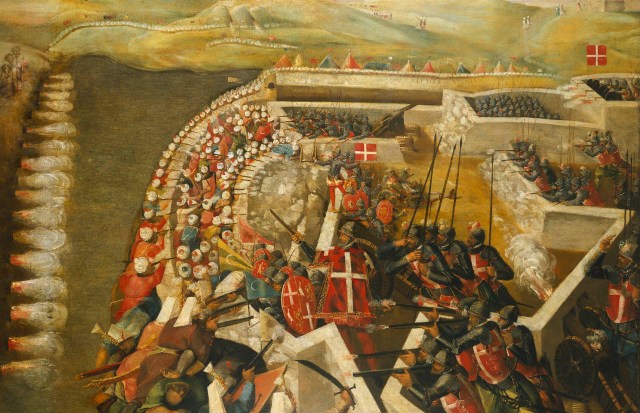
The truth of this statement was to be proved over and over again during the next few months. The Turks were now so enraged by the Christians that any instinct of chivalry which might once have animated their commanders had long since disappeared. Mustapha and Piali both felt equally at fault for the long delay in front of St. Elmo; this small and relatively unimportant fort should have fallen long ago. Dragut, resigned to a long-drawn-out affair by the initial bungling of the Sultan’s commanders, had now become as adamant as the admiral and the commander-in-chief that the siege of St. Elmo should never be abandoned.

On the night of June 14 a Turkish spokesman was sent out into the ditch between the ravelin and the fort to call out to the defenders that Mustapha promised a safe passage to any who wished to leave that night. By his beard, and by the tombs of his ancestors, the Turkish commander-in-chief had sworn that any who wished to retire might now leave the fortress unmolested. It is just conceivable that, had the offer been made a few days earlier, there were those among the younger Knights and the troops who would have accepted. But, by now, they had all resolved to die where they stood. Furthermore, although they knew they could not hold out much longer, their successes had been so great that their morale was high. Merely by looking down at the mounds of corpses that fringed their beleaguered garrison they could see what their defense was costing the Turks. Mustapha’s spokesman was forced to retire under a hail of arquebus shot. There would be no more deserters from St. Elmo.

Throughout the following day the increased bombardment showed that another attack was impending. From Mount Sciberras, from Tigne, and from the re-established heavy batteries on Gallows’ Point the fire never ceased. Deafened, stunned, and tired almost beyond caring, the defenders prepared for the inevitable assault. If the bombardment was intended to demoralize them, it did not succeed. It merely served to put them on their guard and to make them all the more ready for the attack when it came. The night of the fifteenth was also broken by minor raids. The enemy had clearly grown confident and was beginning to feel that the prize lay within his hands.

La Valette, listening and watching from across the water, must have felt that the end was near. St. Elmo had already held out beyond any reasonable expectation. It might be tomorrow, or it might be the day after, but it was inconceivable that the garrison could survive much longer.

The attack began at dawn, on Saturday, June 16. The island was still damp from the night air and the headland was scented with the sea when the flares ran like fuses along the ramparts of St. Elmo. The defenders had noticed the enemy troops massing. They had heard the high voices of the mullahs calling upon the faithful to die for paradise.

One of the saintly murderous brood
To carnage and the Koran given . . .

stood on the high ravelin and cried out that in the holy war between the true believer and Christian all who fell with their faces toward the enemy would inherit the perfect world promised by the Prophet. There in that paradise were wells of clear spring water. The date palms were shady in an eternal afternoon, and the juice of the grape (forbidden to the faithful in this mortal life) would refresh them. There divinely beautiful houris would welcome such warriors to their arms, and the climax of love would last a full ten thousand years.

Vowed and devoted to their other heaven, the Christians awaited them. They heard the dull booming of the tambours and the brassy call of trumpets. They looked seaward and saw that the whole Turkish fleet had crept up during the summer night and now lay like a ring around the point. At such a moment even the bravest felt fear stick dry as a crust in their throats.

Nearly 4,000 Turkish arquebusiers spread themselves in a great curve from the water on Maramuscetto, across the dip below Mount Sciberras, over toward Grand Harbor. They opened a devastating fire on the embrasures of the fort. Ladders, scaling irons, and improvised bridges made of masts and spars were dragged down into that ditch where the bodies of so many of the flower of the Sultan’s army were already black and bursting from summer heat. Piali’s fleet opened fire as the light spread over the water. The sun, rising behind the ships, cast the shadow of their hulls and sails across the sea. Within minutes of this naval bombardment, Mustapha’s gunners on Mount Sciberras opened up with their 60-, 80-, and 160-pound shot. North and south the batteries on Tigne and Gallows’ Point began their cross fire against St. Elmo.

Huddling against the walls, taking shelter behind improvised barricades, the defenders awaited the onslaught. They had fire hoops and incendiary grenades, boiling cauldrons and trumps, piled ready by the embrasures and behind the threatened breach of the southwest wall. Only two nights before, La Valette had managed to reinforce them with a convoy of these incendiary fireworks. He had also sent further supplies of wine and bread, for St. Elmo’s bakery had been destroyed and water was running short.

For this attack — the attack that Mustapha felt sure would deliver the fortress to him — the Janizaries were held back in reserve. In their place, and for the first assault wave, he sent in the Iayalars. They were a fanatical corps, without the Janizaries’ iron training as soldiers but with a complete disregard for life — their own or any other. Maddened by hashish, the Iayalars were a fervid sect of Moslems, deriving their blind courage from a blend of religion and hemp. Like the berserkers of the North, the Iayalars induced a deliberate frenzy which made them oblivious to everything but the lust to kill. They were “picked men, clothed with the skins of wild beasts, and having as head covering gilded steel helmets. The surface of their skin-tunics was enriched with varying designs and characters in silver. They were armed with the round shield and scimitar . . .”

In a frenzied wave, seeing only the line of the battlements before them and paradise beyond, the Iayalars came down for the assault. The pupils of their eyes were like needles, their salivaed lips held only one word: “Allah!”

On the lips of the Maltese was also the word “Alla,” for in their language the Chrisitan god was called the same. Behind the ramparts, and in the breach of the southwestern side, the Knights, the Spanish soldiers, and the Maltese waited.

“In many, nay, in most campaigns, personal feeling enters but little into the contest . . . At Malta the element of actual personal individual hatred was the mainspring by which the combatants on both sides were moved: each regarded the other as an infidel, the slaying of whom was the sacrifice most acceptable to the God they worshipped.” If the concept of a jihad, or holy war, had originated with the Moslems, it was something that the Christians had also adopted many centuries before. The horror, and the implacable nature of the wars of religion, was not only that the soldiers on each side believed heaven awaited them if they fell in battle, they also believed that they owed it to their adversaries to send them to hell.

Beaten back by the defenders’ fire, the Iayalars retired, leaving the ditch filled with bodies. They were followed by a horde of Dervishes. Mustapha was keeping back his crack troops until “the religious” had laid a gangway to St. Elmo with their corpses. At the last, he looked toward the Janizaries and gave the order for the pride of Islam to advance. It was two days since the lieutenant-aga, the general of their corps, had been killed by a cannon ball fired from St. Angelo. Now was the time for the “invincible ones” to redeem his death with Christian blood. Sons of Greeks, Bulgarians, Austrians, and Slavs, these converts to Islam swept forward and on up to the breached walls. Time and again though they charged, they too faltered and broke before the defenders’ fire.

The deadliest toll was taken by a small battery on the southern side of the fort. From this angle the gunners were able to enfilade the advancing enemy. Despite the Turkish shot directed against them, they maintained their murderous rate of fire all day. St. Angelo, too, aided the defenders. The gunners on the high cavalier of the fortress kept sweeping the ranks of the Moslems with a long traversing fire. The cannon blew great black holes in the white surge of the advancing enemy.

Throughout the action both Dragut and Mustapha Pasha stood in full view on the ravelin and supervised the attacks. Dragut was busy everywhere. With his own hands the old corsair laid the guns, advised the master gunners, and directed the bombardment. While Janizary or Iayalar attacked in one section, Dragut made sure that, in the area where there were no Moslem troops, the shot fell thick and fast. The minute and assault weakened and the troops withdrew, he shifted target and kept up an unrelenting bombardment against the weak positions. St. Elmo was like a rock lashed by a hurricane.

It was not until night fell that the attack was called off. It seemed incredible to Turk and Christian alike that so small a fort could have resisted so long. One hundred and fifty of the garrison were dead and many more wounded, but the Moslem casualties littered the whole ground in front of the scarred and tottering walls. A roll call made this same night showed that the Sultan’s forces had lost over 4,000 men in the past three weeks, nearly 1,000 of them in that one day’s attack.

The gallant De Medran was among the dead of St. Elmo. Pepe di Ruvo (the Knight who had calculated the number of shots fired against the fort during the siege) was also killed. De Miranda had been seriously wounded. If June 16 was a victory it was a Pyrrhic one. Small though the losses of the defenders were, they could not afford them. The time was not far distant when Dragut’s battery on Gallows’ Point would prevent any reinforcements reaching them. The moment that happened, all was lost.

For the first time since the beginning of the siege, La Valette refused to order any more men or Knights to reinforce St. Elmo. He called for volunteers. Thirty Knights and 300 soldiers and Maltese from Birgu came forward. They offered themselves for certain death.

— Ernle Bradford

Posted in Books Publishing and Writing, History, Philosophy and Religion | Tagged , , , , , , | 3 Comments

Juxtaposin’: Les Femmes Déformées

Fabrizio del Wrongo writes:

Posted in Art | Tagged , , , , , | 1 Comment

Reading du Jour: An Interview with Musa al-Gharbi

Paleo Retiree writes:

Excellent stuff from Columbia U. sociologist Musa al-Gharbi. Why were social scientists so baffled by Trump’s victory? Did people who voted for Trump have any rational reasons for doing so? What might be done about the left/lib bubble American social scientists inhabit?

Excerpt:

We were talking about Kanye West. Or just black conservatives in general. So there’s this idea that if you don’t tow the line, the progressive line for a lot of race issues, then you’ve “internalized racism.” This is an idea that actually goes back to Marx — he called it “false consciousness.”

But the problem with false consciousness, especially as a social-scientific concept, is that it isn’t falsifiable: You go up to someone and say “You have false consciousness because you believe this or endorse this,” and they go “I don’t have false consciousness: Here are the reasons I come down here, here are the reasons I believe this,” then you say “Aha! That’s just what someone with false consciousness would say.” So it’s not falsifiable. By Popper’s definition of science, this kind of thing is just not science.

And they do this with a lot of blacks, especially black conservatives. Someone might argue persuasively, “Here’s why I believe what I believe.” And how are they responded to? “You’ve just internalized racism. You’ve sold out to the man. You’ve lost your way.” I mean, I got kind of annoyed because Colbert did this thing on Kanye. And he was basically making the same kind of argument: Kanye’s black, he’s a rapper, he shouldn’t support Trump. To have a white person tell a black person how he should feel about something, on the basis of his race no less, is crazy. For a progressive, or someone who identifies as a liberal, to presume to be able to do that to a black person is even worse. But it’s not as uncommon as one might think.

Posted in Politics and Economics | 2 Comments