Kirsten Mortensen’s New Novel

Paleo Retiree writes:

kirsten

“When Libby Met the Fairies and her Whole Life Went Fae” by friend-of-this-blog Kirsten Mortensen is like a chicklit version of a Tom Perrotta or Nick Hornby novel — a likable, touching and appreciative seriocomic look at human-scale lives and (mostly) familiar predicaments. It’s a lightweight, quickly-read entertainment, but it’s something a little more than that too.

Let me make a confession that will no doubt wreck my otherwise unassailable Alpha-male status: Over the years I’ve looked at a lot of chicklit. Hey, a new literary genre was a-borning — and how often do you get a chance to witness that? Plus: I’ve learned a lot about women by sampling the entertainment that many of them enjoy. (The two chicklit novels I can sincerely recommend — Mortensen’s book makes three — are two of the genre’s earliest entries: Laura Zigman’s “Animal Husbandry” and Helen Fielding’s “Bridget Jones’s Diary.” They’re genuinely fun.) The good side of chicklit: it’s a fine platform for talented ladies who want to show off their charm, their brains, their style and their spirit. Some of the bad sides of chicklit, at least as the commercial-publishing world often puts it out there: the books do get formulaic; they peddle and cater to narcissism, not the most endearing of traits; and the character types you run into are limited and predictable. How many sassy and amazing “Sex in the City”-style groups-of-friends can one world bear?

Mortensen’s novel, which is indie-published, brings a lot of freshness to the table. Its story is a whimsical romcom tale of attempted rebirth, but it has an errant, wobbly distinctiveness. Her heroine Libby — a recently-divorced biologist who’s hoping to make a new life for herself as an organic farmer — is a smart and resourceful modern woman, but she’s also got a lot of plain-Jane, nice-girl qualities too, as well as a nerdy and ditzy side. (Not an unusual combo, I’ve found. You may have grown up and gone to school with girls like Libby — I certainly did.) And Mortensen has given the book an unusual setting: the action takes place in western New York State, and the regional details are a joy. You can’t get much further from the world of “Sex in the City” than Dansville, N.Y. (Trust me on this — I grew up a few miles from Dansville.)

Mortensen is charmingly persuasive about what a mess day-to-day life tends to be — about the way, no matter how streamlined and focused our intentions, we inevitably wind up floundering our way through — as well as about women’s internal processes: the rhythms and patterns of how they feel, think, and sense things. (She’s also frank and relaxed about all this — no showing-off, and no politicizing of what doesn’t need to be politicized.) Libby’s job is sort of absurd, yet she’s OK with it, mostly, and besides she needs the money. She’s been cheated-on in marriage, she’s uncertain about her dreams, she’s torn between different men, she can’t bring herself to tell off a bossy older sister, and yet she keeps moving forward. When a teenaged niece arrives on her doorstep — and especially when fairies and elves start showing up and sharing gardening advice — things proceed to spiral out of control. In the midst of the chaos, is a fulfilling new life even a possibility?

Mortensen develops her story in semi-farce, semi-Rube-Goldberg fashion. More than once I found myself thinking, “This is like early Zemeckis and Gale, only female.” By which I meant: where Zemeckis and Gale keep piling on the frenetic action and cleverness, the narrative house of cards that Mortensen builds consists of situations, feelings, emotional pulls and tugs, and doubts. (She has her own brand of fluffily giddy ingenuity.) And, unlike many of the chicklit authors whose books I’ve thumbed through — who seem more interested in writing yakky Me!-Me!-Me! magazine pieces than in creating believable fictional worlds — Mortensen has the real fiction-creator’s spark: the characters (even the male characters) are convincing, and the situations (even at their most contrived) are alive. She has a beguiling, blessedly unlabored touch as a prose stylist too. From sentence to sentence it’s really fun accompanying Libby’s mind, sensations and feelings.

Warmly recommended for anyone in the mood for high-quality, down-to-earth light entertainment.

Posted in Books Publishing and Writing | Tagged , , , , | 11 Comments

Thom Mayne Must Be Stopped

Blowhard, Esq. writes:

Last weekend, I was finally able to get up close and personal to Thom Mayne’s Pritzker prize-winning (i.e. the “Nobel of architecture”) CalTrans 7 District Headquarters located across the street from City Hall in the heart of downtown L.A. To orient you, here’s an unedited Google Maps screencap:

DTLA map Continue reading →

Posted in Architecture, Photography | Tagged , , , , , , , , | 26 Comments

Two Sports Movies From The 1970’s

Sax von Stroheim writes:

One’s a masterpiece, one’s an interesting-if-not-exactly-good little movie.

First the masterpiece:

 Slap Shot (George Roy Hill, 1977)

Image

Starring Paul Newman and this suit

A vulgar, American comedy from one of the 70’s most underrated filmmakers. (Considering the “classic” status of Butch Cassidy and the Sundance Kid and The Sting, one would think he’d get more credit, but the appeal of those movies is usually put down to the dual star power of Redford and Newman). Slap Shot is a perceptive and compelling look at guys, sports, working class towns, class issues in general, economics, homophobia, violence-as-spectacle, and the connections among all of those things. Kind of reminds me of certain Renoir movies (especially Boudu Saved from Drowning) in the way that some Raoul Walsh films (like Sailor’s Luck) remind me of Renoir: it has a dense but lively mise-en-scene that suggests the messiness of life in all of its glory. The look Paul Newman’s wife gives him right at the end of the movie – in which she realizes how sad it is that this guy will always remain essentially clueless – is one of the great looks in American cinema.

Below the Belt (Robert Fowler, 1974 but released in 1980)

Image

Jane O’Brien, a genuine wrestler, as the movie’s heavy: Terrible Tommy

Robert Fowler made only one movie, and it’s about women’s wrestling. It’s based on Rosalyn Drexler’s autobiographical novel, To Smithereens, and though it’s quite amateurish – about half of it seems to be made up of montages set to songs that explain the action and themes of the film, as if no one trusted the filmmaking itself to do those jobs – it’s also very honest and lived-in, full of details that feel like they’ve been taken directly by life. The casting is great: a mix of New York City theater actors and people that look like they were pulled from real wrestling circuits (it makes for a great gallery of hard luck faces). It’s one of those little movies that’s winning not because it’s made with much talent, but because it seems very human, without any of the artifice that you get even when – or, maybe, especially when – a filmmaker tries to consciously, intellectually strip away the artifice

Both movies are currently playing on Netflix Watch Instantly.

Posted in Movies, Sports | Tagged , , , , , | 9 Comments

The Honey of Ikaria

Paleo Retiree writes:

honey_bottles01

Remember that New York Times article from a few months ago about the world’s longest-lived people? They’re the inhabitants of Ikaria, a small Greek-owned island in the Eastern Aegean, just off the coast of Turkey.

After gathering all the data, [the researcher] and his colleagues at the University of Athens concluded that people on Ikaria were, in fact, reaching the age of 90 at two and a half times the rate Americans do. (Ikarian men in particular are nearly four times as likely as their American counterparts to reach 90, often in better health.) But more than that, they were also living about 8 to 10 years longer before succumbing to cancers and cardiovascular disease, and they suffered less depression and about a quarter the rate of dementia. Almost half of Americans 85 and older show signs of Alzheimer’s. (The Alzheimer’s Association estimates that dementia cost Americans some $200 billion in 2012.) On Ikaria, however, people have been managing to stay sharp to the end.

Besides the expected easygoing Mediterranean lifestyle — “We wake up late and always take naps,” says one of the island’s doctors — to what do the people of Ikaria owe their longevity and their good spirits? There’s hummus, goat’s milk and olive oil … A traditional, community-oriented level of development … A tea made from local herbs …

And then there’s the honey of Ikaria. “They have types of honey here you won’t see anyplace else in the world,” the doctor interviewed in the article says. “They use it for everything from treating wounds to curing hangovers, or for treating influenza. Old people here will start their day with a spoonful of honey. They take it like medicine.”

This was something that I — as a lover of good food who always buys his honey wild, who adores inexpensive luxuries, and who by the way wouldn’t mind enjoying a long and upbeat life — couldn’t resist exploring. So off I went and placed my order.

Verdict: It really is extraordinary, and in ways both strange and wonderful. For one thing, the bottles arrived in a sticky, semi-leaky state. They weren’t cracked but they didn’t radiate “FDA-approved, American-supermarket-level of hygiene” either. Those Ikarians really don’t seem to worry about a lot of the things that we who are lost in the world of modern western consumerism do.

As for the way the honey of Ikaria tastes: It’s very rich and viscous, and it has notes and fragrances that are earthy, woodsy, floral and caramely. It’s so distinctive, in fact, that I’d be wary of using it in recipes that call for honey — it’d add too much of its own character, I suspect. But as something on a dessert or in tea, it’s startlingly good. Stirred into a small pot of Greek yogurt or drizzled over some raw-milk cheese, it’s downright magnificent.

I don’t suffer from allergies, so I can’t report on whether it will cure any of those. I haven’t yet used it as a poultice, and I haven’t started taking a spoonful of it in the morning as a medicine either. As for whether or not I’ll live forever ….  I’ll try to remember to get back to you in a few decades about that. So far, though, the honey of Ikaria has demonstrated ample powers as a mood-booster.

Bonus links

Posted in Food and health | Tagged , , , | 4 Comments

The Future and Magical Realism

Fenster writes:

While waiting for Crank 2 to come in to my local library, I thought I’d go to Netflix streaming and see something along the same lines.  I ended up with Miranda July’s second feature, The Future.

What, you say, I missed by at least three or four genres?  Well yes, I guess I missed the mark, but The Future was interesting and original in its own way.  No doubt a tad more twee than Crank 2 but worth a viewing.

The Future centers on a couple in their mid-thirties mightily resisting the idea of growing up.

His 'n her laptops; his/her 'n his/her hairdos

His ‘n her laptops; his/her ‘n his/her hairdos

They’d be really unsympathetic if they did anything.  As it is, for at least the first half of the movie, they do little, or seem to be sleepwalking when they do commit to action of a sort, so it is hard to be all that hard on them.  The action, such as it is, revolves around July’s character straying from the relationship and maybe coming back to it.

Oh, and there’s a talking cat, an injured stray housed in a shelter.  The couple has been told that they may have it on adoption, but that they must come to pick it up exactly when it has recovered in a month or else it will be euthanized.  You might say this device, which forces the two to consider what it means to make a commitment, propels the plot forward.  And if you did you would be technically correct.  It’s just that there is not that much plot to propel and in turn not much force is needed to propel it.

I jest, and there is something awful and cringeworthy about the whole proceeding.  But the film isn’t like much else, and seems very much to spring from July’s head. And there’s something to be said for that.  At a time when so much A-level talent goes into boosting production values on adolescent claptrap (see: Tarantino), you almost want to give July extra points for originality, even if the underlying talent is at best at the B- or C+ level.

Unlike July’s first film, which seemed satisfied luxuriating in indie quirkiness, this one works to dig a little deeper, too.  Mostly, this involves an unexpected shift to magical realism in the film’s second half.  I won’t do the details: suffice it to say that, as an example, one of the main characters figures out how to stop time, and takes advice from a talking moon in the sky.  Does it work?  Well, yes, in a way.  I mean, it is at least a way out of what threatened to be a cul-de-sac, plot-wise.  Magical realism can do that, in a pinch.  Don’t know where to go to tie things up?  Bring in the magic.

Which brings me after this set of digressions to the point, more or less.  What do you make of magical realism in films?  Better yet, what is it?  Is it the same thing in film as it is in literature, or something different?  When is it serious and when an affectation?

When academic types ruminate on magical realism, they tend to think first about literature, not film, and to focus mostly on Spanish-language authors like Marquez.   That lets the academics fit the genre comfortably into what Stephen Slemon calls post-colonial discourse.  This renders the concept political from the get-go.  As such, it is hard to square with a more expansive use of the term as applied to something as day-to-day as Family Guy.  So from one point of view, the idea is bound up with pomo post-colonial thinking; at the other extreme, a wacky cartoon serves as an example of the form.  That’s quite a stretch.

It’s probably the case that different artists put magic and realism together in different ways for different purposes, and no great thing is to be gained by trying to shoehorn everything into one all-purpose definition.  Still, despite his stilted academic style, Slemon is on to something when he writes:

The term “magical realism” is an oxymoron, one that suggests a binary opposition between the representational code of realism and that, roughly, of fantasy. In the language of narration in a magic realist text, a battle between two oppositional systems takes place, each working toward the creation of a different kind of fictional world from the other. Since the ground rules of these two worlds are incompatible, neither one can fully come into being, and each remains suspended, locked in a continuous dialectic with the “other,” a situation which creates disjunction within each of the separate discursive systems, rending them with gaps, absences, and silences.

That’s all a little high-toned for me, and what with the language about “the dialectic with the other” it is well suited to post-colonial thinking.  But there is something to the oxymoronic quality between the magic part and the realist part.

As David Isaak has written:

The brilliant psychiatrist Stanislav Grof describes the boundaries of states of consciousness as being similar to the beach. On the shore, everything is stable, and beyond, out in the gentle rise and fall of the ocean, everything is stable in another way, but the real action is in the surf zone, where the two worlds intersect. That uncertain, unpredictable, unmappable zone is where Magical Realism reigns.

Cinema isn’t at home in the surf zone. The surf is fluctuating, moving, indescribable, beyond rules. This is a comfortable region for the writer, with all perceptions coming through the consciousness of characters, or at least a narrative voice; but it is difficult territory for the presumed objectivity of the camera. Therefore, I believe the key element in Magical Realism in film is an acceptance of ambiguity that is rare in film. This can range from a powerful but unexplained undercurrent of meaning behind realistic events, to intersections or intrusions of another order of reality.

To put it in more practical terms, for me Magical Realism in the cinema consists of ambiguous stories where the peculiar or magical elements could, in principle, be explained away; yet preserves a sense of purpose and portent that goes beyond the surface meaning.

I like the notion that film is not that much at home in the surf zone and that novelists like that zone better.

Dramatists, too.  I wonder it if it coincidence that some of my favorite examples of magical realism in film have direct ties to theater, which is more at home in the surf zone.  The Future is itself an adaptation of July’s performance work.  Moonstruck and the way-under-rated Five Corners were both written by the dramatist John Patrick Shanley.  And the wonderful Atlantic City, which has its share of magical realism (albeit understated) was written by the dramatist John Guare.  These magical realism films work for me quite well, and I think it is because they are subtle about introducing the magic, blurring the line between film and theater in a pleasant way.

Of course, the magical realist film that has made the biggest splash recently is Beasts of the Southern Wild.  I liked it, but understood its detractors, too, who often found it patronizing in, well, a post-colonial kind of way.  Here’s an “unrepentant Marxist”, Louis Proyect, arguing death to magical realism:

After twenty minutes of “Beasts of the Southern Wild”, I walked out of Lincoln Plaza Cinema muttering under my breath about how much I hate magical realism, especially in movies.

I sympathized with the fatwa against Salman Rushdie, not so much from the blasphemy angle but on the aesthetics. Back in 2005, there was a review . . . of Salman Rushdie’s latest, “Shalimar the Clown”. I figured that the novel had to be bad from the get-go if for no other reason that it had something to do with clowns. Clowns and magical realism are a particularly toxic combination, like washing down crushed glass with lye.

Ouch.  I suppose there’s nothing special about magical realism that intrinsically makes for a satisfying work.  It’s all in how it’s done.

Posted in Movies | 2 Comments

Quiz o’ th’ Day

Fenster writes:

On April 13, 1945, the Berlin Philharmonic played Bruckner’s Fourth Symphony.  At the exits, members of the Hitler Youth handed out:

1. an early version of the nicotine patch

nazi1

2.  Eva Braun inflatables

oc snafu nazi boobs

3.  small anti-gravity devices

nazischematic

4.  condoms

s640x480

5.  cynanide tablets

6253

Posted in Uncategorized | 4 Comments

Notes on “Crank 2: High Voltage”

Fabrizio del Wrongo writes:

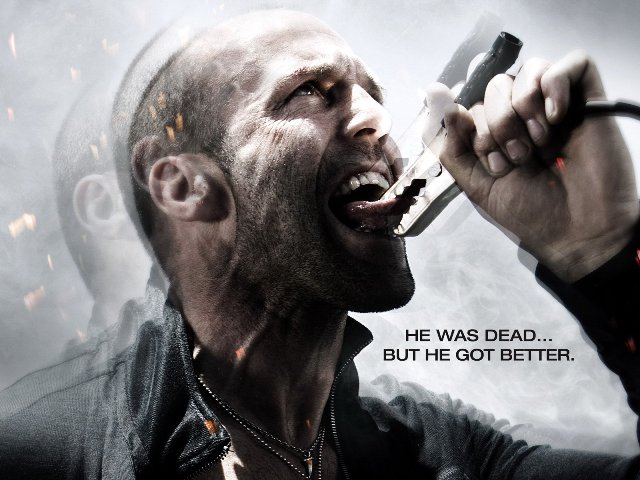
crank_2_wallpaper_1

I think “Crank 2” is better than the original. It may also be one of the best slapstick comedies of recent years. (It suggests Frank Tashlin on speed or “Pee Wee Herman’s Big Adventure” as recounted in pantomime by a ‘roided-out, perpetually masturbating frat boy.) No recent movie is as in touch with the culture or as willing to blow it up for the sake of ridicule, ethnic humor, and dick jokes. Are writer/directors Mark Neveldine and Brian Taylor commenting on the culture or simply running right over it? Is there a difference? Whenever Statham sticks his finger into a light socket or rubs his crotch against an old lady in order to jolt himself into action, we’re reminded of the often crude, mechanistic nature of action movies. It’s not a critique, exactly, but there’s an integrity to the completeness of its submission to base drives and impulses — a submission which itself speaks to the crass character of the culture. Depending on your disposition this kind of thing will seem either dangerously reductive or exhilaratingly savage. But however you take it it’s not simplistic: “Crank 2” is dense, cohesive, and arrhythmic in a way that feels planned out from conception. I imagine that Neveldine/Taylor rely on storyboards or thickly annotated screenplays, because nothing in their movies feels arbitrary, despite the wild-ass nature of the content and presentation. The result is a density of sensation I’d compare, with some hesitation, to certain hip hop records of the late ’80s and early ’90s — “Paul’s Boutique,” for instance. Have movies finally caught up to music, video games, and graphic design in their ability to provide an immersive, collage-like, and mostly non-linear media experience?

Posted in Movies | Tagged , , , , | 15 Comments

Inserts

Paleo Retiree writes:

A pet theory of mine is that our health-care crisis would be 90% solved if people would 1) lose some weight, 2) quit the cigarettes, 3) knock off the packaged foods, 4) take a daily walk, 5) act their age, and 6) quit sticking the wrong things up their butts.

Posted in Food and health, Humor | Tagged , , | 3 Comments

Ahead of his time

Fenster writes:

Blowhard Esq. is especially fond of Montaigne.  Does he know Montaigne invented Craigslist?

Posted in Uncategorized | 1 Comment

The Constitution is SO 200 Years Ago, You Guys

Blowhard, Esq. writes:

constitution-burning1

Georgetown University law professor Louis Michael Seidman, author of the forthcoming book On Constitutional Disobedience, recently had an op-ed in the NYT titled “Let’s Give Up the Constitution” that’s so egregiously stupid and poorly argued that I feel a response is necessary. OK, a response from me isn’t that necessary, but I’m barreling ahead anyway. FULL DISCLOSURE: I got a C in con law so you should probably ignore everything I say. Assuming you’re not wise enough to go elsewhere, following is the op-ed in full interspersed with my sarcastic ranting studied commentary. Continue reading →

Posted in Education, Law, Politics and Economics | Tagged , , , , | 15 Comments