Some Oscar Counterprogramming

Sax von Stroheim writes:

I was thinking of writing up a snarky take on the Academy Award nominations, but then decided I didn’t really want to participate in that even as a joke. (I believe the official Uncouth Reflections editorial policy on the Oscars is, “Who cares?”). So here’s my list of five movies from last year that (a) I enjoyed immensely and (b) were in no danger of ever being nominated for any kind of award.

Contraband (Baltasar Kormakur, 2012)

An American remake of an Icelandic thriller, directed by the star of the original movie. It combines the best parts of Euothrilllers – a lack of sentimentality, muted melodrama, a sense of place – with the best parts of Hollywood thrillers – flamboyant bad guy performances (here given by Giovanni Ribisi and Diego Luna) and Mark Wahlberg.

Resident Evil: Retribution (Paul W.S. Anderson, 2012)

Egghead reason: a formally playful exploration of the way contemporary 3D/CGI technology has infected the way we think about the world. Non-egghead reason: Milla Jovovich in bondage gear killing zombies.

Alps (Yorgos Lanthimos, 2011)

Lanthimos made a film called Dogtooth that a lot of folks other than me liked. Dogtooth, a European art house movie, made in 2009, took a daring and controversial stand against the bourgeois patriarchy (like just about every European art house movie from the last 60 years). Alps, though, moves beyond sociology to something really dangerous and daring – the idea that even our most intimate relationships might be built upon theatrical play-acting. It’s weird and wrenching.

End of Watch (David Ayer, 2012)

This is a very good Joseph Wambaugh-type look at police culture, with lots of funny/true observations and some exciting action scenes done in a well-executed version of the contemporary shaky-cam-heavy style. Most movies about L.A. police officers are about corrupt L.A. police officers, but here they’re presented as working/middle class heroes. Not perfect ones, maybe, but guys and gals driven by a desire to help people. The movie’s subject is how crime in L.A. is becoming more like crime in Mexico, and what that change is doing to the police force that’s trying to fight it.

The Vow (Michael Sucsy, 2012)

Magic Mike is the Channing Tatum movie liked by audiences and critics alike. This is the Channing Tatum movie liked just by audiences, but I think it’s the better movie. It isn’t actually based on a Nicholas Sparks novel, although it’s genre still seems to be “Nicholas Sparks Movie”. Having said that, it’s quite moving and it (surprisingly) doesn’t smooth out all of the emotional wrinkles. I’m still waiting for someone to come along to be the new Douglas Sirk – i.e., a guy or gal who turns Hollywood weepies into world historically great art. Michael Sucsy isn’t it, but in this movie he comes closer than anyone else has in quite a few years.
Posted in Movies | Tagged | 5 Comments

Moviemaking Linkage

Paleo Retiree writes:

Posted in Linkathons, Movies, Performers | Tagged , , , , , | 2 Comments

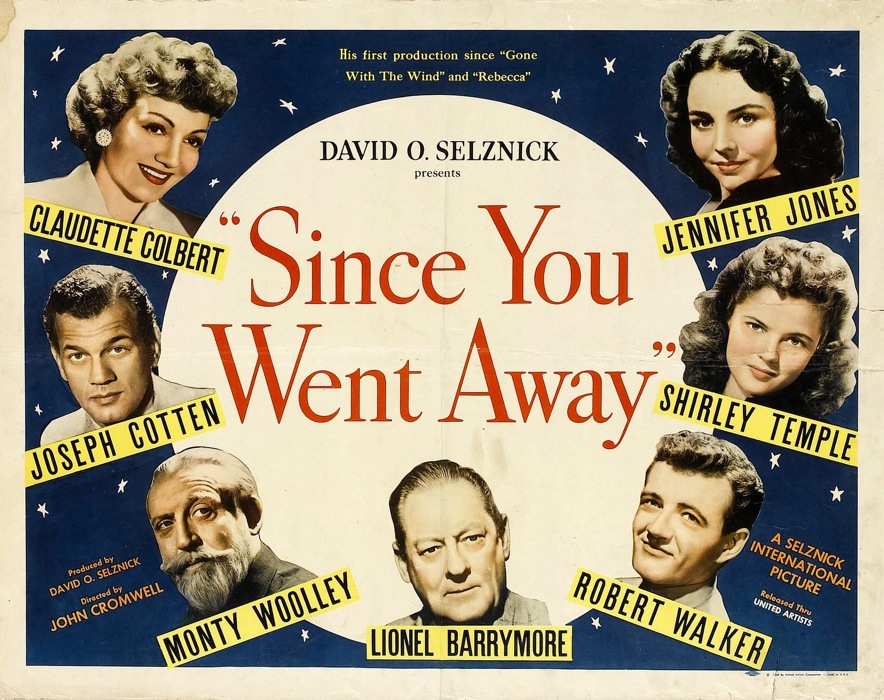
“Since You Went Away,” a Culture’s Dreams, and the Agee-DOS Dosado

Fabrizio del Wrongo writes:

1342680879

“Since You Went Away” doesn’t have a great reputation among filmbuffs, and it’s not hard to see why: it’s broad, sentimental, and downright propagandistic in its treatment of small-town American life (at nearly three hours, it’s also looooonnnngggg). This is the sort of movie that often gives intellectuals the heebie jeebies; they tend to regard it with a derision normally reserved for Sunday church services or the paintings of Norman Rockwell. But when I caught up with it recently, via the excellent DVD put out by MGM, I had no trouble being impressed by it, my own set of smarty-pants hang-ups notwithstanding. Written and produced by David O. Selznick, from a book by Margaret Buell Wilder, and directed by a host of DOS lackeys, the movie deals with the female-centered home life of the Second World War. In making it one assumes Selznick intended to give a cozier, more contemporary spin to the Scarlett-preserves-Tara sections of “Gone With the Wind,” as well as to evoke the cloistered mood of “Little Women.” He was pretty successful on both counts: as emotionally pickled as the movie often is, it feels faithfully drawn from particulars, and it holds you tight within its frame of reference.

Continue reading →

Posted in Books Publishing and Writing, Commercial art, Movies, Performers | Tagged , , , , , , , , | 6 Comments

Not My Favorite Horse Racing Movie

Sax von Stroheim writes:

Dead Cert (Tony Richardson, 1974)

It looks more exciting than it is

It looks more exciting than it is

Something the Brits do pretty well: take their decent-to-classic mystery novels and turn them into solid-to-great TV programmes and movies. It’s rare to come across one that doesn’t have at least a few redeeming qualities. So that’s why it was surprising, if not stunning, to see one, made by a “real filmmaker”, that’s so sloppy. I have no idea what drew Richardson to this material: it doesn’t seem to fit in with his other work at all. He may have been hoping it would be a hit, but he just doesn’t have the touch for this kind of thing. Dick Francis’ novel is, at best, a light entertainment: full of shallow characters and predictable plot turns. Its main virtue is its backstage tour of English horseracing. The characters are too thin for Richardson to make their inner lives very interesting (a Richardson specialty in his other movies), and he flubs a lot of the basic set-up, which makes it a pretty poor tour guide. There is some good footage of horses racing and jumping, but the editing is so jumbled that I never got a sense of what was supposed to be happening in the races themselves. The movie is spatially confused throughout, though: Richardson cuts back-and-forth from close-ups to crowded, Altman-like long shots in such a way that I was always left wondering exactly who or what I should be looking at in any given scene.

Posted in Movies | Tagged , , , | 4 Comments

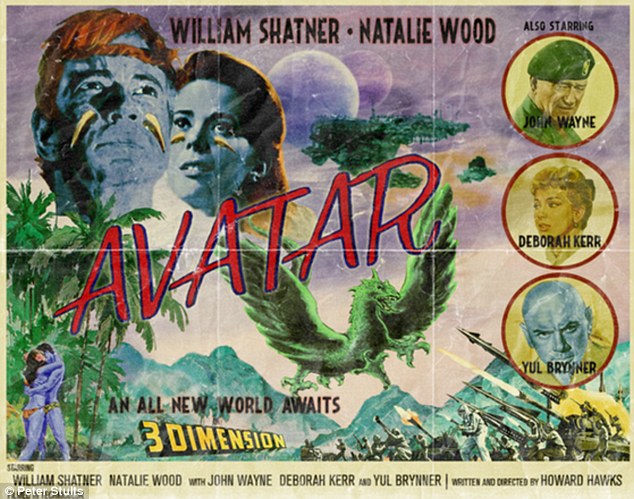
Today’s Blockbusters . . . Yesterday!

Fenster writes:

A funny and entertaining re-imagining of modern blockbusters had they been done in the 1950’s.

article-0-1164456E000005DC-72_634x499

Posted in Movies | 1 Comment

Fear of Movies

Sax von Stroheim writes:

Two new movies, both good, by any reasonable objective standard, in that they seem to successfully achieve what they set out to achieve. But one betrays a fear of commitment, a fear of failure, while the other risks kitsch to reach something sublime.

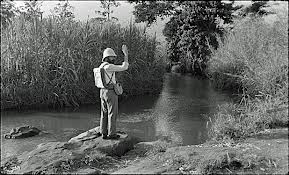
Tabu (Miguel Gomes, 2012)

This way to whimsical poignancy

This way to whimsical poignancy

It may seem ungenerous of me to criticize this small, idiosyncratic, formally playful movie for a fear of taking risks, but that’s, ultimately, how it came across to me: the whimsy and the formal playfulness standing in for a need to actually commit to making a movie – a commitment that leaves you open to failure, to looking foolish, but also makes it possible for the kind of success that doesn’t feel contrived or calculated. Gomes indicates emotion rather than attempting to express it, giving Tabu the same push-pull feel of some of Wes Anderson’s movies. Having said that, this is much better than most cover-your-ass film festival favorites: it has a sense of humor, some good performances, and a few genuinely poignant moments. I suspect high brow cinephiles have embraced it, in part, because it remains “aesthetically correct” while still delivering some basic movie pleasures.

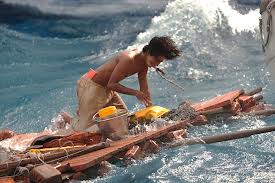
Life of Pi (Ang Lee, 2012)

More survival movie than feel good fantasy

More survival movie than feel good fantasy

A big budget, effects-driven movie, based on a popular novel that might have been chosen for Oprah’s Book Club. It’s never far from being kitsch, and could be aptly described as Avatar meets the Tree of Life. I think it ends up not being kitsch, though, because (a) Ang Lee’s direction is nuanced and sensitive and (b) it’s really fucking terrifying. This is a rare kind of movie today: a fantasy movie that looks squarely at mortality: by the end it feels closer to the Liam Neeson survival movie The Grey than it does to standard Holiday feel-goodery. Tangentially, I really appreciated that it seemed to take religion seriously, and without any kind of condescension.

Posted in Movies | Tagged , , , | 2 Comments

Lesser Dante is still Dante

Sax von Stroheim writes:

The Hole (Joe Dante, 2009)

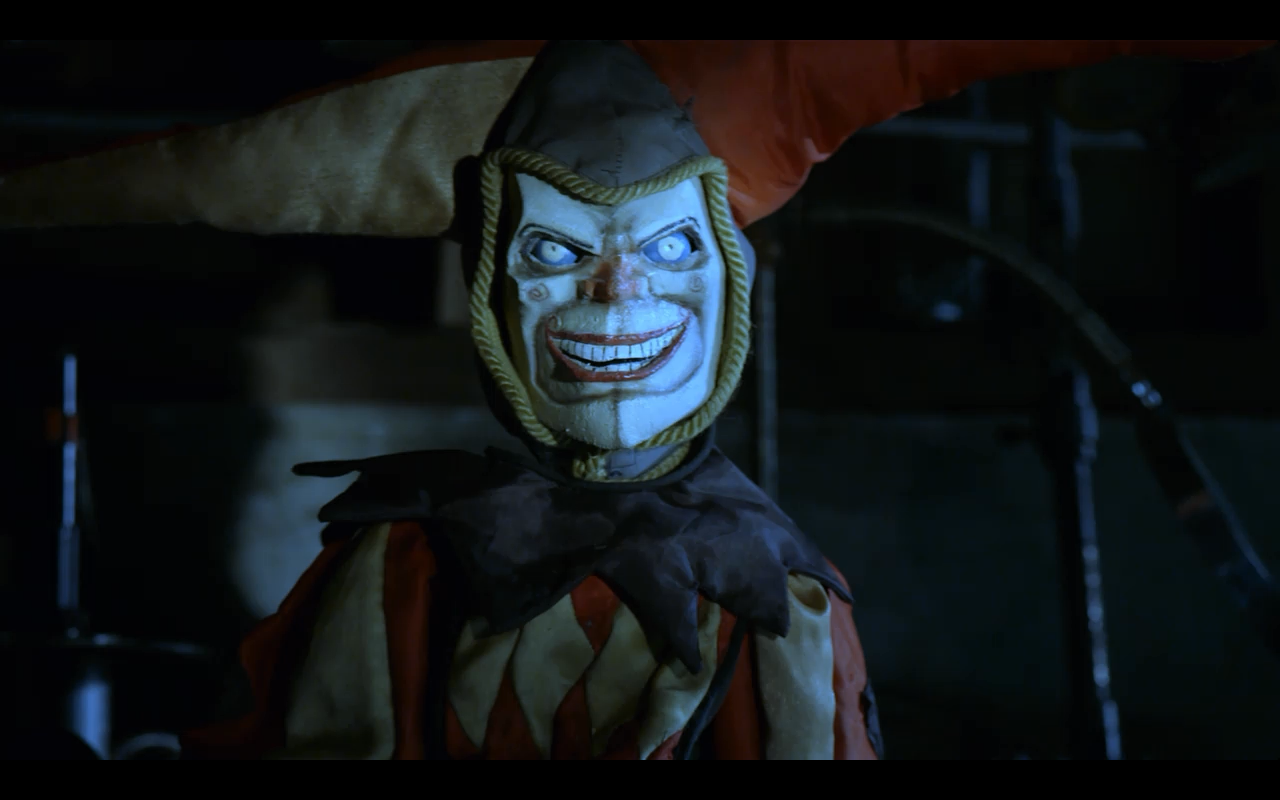
Screen Shot 2013-01-09 at 10.28.01 AM

This li’l dude is pretty creepy

I watched this in 2D off of Netflix streaming, but it seems like it would have been a fun thing to see in 3D at the movies. Flattened out, it’s enjoyable enough, with a few truly scary moments, but it’s firmly Lightly Likable rather than the Expressive Esoterica/Far Side of Paradise of Joe at his best. In 2D, there’s nothing new here. It’s almost a “Joe Dante’s Greatest Hits” type thing, with sequences plucked from his other movies: the climax pays homage to his segment of the Twilight Zone movie and I’d guess is the part of the movie that suffers most from not being in 3D. However, The Hole is almost completely lacking in the Looney Tunes-satire of most of his other movies. I did really like the creepy jester.

Posted in Movies | Tagged , , , | 1 Comment

Time, out

Glynn Marshes writes:

Smart people try to do things intelligently, but it turns out their fine brains aren’t necessarily much help, and sometimes may even get in the way.

Take the planning fallacy, for instance. Intelligent people — perhaps even moreso than the less intelligent — tend to underestimate how long it will take to complete a task, according to Nobel Laureate and Princeton psych prof Daniel Kahneman.

Kahneman co-coined the term “planning fallacy” in 1979. Other smart people have since piled on with theories about why we fall victim to it: it’s “optimistic bias,” they say, or “focalism,” or “authorization imperative.” Oh my.

But maybe the real culprit is the nature of time itself.

Or more precisely, the way time isn’t space, and yet we conceive of time in spatial terms.

We think of it as a vessel, with dimensions — a vessel we can fill with stuff.

But it’s not a vessel. Not exactly. Perhaps because it’s invisible — perhaps we need to be able to see something to really ascertain its dimensions. Time is a chimera, therefore, measurable yet also an abstraction, an idea.

It’s easy to know how much stuff I can fit into a shoebox, but offer me 10 minutes of time and the farthest wall seems unreal. I can’t tell exactly where it is . . . it seems negotiable.

And while you might say — fancifully — that a shoebox full of family photos contains more space than a shoebox that holds, merely, a pair of shoes, there’s nothing fanciful about the difference between 10 minutes spent doing something meaningful and 10 minutes of housework or running errands or surfing cable TV stations.

You see? Time is different.

And we’re suspicious of people who overstate their abilities to ration time. We view such a person (if he even exists in real life, which I doubt) as unbalanced, inhuman. Or as a fool. “Think of the time I save,” sings the time-study man in the musical–

At breakfast time I grab a bowl.
And in the bowl I drop an egg.
And add some juice.
A poor excuse for what I crave.
And then I add some oatmeal too and it comes out tasting just like glue.
But think of the time I save!

–and we laugh at him. The fool!

And yet, our time-study man is also The Pajama Game‘s hero, the love interest. Managing time well, it seems, is something of a manly art, whereas running short on time comes across as spacey and girlish.

(He shows up on time for their date; she is still upstairs fussing with her make-up.)

I’ve noticed one person in particular who seems never to fall prey to the planning fallacy. He is also never hurried — and in being unhurried epitomizes, to my eye, something fundamentally masculine . . . and it occurs to me: perhaps it is masculine because being both unhurried suggests or overlaps with a kind of physical courage. Because insofar as time does share something in common with a shoebox, the far wall is death . . . and facing death calmly is emblematic of masculine courage, no? “Today is a good day to die,” says the warrior on the morning of the battle . . .

And yet how much simpler things would be if time were less . . . protean. If its signposts were not dreams in front of us and ghosts behind but concrete things, things that stub a toe . . . how much less time we would lose, without noticing how we’ve lost it . . .

Posted in Personal reflections | 2 Comments

Linkathon

Paleo Retiree writes:

Posted in Art, Linkathons, Politics and Economics, Sex | Tagged , , , , , , , , | Leave a comment

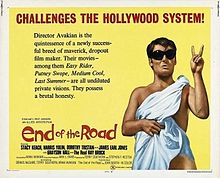
End of the Road (Aram Avakian, 1970)

Sax von Stroheim writes:

My list of “Films that Belong to an American New Wave that Didn’t Really Exist” includes De Palma’s Greetings and Hi, Mom!; Norman Mailer’s Maidstone; Robert Downey, Sr.’s oeuvre; Shadows, Faces, and Opening Night; Robert Kramer’s Milestones; Mickey One, The Connection, Dusty and Sweets McGee, The Swimmer, and David Holzman’s Diary; various works by Andy Warhol; and, now, Aram Avakian’s adaptation of John Barth’s novel End of the Road.

220px-The_End_of_the_Road_FilmPoster

Rated X for chicken screwing

Avakian’s movie captures the splintering of the American consciousness at the end of the 1960’s even as it was happening. Devastating, daring, and surprisingly all-of-a-piece, with James Earl Jones, Stacy Keach, and Harris Yulin all giving, early in their careers, what seem like career high performances. Dorothy Tristan is great, too: she seems like an actress who was made for this era. Keach plays an academic suffering from heavily symbolic catatonia and Jones is the deranged psychiatrist who tries to cure him. Terry Southern produced and wrote the screenplay, and it feels it. A favorite movie of Steven Soderbergh (he asked Warner Brothers to finally release it on DVD): it does remind me of Soderbergh’s early, more boundary-pushing work, from before he developed a severe fear of movies.

Posted in Movies | Tagged , , , , , , | 3 Comments