Excellent Email Subject o th Season

Fenster writes:

Messiah Returns to Brandeis

Join the Brandeis community for our annual community sing-along of George Frideric Handel’s stunning oratorio MESSIAH. It is led by students from the Brandeis-Wellesley Orchestra and the Brandeis University Chorus under the direction of Professor James Olesen. This year, there will be a special finale:Brandeis President Fred Lawrence will conduct the “Hallelujah Chorus.”

And you thought he was coming back to Missouri!
Posted in Philosophy and Religion | 3 Comments

“The Sadist”

Paleo Retiree writes:

sadist01

Ultra low-budget — shot in two weeks for $33,000 —  b&w psycho-killer thriller with Arch Hall, Jr. as the nutcase, written and directed by James Landis, and set almost entirely in an automobile junkyard in the California desert. It’s partly a bad-movie hoot, but it also has a lot of scrappy appeal, and it works up some effective tension of a surprisingly harsh (for its early-‘60s era) kind.

Hall wears tight jeans with a big belt buckle, swigs soda pop, shows off his pompadour haircut and gleaming teeth, and sneers, postures and smiles threateningly in amazingly exaggerated ways — he was a either a truly terrible actor, over-trusting of his director, or an avant-garde genius. The Question Lady and I found it impossible not to like and enjoy him, though — Hall had some undeniable kind of teen-exploitation-movie, lower-half-of-a-double-bill star power. And you could certainly never accuse him of not having gone balls-out. The other actors do well enough — and Marilyn Manning, as the psycho’s white-trash g.f., is better than that. One of the potential victims is played by Helen Hoving, an earthy/ethereal beauty of a very soulful sort — she wouldn’t have looked out of place in a D.W. Griffith movie. (She discovered Jesus soon after making “The Sadist” and never acted in movies again.) But everyone pitches in enthusiastically and helps the action move forward in occasionally shocking ways.

The film was loosely based on the Charles Starkweather / Caril Ann Fugate case, and —  who knows? — may have inspired “Badlands” and “Natural Born Killers.” A lot of trash-movie buffs are very fond of the movie, and The Question Lady and I had a good time surfing the web looking for bits of lore about the movie and its makers.

Fun trivia: the cinematographer was the later-legendary Vilmos Zsigmond; and the film director Joe Dante is one of “The Sadist”‘s biggest fans.

Bonus link

  • A long q&a with the smart and affable Arch Hall, Jr., who went on to become a professional airplane pilot.
Posted in Movies | Tagged , , , | 7 Comments

Linkathon

Paleo Retiree writes:

Posted in Linkathons, Music, Politics and Economics | Tagged , , , , , | 7 Comments

Queer Guy for the Alpha I

Fabrizio del Wrongo writes:

I’ve been amused in recent years to see terms and ideas seemingly derived from the “Game” blogosphere turning up in respectable outlets. The rise of the word “alpha” has been particularly interesting. Yes, I know that “alpha male” is not a new term, but its use outside of nature shows, and especially within a marketing context, strikes me as being pretty new. Commercials which use the term seem to be telling guys that, if they buy X product, they will instantly cast off the chains of betadom and become irresistible to women, just like when they use Axe Body Spray.

I see that Dockers has a whole line of pants branded as “alpha,” though the logo has the last “a” in parentheses for some unfathomable reason. Here’s a commercial:

Continue reading →

Posted in Personal reflections, Sex, Television, Women men and fashion | Tagged , , , , , , | 14 Comments

Paleos and Porn

Paleo Retiree writes:

I’ve been spending some time recently marveling at paleoconservatives, and particularly at the traditionalist-Catholic crowd. Now, I’m sympathetic to a fair amount of the cases they make, and the paleo/traditionalist critique of modernity is one of the most eye-opening things I’ve run across in recent years. (You can get a good taste of it by exploring Jim Kalb’s site and/or by reading my four-part interview with Jim: Intro, Part One, Part Two, Part Three.) My own blogging has occasionally elicited appreciative and brainy comments from serious and intelligent paleo/trad/Catholics. I’ve learned a great deal from my encounters with this crowd.

And then there’s the issue of porn …

Porn is an issue on which I’ll never see eye-to-eye with them. To many of the paleoconservatives, the traditionalists and the especially the trad-Catholics, porn seems to be the work of the Devil. It’s created by the wicked, the damaged and the depraved, and it destroys lives and undermines Western Civ. The idea that many of the producers and performers might be semi-rational people making their own decisions seems inconceivable. As far as I can tell, it’s a deeply-held assumption for the paleo/trad/Catholic crowd that nobody in his/her right mind would choose voluntarily to have sex for money on camera. So, inescapably and almost by definition — and no matter what the actual evidence reveals — porn performers aren’t in their right minds. QED, right? The idea that many millions of people manage to enjoy the occasional look at sexy imagery — even the extreme stuff — without having their lives wrecked by the experience seems like a hard one for them to wrap their brains around. And the further idea — one that I hold — that racy erotic pleasures are a redeeming feature of civilization really seems to flip them out.

Incidentally, I agree completely that the ease-of-access-to-porn that the digital universe has brought about is a concern. Is it really desirable for pre-teens to be running across the material that, for instance, Kink.com puts online? (Kink.com the company is extremely responsible, but a quick Google Image search on Sex & Submission or Hogtied.com will demonstrate how much of their content has escaped into the wild.) Still: Given the fact that online producers who are criminalized in one country can instantly relocate their businesses to another country, I don’t know practically speaking what can be done about it. And even if there is something practical (law-wise) to be done about it: I revel in the roughhousing, Wild-West, everyone-gets-to-have-an-opinion cosmos that is the internet. Thanks to it, many voices that wouldn’t otherwise be heard — my own, for instance, but also those of the paleo/trad/Catholic set — are able to get out in front of the public. For the sake of gaining greater control over porn, would I be willing to give up some of these benefits? Hell no.

FWIW, here’s the sense that I make of porn. For one thing: It’s a branch of erotic entertainment, a field that also includes pole dancing, fashion, romance novels, special bikini issues of sports magazines, ballet, striptease, and many foreign movies. (If you think ballet is out of place in the above list, I suggest you read the work of the former ballerina Toni Bentley, who makes it quite clear how sexually driven — and erotically-intended — much of ballet is. It’s supposed to be, among other things, a high-class turn-on.) To me, all of the above entertainment forms are potentially enjoyable, even potentially transporting in a religio-aesthetic way. For another: porn is an adult pleasure analogous to booze, which means: potentially dangerous, sure. Some people are going to have serious trouble with it, sure. And some lives will get wrecked. But many can handle it fine, and in a general way it’s one of the rewards of civilized life. Besides: Are you really in favor of Prohibition?

Posted in Personal reflections, Sex | Tagged , , | 22 Comments

“Tiny Furniture”

Fabrizio del Wrongo writes:

tiny_furniture_poster-xlarge

Lena Dunham has deflected attempts to categorize her work as mumblecore. Watching her “Tiny Furniture” I understood why: the picture is tightly scripted and controlled, a caterpillar-like series of awkward-comic vignettes that never lapses into navel gazing or gets encumbered by dust bunnies. That’s probably why I enjoyed it more than I have the work of mumblier directors, which often seems so intent on being authentic (whatever that means) that it just about disappears while you’re watching it. (These films tend to play like “My Night at Maud’s” with lousy dialog, if you can imagine such a thing.) Dunham, by contrast, has fashioned her screenplay to play to her strengths, namely her dry, self-deflating wit and her oddball comic timing. This latter gift may not be the same as having a great “movie sense,” but in a film comprised of comic encounters it serves pretty well  — the episodes swell, crest, and flatten out like jokes in slow motion, and they’re over before you have a chance to grow bored of them.

Continue reading →

Posted in Movies | Tagged , , , , | 4 Comments

“Bandits of Orgosolo”

Fabrizio del Wrongo writes:

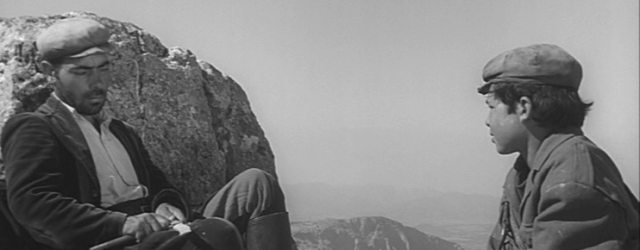
20100616180617banditi_a_orgosolo

I enjoyed this late Neorealist film directed by Vittorio De Seta. (What a name for an Italian filmmaker to be cursed with!) It deals with the attempts of a Sardinian shepherd to evade the law after he’s wrongly accused of stealing some pigs. Hiding out in the countryside, he’s forced to balance his desire to save his skin with his duties towards his flock and his younger brother; both parties follow him across the landscape, forever complicating the elaborate game of hide and seek he’s playing with the police. It’s no exaggeration to say that the movie does for sheep what “The Bicycle Thief” did for bikes, meaning that it uses them to demonstrate just how transitory economic well-being can be. As the shepherd’s prospects grow worse, the landscape grows more forbidding, yet it retains a ferocious, unsentimentalized beauty. At times the images seem lit from within, as in a Baroque treatment of the flight into Egypt (there are many night scenes). In its rugged visual poetry and its cool but empathic portrayal of a hardscrabble people, it bears comparison with the best works of Robert Flaherty, “Man of Aran” in particular, as well as to the Taviani brothers’ “Padre Padrone.”

Posted in Movies | Tagged , , , , , , | 3 Comments

“Damsels in Distress”

Blowhard, Esq. writes:

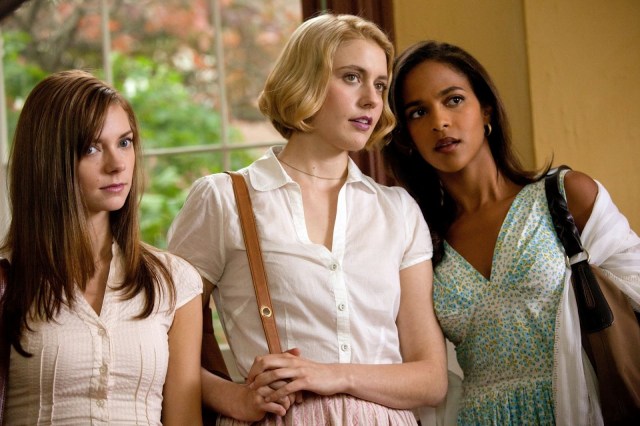
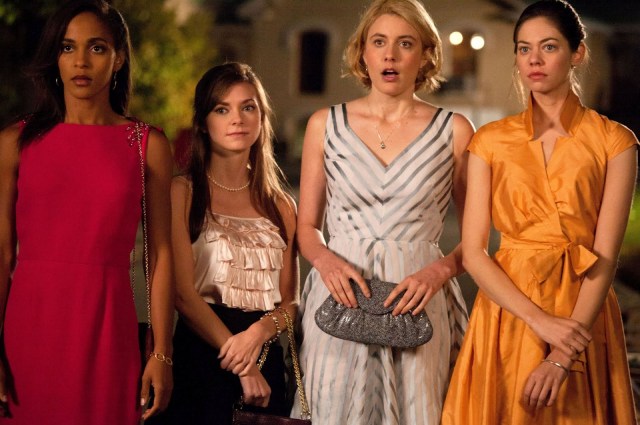
damsels-in-distress03Like Fabrizio, I recently watched Whit Stillman’s latest mocking eulogy for WASP culture and enjoyed it quite a bit. In the DVD commentary Stillman says the budget and shooting style was like his first film Metropolitan and this movie feels like a continuation of that one. That is, a closed-off fantasy world of dim yet hyper-articulate upper-class East Coast white people who speak in epigrams. Stillman likens the movie to an Archie comic, but I doubt Archie ever used anal sex as a plot point, not even in the oblique way Stillman refers to it here.

At the risk of embarrassing myself, I think one of the reason I love Stillman’s films so much is because they shaped my idea of New York City. Scorsese’s low-life Italians, Woody Allen’s neurotic Jews, and Stillman’s silly WASPs each inhabited a different yet idealized version of the city that I fell for.

This is the first movie I’ve seen starring indie darling Greta Gerwig and I thought she was terrific. A graduate of Barnard, she betrayed no difficulty delivering Stillman’s stylized dialogue, even though during the commentary she says, “I felt like I was swimming with cats.”

DID1

Related

Posted in Movies, Personal reflections, Travel | Tagged , , , | 7 Comments

Whazza Conservative?

Fenster writes:

As the geneticist/journalist Matt Ridley begins his review of Nassim Nicholas Taleb’s new book Antifragile:

You don’t need a physics degree to ride a bicycle. Nor, Nassim Nicholas Taleb realized one day, do traders need to understand the mathematical theorems of options trading to trade options. Instead traders discover “heuristics,” or rules of thumb, by trial and error. These are then formalized by academics into theorems and taught to new generations of traders, who become slaves to theory, ignore their own common sense and end by blowing up the system.

Just so, no?  I mean, it has the ring of truth about it, at least for a hidebound evolution-answers-all-even-if-I-am-not-myself-a-scientist guy like me.  It seems reasonable to me that our capabilities to discern and measure patterns inevitably gives rise to a reification of those explanations, putting of them at the top of some hierarchy, as though they come first in some Platonic sense, with the world to follow.  As Ridley goes on to remark, discovery is a trial and error process (though, to be fair, a process in which theoretical insights play a key part in the iteration of trial and error).

Is this relevant to the discussion on this site about whether America has a conservative tradition? Maybe.  At the least, I think it is wise to start by recognizing that Conservative Traditions or Theories of Conservatism need to be taken off any unnecessary pedestals.  The political ideas/ideals don’t come first.  Better, perhaps, to start by looking at what actually happened in America and go from there.

Paleo linked to an article by Patrick Deneen from Front Porch Republic, a kind of paleo-con publication (and here I thought Paleo Retiree named himself in honor of his eating habits).

I liked that Deneen was on to this problem of putting theory first.  As he seems to suggest, people end up turning complex historical lineages into rough and ready Big Ideas, then swinging them around like clubs.  I take my Conservative club and bang you on the head before you can hit me with your Liberal club.  Meanwhile, what do we mean by these clubs?  As Deneen points out, much of what we think of as the conservative tradition in America comes from a kind of liberal tradition, meaning that the conservative-liberal fight is really just a form of cousin’s war.  As he puts it, most of the tenets of conservatism in America, like the parallel tenets of liberalism, presuppose the primacy of the individual, going back to Locke, Hobbes and the rest.  The only tenet of conservatism that is in tension with the dominant theme of individualism is support for family and tradition–i.e., a recognition that we are not really the masters of our own fate, but, like it or not, part of a more deeply woven fabric.  Under this view, it is an inescapable part of political philosophy to accept that fate, and that fabric, and deal with it.  Can’t be wished away with dreams of autonomy.

Alas, Deneen concludes “a true conservatism has few friends in today’s America” except, perhaps, on his front porch.   Sounds about right.

But might Deneen’s analysis be sharpened a bit by adopting a little more scouring a la Ridley and Taleb?  Deneen does spend most of his energy discussing intellectual traditions as though they lead events around on a neat little dog leash.  But what if we give a little more weight to the events themselves?  Might that possibly illuminate a bit more of the predicament Deneen is concerned about?

Here’s one possible path in that direction: Rogers Smith’s Beyond Tocqueville.  The abstract:

Analysts of American politics since Tocqueville have seen the nation as a paradigmatic “liberal democratic” society, shaped most by the comparatively free and equal conditions and the Enlightenment ideals said to have prevailed at its founding. These accounts must be severely revised to recognize the inegalitarian ideologies and institutions of ascriptive hierarchy that defined the political status of racial and ethnic minorities and women through most of U.S. history. A study of the period 1870-1920 illustrates that American political culture is better understood as the often conflictual and contradictory product of multiple political traditions, than as the expression of hegemonic liberal or democratic political traditions.

In other words, we have had a more bustling and lively set of energies in a “true” conservative direction than we may often realize.  It has been, though, a true reactionary tradition, and it has tended to lose most of the fights.  In consequence, it has vanished for conservatives.  For liberals, it exists mostly in the form of of grimm bedtime stories.  White people will lynch again given half a chance.  The country is forever racist.  The church and its allies will stop you from your right to reproductive freedom.

Me, I am from Massachusetts, and I don’t see much reactionary behavior in the vicinity, and thus I have been prone to laugh at my fellow blue-staters’ obsessions.  But Smith’s analysis–and it is worth a read, as a decent scholarly work–reminds me that liberal bedtime stories have a mooring in the truth, in actual history.

So I think we have had a conservative tradition in the country.  OK, it hasn’t been highfalutin’ and may have substituted Father Coughlin for Edmund Burke.  But if Deneen wants to know why no “real” conservatism, Smith may help him with his answer.

Posted in Politics and Economics | 6 Comments

Joss Whedon’s Disney’s “Marvel’s The Avengers”

Sax von Stroheim writes:

I finally caught up with the year’s biggest hit. I’m a longtime reader of super-hero comics, and while the Avengers comics by Jack Kirby, Stan Lee, et al. aren’t my favorites from Marvel’s Silver Age, I do like them quite a bit.

Here’s what I liked:

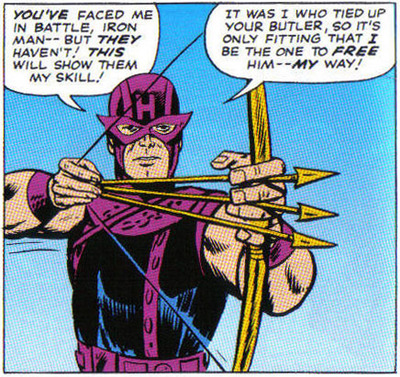
1)   There’s a very Marvel comics-style moment where Hawkeye – the world’s greatest archer – shoots some kind of super, high tech arrow at a computer so that it plugs directly into its USB port to give him access to it. It’s goofy, but I smiled because it’s exactly the type of thing that would happen in an Avengers comic.
hawkeye1

Hawkeye, as drawn by the great Don Heck

2)   There’s a very Joss Whedon-style moment near the end, where the bad guy, Thor’s evil step-brother Loki, is starting to deliver a pompous, gloating, villainous monologue to the Hulk, and the Hulk cuts him off by grabbing his leg and swinging him repeatedly into the floor. It reminded me of the great moment in “The Train Job” episode of Firefly, where a bad guy is threatening to take revenge, and Mal (the Han Solo-like leader of our heroes) kicks him into a spaceship’s engine intake, killing him instantly. In both cases, Whedon gets a laugh by tweaking our genre expectations of what a hero usually does when confronted by a raving villain (i.e., listens to him rather than doing something sensible).

3)   After he’s told that he can’t compete with Thor and Loki because “they’re gods”, Chris Evans as Captain America delivers the movie’s best line: “There’s only one God, and I’m pretty sure He doesn’t dress like that.” Evans plays it completely straight, here and throughout the movie, never condescending to Cap’s old-fashioned idealism.

I don't know, Cap: who BUT a god would dare to dress this way?

I don’t know: who BUT a god would dare to dress this way?

4)   Tom Hiddleston as Loki was good. He nails the Stan Lee-style faux Shakespeare dialogue.

5)   ScarJo:

...look at her...

…look at her…

Here’s what I didn’t like:

1)   The visual effects are poorly integrated, both with the “live action” and with other visual effects. Michael Barrier joked that the movie could be called The Battle of the Visual Effects Houses, and I agree. I never had the sense of a coherent aesthetic vision behind any of the CGI. This leads to several problems:

a)    The seams are showing all over the action sequences. It’s very noticeable every time we go from effect to effect, so the spaces all feel needlessly chopped up.

b)   There’s a very apparent change from actor to videogame avatar every time one of the heroes does something heroic. CGI-Captain America doesn’t move anything at all like Chris Evans as Captain America. That was a problem I had with the Sam Raimi Spider-Man movies, too, but I was kind of surprised that after ten years they haven’t gotten the technology to the point where it looks any better.

c)    Relatedly, every time Robert Downey Jr. speaks as Iron Man (i.e., when it’s not him on screen, but just a CGI’d suit of armor), he sounds like he’s phoning in voice-over work on a videogame.

d)   More on videogames: I guess if you don’t play videogames, you might not notice and be bothered by the way these movies feel like videogames. A friend described the alien army in the movie’s climactic battle sequence as “a bunch of video game extras”, and, well, they are. I felt something similar while watching “Prometheus” earlier this year: all these people were raving about Sir Ridley’s sense of design and all that, but the movie just seemed like it had been cobbled together with bits and pieces from HALO and Dead Space. To be fair, those games were deeply influenced by the original “Alien” movies, but still…

2)   Putting a drippy fan-service character – Agent Coulson – at what’s supposed to be the “emotional center” of the movie. In case you aren’t familiar with the term, a “fan-service character” is common archetype in contemporary super-hero comics. He (or very, very rarely she) is supposed to stand in for all the comic book fans of the world. He usually parrots, in the world of the comic, the same kind of feelings that the fans have towards their favorite characters. Sometimes, in the comics, this works, and I’d be happy to provide examples if anyone actually cares. Most of the time, though, it comes across as one of the more masturbatory things in an already ridiculously masturbatory genre, as it does here. The problem is always that the love/admiration the fan-service character has for the super-heroes isn’t based on anything in the comic book, or, in this case, the movie, itself, but on the feelings the writers are presuming we already have for the characters.

A nerdy white guy: just like me!!!

It’s a way to use our pre-existing feelings of nostalgia for these characters as a replacement for having to write scenes that express any kind of honest, emotional connection between them. Actually, I didn’t just “not like” this aspect of the movie: I outright hated it. I agree with Michael Barrier that it’s a sign of the movie’s emptiness that Coulson is at its center: it turns the movie into a game of fill-in-the-blank.

3)   Samuel L. Jackson. He just seemed to not give a shit. Which, normally, a guy getting paid to walk around in a big CGI spectacle, not giving a shit? Normally, I think that’s fine. Sometimes, I think it’s kind of admirable! But Jackson threw a Twitter fit when A.O. Scott gave the movie a mixed review, and if you’re going to throw a fit about a movie you’ve made, at least try to throw it for a movie that it looks like you gave a shit about when making it.

4)   Oh yeah: out of the billions that this movie made, virtually none of it went to any of the guys who actually created these characters and these stories in the first place.

Hail to the King!

Hail to the King!

To sum up: though I had a few laughs along the way, “Marvel’s The Avengers” really demonstrates how the Marvel Movie Method works: take some charismatic, funny actors and blend them in with some shitty CGI and indifferently directed action sequences. Since audiences will happily drink this stuff up, I guess I don’t blame them for not bothering to make better movies. Still, that philosophy just seems to add insult to injury, considering it reveals just how little they really comprehend and/or care about the artistic legacy of Jack Kirby (and others) that is, unfortunately, under their stewardship.

Posted in Movies | Tagged , , , , | 8 Comments