
The Question Lady writes:
When is it OK for somebody to use their iPhone (or any phone) when they’re out with other people?
The Question Lady writes:
When is it OK for somebody to use their iPhone (or any phone) when they’re out with other people?
Paleo Retiree writes:

Over the last few weeks, I’ve been working my way through an Animal Planet “animal hoarders” show on the tube. (Actually on Netflix Instant — haven’t had a cable subscription in years. Why bother with one? The Question Lady and I don’t care about sports; we graze for news online; and we do whatever TV watching we do these days via Roku.) The show is nothing special so far as movie/TV-making goes — it’s standard contempo reality-doc stuff. But I’ve gotten fascinated by it anyway, and for a variety of reasons.
One of them is the sociology factor. Most of the hoarders — and the baffled-and-unhappy friends and family members — that the show focuses on are white working-class (or poorer) people. I was amazed by …
Also: how few of them have what you might think of as productive jobs. For many of them disability seems to be their main, if not only, source of income. Co-blogger Glynn Marshes points me to this informative article about how rapidly use of disability has been growing in the last decade. Fact Du Jour:
From 1980 to 2002 there was no change in the percentage of the workforce claiming disability, yet the “disability participation rate” has embarked on a 4.5 percent ascent each year for the last decade. There is now 1 person collecting disability for every 12 in the workforce.
I’ve also been fascinated by the show as a study in forms of delusion. The hoarders — who typically have little money and not much space but are caring for 30 to as many as 200 animals — clearly see themselves as reasonable people. Some of them are instantly-identifiable as cracked, but many of them appear to be — if you were to run into them away from their animals — sane. It definitely has me wondering about how many of the rational-seeming people I deal with day-to-day are, in their private lives, complete loons.
What the show mainly has me musing about, though, is the distance between the kind of lives these people lead and the world I inhabit. They don’t eat the kind of food I eat — often, they don’t even have sitdown mealtimes together. They don’t think the same thoughts I do, or consume the same kind of mental fodder. Their life-expectations and their behavior-patterns go off in directions that are completely alien to me. Often while watching the show I find myself thinking, “Wow, has the gap between middle-class-and-above people and working-class-and-below people ever been greater, or more dramatic, than it is now?”
Although many of the people who appear on the show are clearly bright and/or perceptive and/or sweet, the life they’re leading has “Idiocracy” written all over it. They don’t feel like co-citizens to me so much as members of a different (if related) species. Which I don’t intend, believe it or not, as a putdown. I find it impossible not to feel for them (OK, many of them), and for their plight.
Have you gotten fascinated by any reality-doc TV shows recently?
Fabrizio del Wrongo writes:

Do you like movie lists as much as I do? They seem to me to be a great way to explore movie history — perhaps even the only way. A fledgling movie buff could do a lot worse than starting with the results of the recent “Sight & Sound” poll, or Roger Ebert’s list of “Great Movies,” or Jonathan Rosenbaum’s 1000 essential movies, or even this nice little book, and then using them to develop a working knowledge of cinema history, one viewing experience at a time. In fact, if you don’t do something like this, and then develop your tastes further by exploring your own peculiar interests, you’ve pretty much consigned yourself to whatever’s being promoted as a “classic,” and that’s no fun at all, especially considering some of the turds that have come to be regarded as classics. And it can often be pretty daunting tackling an unfamiliar genre or tradition without first acquiring some kind of starting point or syllabus. Continue reading
Fenster writes:

What ethical assumptions will need to be written into the programs for driverless cars, and who will make the decisions?

Is it moral to print a gun?

Is the return of eugenics in some form inevitable?
epiminondas writes:
Paleo Retiree writes:
Fenster writes:
Two schools of thought on the current crisis in higher education.
They are not mutually exclusive by any means, but there is a definite tension between the two.
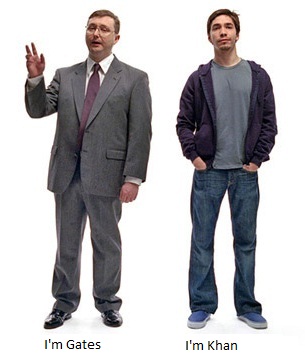
On the one hand, we have Bill Gates. Here is a link to an Atlantic article highlighting a Power Point presentation by Gates on the crisis in higher education. It appears to me to be a conventional, even orthodox, reading of the situation and what to do about it. One delivered via Power Point no less! With all the crazed innovation out there looking for traction, Gates turns the narrative into one of increasing graduation rates. Don’t cut budgets further–we’ve cut enough. And let’s focus on finding ways to increase college completion on time. But . . . .

Then there’s Salman Khan, founder of Khan Academy someone Bill Gates thinks a lot of. Here is his view on the future of credentials.
Here’s what I think it could look like in five years: the learning side will be free, but if and when you want to prove what you know, and get a credential, you would go to a proctoring center [for an exam]. And that would cost something. Let’s say it costs $100 to administer that exam. I could see charging $150 for it. And then you have a $50 margin that you can reinvest on the free-learning side.
I think that is consistent with the mission. You are taking the cost of the credential down from thousands of dollars to hundreds of dollars. And the [software] system would tell them they are ready for it. So no paying tuition for community college and then dropping out, or even finishing the whole thing and saying “Oh, I’m $20,000 in debt and what did I get out of it?”
Now you are like, “Look, there is this micro-credential in basic accounting I can get for $150, and I basically know I am going to pass before I invest that money.” That would be a huge positive for the consumers of education, and it could pay the bills on the learning side.
Note Khan does not equate credentials with graduation and “degree completion on time”. Now don’t get me wrong: degree completion is, all else being equal, a good thing rather than a bad one. But obsessing over completion, especially if it diverts attention from more efficient paths, is a blunderbuss approach to the problem, and one that betrays the POV (and interests) of the large institutions that now comprise the higher education sector industry.
Hmm . . . where have I seen this before?
Fenster writes:
Critics just can’t seem to get enough of re-appraising the long form Heaven’s Gate. In yesterday’s Boston Globe, Ty Burr added to the buzz with his own long form article, the chief benefit of which was that he used the space to take apart most of the claims to the film’s greatness. I admire that view but continue to wonder why the fuss when the 219-minute version was available on VHS a few years after the 1980 theatrical release, and with a brief foray back onto the big screen in 2005. It made me despair of all the talk of greatness revealed if only we could see the Great Artist’s unsullied vision.
Then I secured a DVD with the “extended cut” of Kenneth Lonergan’s Margaret, and revised my cynicism about unsullied work by the great artist. The three-hour Margaret was, for me, an astonishing experience.

This is the long version that Lonergan was unable to cut back to the 150 minute maximum he had been allowed by the studio. Martin Scorcese and Thelma Schoonmaker were brought in with scissors to do the deed, with the shorter version seeing theatrical release.
I haven’t seen the theatrical release and don’t know what was cut. To be fair, the long version does include lots of subplots, minor character development and musical/visual interludes that one could argue could be cut with little loss of narrative power. Indeed, one could argue that a conventional narrative would benefit from a fair amount of trimming. But Lonergan does not seem that interested in a conventional narrative, and bully for that. I found myself luxuriating in the meandering and meditative quality that is in ample supply. I know the old adage about good writers needed to kill what they love with the editor’s pen, but I for one am extremely pleased he spared as much of his vision as he did.
Lonergan’s dialogue is distinctive. Pinter is a master of the pause and Mamet the fuck-you. Lonergan is the master of the missed connections in conversation, and of people talking past one another even as they struggle to address the other. On its face, conversation is about character’s expressing themselves through verbal exchange. In fact, our own life conversations are all-too-often stunted, running off in unclear directions since the interlocutors are often not clear about what it is they actually wish to reveal, or to express. Good conversation–healthy conversation–is cumulative and iterative. Many of Lonergan’s characters show a tendency to serial monologues while in apparent conversation. They just have to say what they have to say.
The performances are stellar. I don’t usually like Anna Paquin and, truth be told, I didn’t like her here that much. All the better for that slightly obnoxious and overbearing quality–it is the heart of her character Lisa. Lisa’s mother is played by Lonergan’s real-life wife, J. Smith-Cameron, a stage actress of apparently some repute (I have never seen her before) who brings the right nuance and depth to the role. Elsewhere–well, where else will you find Jeannie Berlin, Mark Ruffalo, Jean Reno, Allison Janney, Matt Damon and Matthew Broderick?
I don’t risk spoiling the plot, such as it is, to at least say what it is about. It’s Woody Allen terrain–Upper West Side. Lisa, a 17-year old high school student, finds that her way-too-advanced cognitive and intellectual abilities are way outmatched by life. She witnesses–well, she more than witnesses–a terrible accident, and is set to grapple with the meaning of the event, and her part in it. Yes, she is a drama queen, and you cringe when she acts out. Still, there is something gritty and admirable about her struggling, as she tries over and over again to counter the senselessness of events with the few inadequate tools at her disposal.
When called out by an older friend for being a drama queen, her response:
Lisa
You think I am making this into a dramatic situation because it is dramatic?. . .
Emily
I think you are very young.
Lisa
What does that have to do with anything? If anything it means I care more than someone that’s older. Because this kind of thing has never happened to me before.
And as it turns out, there is some truth to what she is saying. The adults don’t have a ton to add to her learning, save to point out that life involves a certain getting used to.
Daniel Kahneman has written, “the world makes much less sense than you think. The coherence comes mostly from the way your mind works.” In a sense, Margaret is just another coming of age story, though it is one that shows quite plainly what is gained and what is lost in the forging of mental constructs we refer to as maturation.
Fenster writes:
What do you suppose honey isn’t doing? And to whom? And who is going to do it instead? And is it being done at the time the picture was taken?

What do you think makes for a great bar?
 Blowhard, Esq.
 Callowman
 Sherbrooke
 Eddie Pensier
 Enzo Nakamura
 Epaminondas
 Fabrizio del Wrongo
 Fenster
 Brundle Guy
 Glynn Marshes
 Paleo Retiree
 Atypical Neurotic
 Question Lady
 Sax von Stroheim
 Sir Barken Hyena
 The Mistaken

