Aoun on Higher Education

Fenster writes:

I am basically a higher education person, more comfortable in an institution than out on my own, and more comfortable in a non-profit, mission-based organization than in a for-profit one.  I recognize this to be a matter of temperament and make no special claims about better and worse, other than the claims that I cannot help but make due to my temperament.

But I have also been professionally curious and, having started out in higher education, also spent time in other sectors.  I remember when I made my way back to higher education after more than ten years as an investment banker that I felt that I had died and gone (back) to heaven.  I was a decent investment banker but simply lacked the killer instinct to be really good at it.

But though I returned to the land of the Eloi I nonetheless had spent appreciable time among the Morlocks, and felt that, if nothing else, a dose of Morlock thinking might be helpful in Eloi-land.  When I would point out the obvious–that higher education might be many wonderful things but it was also a business–my comments would typically be met with a kind of blissed-out astonishment.  Why, didn’t I know that the oddly decentralized and ungovernable university model has a far longer history than the profit-driven corporation, and that it therefore has the upper hand in terms of proving evolutionary worth?  It is an oddly compelling argument, all the more odd since it is Burkean in its essence, and higher education people strongly resist being characterized as conservative.

Of course all irony disappears under the microscope.  The answer to this riddle is that higher education people are conservative at their core.  Not conservative politically, of course, but conservative where it counts–on the home front, in the defense of the institutions that house and feed them, and that give them status and prestige.

And therein lies the problem.  All well and good to say that all higher education must possess some magic mojo descended from Peter Abelard, some distilled essence of otherness.  And for sure there are aspects of learning, both teaching and research, that rightly cause education to resist full-scale corporatization.  But, to return to my lessons from my time with the Morlocks, who can deny that universities have also become big business?  There’s a business model.  There’s money coming in and coming out.  There’s the need for competitiveness.

Most of all, there is the near-universal quality of higher education in the current era.  You don’t need to resort to Bell Curve style arguments to grasp a simple truth: that in an era of near-universal education, huge sections of the institution will be less like a medieval university than a corporate training center.  That’s just inevitable, and it is always amusing for me to observe how frantically many faculty attempt to deny the obvious, and to drag up ideal models as a way to defend their places in a higher education world with deep, deep ties to reality.

The size and scale of higher education, therefore, guarantee its diversity of aims, approaches and underlying rationales.  It becomes constricting to consider it all of a piece, especially because of the nagging tendency to fall back on a small piece (the medieval ideal and its legitimate descendants) for the whole (the whole mehgillah from history at Harvard to a radiology assistant program at a local community college).

So now comes Joseph Aoun, the very capable and wise president of Northeastern University.
Here is his contribution to the recent heated discussions over whether change is finally, finally making its way to the sheltered groves of academe.  His answer: yes, change is coming and it will be transformative.

It is in one sense a ballsy move for the President of an earthbound entity, one whose constituencies are now just beginning to move out from the shadows of denial into what they fear will be a much too sunny future.  But Aoun’s remarks do touch on the central points that higher education leaders (if that term is not too much the oxymoron) will have to grapple with in the not distant future.

Here is an important passage, one in which he speculates on the effects of MOOCs (Massively Open Online Courses):

Most significantly, MOOCs are causing higher education to shift from a vertically integrated model to a horizontally integrated one. For centuries, higher education has been a vertical enterprise: Its core functions — knowledge creation, teaching, testing, and credentialing — all have been housed within colleges and universities. MOOCs disrupt this model by decoupling teaching and learning from the campus on a mass scale.

This shift will accelerate as MOOCs continue to take hold. As more people use massive online courses to assemble new educational pathways, the companies that provide them will likely turn to outside partners such as private testing firms to administer exams to large numbers of students, detaching assessment from colleges and universities. Next, credentialing will be separated from colleges as well, as students press providers to offer degrees or other formal validation of the knowledge and skills they’ve acquired. Still more external players may get involved in the credentialing process, such as state agencies or professional associations.

Before long, higher education will look very different than it does today. Vertically integrated universities will continue to exist, but they’ll be joined by a variety of horizontally integrated competitors with the ability to perform the same core function for many more people. In short, the monopoly that colleges and universities have on advanced learning and degree granting will be dismantled. Ultimately, this will cause even more aspects of higher education to be scrutinized.

And all of this seems to be happening at quite a clip.  MOOCs are a very recent pheonomenon, as are the entities, like Coursera, that house them.  Ah well, said the skeptics a few months back, it is one thing to offer a course but it is something else altogether to figure out how to legimately give credit for it, or to assemble them into something resembling a degree.  Well, now we have the first steps toward credit, and degrees and such are not far behind.

Aoun cannot help but make some concessions to his role as president of an earthbound university.  One, of course, deals with the possible effects on diversity, if MOOCs and such end up offering a plain vanilla view of accomplishments and qualifications that conflicts with the prevailing holistic view in the industry.  The other is that MOOCs could result in a two-tiered system:

. . . .one tier consisting of a campus-based education for those who can afford it, and the other consisting of low- and no-cost MOOCs. This stratification could be reinforced if the colleges and universities that offer massive online courses reserve degrees for the graduates of their physical campuses and provide lesser credentials for their MOOC graduates — in effect, creating a “luxury” brand and an “economy” brand.

The only problem I have with this formulation is that we already have a system that is stratified.  Although the current system is stratified into many gradations, not just two, there is no doubt they are arrayed on a prestige continuum of sorts.  But because of the strength of the institutions to place institutional needs as a top priority, we are stuck with a stratification in which many students pay a high four year cost for an education that includes a lot of things that, for them, may not add appreciable value.  All the more reason for a big unbundling.  Let the folks who want to go to Williams go there.  Let others do other things in a freer, less institutionally-constrained, environment.

Posted in Education, Personal reflections | Leave a comment

Palladio Award Winner

epiminondas writes:

Palladio Award Winner

Andrea Palladio was one of the greatest architects the world has ever known.  He was born in Padua in 1508 and died near Traviso in 1580.  He is mainly known for the 23 surviving villas he designed which are scattered about the Veneto, and which are tourist magnets for Renaissance enthusiasts around the world. Your trusty correspondent has personally visited about half of them.  They are truly mind-boggling.

So it’s really no surprise to learn that there are annual awards now given for classical architecture named for Signor Palladio.  Among this year’s winners is a federal courthouse in Tuscaloosa, Alabama.  Although the proportions and some of the details are severely Doric, you can still feel the presence of the modern era in the way the buildings are shorn of ornament.  However, the construction is so cleverly designed and the colors so warm and inviting, that you don’t notice that.  Personally, I would like to see more fountains and statuary (not modernist junk) scattered around to soften the effect.  But I like this and am heartened to see that our society still reveres its history.  I have always maintained that no society can long survive untethered from its own past.  Perhaps we’re not ready to roll over quite yet.

Posted in Architecture | 3 Comments

A return of the term “financial repression”

epiminondas writes:

A return of the term “financial repression”.

As we head down the path blazed by Argentina, we need to understand the concept of “financial repression”.  It was a term used years ago to describe the downward spiraling economies of nations like Argentina. It might be well to review why that term is useful in the US going forward.

Posted in Politics and Economics | 1 Comment

Is this a trick?

Fenster writes:

Burial insurance from Senior Life Insurance company advertises that policyholders get lifetime coverage!

Posted in Uncategorized | 2 Comments

The Collapse, Part Three

Paleo Retiree writes:

This is Part Three of a three-part series. Part One of this series is here. Part Two is here.

As helpful as those resources are, though, I confess that temperamentally I’m not of the “We can make it work” persuasion. I really do hope that responsible people with access to levers of control can nurse the system along. Truly, I wouldn’t mind seeing our current lame-o arrangements last for another 30-40 years. After all, by that point my wife and I will be off the scene and it won’t matter to us any longer. A peaceful, easy slide to the finish line — with lots of opportunities along the way for good food, excellent friends and rewarding intellectual and artistic adventures — would suit me just fine.

Sadly, though, I’m temperamentally someone who looks at the “Where does money come from?” question and thinks “That’s not just terrifying, it’s ridiculous!”

Does this reaction make me a realist or a childish hysteric? I have no idea — but since I seem to have no choice in the matter, I’ve made a point of going where the response has led me. And where the response has led me is in the direction of what’s called the “monetary-reform” movement.

The monetary-reform crowd is made up of people who look at the way money works in what they call our “debt-money” (or “credit-money”) system and think, “That’s rigged entirely in the favor of bankers; it’s bound to lead to collapses of the kind we’re living through; and it can’t go on forever.” Then they try to come up with ways of structuring a money economy that would serve us all better.

Their usual solution, FWIW, is “public banking” — to take money-creation out of the hands of government-backed bankers and to create debt-free money via more public means.

Let me pass along a reading and viewing list for those who might share my temperament. I think of it as Monetary Reform 101.

  • Paul Grigon’s 76 minute long animated picture “Money As Debt” is the fastest way to get onboard here.
  • Ellen Brown’s “Web of Debt” is probably the most popular of the monetary-reform books, and Brown herself has become a staple on fringe-y talk shows. Here’s Brown’s blog; here she links to lots of articles she’s written.
  • I’m particularly partial to a monetary reformist named Thomas Greco. His book “The End of Money and the Future of Civilization” hits many of the same points Brown’s does, but it’s shorter and punchier. It’a the monetary-reform book I’d suggest starting with.
  • Steven Zarlenga runs something called The American Monetary Institute, whose rewarding website is here. I haven’t squared off with his epic book “The Lost Science of Money” but I’ve read, watched and listened-to numerous interviews with him and have gotten a great deal out of the exercise.
  • Dennis Kucinich was the movement’s sole representative in D.C. Dang: Why wasn’t I aware of how cool he is while he was actually in office?
  • Although the heterodox Australian economist Steve Keen (his main book is “Debunking Economics“) identifies himself as a post-Keynesian, I’m happy to group him with the monetary-reform crowd; his critiques of conventional economics make him at least a sympathizer, and like Michael Hudson he sometimes turns up at monetary-reform events. (Mainstream economists tend to be contemptuous of the monetary reformers, and to dismiss them as, at best, cranks.) Numerous interviews with Keen can be found on YouTube.
  • Question Du Jour: Why should the only money we can use be the money that the government demands and requires? Shouldn’t we also be able to create and use our own mediums of exchange? Watch a decent little doc about Switzerland’s interesting and successful Wir Bank here.

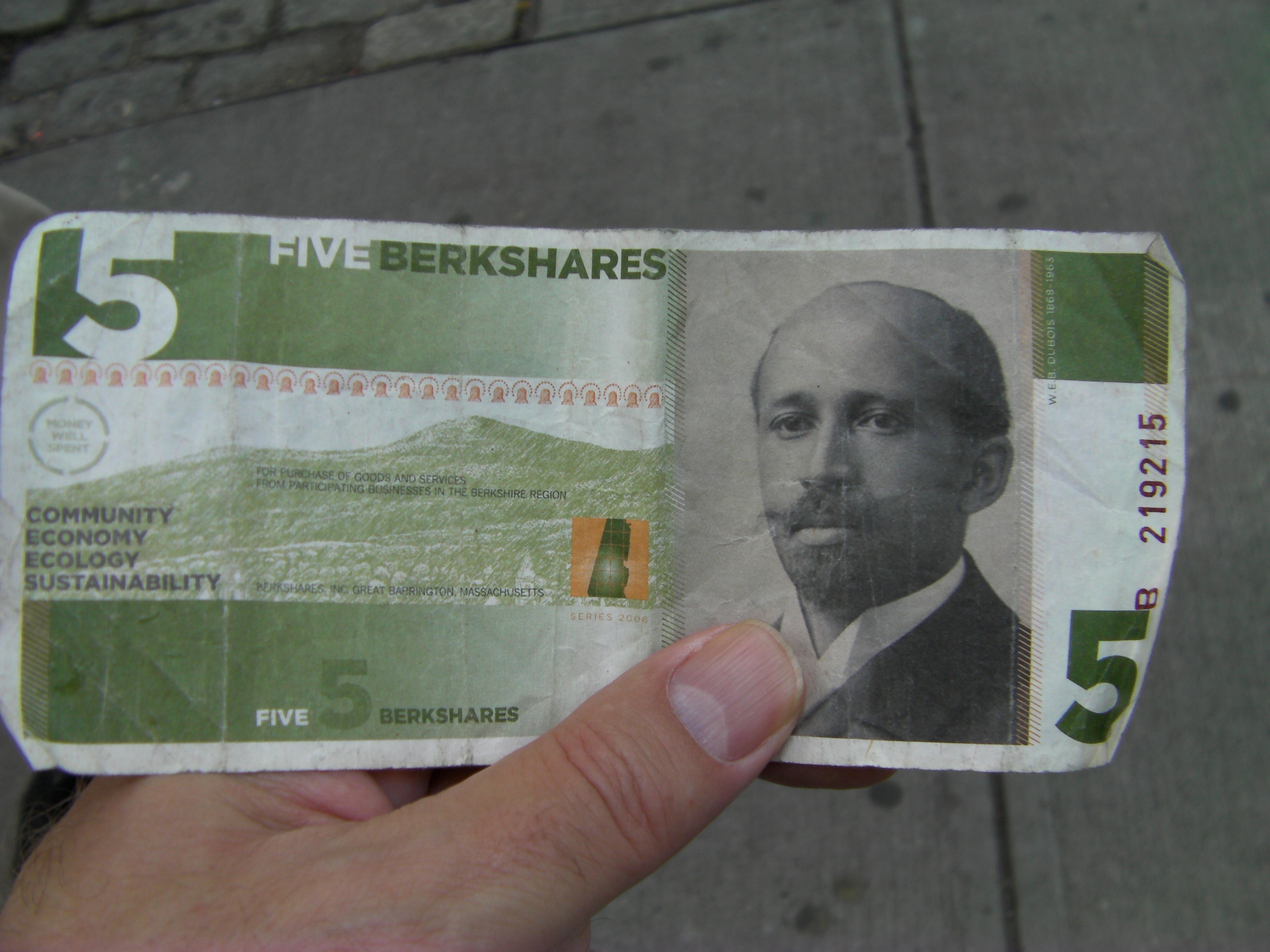
Incidentally, if you follow your curiosity down this particular rabbit hole you may find yourself in an Alice in Wonderland world where right and left lose all their conventional meanings. It’s a world where G. Edward Griffin — a guy with John Birch Society connections whose book “The Creature from Jekyll Island” tells the tale of the birth of the Federal Reserve — stands affably alongside smaller-is-beautiful localist-hippies who experiment with local currencies — aka “complementary currencies” — like BerkShares and Ithaca Hours. Some may find this disorienting; I rather enjoy it.

One of the best ways to begin exploring the monetary-reform world is with Positive Money, a U.K.-based outfit dedicated to spreading the word about how insane our financial arrangements are. They’re young, they’re intelligent and they’re very clear in their presentations. Here’s a few short talks by them:

Here are some more talks to explore. They’ve even created a two-hour-long documentary. It takes some patience to get through but it’s well worth the effort. Here it is:

So, should you care to have a fantasy about me, you can picture me living in a granola kinda town, sitting on top of a small pile of precious metals while doing debt-free business both by barter and in a local currency. I feel that such a life would suit me just fine.

How have you reacted to the financial collapse? Have you treated yourself to much research into causes and possible solutions? Any recommendations to pass along?

Posted in Personal reflections, Politics and Economics | Tagged , , , , , , , , | 14 Comments

All What Jazz

Fenster writes:

To my post on the possible demise of jazz, dearieme wrote in to say that the chap to read is Larkin.

Larkin being the poet Philip Larkin (subject of this recent article, link thanks to Arts & Letters Daily).  Larkin doubled as a jazz critic for the Daily Telegraph though the sixties.  The book presents his criticism from the start, 1961, through 1971.

Interesting that while the buzz today is whether jazz is dead in the 21st century, from Larkin’s POV it was over by 1945.  Larkin has a love-hate relationship with jazz which can be summed up fairly easily: love the early stuff, hate the new stuff.

Larkin’s asthetic view is fairly straightforward: does music give pleasure?  And for him, jazz started going downhill, and fast, when it stopped being about the pleasure the music can bring and started being about something else.

Here he is an (unpublished) piece on John Coltrane, written a few short weeks after Coltrane’s death in July 1967.

Well, I still can’t imagine how anyone can listen to a Coltrane record for pleasure.  That reedy, catarrhal tone, sawing backwards and forwards for ten minutes between a couple of chords and producing ‘violent barrages of notes not mathematically related to the underlying rhythmic pulse, and not swinging in the traditional sense of the term’ (Encyclopedia of Jazz in the Sixties); that insolent egotism, leading to forty five minute versions of My Favorite Things until, at any rate in Britain, the audience walked out, no doubt wondering why they had ever walked in; that latter-day religiosity, exemplified in turgid suites such as “A Love Supreme” and “Ascension” that set up pretension as a way of life; that willful and hideous distortion of tone that offered squeals, squeaks, Bronx cheers and throttled slate-pencil noises for serious consideration–all this, and more, ensure that, for me at any rate, when Coltrane’s records go back on the shelf they will stay there.

I will pause here just for a moment to point out that the preceding paragraph was, with the short exception of the first few words, all one sentence.  And I thought I could run on!  He is obviously worked into quite the lather at this point.  So he goes on:

Of course, a great deal of this falls into place if one reflects that Coltrane was a “modern” jazzman.  The adjective ‘modern’, when applied to any branch of art, means ‘designed to invoke incomprehension, anger, boredom or laughter, and Coltrane was simply part of the melancholy tendency since 1945 to remove jazz from our pleasures and place it, with all the other ‘modern’ arts, among our duties.  Much of this was doubtless due to the fact that Coltrane was an American Negro.  He did not want to entertain his audience: he wanted to lecture them, even to annoy them.  His ten-minute solos, in which he lashes himself up into dervish-like heights of hysteria (editor’s note: you oughtta know!) are the musical equivalent of Mr Stokely Carmichael (editor’s note: did I say this was unpublished?).  It is this side of his work that appeals to the Black Power boys (editor’s note: ouch!) such as LeRoi Jones and Archie Shepp; toward the end of his life, he had become associated with younger players of even wilder and more excruciating exhibitionism than himself, such as Pharaoh Sanders.  It is not surprising that pianist McCoy Tyner and drummer Elvin Jones, for long his associates and admirers, quietly dropped off the wagon.

Virtually the only compliment one can pay Coltrane is one of stature.  If he was boring, he was enormously boring.  If he was ugly, he was massively ugly.  To squeak and gibber for sixteen bars is nothing; Coltrane could do it for sixteen minutes, stunning the listener into a kind of hypnotic state in which he read and re-read the sleeve note and believed, not of course that he was enjoying himself, but that he was hearing something significant.  Perhaps he was.  Time will tell.  I regret Coltrane’s death the way I regret the death of any man, but I can’t conceal the fact that it leaves in jazz a vast, a blessed silence.

Editor’s note: note the clever use of ‘blessed’ at the last moment.  Two can play this religious high ground game.

As you can see, Larkin is a first-rate ranter.  If you are going to have firm opinions, you might as well rant well and write well if you seek to persuade.  The book puts me in the mind of other fine rants like Tom Wolfe’s books on modern art and architecture, but the prose style is Larkin’s own, and not Wolfe-like.  Wolfe is faintly amused/bemused by the vacuousness of what he sees.  Larkin by contrast is very clearly angry and hurt.

For me, it takes some historical imagination to get myself to understand Larkin’s disappointment.  Me, I can still get angry at how punk (and its many happy-amateur successors) shoved aside music that was pleasurable to listen to, and that was–duh–musical.  This was the rise of the talentless playing for the stupid, circa 1974, and it is with us still (see Sir BH’s earlier post on Austin alt music).

For me, jazz, both pre and post bop, are part of a seamless web of musical development.  Yes, I understand how jazz got less accessible, and wanted to be about new things, but I don’t myself feel the pain.  And I myself listen more to Monk than Louis Armstrong.  Does that mean time has told?

Posted in Music | 12 Comments

Quote of the Day

Blowhard, Esq. writes:

“I ceased in the year 1764 to believe that one can convince one’s opponents with arguments printed in books. It is not to do that, therefore, that I have taken up my pen, but merely so as to annoy them, and to bestow strength and courage on those on our own side, and to make it known to the others that they have not convinced us.” — Georg Christoph Lichtenberg

Posted in Philosophy and Religion | Tagged , | 5 Comments

The Collapse, Part Two

Paleo Retiree writes:


This is Part Two of a three-part series. Part One is here.

Another distinction that I’ve found useful is between people who think the current system can be responsibly and successfully managed and people who think that our current system is hopelessly rigged in favor of the banks and needs rebuilding from the ground up.

As far as I can tell, whether you’re on one side or the other of this question has nothing to do with political alignments or philosophies, let alone with rationality generally. It has to do with temperament, and with personal reactions. The reason for this, I suspect, is that it can be hard to look very far into the financial crisis without finding your brain latching onto such larger questions as “What is money, exactly?”, and “Why do we accept money as money?”, and “How does money get created”?, and “Who gets to create it, and why?” Scary thought: If our financial world is at heart nothing but a confidence game, what happens when people start to lose confidence in it? If money is but a magic show, what becomes of the illusion when the curtains are pulled back?

Once questions like these start to be asked and answered, personal feelings start to intrude bigtime. Do you react to what you’ve learned by musing, “Hmm, a bit jerrybuilt, sure, but I can see ways of making it work”? Or do you respond by thinking, “Good lord, it’s a house of cards built on a shifting bed of quicksand!”? Which reaction you have seems to me to be entirely a matter of temperament.

Happy to admit that I’ve learned a lot from some representatives of the “We can make it work” crowd. My favorite responsible resources have been the book “13 Bankers” (by James Kwak and former IMF honcho Simon Johnson) and Charles Ferguson’s documentary movie “Inside Job.”

In fact, if a friend were to ask about the fastest way to get up to speed on What Just Happened, I’d suggest watching “Inside Job,” a tough (but easy-to-watch) look at the crisis that argues (as does “13 Bankers”) that what we’ve lived through has been a slow-motion coup d’état by the financial sector. Ferguson isn’t just another documentary filmmaker, by the way. He’s a successful entrepreneur and political insider who turned to documentary filmmaking in order to pass along what he’s seen and learned.

In essence: Over the course of some decades, the financial sector has taken over our political sector. And not just metaphorically, either: our bankers have made our political rulers their bitchez. That’s the main reason, IMHO, why it’s such a waste of time to let yourself get swept up in the usual Dem-vs-Repub, Obama-vs-Romney battles. It’s Wall Street that’s calling both their tunes. The real battle here is between Wall Street (and their political flunkies) and the Rest of Us.

“Inside Job” has occasionally been available on Netflix Instant View, but even if it isn’t currently on offer there it’s well worth buying. If you’re reluctant to shell out, try looking at it this way: the DVD is the same price as an inexpensive book and — let’s admit it — unlike most of the books you buy, which you’ll never read, you’re very likely to make your way through a DVD.

Another “it can be managed” group that I’ve learned a lot from is what’s called “MMT” — the Modern Monetary Theory crowd. Like many people who encounter the group, I’d initially been completely unaware of their existence — they’re very unorthodox by mainstream standards. And I found it hard not to react to them with intense suspicion. Most are academics (often based at the University of Missouri, Kansas City), and for some reason many of them are prone to both didacticism and high-flown “Don’t be ridiculous”-style language-use. Both these tendencies set my alarm bells to ringing loudly. Plus, the MMTers purport to be doing nothing more or less than describing the accounting-level basics — the by-definition truths — of how today’s monetary/financial system works. Crank that I am, I’m always suspicious of people who claim to be beyond ideology and to be delivering the mere simple factual truth.

A couple of further misgivings I have about them (not that I’m really entitled to these misgivings …): The MMTers tend to see the economy as more amenable to a lever-throwing-and-dial-twisting style of management than I’m comfortable with; and they radiate a kind of “If only decent people who REALLY understand how things REALLY work were in charge, everything would be fine” attitude that completely puts me off. FWIW: My aversion to both these things probably has its roots in the ’60s and ’70s, when hyper-confident, top-down government Keynesians lost all control of the economy while assuring us that they knew exactly what they were doing, as well as exactly which levers needed to be pulled.

Still, they’re a smart and startling crew. On an ultra-basic level the MMT message is: Too many people (and that would include politicians and economists as well as you and me) are applying notions that held true during the gold-standard years to the very different reality of our fiat-money world. (Fiat money, credit money, debt money … Whatever.) And we screw up because of this. If only we understood — and were honest with ourselves about how — today’s economy really works, then we could finally get back in charge of it.

Are the MMTers as right as they claim to be about How Things Really Work? Is their description of how our economic/financial world works as free from ideology as they say it is? And even if it is, does such knowledge really confer the kind of do-gooding power they seem to think it does?

Of course I don’t know. But I can say that the MMT crowd is starting to make an impact on the general discussion — you’ll be seeing and hearing more of them. I can also say that wrestling with their arguments has scrubbed some scales off my own brain. Plus, hey, it can’t be a bad thing that MMT sends both Gary North (hardcore Austrian) and Paul Krugman (hardcore Keynesian) into conniption fits.

Some prominent MMT types you might enjoy exploring include L. Randall Wray, Warren Mosler and Bill Mitchell. The popular website Naked Capitalism, hosted by a woman who calls herself Yves Smith, has been influenced by MMT. I haven’t gotten around to Yves Smith’s own book yet, but it’s on my bedside. (OK, in my Kindle.)

My personal favorites of the MMT crowd are two guys who are less academic-and-theory-bound and more practically-oriented than most of the others are: William Black and Michael Hudson. These days Black teaches, but back in the ’80s he helped clean up the Savings and Loan mess. (Here’s a great piece by Black.) Hudson currently writes and teaches, but back in the day he worked for Chase and for Arthur Anderson. (Here’s Hudson’s latest book.) Both of them have a lot of informed, enlightening and lively things to say. The easiest way to start with their contributions might be to type their names into the YouTube Search box. Both have been interviewed on video numerous times.

To be continued tomorrow …

Posted in Personal reflections, Politics and Economics | Tagged , , , , , , , , , , | 13 Comments

The Collapse, Part One

Paleo Retiree writes:

This is Part One of a three-part series.

Since my recent retirement, the main way I’ve been busying myself intellectually has been in trying to make sense of the financial collapse of 2008. “What on earth just happened?” is/was my basic response to the events of that year. My only excuse for being as uninformed as I was about the situation: While epic shenanigans and dramas were unfolding in the political and financial worlds, I was paying attention to other things: movies, books, computers, food, personal life …

Realizing that I had a lot of catching-up to do, I’ve read books, I’ve watched documentaries, I’ve haunted blogs … Not being in possession of a math-type brain (to put it mildly) and having less than zero experience in the financial world — I can barely, and only for mere seconds at a time, wrap my mind around what a credit-default swap is — I want to make it clear right up front that I have nothing of worth to add to the information-and-analysis part of the discussion. (Hey, I generally like to be a modest person, but one virtue I’m happy to claim for myself: When I don’t have personal experience with a field I make an effort to restrain myself from carrying on about it like an expert.)

The main benefit of my haphazard research: I now feel familiar with the discussion — with the basic information; with the points people talking about the collapse generally make; with the positions that are argued for and against (and argued from); with the responses and solutions that are proposed; etc. I can watch the news and pay attention to the debate and actually follow along in a familiar-with-the-material kinda way. And even if I’m too smart about my dumbness to enter into the debate, I can’t resist treating myself to an opportunity to pass along some observations about it.

OK, then.

First, a distinction I’ve found useful: between mainstream people and the fringier crowd. Between, in other words, people who take seriously the case offered up by the politicians, the mainstream press, the mainstream economists, and the Fed and people who don’t. To repeat myself: On the one hand: People who take (or pretend to take) the official narrative at face value. On the other: People who are skeptical of the official narrative. (Do Bernanke and Obama buy their own class’ p-r? I wish I knew.)

Here, I’m so temperamentally incapable of respecting the establishment’s account — essentially, “Not to worry. Mistakes were made (blizzard of details here) but we’ve got things under control now” — that I have nothing to add. After all, either you’re someone who’s part of The Matrix (also called “The Cathedral” by some reactionary sites I enjoy visiting) or you’re someone who has made an escape from it — or who, perhaps, never bought into it in the first place.

My second observation came as a surprise to me: While the Dems and the Repubs enact the requisite conventional-narrative fistfight, real lefties and real righties turn out to share much in common. One of the most striking things that has hit me during my explorations is the way that the analyses and descriptions of What Just Happened offered up by the real left and the real right overlap almost completely. The interpretations and solutions they propose may differ dramatically … but what they’re seeing and describing is often the exact same thing.

Here’s one small example from among the many that I’ve run across. Ann Pettifor, a British FDR-loving social democrat of the Dalai-Lama/Bono sort, explains here that the current mess dates from the early ’70s. Nathan Lewis, a gold bug who writes for Forbes, thinks so too. The differences set in only at the level of explanation: Pettifor thinks it’s because the early ’70s is when capital controls were lifted. Lewis thinks it’s because the early ’70s is when Nixon took the U.S. off the gold standard. To me, what’s more striking is the way they agree — something happened in the early ’70s — than the ways they disagree.

(So shoot me: I like both Pettifor and Lewis. They’ve both got valuable contributions to make, and they both make ’em in ways I enjoy. A general life-lesson I can’t resist venturing: In politics and economics, no one possesses the one final answer; many people have things of value to add; and those things of value can come from all over the political compass.)

FWIW: My favorite source for leftie info and interpretation about the financial world has long been Doug Henwood, whose reporting on Wall Street I’ve followed since the ’80s. I love Doug’s book “Wall Street”; you can download a free copy of it here. Highly recommended: It’s clear, feisty without being tendentious, eye-opening, and full of startling info. One typical passage:

Take, for example, the stock market … What does it do? Both civilians and professional apologists would probably answer by saying that it raises capital for investment. In fact it doesn’t. Between 1981 and early 1996, U.S. nonfinancial corporations retired over $700 billion more in stock than they issued …

Smart, informative stuff, and delivered in a way even I can follow. I can’t imagine a better presentation of what Wall Street is, what it does, and how it works.

My favorite rightie source is the above-mentioned Nathan Lewis. I loved Lewis’ book “Gold: The Once and Future Money.” As absurd as the goldbug position can often seem, I found Lewis’ book amazingly informative and provocative. I’ve been surprised, in fact, to discover that gold can be an interesting vantage point from which to look out upon the financial, political and economic worlds. Fun to notice too that, at his rich and quirky website, Lewis reveals himself to be a major (and inspired) fan of traditional urbanism.

To be continued tomorrow …

Posted in Personal reflections, Politics and Economics | Tagged , , , , , | 22 Comments

Quote of the Day

Blowhard, Esq. writes:

“I leaf through now one book, now another, without order and without a plan, by disconnected fragments…If I encounter difficulties in reading, I do not gnaw my nails over them; I leave them there. I do nothing without gaiety.” — Montaigne

Posted in Art, Books Publishing and Writing, Philosophy and Religion | Tagged , , | 5 Comments