
Blowhard, Esq. writes:
 As these two posts alluded to, I just finished reading Sarah Bakewell’s excellent biography of the French writer Michel de Montaigne. Continue reading
Blowhard, Esq. writes:
As these two posts alluded to, I just finished reading Sarah Bakewell’s excellent biography of the French writer Michel de Montaigne. Continue reading
Fabrizio del Wrongo writes:

Johnnie To’s latest, entitled “Life Without Principle,” combines the financial-and-business-sector setting of his last film, the romantic comedy “Don’t Go Breaking My Heart,” with his customary gangster milieu. It’s organized around the Greek debt crisis, which To uses to highlight his familiar themes of loyalty, risk, chance, and human interdependence. Money rules the day here, and as you might expect it’s a capricious mistress: the characters wish for it, curse it, bet on it, kill for it. But To avoids making simplistic moral points. Rather, he uses money as he did the missing gun in his 2003 “PTU” — as a device to connect the characters and spur them to interaction. Aiding him in this is a switchback structure, blatantly lifted from “Pulp Fiction,” which artfully overlaps each storyline and underscores how cause and effect play out within the plot. (Rarely have the whims of financial markets been so cleverly compared to the fickleness that characterizes everyday human relationships.) As with most of To’s films, there’s little here that will impress as high art, but the movie sings in its calm precision, its quietly modulated tone. Johnnie To has more control over what he puts on screen than just about any director currently working.
Blowhard, Esq. writes:
Sometimes, you come across something so jaw-droppingly bad that the ridiculous awfulness must be shared. This is the first page of The Adventures of Lucky Pierre by Robert Coover:
 Me, if I continue any further.
BTW, the author is a graduate of the University of Chicago and a literature professor at Brown.
(H/T to ghostinmarble who naively purchased this at the recommendation of a bookstore clerk and is currently plotting her revenge.)
Do you think ambiguity has been destroyed by emoticons?
Fabrizio del Wrongo writes:
The culture doesn’t provide for much in the way of girliness these days. Have you noticed? I guess I should define what I mean by girliness, but I’m not sure I can whittle it down to a list of qualities, and I’m not sure I want to. Nor do I think it’s necessary that I spell everything out for you. I think you all know what I’m talking about anyway: you’re familiar with the butt-kicking babe character that’s so common in the movies, and you probably live near at least one lantern-jawed teen who competes on the women’s lacrosse squad at your local high school. Maybe she’s even kicked sand in your face and swiped your girlfriend. These are the predominant female archetypes of our culture, for better or for worse. Why have women begun to strenuously emulate traditional male models? It’s an interesting question, one that I don’t have an answer to. Maybe it’s something in the water that nudges ’em down that path. Or maybe it’s like Halloween for them — a chance to play dress-up and assume a role. Or maybe they’re just falling in line with what they see on television. It occurs to me that perhaps the biggest driver of female behavior in recent memory, “Sex and the City,” featured a troupe of women who acted not like girls but like gay men. And though gay men are a lot of wonderful things, they’re not exactly girly. Continue reading
Paleo Retiree writes:
“Between 1950 and 1953, New York City spent $143 million on schools, $4 million on libraries, $70 million on hospitals, and $172 million on highways … Other cities went further.”
I found the quote in this new book.
Blowhard, Esq. writes:

This past weekend your friend and humble narrator (sorry) took in the new grand deluxe Stanley Kubrick retrospective at the Los Angeles County Museum of Art. Continue reading
Paleo Retiree writes:
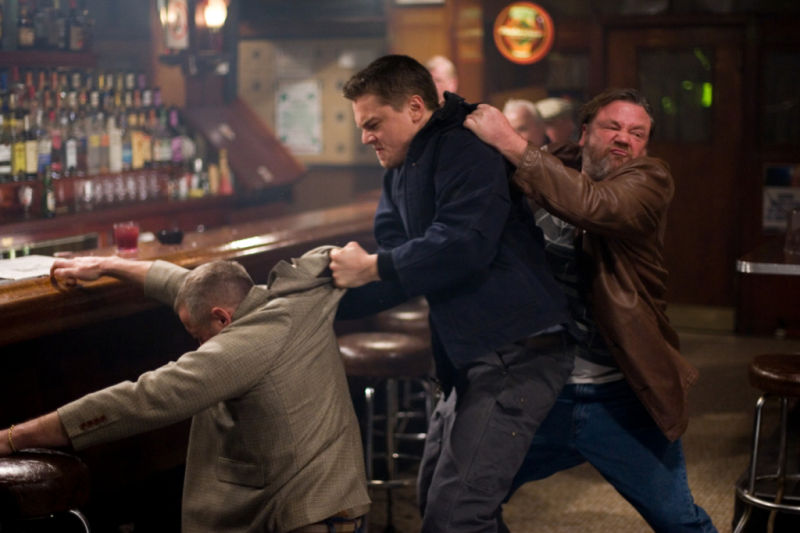
I sat all the way through Martin Scorsese’s 2006 movie even though I never felt more than half-involved with it.
It’s a remake of the Hong Kong thriller “Infernal Affairs,” and it’s in Scorsese’s exuberant, burning-in-hell, “Goodfellas” mode. It’s set in Boston with two contrasting heroes: Matt Damon as a young cop with crime connections (to boss Jack Nicholson); and Leo DiCaprio as a good-family’s rebel who goes undercover, taking up with Nicholson’s posse. Matt and Leo have contrasting divided souls and loyalties too.
It’s an odd jumble. Despite the gritty Boston Irishness on display, the material is really just a diagrammatic excuse for a lot of action and faceoffs. But Scorsese fills the screen with anguish, torment, and bravado anyway, and he goes on for 2 hours and 20 minutes. Why?
Still, there’s fun to be had watching the actors strut, agonize, do accents, wear bad hair and clothes, and blow each other away. And Scorsese delivers a more alert directorial performance than he did in “Casino,” his last effort in this vein. Plus I enjoyed the way he made fun of that wildly ugly Brutalist atrocity, Boston City Hall. Still: Didn’t love it, didn’t hate it.
Fast-Forwarding Score: An eighth of the movie
Blowhard, Esq. writes:
I love indigenous/primitive art. These are from LACMA’s “Art of the Pacific” collection.

 I’ll let you write your own caption for this image.
Blowhard, Esq. writes:
“Of all famous warriors, Montaigne most admired the Theban general Epaminondas, who was known for his ability to keep furor in check: once, in mid-battle and ‘terrible with blood and iron,’ Epaminondas found himself face to face with an acquaintance in whose house he had stayed. He turned aside and did not kill him. That might seem unremarkable, but in theory a soldier should no more be capable of such conscious restraint than would a shark in a feeding frenzy. Epaminondas proved himself ‘in command of war itself,’ as Montaigne wrote; he made the battle ‘endure the curb of benignity’ at the very height of ecstasy.” — Sarah Bakewell, How to Live: or A Life of Montaigne
 Blowhard, Esq.
 Callowman
 Sherbrooke
 Eddie Pensier
 Enzo Nakamura
 Epaminondas
 Fabrizio del Wrongo
 Fenster
 Brundle Guy
 Glynn Marshes
 Paleo Retiree
 Atypical Neurotic
 Question Lady
 Sax von Stroheim
 Sir Barken Hyena
 The Mistaken
