
The Question Lady writes:
How do you deal with strangers who overhear the conversation you’re having and comment on it?
The Question Lady writes:
How do you deal with strangers who overhear the conversation you’re having and comment on it?
Fenster writes what he likes about . . .
. . . . Michel Camilo’s From Within.
That an essentially acoustic trio can rip the roof off better than 99% of amped-up groups overly reliant on the volume knob.
Anthony Jackson handling a wide-necked six-string bass like it is a toy.
Horacio “El Negro” Henandez’s turn on the drums. How does he make a blizzard of percussion seem so casual and effortless?
Camilo’s exuberance and graciousness toward his fellow musicians, ending with a smile of joy and thanks that is palpably real.
The Question Lady writes:
Do you ever think of yourself in the 3rd person? When and how? (Example: “That’s not the kind of thing Wayne Gretzky would do,” which you would say if you were Wayne Gretzky.)
Fabrizio del Wrongo writes:

“The Abyss” features one of the most striking opening shots in early cinema (it was released in 1910). Taken from the center of a busy urban street, it shows a woman walking away from the camera as traffic throngs around her. The poetic quality of the image is betrayed by a sense of unease. The woman seems listless, otherworldly, lost. For a moment you worry she’ll be struck by the streetcar moving towards the camera or that she’ll stray into the path of a moving bicycle. But at the last second she stirs to life and climbs aboard the trolley. Temporarily, at least, she’s rejoined the world of the living.
Sir Barken Hyena writes:
As a youngin’ I was first exposed to music theory in high school. I had a great music teacher, one of those rare souls blessed with contagious enthusiasm. I found, to my surprise, that I had a knack for it. It was the opposite of math: I got it instantly while everyone else struggled and lagged behind. Effortless A’s in a subject that was actually hard for once. I did my harmonization assignments in pen – no erasing! – and got 100%. Take that losers!
And yet, and yet…what did it all really mean?
I could hear that a Dominant Seventh resolved to the Tonic, and that same relationship could pivot to another key…but why? What forces were at work here? Where did these currents in sound come from? And, more mysterious, why did chords have emotional resonance at all?
Music Theory didn’t seem even to ask these questions. Now, at this time I was a devotee of Harry Partch. He was an early 20th century composer who threw the whole of western music out the window, along with it’s complex harmonic system going back to the Middle Ages. Instead of 12 tones per octave, he developed his own scale of 43, and an orchestra of instruments to play it. This led me to believe that music theory as I learned it was arbitrary, a matter of conditioning. We all grew up hearing the Dominant/Tonic thing millions of times (think 50’s doo-wop) and so it became implanted, and expected.
I gave up on music theory and hewed to the blank slate, as supplied by Brian Eno and others. (See my post The Brian Eno Disease). Having run that ship aground after rowing in circles, I’ve returned to the world of Dominants and Tonics and Modulations and all of that. But not Theory: I’m learning harmony by playing guitar and piano, empirically, with hands on and not a blackboard in sight. The right way. And I think I have a clue as to how and why those mysterious chords work their ineffable magic on us.
Here comes Mr Science!
To explain further, humor me while I put on my Mr Science hat. First let’s distinguish between noise and musical tone. Most natural sound is noise, which doesn’t mean unpleasant, only chaotic. Waves on the beach, wind in the trees, etc. But musical tone has pitch. And that sense of pitch comes from a defined series of tones hidden within that we don’t perceive outright, but the brain decodes. And it’s always the same: it’s called the Harmonic Series. Play a C on a trumpet, a piano, a flute, they all have this same series.
Now, why would we be able to hear this? It’s a complex process to decode sound, there must be some payoff or why would the ability have evolved? Because the series is also the key to timbre, or tone color, so it also helps us hear what kind of emotion is behind the voice: a growl from cooing, a cry from a shout of joy, and so on.
Thought That Was Dull? Now Comes the History
In the past, almost all music, all over the world, was monotonic: only one tone was sung or played at a time, no matter how many instruments. Harmony, or polyphony (“many sounds”), which is used in virtually every minute of music we’ve ever heard in our lives, had not been invented (I’m simplifying for the sake of clarity so hold your fire, pedants). No 50’s doo-wop for the Romans.
Harmony as we know it started to develop in the Middle Ages. Why would it take so long? Well, any non-musician who’s sat at a piano and made an awful cacophony can grok that there’s some secret knowledge needed to put tones together in a way that makes nice music. And bit by bit, the monks of Europe figured it out. Clearly, they had some time on their hands. Slowly they built a systematic method of harmonizing different tones that produced pleasing music. It was unlike anything heard before.
And the way they did it was to use the harmonic series, embedded in nature, to guide the placement of these new extra tones. Bit by bit the system was expanded, through Bach, Stravinsky and jazz to the deep complex harmonies we have today.
So Where Does The Brain Hacking Come In?
If the emotional content of a voice is imparted to us and decoded by the brain via the harmonics, perhaps chords work the same way? And that’s where the hacking comes in. Because the chords we use only approximate the harmonics of nature. The actual tones are rearranged in subtle and complex ways. When we go from simple sounds like our doo-wop to more complex harmonies like The Rite of Spring or Thelonius Monk, nature has been left far behind.
Steven Pinker in his fascinating book “How the Mind Works” speculated about the origin of the aesthetic response to visual art, which has no apparent evolutionary survival justification. Basically he described it as the equivalent of cheesecake. Cheesecake packs together dense flavors that don’t occur together in nature, which thus overwhelm the palette and make the pleasure meter go off the chart in a way that natural foods don’t. The visual senses are similarly overwhelmed by art.
As a theory of aesthetic pleasure I find this wanting, to say the least, but I’m not trying to explain pleasure but communication. Suppose that our modern chords plug into that part of the brain that expects to decode emotions from voices, but the sounds going in don’t quite fit the templates, and so it tricks out strange new sensations, never experienced in nature? The brain’s system has been hacked, and the internal workings exposed to the harmonic scientist now in control, who takes it where he will. That would make the polyphony of those ancient monks, and modern Monk, a form of low tech brain hacking, quite akin to the way graphical perspective tricks the eye in art.
If so, it makes me wonder what other strange sensations might be slumbering within us, just waiting for some genius to think of a hack to bring them to life?
The Question Lady writes:
How would you describe your memory? Mine is so arbitrary: I can memorize 10,000 words, but can’t remember whether or not I turned off the stove after I leave the house. I have a horrible time with people’s names five minutes after I meet them, but can remember phone numbers for years.
Fabrizio del Wrongo writes:

Kenneth Branagh has directed “Thor” with the sort of gloppy boyishness that I’ve sometimes enjoyed in his acting. The tone is consistently breathless, jaunty even, and not a frame of it is underworked. I took it as an effective antidote to the “realistic” trend in superhero movies, epitomized by Christopher Nolan’s “Batman” films with their square literalism and glowering attitudinizing. By contrast “Thor” is dippy and cheekily hyperbolic; it has a Liberace loopiness, and it might be the gaudiest pop fantasy since the 1980 “Flash Gordon.” As the Norse god of thunder, Chris Hemsworth is all hunk, but he’s surprisingly good with humor. This comes across primarily during his scenes on Earth, where Thor’s father Odin (Anthony Hopkins) banishes him to learn humility. The screenplay milks these scenes for fish-out-of-water yucks, and Branagh and editor Paul Rubell give the gags just the right emphasis — they come in from the side, like wisecracks, then get out quick. The New Mexico town in which the Earth material is set is filled with neon signs and rundown space-age architecture, and there’s a notable absence of chain stores. It’s like a daydream of ’50s-style shagginess, one rendered in strokes so broad that you register it half-subliminally, out of the corner of your eye. This provides an effective counterpoint to the visual bombast of Asgard, the realm of the gods, with its chiaroscuro shadings and riotous Jack Kirby detailing, and for a while the movie maintains momentum mostly by visual means, happily seesawing between its two main locations. It’s a pity that the plot eventually catches up with the art direction. Like so many over-marketed, effects-laden productions, “Thor” feels like it was written by committee and begun before the screenplay had found a satisfying shape. The motivations of Thor’s main antagonist, his brother Loki (a dyspeptic Tom Hiddleston), are many and muddled, and Thor’s group of Asgardian pals has little to do once they show up on Earth to rescue him; one suspects they were conceived in order to round out the line of action figures. It’s also something of a drag that Thor, the mighty god of storms, war, and oak trees, is forced to learn a politically correct lesson in order to assume Odin’s mantle. It eventually leads him into the arms of a bloodless Natalie Portman, who does nothing here to deter me from the opinion that she’s the worst major actress in American movies.
Fenster writes:
The ever-mysterious Question Lady asks how you handle people who disagree with you politically. Fenster wrote in response:
I used to engage, and even argue, more than I do now. That is for two reasons. First, I found that engagement didn’t change much, that it tended to estrange those close to me, and that even if I did change a mind it wouldn’t change as much of the world as my feistiness was seeking for validation. Second, while I believed it was important to point out error, experience proved how often I was myself off-track, and in time I reflected, however uncouthly, that modesty in opinion was also a good policy.
To elaborate on that last point.
It has been noted that the idea of the narrative has migrated from the literary realm and has invaded politics. See this nice Poynter article for a view of the situation.
The Poynter article contains a quote from the London Review of Books which encapsulates the situation nicely:
Back when I was at university, the only people who ever used the word ‘narrative’ were literature students with an interest in critical theory. Everyone else made do with ‘story’ and ‘plot’. Since then, the n-word has been on a long journey towards the spotlight – especially the political spotlight. Everybody in politics now seems to talk about narratives all the time; even political spin-doctors describe their job as being ‘to craft narratives.’ We no longer have debates, we have conflicting narratives. It’s hard to know whether this represents an increase in PR sophistication and self-awareness, or a decrease in the general level of discourse.
We all know the power of the narrative. Our brains are wired to make sense of things, even when the events themselves are complex, disordered and ambiguous. It is one of the things we do best and is a glory of cognition.
The only problems is how often we are wrong, especially when the sensemaking is taking place under pressure, complexity and ambiguity.
Take these poor Romney staffers drowning their sorrows in a hotel bar near the Boston Convention Center after their candidate’s concession speech. In Byron York’s telling:
“I am shocked, I am blown away,” said Joe Sweeney, of Milwaukee, Wisconsin. “I thought I had a pretty good pulse on this stuff. I thought there was a trend that was going on underground.”
“We were so convinced that the people of this country had more common sense than that,” said Nan Strauch, of Hilton Head, South Carolina. “It was just a very big surprise. We felt so confident.”
“It makes me wonder who my fellow citizens are,” said Marianne Doherty of Boston. “I’ve got to be honest, I feel like I’ve lost touch with what the identity of America is right now. I really do.”
Poor dears. And I mean that sincerely. They got it bad and it ain’t good.
A similar situation unfolded this election relative to polling. Sure, some of the polling analysis was done by bought and paid for spinsters like Karl Rove, who was apparently crunching numbers frantically on Fox even after Ohio was called, determined as he was to have events fit his narrative.
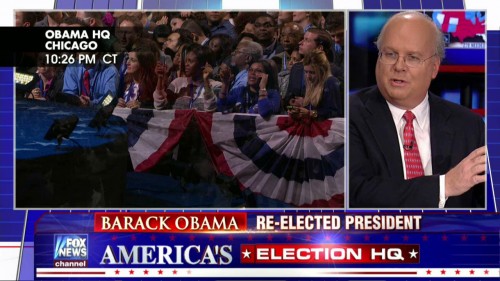
But there was a lot of disagreement, too, between the seemingly independent pollsters. Even some of them apparently fell under the spell of the narrative, finding underground currents where there were none. As this Chronicle article points out, the quants won out over the narrative folks where prediction is concerned.
Me, I am not a quant person. I’ve always been a qual person and, in part to compensate for lack of quant chops have a well-developed sense of the narrative. I am typically good at making at least some sense of a situation and finding useful ways to persuade and articulate. That skill has helped me much as a career as an administrator and executive, explaining complex situations to Boards, presidents and staff, mostly in higher education.
But long reflection does suggest that great care must be taken with the narrative.
Sir Barken Hyena writes:
I’ve long found myself frustrated by the musical culture I’ve had to live in, and been drawn to other cultures as a kind of refuge. At home sick for a day recently, I watched three documentaries on Netflix that aptly highlighted my likes and dislikes, and what I think a healthy musical culture can be. And what an unhealthy one never is.
First up was “I’ll Sing For You”, a well-named and refreshingly unpretentious affair, about the Malian guitarist and singer Boubacar “KarKar” Traore, who’s almost an institution in his home country. Part biopic, part travelogue, part music video, we follow KarKar around Mali while he plays his guitar and sings in various impromptu settings: on a boat sailing down a river, on a train, in villages and homes and ruins. This clip gives a good idea of the flavor of the film (that’s Malian superstar Ali Farke Toure on the right)
Some time is spent on KarKar’s glory years when Mali first gained independence – he’s something of a patriotic figure there – and his subsequent travails as an immigrant in France when he dropped out of sight, and his return and rediscovery. But not too much is made of this, he’s certainly never described as any kind of suffering artist struggling to bring his creative visions to the world. Rather he’s shown as grateful for the mere opportunity to sing for us. Which he does with deep feeling and infinite grace, as the clip shows.
Mali is desperately poor and it’s clear that the people struggle daily with their poverty. One result of that struggle is a musical culture that’s bursting with vitality and feeling, and the Malians are clearly damn proud of it. With good reason.
Next up was “Life After Django Reinhardt”, about celebrating the Gypsy jazz great’s 100th centennial. A collection of guitarists who have followed in his footsteps, some of them also Gypsies, explore their love and devotion to this phenomenal musician. Like “I’ll Sing For You”, it’s an unpretentious production, with lots of vibrant playing and scenes of musicians just having a great time doing what they do best, what they love. They relate various fond memories about how the came to know Django’s music and what it’s done for them. There is little to no discussion of money, the music business, how all of these guitarists make a living, or even if they are professionals at all. That’s not what these guys are about. What they’re about comes through loud and clear in every frame: the pure enjoyment of music, for it’s own sake.
See if you can keep your feet still for this clip (the young guy at the end is Django’s grandson):
And lastly, (sigh) we come back home to the US and “Echotone”, a rambling and definitely highly pretentious doc about the Austin, Texas music scene and the efforts of some poor struggling artists to maintain their integrity in a world deeply hostile. Besides some background about the impact of the city’s explosive growth on the music scene, mostly we follow around various hopefuls as they try to build careers out of their music. In contrast to the other two, I didn’t enjoy even one moment of the musical material, which is the usual indie garbage churned out these days. To my ears there’s not one moment of honest music here. It’s all playacting. There is talent, no question. And dedication, hard work, yada yada, all admirable I suppose. But what is it all for? Why do they bother? Unlike the other docs, this one is pretty much always about money, in one way or another. Like how the musicians never have any, and how the city government never wants to spend money on the music scene, which is somehow a goldmine waiting to be dug at the same time it’s unable to pay for the hipster’s guitar strings.
The constant claim is that they just want to do their thing but strangely they never actually act like it. Mostly they talk about their efforts to overcome public indifference to what they’re doing, while very unconvincingly protesting indifference to the same. And the music clips reveal a discomfiting self-conscious aspect. They remind me of the kids in music stores trying out electric guitars, always looking over their shoulders to see if they’re being noticed while they jam out. Rock stars in their own minds, but they can’t bring themselves to admit that’s what they want, because of the strange obsession with “authenticity”, whatever that is, which is the one thing that escapes their grasp. Well, that and money. And that’s what an unhealthy culture, which this is in my view, can’t produce: real music.
All are on Netflix Instantview.

 Blowhard, Esq.
 Callowman
 Sherbrooke
 Eddie Pensier
 Enzo Nakamura
 Epaminondas
 Fabrizio del Wrongo
 Fenster
 Brundle Guy
 Glynn Marshes
 Paleo Retiree
 Atypical Neurotic
 Question Lady
 Sax von Stroheim
 Sir Barken Hyena
 The Mistaken

