
Fabrizio del Wrongo writes:
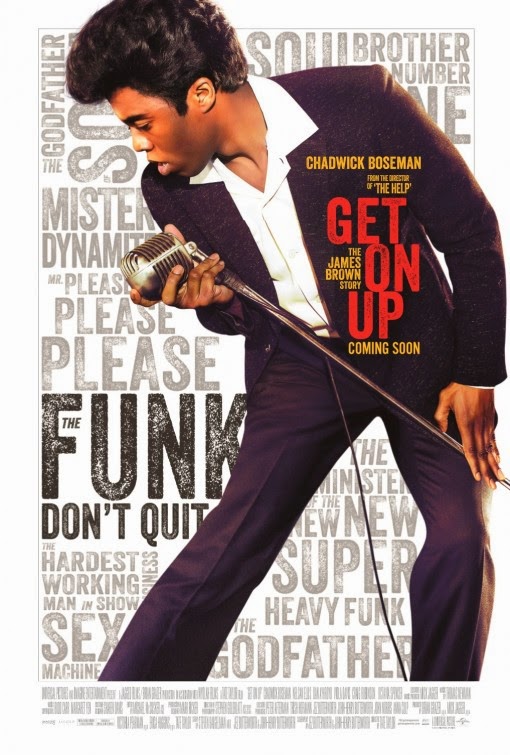
“Get On Up,” the recent biopic about funk legend James Brown, tries to break all the rules. In this sense it’s a bit like Todd Haynes’ “I’m Not There,” which treated the life of Bob Dylan as a medley of styles, attitudes, and costumes. Like “I’m Not There,” “Get On Up,” doesn’t have a clean narrative through-line, but it’s free of that graduate-thesis tone — that brittleness — that can make sitting through a Haynes movie feel like being in school. Director Tate Taylor and writers Jez and John-Henry Butterworth are out to nail Brown as an idea. Their movie is a sort of essay on the artist as a prick and egomaniac — one whose talent and drive were such that the world couldn’t help but slip into his groove.
I suppose it’s trite to describe the movie’s rhythms in musical terms, but that’s what I think Taylor and editor Michael McCusker are going for: The tempo is offbeat, and the manner in which the cutting slides us into and out of different time periods can feel a bit like syncopation. That’s not to say the approach is always successful: there are moments when the picture’s cleverness is apparent more in concept than in execution. But even at these moments I was willing to go with it, perhaps because I’ve seen enough biopics to be wary (and weary) of their conventions. The standard elements of the genre are present in “Get On Up,” but they’ve been filliped, curlicued, truncated. We see that Brown gets involved in drugs, womanizes, and beats his wife — yet we’re denied the narrative effects we expect to flow from the introduction of these elements. At one point we see that Brown’s son has contracted impetigo, but it’s never followed up on; it’s not even explained. Does it need to be? We understand that Brown is an unsatisfactory father. And when the boy later dies in a car crash, our minds fill in the pieces that are missing from the story. That disease, introduced in so unexpected a manner, stays with you in a way a standard scene of neglect would not.
Many have complained about the unconventionality of the movie’s structure. For these folks the narrative beats of the biopic are like the Stations of the Cross: their fulfillment is an end in itself. They want to see the scene in which Brown suffers for doing drugs, in which the battered wife has her say, in which someone chastises JB for mismanaging his money or not being there for his kids. They want these scenes not because they bring them closer to the subject, but because they involve them in a ritualized drama that allows them to feel that the subject has been brought closer to them. Taylor and the Butterworths have, for the most part, dispensed with all that. Instead they’ve given us a movie that keys us into the various facets of ambition and talent — many of them thorny, even unpleasant — and asks us to reckon with them. The points the picture makes are disbursed; they aren’t organized in a linear, one-thing-follows-another fashion. It might help to view “Get On Up” as a scattergraph rather than as a biography. In some ways it’s closer to “Tyson” than it is to “Ray.”
The movie does overdo a couple of ideas. I grew tired of the callbacks to the actor who plays the juvenile Brown; they’re inserted into the picture whenever the filmmakers want us to remember the singer’s roots as a pauper and an orphan. There’s a sort of desperation in this, a sense that Taylor is worried you’ll fall out of sympathy with his subject. It’s hard to blame him: he is, after all, making a commercial movie. Yet it’s deadening because it contradicts the fast-and-loose bravado of the surrounding material. I had similar feelings about some of the scenes between Brown and his friend and bandmate Bobby Byrd. Byrd, who is played by the beatific Nelsan Ellis, is saddled with the Joseph Cotten role from “Citizen Kane,” and his nobility gradually becomes a bore. Fortunately, the character is redeemed somewhat by the wonderful last sequence, which has Brown plaintively serenade his wayward friend with a moving a capella version of “Try Me.” It’s one of the more affecting evocations of male friendship in recent movies.
It makes sense that Brown would make peace through song: The movie’s theme, expressed through its style as well as in words by a producer character while attempting to describe the appeal of Brown’s grunts and squeals, is that surface details are capable of conveying a deeper resonance, a fuller meaning. And the timbre of Brown’s voice in that sequence says all that’s worth saying about his feelings for Byrd. What is the meaning of James Brown? I think it’s to the movie’s credit that it doesn’t present you with one — you have to glean it from the details. It’s in the keyed-up dazzle of the editing and the sizzle of DP Stephen Goldblatt’s period images, many of which have the closeness and heat of vintage concert photographs. It’s in the screenplay’s pugnacious refusal to apologize, explain, or make excuses. And it’s in the sinewy performance of Chadwick Boseman, who portrays Brown as a man challenging the world to keep pace with his talent.
I didn’t love Boseman’s performance as much as many others did. There are moments when you can see him trying to summon Brown’s gnomic brand of braggadocio and not quite succeeding. There are even moments when I thought I detected terror in his eyes as, probably, he delved deep for something and then realized he hadn’t quite found the right vein. This usually happens when the screenplay has him address the camera directly — a problematic device, though it pays off in a couple of instances. Still: Was there a tougher role in movies in 2014? Playing James Brown while avoiding caricature is no mean feat. And in a physical sense at least Boseman is all one could hope for. He maps out in sweat and persistence an image that does justice to the hardest working man in show business.





 Blowhard, Esq.
 Callowman
 Sherbrooke
 Eddie Pensier
 Enzo Nakamura
 Epaminondas
 Fabrizio del Wrongo
 Fenster
 Brundle Guy
 Glynn Marshes
 Paleo Retiree
 Atypical Neurotic
 Question Lady
 Sax von Stroheim
 Sir Barken Hyena
 The Mistaken
