Fabrizio del Wrongo writes:
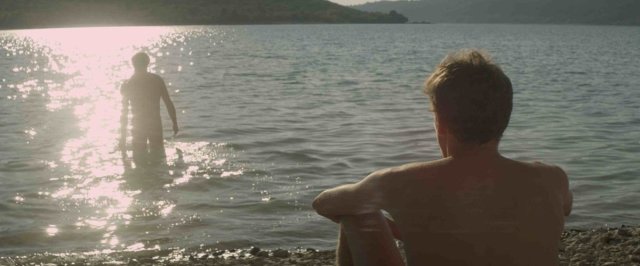
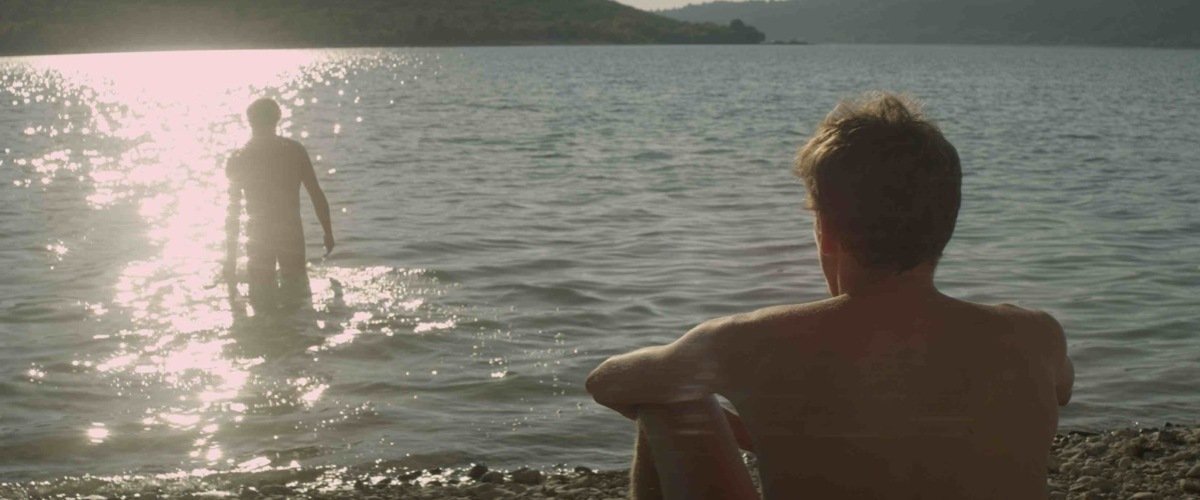
In “Stranger by the Lake,” writer-director Alain Guiraudie mines some of the thematic veins explored by William Friedkin in “Cruising”: it’s a picture about the danger and exhibitionism inherent in male-on-male courtship. The setting is a lake in the south of France where gay men gather to sunbathe in the nude. Slim, tanned, and toned like underwear models, they lie on the gravel-strewn shores, their cocks flopped between their legs in nonchalant advertisement. When an agreement is arrived at, they pair off, put on their sneakers, and stride into the surrounding woods for sex. Then they dress, get in their cars, and go home. We see nothing of their lives away from the lake. In fact, we never leave the locale. Guiraudie wants us to understand that the lake is an independent world with its own set of rules, a place where men gather not just for company but to test their physical limits — preferably in front of an audience. The lake itself is a sexual metaphor: mysteriously placid and rumored to be filled with giant catfish, it beckons the naked bodies with pleasures both tantalizing and menacing.
The stark setting helps to aestheticize the actors’ bodies. Emerging from the water or lounging on the shore, the men have the physical poise — the repose — of the athletes depicted on Greek pottery. It doesn’t hurt that Guiraudie has a painter’s eye for composition; it lends his and cinematographer Claire Mathon’s images a serene monumentality that banishes any hint of tawdriness or camp. (I can’t think of another movie that treats male nudity so classically.) When Guiraudie wants to shift moods, he modulates the lighting and the effects of the sun and weather. As in Rohmer’s films, the wind in the treetops seems keyed to the characters’ inner turmoil. The movie’s design ethos might be described as minimalist, and the urge to pare away extends to the diagrammatic plot, which has Pierre Deladonchamps’ Franck fall for Christophe Paou’s Michel. The latter man may be a murderer, but Franck is too smitten to exercise caution. The resulting conflict plays out in ways that suggest an erotic thriller reduced to its most basic elements.
Not everything works. There’s something banal in the way the knife’s-edge sexiness of Michel is contrasted with the glumness of a lake regular named Henri, portrayed with Depardieu-like fleshiness by Patrick D’Assumçao. I fear we’re intended to understand Henri in straight terms, as the dowdy girl whom the good boy overlooks in favor of the sexy femme fatale. I think we’re also supposed to share in the guilt Franck experiences as a result of his rejecting Henri in favor of someone more exciting. But, then, Guiraudie is aiming for something elemental, and he needs to plumb the banal in order to get at the roots of his material. If he doesn’t quite stick the landing it may have more to do with the fact that his even-keeled, abstracted approach doesn’t grant us access to the madness of Franck’s desire. There’s a melodramatic premise here, but we’re kept outside of it. The tenor is closer to l’amour intellectuel than l’amour fou.







 Blowhard, Esq.
 Callowman
 Sherbrooke
 Eddie Pensier
 Enzo Nakamura
 Epaminondas
 Fabrizio del Wrongo
 Fenster
 Brundle Guy
 Glynn Marshes
 Paleo Retiree
 Atypical Neurotic
 Question Lady
 Sax von Stroheim
 Sir Barken Hyena
 The Mistaken
 Uncouth Reflections