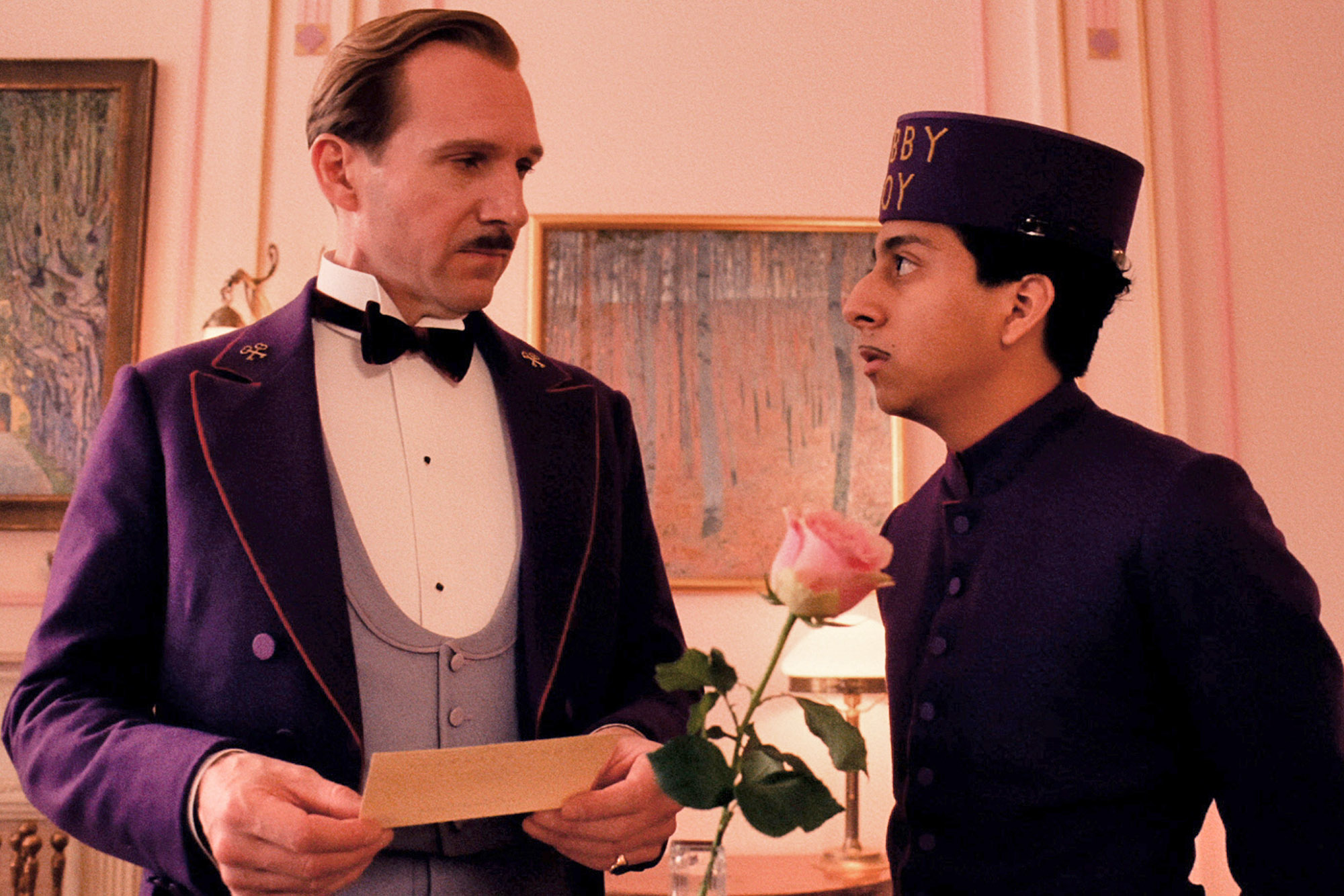
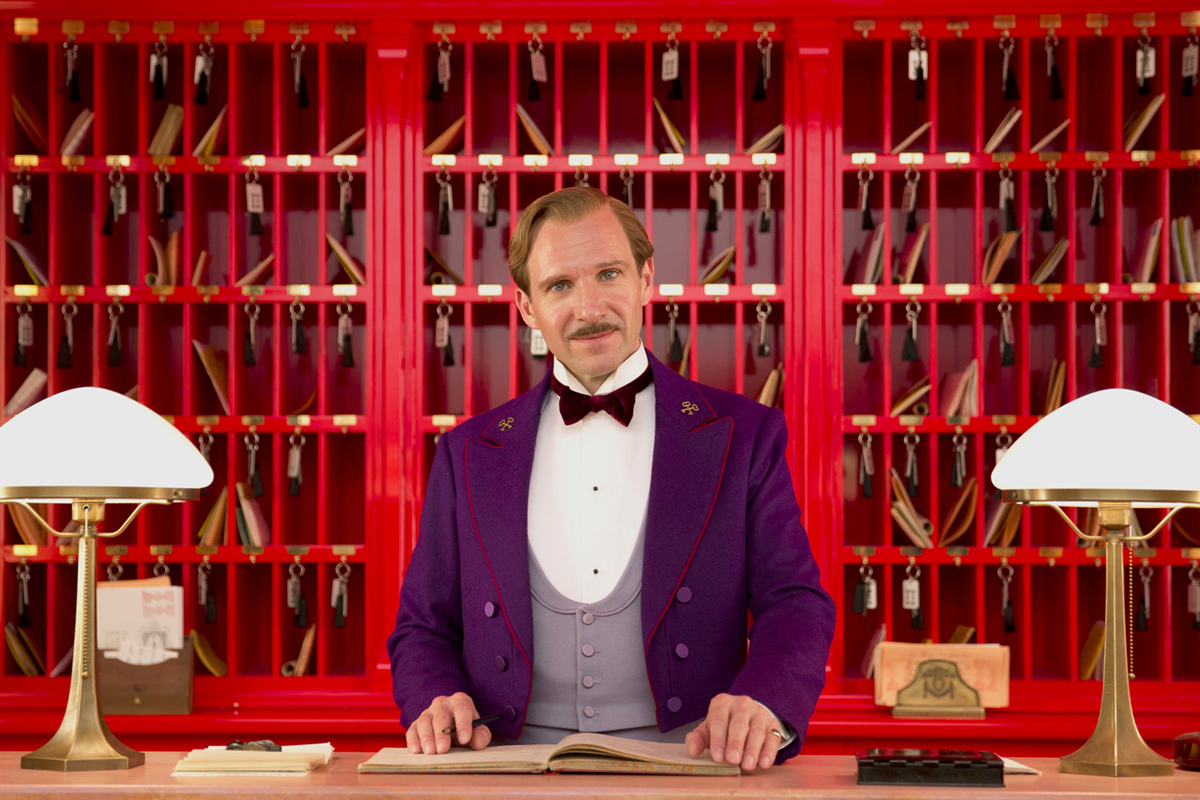
Wes Anderson’s stab at a screwball comedy, watching THE GRAND BUDAPEST HOTEL felt like staring at a wall of hyperactive Swiss clocks. The production design, cinematography, and costumes are simultaneously enchanting and oppressive. The movie it most reminded me of is “300” — so weighted down with design and aestheticism that I felt suffocated. Anderson’s constant symmetrical, centered framing (he even shot the film in the more balanced Academy ratio instead of widescreen) in particular comes off like an Aspie-OCD tick. Along with his use of zooms it flattens the space and makes the film resemble a children’s storybook, admittedly a plus or minus depending on your POV. To ornament even further the narrative is actually a story-within-a-story, like Russian nesting dolls. I empathized with Anderson’s hipster-fin-de-siecle sensibility but I was never involved with the Ralph Fiennes character, here playing a hotel concierge and gigolo who gets involved in a murder mystery, or his relationship with the lobby boy played by Tony Revolori. The film is ostensibly about the decline of civilization, but the hotel is just as stylish (from Belle Epoque to Bauhaus) at the end of the movie as the beginning, so what exactly was lost?
Although I didn’t respond much to the movie, Sax did, so allow me to turn the floor over to him.
Sax von Stroheim writes:
Wes Anderson’s INGLOURIOUS BASTERDS: Civilization — and not just Civilization but the most ephemeral artifacts of civilization (perfume, romantic poetry, paintings, good manners) — as our only real bulwark against Barbarism, riddled throughout with a melancholy suspicion that that might not be enough. I think, like Anderson’s last two live actioners (DARJEELING LTD and MOONRISE KINGDOM), that it’s a great movie and something that I’d call a masterpiece if I didn’t think that that word is slightly inappropriate. Not because the movies aren’t great — I think they’re among the greatest contemporary American movies — but due to Anderson’s deliberate holding back, a defensive push-pull that drives him to undermine these perfectly choreographed and art directed moments, as if he’s the Marquis de la Cheyniest sabotaging his own prized clockwork toys. It’s a movie that wants to believe in masterpieces but retains a painful sliver of skepticism. Anyway, in these last three movies, Anderson shows himself to be the heir of the great Hollywood auteurs of the 30s (mainly Lubitsch, Von Sternberg, Hawks, but also, in MOONRISE KINGDOM, Walsh), but a true 21st-Century American Renoir.
I’ve decided to switch the Prog Selection to the broader Art Rock category, which in my mind contains Prog but also embraces antithetical works from the punk side of the spectrum. An early pointer to which we have here in this wonderful, funky and bizarre track by Eno. With the incomparable rhythm section of Percy Jones and a pre-superstar Phil Collins.
Spotted recently: J.P Morgan/Chase lending support to LGBT Pride Month and Marriott International promoting a trans fashion model. Small reminder to diversity fans — you aren’t fighting the power. You are the power.
Related
Steve Sailer cuts through the fog to identify the power struggle beneath the diversity debates.
The proud and good craftsmen at Xtreme Cuts: Yuri, David and Robert
Thank god the era of the men’s hair stylist is over. Hair stylists, eh? Fussiness, “styling products,” girly smells … It seemed like part of the worldwide conspiracy to make men as vain, as vapid and as anxiety-ridden as too many women are. Yet, for a couple of decades, what really were our options? Traditional barbers were growing scarcer, and the ones who remained in business seemed to lose more of their skills with every passing year. So, off to the hair stylist it was.
But since the late ’90s the traditional barbershop has been making a comeback. (I shared a few snapshots of a genuine old-time smalltown barbershop here.) And since my trusted and excellent barber Frank — is there an HBD explanation for why so many good haircutters are of Italian descent? and why so many of them are named Frank? — mysteriously disappeared three years ago (one day, I moseyed over to his shop, found the building being demolished, asked what had become of Frank … and no one could tell me), I’ve been sampling the work of many barbers and many shops, both in NYC and in California.
Thanks to the fine folks at Century Link, I had no internet for Friday’s Wildcard. But we’re nothing if not flexible here, so we’re going to run with it. Today we have the prescient electronic music of Tom Dissevelt & Kid Baltan, a Dutch duo that made refined glittery futuristic music from the crude and blunt tools of the era. An incredible amount of work went into making these wonders of sound in the pre-multitrack and synthesizer era. And the results stand up today just fine against their MacBook Pro wielding successors.
Italian poster for this staple of the French New Wave. Featuring art by the mysterious Donelli, whose splashy watercolor style graced a few New Wave posters, including a couple for Godard’s “My Life to Live.”
Godard must have liked his work, as there’s a moment in “Contempt” in which one of Donelli’s “My Life to Live” posters is visible hanging in the background. And here’s JLG himself being interviewed in front of one:
I spent some time with the DVD of Peter Watkins’ 1967 “Privilege” the other day. Confession: I didn’t get much out of the movie, which features Watkins’ usual combo of showy modernist stratagems and semi-hysterical point-making. I found it to be terribly paced and pretty blah looking, and I thought the lead performance by Paul Jones was painfully obtuse.
But what do I know? “Privilege” is celebrated by some for the way in which it highlights the propaganda potential of popular performers. I’ll admit that the movie makes some valid points (who would deny that pop icons often command a creepy sort of sway?), though none of them, it seems to me, warrant the apocalyptic emphasis that Watkins gives them. (Though I suspect we can all recognize similarities in the mass appeal of the Beatles and that of Hitler, allow me to suggest that comparing the two might be a little . . . tone deaf.) And I found the filmmaker’s scolding, leftist-professor gaze to be wearying. I kept asking myself: Isn’t it rather ungenerous to condemn pop culture without even trying to appreciate what there is in it that people might respond to? Watkins takes what might have been fodder for a lively travesty — the intersection of mass media, consumerism, religion, and democracy — and uses it to mount a barking denunciation. Where this sort of thing goes I’d much rather spend time with “Wild In the Streets,” “The President’s Analyst,” “Nashville,” or “Smile” — satires that are alive to the appealing aspects of the things they’re skewering.
Fortunately, the DVD that Netflix sent me also included a 1962 documentary on Paul Anka called, with more than a touch of irony, “Lonely Boy.” Directed by Wolf Koenig and Roman Kroitor, it’s believed to have inspired Watkins to make “Privilege.” Frankly, I think “Lonely Boy” puts the later film to shame. In around 20 minutes it gives you the Anka phenomenon in all its layered grotesqueness. There are the screaming girls, both ecstatic and disturbed; the slightly homoerotic coterie of male handlers; the weird spectacle of a pre-fab image made to take the stage and enact itself. The film is very knowing — Koenig and Kroitor are anything but naive — yet it reveals a lot of humanity. You get a sense of Anka’s talent, ambition, and charisma. (He suggests a cross between a Caravaggio model and Mickey Mouse.) And the girls who worship him are, in their intensity and vulnerability, touching and unnerving in ways that only young girls are capable of being. Koenig and Kroitor are open to the human aspects of fandom. Watkins, by contrast, surveys the pop landscape and sees only automatons waiting for the jackboot.
In summary, I found the unassuming “Lonely Boy” to be strange and provocative, the archly radical “Privilege” a snooze.



 Blowhard, Esq.
 Callowman
 Sherbrooke
 Eddie Pensier
 Enzo Nakamura
 Epaminondas
 Fabrizio del Wrongo
 Fenster
 Brundle Guy
 Glynn Marshes
 Paleo Retiree
 Atypical Neurotic
 Question Lady
 Sax von Stroheim
 Sir Barken Hyena
 The Mistaken
