Fabrizio del Wrongo writes:

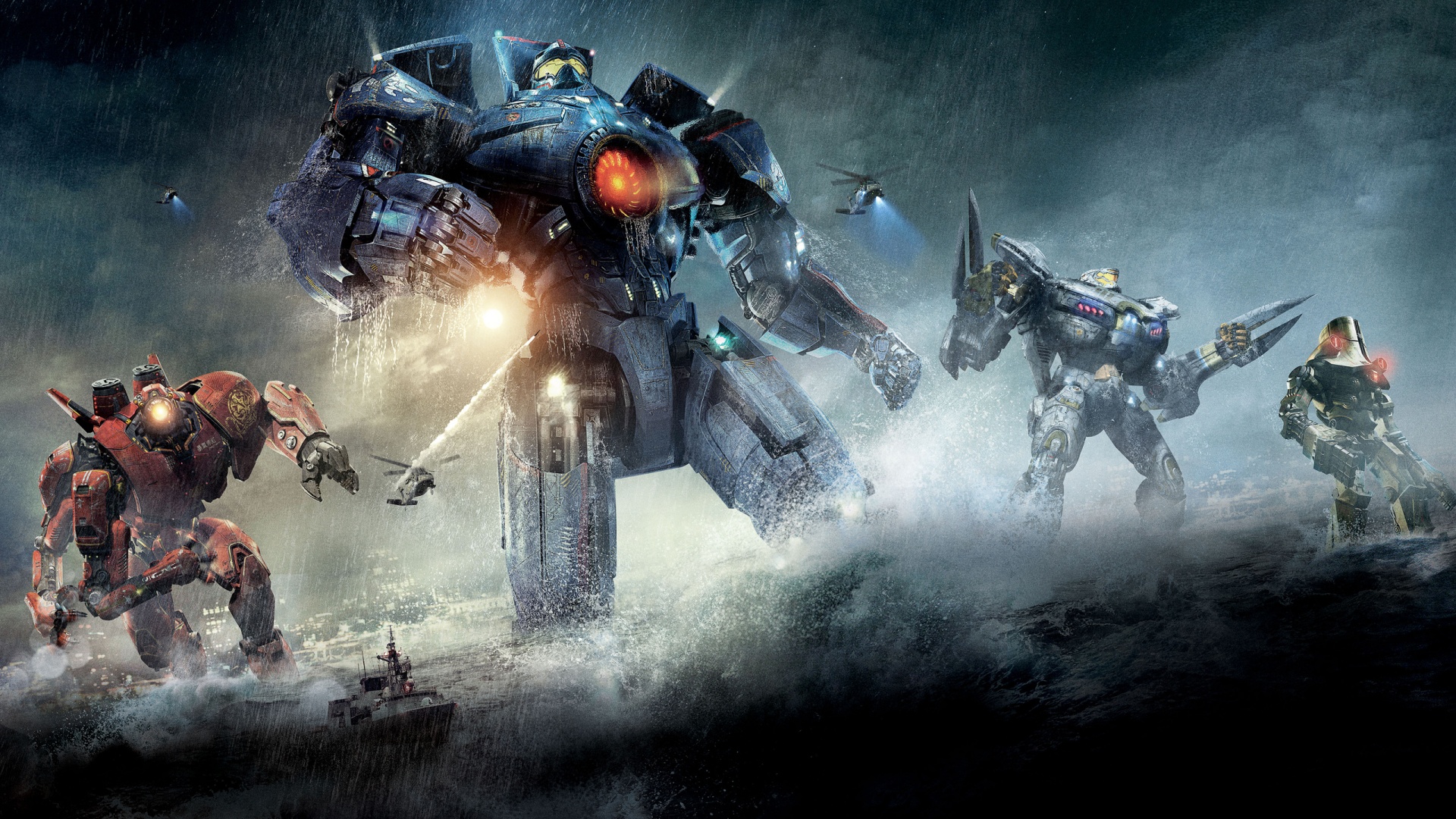
The ad campaign features more cool images than the movie.
“Pacific Rim” comes across as a dream project for director Guillermo del Toro, his chance to blow his geek-visionary load while fireworks explode on the soundtrack. The concept is suitably awesome: giant robots battle giant monsters in an apocalyptic showdown. It’s strange, then, that the movie is so lacking in basic virtues, like verve and excitement.
Del Toro made his name with atmospheric creep-outs like “Cronos” and “The Devil’s Backbone,” and his flair for baroque design and organic yuckiness brought pulse to routine projects like “Mimic” and “Blade II.” But he’s not much of an action director, a fact made clear by his two “Hellboy” pictures, both of which fall apart as soon as they turn into big-canvas extravaganzas. Some filmmakers — del Toro’s friend Peter Jackson, Robert Zemeckis — find their voice in complexity; they’re natural-born jugglers. Del Toro, on the other hand, is best when he hones in: the most memorable bits in the “Hellboy” movies are those set in the heroes’ underground lair (a sort of geek Shangri-La), because the director is able to bring out the passion and tenderness inherent in the characters’ eccentricities (it’s clear that del Toro identifies with these freak outcasts). That kind of intimacy is vital to del Toro’s effectiveness: He’s essentially a miniaturist, a curator of details and curiosities. When broadened in scope his work retains the fetish for detail but loses the intensity of focus that made it seem so alive. It’s as though a piece of medieval marginalia had been copied to a mural at a scale so large the eye can’t take it in. When this happens del Toro’s movies turn to mush; you can almost feel the director flailing.
“Pacific Rim” is virtually all big-canvas, and much of it is a mess. The narrative, which centers on the efforts of a robo-pilot named Raleigh to prove himself to the brass (there are echoes of “Top Gun”), is both overly familiar and poorly engineered. Del Toro and co-screenwriter Travis Beacham blur the storyline with complications, and they end up detracting from the ding-a-ling appeal of the concept. A romance between Raleigh and his co-pilot, a wee Japanese woman who — too predictably — is a whiz at martial arts, is bloodless from the get-go (Maverick and Goose generated more heat), and a subplot in which a scientist attempts to mind-meld with the beasties has more weight in its build-up than in its payoff. I was grateful for Idris Elba, who plays the good-guy honcho; he has a sturdiness that keeps you oriented, even though his character’s motivations often seem to be hovering about his head like comic-book thought balloons. And Ron Perlman is amusing in a role that’s too small. (His name made me giggle: he’s called Hannibal Chau.) But it’s not enough to compensate for the hole at the movie’s center. As Raleigh, Charlie Hunnam has no cockiness or charm, leaving you with nothing to root for. And del Toro allows the actor to look foolish: When Hunnam wants to communicate bravado, he hooks his thumb behind his belt and does a self-conscious saunter. He looks like a bar douche preparing an approach.
For a movie dedicated to Ray Harryhausen and Ishiro Honda, the behemoths of “Pacific Rim” are strangely lacking in personality, something you’d never think to say of the Ymir or Godzilla. Del Toro doesn’t invite the eye to linger: the monsters are shown in a blur of bits and pieces, the robots mostly in crowded hangars as they’re tinkered on by futuristic garage mechanics. When the combatants galumph into action the images are shrouded in computer-assisted water and darkness, presumably to conserve on the effects budget. I spent the movie straining my eyes, trying in vain to appreciate the wonders that had been promised by the ad campaign. It doesn’t help that the editing is jumbled and close-in, failing to give these giants the breath and space they need to live in the imagination. At nearly every turn, “Pacific Rim” substitutes chaos for awe.
We’re twenty years into the CGI revolution. Is it possible the products of computer animation have become less satisfying? The dinos of “Jurassic Park,” created by practical effects gurus like Dennis Muren and Phil Tippet, were made in conscious emulation of Harryhausen’s style, his tinkerer-magician’s spirt. That T-Rex may have been compiled by a computer, but it had presence — it performed. Now effects are split up among digital factories (at least eight on “Pacific Rim”) and carried out by teams of computer jockeys who specialize in minutia (one might do skin textures, another hair). This has resulted in movie monsters that feel cranked out and impersonal — that lack soul.
Soullessness wouldn’t be fatal if del Toro had the visuospatial instincts necessary to give his sequences majesty and scale. That’s what made moments in Michael Bay’s “Transformers” films so jaw-dropping. Bay is a crass opportunist, but he has a gift for working big. And there’s nothing in “Pacific Rim” that can touch the best bits of “Dark of the Moon,” like the incredible skydiving sequence, or the scene in which a giant roboticized drain snake pulverizes a building in a cyclone of destruction. Bay is reviled by critics and large swathes of the filmgoing public because he makes movies that have the sensibility of big-budget beer commercials. Del Toro, by contrast, is beloved for his fanboy rhapsodizing and his sensitivity towards genre archetypes. But Bay’s giant robot movie accomplishes something del Toro’s doesn’t: it transforms pixels into genuine spectacle.
Visually, “Pacific Rim” is most notable for its use of light and color: del Toro and his team have given the film a look that is consistent throughout the story’s settings, from the heroes’ militarized hangar to the streets of a “Blade Runner”-inspired Hong Kong. Here the movie’s darkness is effective: the glowing neon lights and the monsters’ bioluminescence create the impression of a nighttime world alight with hidden marvels (it’s like the deep-sea exploration footage familiar from nature documentaries). But there’s a downside to this kind of fussiness: the digitally shot film has been so tweaked through color-grading that its teal-orange palette is oppressive. It’s there in shot after shot; I couldn’t get it out of my consciousness. Digital technology was supposed to open up new possibilities for the look and design of movies, and in many ways it has. But it’s also resulted in a depressing sameness. Like their CGI monsters, the look of summer blockbusters is both technologically impressive and devoid of something essential, something perhaps related to the hard-to-pin-down set of qualities that gave traditional film its complexity and suggestiveness. Is it possible we’re witnessing the auto-tuning of movies?
The best thing in “Pacific Rim” might be the prologue, which fills in the picture’s back story with big, semi-satirical strokes that made me think of Paul Verhoeven. Here the movie is light on its feet, knowingly tongue-in-cheek, and smart. We even get a great “holy shit” image of a monster dismantling the Golden Gate Bridge (it’s an homage to Harryhausen). This sequence made me yearn for a “Pacific Rim” more in line with del Toro’s strengths — one that isn’t trying so hard to rock your world. Maybe we’ll see it in the prequel.
Related






 Blowhard, Esq.
 Callowman
 Sherbrooke
 Eddie Pensier
 Enzo Nakamura
 Epaminondas
 Fabrizio del Wrongo
 Fenster
 Brundle Guy
 Glynn Marshes
 Paleo Retiree
 Atypical Neurotic
 Question Lady
 Sax von Stroheim
 Sir Barken Hyena
 The Mistaken
