Linkathon

Paleo Retiree writes:

Posted in Education, Linkathons, Politics and Economics, Sex, Uncategorized | Tagged , , , , , | 1 Comment

Atheism and Empathy

Fenster writes:

At the epiphenom blog, Tomas Rees takes a look at empathy and atheism.  The title of the blog post is “Atheists Lack Empathy and Understanding”.  The post reviews existing studies that correlate atheism and autism and goes on to focus more closely on one academic study that uses statistical methods to chart causality relative to factors such as belief in God, autism, gender, tendency to systematize and empathy.  As he concludes:

. . . in the end, this is really good evidence that, at least in the kinds of religion favoured in the USA, an inability to empathise and read other peoples minds is linked to decreased belief in personal gods. But why might this be?

Well, actually it fits well with other research which finds that loneliness can increase belief in the supernatural. And it also fits with brain imaging studies that found that highly religious people who engage in personal prayer use the same parts of their brains as they would when talking to a good friend.

So it seems that an essential part of the belief in a personal God is the ability to relate to it as a personal friend. It perhaps then isn’t surprising that people whose minds don’t work that way are less likely to believe.

Interesting.  It makes intuitive sense to me that the tendency to believe in a supernatural type God could well be associated with psychological or physical differences.  And that autism/empathy could well be one of those axes.  None of this tells you much, though, about whether any such beliefs are well founded.  Who can make the more credible case about God’s existence–those with more empathy or those with less?

Whether autism is a disease or a natural expression of the genome, most people are not autistic and will therefore tend to value empathy, as well as its fruits.  In turn, there may be a tendency to jump from an appreciation of empathy to support for a belief in a supernatural God.

A good deal of the discussion in the comments section relate to the title of the blog post, which is “Atheists Lack Empathy and Understanding”.  Several considered this a perjorative version of the study’s actual conclusions, which don’t have to be read as uncharitable toward atheists.  After all, as one commenter noted, the headline could just as easily have been “Low Empathy can Lead to Atheism”.  Or even the likely Dawkins version: “Empathy a Necessary Precondition for God Delusion”.

Posted in Philosophy and Religion | Leave a comment

Juxtaposin’: Automotives

Fabrizio del Wrongo writes:

Posted in Television | Tagged , , , , , , , , , | 8 Comments

Linkathon

Paleo Retiree writes:

Posted in Linkathons | Tagged , , , , , , | 9 Comments

Thoughts on Nassim Nicholas Taleb’s “Antifragile”

Atypical Neutoric writes:

This will not be a book review in the classic sense, i.e. I will not pick nits or ride a hobby horse. Nor will I deliberately misunderstand the author’s position, all the easier to replace it with a straw man that I proceed to denounce out of smug superiority.

Antifragile: Things That Gain from Disorder, the most recent book by Nassim Nicholas Taleb, a self-described flâneur, quondam options trader and author of Fooled by Randomness and The Black Swan, is a book that bears re-reading. I finished my first read-though last weekend and am certain to return to it some time soon. What I would like to comment on here is how some of NNT’s observations can be applied in areas other than one’s portfolio of financial investments. I was pleased to discover that even before I read the book, I was, in many ways, on my way to becoming an antifragilista, if not flâneur, in my own right, especially in the areas of health, diet and exercise.

Indeed, NNT would be the first agree that a person’s most tangible assets (life, health and sense of well-being) are more important and more at risk by what he calls fragility in modern life than his stock portfolio. An object or system (either living or inert) is fragile if it is harmed by volatility (shocks, bad surprises, stressors, sudden changes in routines, etc.), is robust if is not and is antifragile if shocks, bad surprises, stressors, sudden changes in routines not only do not harm it, but actually make it stronger, better, healthier and so forth. NNT’s point is that robustness is not enough.

In the area of health, increasing one’s own antifragility entails applying the via negativa (knowing what not to do) and avoiding iatrogenics, harm done by the healer, including especially side effects. While NNT uses iatrogenics by extension for harm caused by policy makers in the attempt to “do something”, literal, as opposed to metaphorical, iatrogenics touches everyone, especially those who don’t mind being called “health care consumers”. But doctors aren’t necessarily evil; they simply suffer from the same cognitive biases that their patients do, namely a preference for doing something as opposed to doing nothing (and letting nature take its course) and for adding a substance rather than removing one.

In my own life, applying the via negativa and avoiding iatrogenics have involved simplifying my diet by reducing it to simple heuristics (rules of thumb that are useful, but like fire, can be dangerous too if overapplied): a preference for foodstuffs that have been consumed without harm for millennia (meat, eggs, animal fats, wine) and avoidance of novelties (industrial vegetable oils, unfermented sugary drinks, including orange juice). But, in my view, the dietary novelty that has the greatest impact on health is the sheer ubiquity of food, rather than whether a particular item was eaten by hunter gatherers or not. To mitigate the risk of overeating that this abundance poses, I simply do not eat breakfast. Or rather, I eat breakfast at lunchtime, when I am less likely to be offered something sickeningly sweet in the cafeteria at work. This is much simpler than, say, counting calories or macronutrient blocks, and far less stressful to apply. This is what makes it robust. What makes my no-breakfast heuristic antifragile is that applying it guarantees that I do not eat the same amount each day, and that I am hungry until noon (hunger is a beneficial stressor), yet manage to eat enough on average. I am also free from dependence on the factuality of accompanying narratives (such as whether Gary Taubes is totally or just partially right about Why We Get Fat) or other attempts to turn heuristics into isms.

Posted in Books Publishing and Writing, Food and health | Tagged | 3 Comments

“Wonderland”

Blowhard, Esq. writes:

wonderlandWhile browsing through the clearance table at my local Barnes & Noble, I came across this Michael Winterbottom movie for $2. Probably my favorite movie last year was Winterbottom’s “The Trip,” and given that two bucks is less than I pay for my morning coffee, it was a slam dunk.

“Wonderland” is a plotless slice-of-life about three lonely, working class London sisters as they deal with their various hook-ups, baby daddies, and parents over a four-day period. In its attempt to juggle various intersecting lives and relationships, it appears to be Winterbottom’s attempt at an English “Nashville” or “Short Cuts.” Coincidentally, “Wonderland” was released in 1999, the same year as Paul Thomas Anderson’s “Magnolia,” itself an homage to Altman. But as Paleo Retiree points out in his piece on Winterbottom’s “9 Songs,” whereas Anderson seems to work only in an Oscar-baiting, swing-for-the-fences, operatic mode, Winterbottom’s films are in a much more relaxed, minor key.

Well, this movie was a bit too relaxed and minor for me. Winterbottom shoots it with a grainy filmstock and dialogue that feels improvised to give it a verité feel, but the almost total lack of narrative drive made it easy to hit the fast-forward button more than a few times. That the first major conflict comes at the 48 min mark of this 1h 50min film should give you an idea of the movie’s listlessness. Roger Ebert says in his review, “While most plots march from the beginning to the end of a film, these kinds of films move in circles, suggesting that life is not a story but a process. They’re more true to life.” But, everyday life can be pretty boring, can’t it? On the other hand, I enjoyed the fact that Winterbottom showed regular London life and not a sexed-up tourist destination — while Tower Bridge, St. Paul’s Cathedral, and the National Gallery all appear in the movie, they’re pushed into the background or caught out of the corner of the camera’s eye.

More:

Posted in Movies | Tagged , , , , , , , , | 3 Comments

Jack Donovan’s “The Way of Men”

Fabrizio del Wrongo writes:

TheWayOfMen02

I enjoyed Jack Donovan’s book about manliness, “The Way of Men.” The title has a dual significance. On the one hand it frames the book as an investigation into what it means to be a man in the primeval sense — a sort of “Beyond Thunderdome,” back-to-basics look at masculine modes and forms. But on the other it signals that it’s a “how to” manual designed to light a way forward, to clear a path for 21st-century dudes who feel neutered by our current gynocracy and are yearning for a way to get their balls back.

Continue reading →

Posted in Books Publishing and Writing, Politics and Economics, Sex, Women men and fashion | Tagged , , , , , , , , | 8 Comments

If It’s Not A Feminist Tract, It’s Crap. Apparently.

Glynn Marshes writes:

I happened across a thread on Goodreads about DH Lawrence’s novel, Lady Chatterley’s Lover. The title of the thread is “Why wasnt Mellors concerned about satisfying Connie”– and here’s a sample of the thread’s comments:

The love story between them was unconvincing . . .

This book is an anti-feminist novel from my perspective. The girl is strong in the beginning, then marries some guy she doesn’t love for no apparent reason, and only when some asshole guy comes along does she learn anything about herself? It just didn’t convince me at all.

Continue reading →

Posted in Books Publishing and Writing, Politics and Economics, Sex | 9 Comments

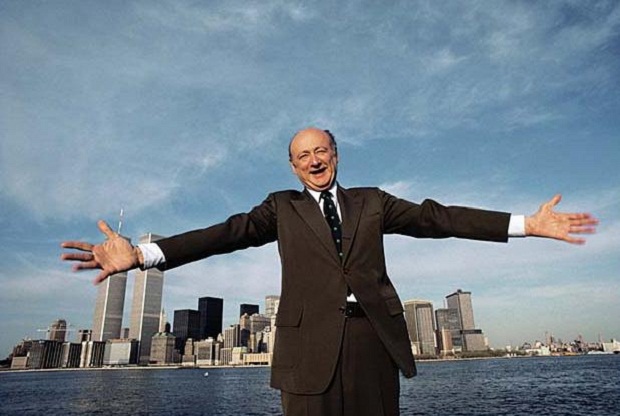
Ed Koch, RIP

Fenster writes:

koch39

Here is the Times’ obit for Ed Koch.  It includes a passage on how Koch’s record has been judged:

” . . . historians and political experts generally give Mr. Koch mixed-to-good reviews.”

Well, OK.  I would myself say mixed-to-excellent but for the Times mixed-to-good will have to do.  As long as you acknowledge that the positive side of the ledger is reserved for the things that were of the greatest importance.  Koch was flawed as are we all.  But he did the right things on the things that mattered the most, and that counts for a lot.

I served in the budget office in New York City in Ed Koch’s first term.  I know the knocks against Koch, especially as he got into later terms in office, and some of them are true.  But I will always hold him in the highest regard for doing what he had to do, which was to fix the fiscal mess he inherited.

Doing what must be done sounds like it ought to be easy but in politics it is anything but.  Politicians are ever inventive at not doing what must be done.  New York City was fortunate that this odd and unusual man was elected, since he did what less odd and unusual elected officials are loath to do: the necessary.  T’was ever thus, and so it remains to this day–witness both Dems and Rs in DC.

The Times‘ obit includes a very interesting video interview with Koch from 2007 in which the former mayor, while of course rambunctious as ever, gives a reflective self-assessment of his years as Mayor.  One section starting at 11:15 jumped out at me, given my time in the budget office.

I’m not a financial genius.  Not at all.  But I know you don’t spend money you don’t have.

So far that sounds right.  You expect him to go on to tell a conventional narrative about how the budget people told him there was no money, how he backed them up and did the right thing, etc. etc.  Right?  Not exactly.  Koch fills in the details adding a twist, one which is important in judging how he comported himself in treacherous political and fiscal terrain.

I’m told by the budget people we have no money. . . I believe my people, and so when the labor people come in and they want to negotiate and they want a raise, I said “Don’t be fucking foolish.  There’s no money here, no food in the cabinet, nothin’ in the refrigerator.  There’s not going to be any increase”. . .

But your labor people know more about your budget, and how much is there, than you do.  And the labor people said, “Mayor, you’re wrong.  You got money!  You got money! And we want it!”  (laughs)  So I go to the budget people and I say “Listen.  Did you tell me the truth when you said there was no money?”  And they’re looking very sheepish.  And I know they didn’t tell me the truth and I say “Listen to me. This is the last time I will tell you.  If you ever lie to me again, you’re fired.  And I want you to know: you think I will give away things you wouldn’t give away.  I don’t give away.  I’m here to protect the city.  But I gotta to know what the truth is, what the facts are, if I’m gonna do it.  You understand?”

That must have been both a good and bad conversation from the point of view of the budget director.  Bad: he’s caught, called on the carpet and his job has been threatened.  Good: the Mayor holds himself out as a different kind of politician, someone who can handle the truth.  A scary conversation too . . . politicians got the city into the mess and their natural inclination would be to keep doing it.  Can this guy Koch be trusted to do the right thing?

It turned out that Koch was up for the challenge.  IMHO he gets an A for this, most critical, part of his mayoralty.  Things got frayed as time went on to be sure.  If there is an argument for term limits, Koch’s three terms make it quite effectively.  Political arteries harden, obligations become barnacles encrusting the ship of state, favors necessary to break logjams morph back into reliable systems of corruption.  Ah yes, but we’ll always have Manhattan, 1979.

He had many lives before and after his terms in office, especially after it, when he simply refused to leave the limelight.  Not many can say, as Wikipedia says of Koch, they they have been a “lawyer, politician, political commentator, movie critic and television reality show judge”.  Actor, too.  Fortunately, he was good at most, and entertaining at all.  I’ll miss him.

Jonathan Soffer’s book Ed Koch and the Rebuilding of New York City, is the most recent assessment of his terms in office, including the good and the bad.    I wrote about the fiscal crisis a few years back here.  Koch (the documentary film) opens today in New York, just a few hours after his death.

Posted in Politics and Economics | Tagged , , | 7 Comments

Linkathon

Paleo Retiree writes:

Posted in Linkathons | 4 Comments