
Paleo Retiree writes:
Here.
I scored a 78. How’d you do?
Fenster writes:
When I worked at an art and design school, one of the predictable debates centered on the wisdom of interdisciplinary approaches. This particular school was famed for its intense studio orientation, departmentally based. The faculty in each of the 20+ majors strongly resisted calls for interdepartmentalism. Administrators, by contrast, were more likely to be in favor. Academic administrators tend to be synthesis-seekers rather than taker-aparters, and financial administrators liked the cost saving potential.
In the end, the debate raged on educational grounds, as is only appropriate. Synthesizers pointed to a world of the future in which all kinds of boundaries will be spanned, making a pure departmental approach hidebound and reactionary. The departments argued back that the best way to equip a student to take on complexity is deep immersion in one thing, or at least one thing at a time. Learn sculpture; the better to move on to film.
Something of this debate can be found in E.D. Hirsch‘s current article in the estimable City Journal. Entitled “A Wealth of Words”, the article argues that the key to upward mobility lies with the prosaic mastery of vocabulary–more, and mere, words.
Hirsch has been known for some time to be an advocate for what might be called old-fashioned approaches to learning. This article is no exception. He argues that the U.S. made a wrong turn when it overly embraced progressive educational thinking. This manifests itself in primary school by an over-emphasis on what he calls “how-to-ism”.
How-to-ism has failed because of its fundamental misconception of skills, which considers them analogous to automated processes, such as making a free throw in basketball. In English class, young children are now practicing soul-deadening how-to exercises like “finding the main idea” in a passage and “questioning the author.” These exercises usurp students’ mental capacity for understanding what is written by forcing them to think self-consciously about the reading process itself. The exercises also waste time that ought to be spent gaining knowledge and vocabulary. The increasingly desperate pursuit of this empty, formalistic misconception of reading explains why our schools’ intense focus on reading skills has produced students who, by grade 12, can’t read well enough to flourish at college or take a good job.
To analogize to the art school, Hirsch would likely take the department’s side. He favors content-based instruction and what he terms domain immersion.
The advantages of content-based instruction are enormous. One is that the topic itself is interesting, so the student has a strong motivation to understand what is being said or written. But an even more important advantage is that immersion in a topic provides the student with a referential and verbal context that is gradually made familiar, which encourages correct guesses of word meanings at a much more rapid pace than would be possible in an unfamiliar context. Psychologists refer to certain skills as being “domain-specific,” so perhaps a better name for content-based language acquisition would be “domain immersion.” The idea is to immerse students in a domain long enough to make them familiar with the context—and thus able to learn words faster.
Old fashioned? Literally speaking, perhaps. But “old fashioned” has a perjorative connotation that may not apply here all that well.
Hirsch also advocates pushing his approach down the age continuum as far as possible, to pre-school. He believes that at least some of the entrenched inequalities in educational outcomes (especially those that are racially-based) can be ameliorated with a renewed emphasis on vocabulary building. He points out that the armed forces best predictor of long term job performance is the Armed Forces Qualifications Test (AFQC), but only after double weighting the verbal sections (essentially vocabulary) over the math sections. The weighted AFQC also appears to make a good portion of the racial disparities go away as well.
I am persuaded in part by my own experience hosting a Chinese exchange student for four months–a high school sophomore at an elite Beijing school. He likes the thematic aspects of his American education, and to some extent dreads a return to the deadening lectures, memorization and long hours studying back home. But he also liked his American school–one of the best, by the way–because it was easy. His curriculum is just further advanced.
Fabrizio del Wrongo writes:
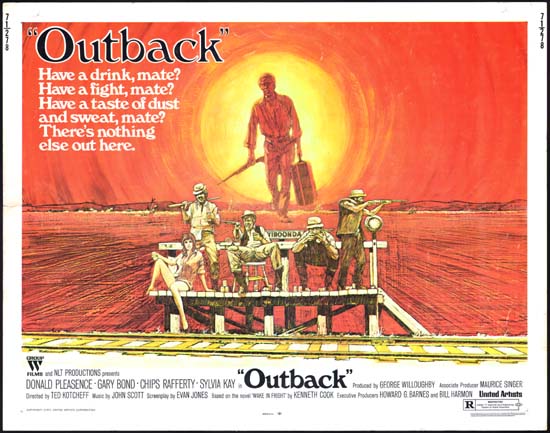
Movies aimed at revealing the essential brutishness of man are pretty hard to pull off. Attempting to scrape through the moral shell — to, in effect, reveal the rottenness of existence — they often end up feeling, well, pretty rotten. An example that springs to mind is the Soviet war screecher “Come and See,” a movie so intent on rubbing your nose in awfulness that watching it feels a bit like being subjected to an act of ritual humiliation. Filmmakers will sometimes attempt to sidestep this by larding the material with pseudo-profundities. “Apocalypse Now” is a case in point. The ending of that movie, in which Brando squats in a temple and spouts undergraduate-level gush about mythology, feels like Coppola desperately trying to will the movie into being about something more than cool war scenes — to assure us he’s got more on his mind than helicopters and fireworks. It didn’t have to be that way: Coppola could have followed Conrad more closely and made the movie about the Martin Sheen character’s slow disavowal of the trappings of civilization. But instead he chose to make Sheen a mini-Kurtz from the start, and so his journey feels perfunctory and suspenseless. When your movie opens with your main character naked and howling into the abyss, where can you go but into mythology?
Fenster writes:
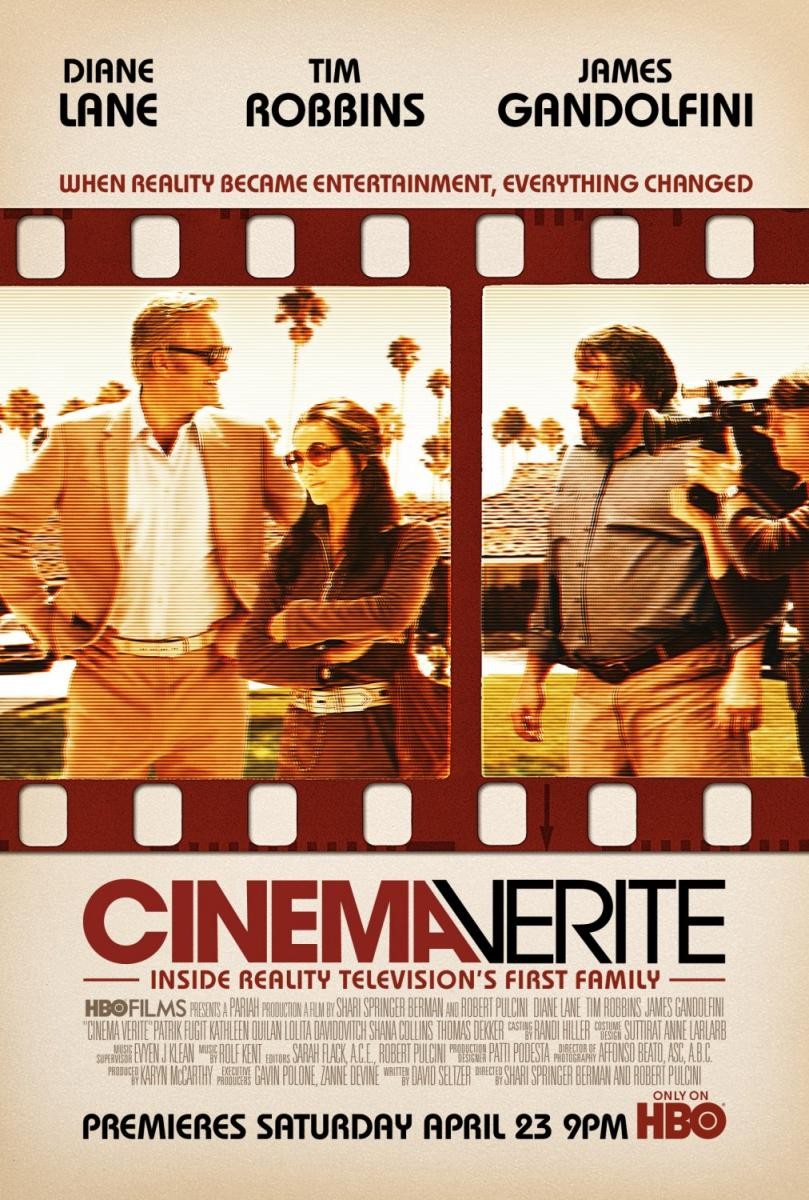
Despite the name, Cinema Verite (2011) is not a straight-up documentary like those of Frederick Wiseman. Nor is is a documentary about a the making of a feature film, like Lost in La Mancha. It is the rarer bird: a feature film about the making of a documentary. (Sidenote: on the DVD, there’s a “making of Cinema Verite” short, so that would constitute a documentary about a feature film about the making of a documentary–the possibilities are endless!)
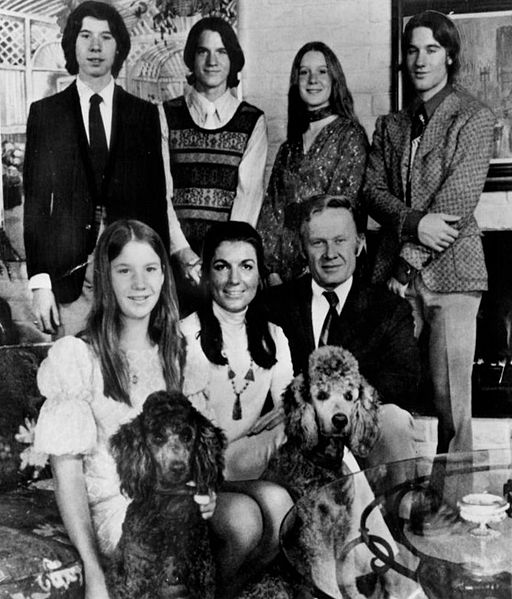
The film charts the making of a series created for public television back when it was more often referred to as educational TV. That show was An American Family, and it charted over 12 episodes in 1973 the comings and goings, cinema vérité style, of the Loud family of Santa Barbara, California.
I wonder how many of this blog’s younger ‘viewers’ will recall the show, and how large an impact it had at the time. It was quite a phenom. The first reality TV show, beginning a lineage that runs to Albert Brooks’ Real Life as well as to Snooki and Jersey Shore.
As is the case with today’s reality TV, all “cast members” had their day in the sun on An American Family. But the stars of the show, if you will, were husband and wife Pat and Bill (seated, right) and son Lance (standing, right). Pat and Bill created drama because their marriage came apart on screen. Lance created drama because he came out on screen–flamboyantly ahead of his time in 1971, when the series was filmed.
The idea behind the show was faintly anthropological. James Gandolfini, playing the show’s creator Craig Gilbert, pitches the show to Pat Loud (Diane Lane) by arguing that the time is right to bring Margaret Mead to America. If so, I suspect he found it hard to be the classic participant observer in his own culture. Everybody got caught up in ways that you might expect when all are members of the same tribe.
In his introduction to the family in the show’s first installment, the real Gilbert says:
The family was filmed as it went about its daily routine. There is no question that the presence of the camera crew and equipment had an effect on the Louds, one which is impossible to evaluate (emphasis added).
One way of thinking of Cinema Verite is that is an attempt to do just that: to evaluate anew the interplay between camera, crew, family, audience–the whole schmear. The new filmmakers want to make it clear that the camera disrupted immensely. And of course they take liberties with the parts of the backstory that never made it to film in “real life” (highlighting the relationship between Gilbert and Pat Loud, for instance) that were clearly not part of the original series, looking to “explain” the goings on in a way that the Gilbert could not in the moment.
But this is a tall order for a feature film out to entertain. For one, there’s the cutting room floor problem. An American Family tried to distill multiple lives over seven months into 300 hours of raw footage and then down to 12 hours of television. The movie condenses further, to 86 minutes. So while the original series had the time to precipitate out at least three dramatic leads (Pat, Bill and Lance), the feature film makes do with one–Pat–and so Cinema Verite is mostly her drama. Seneca Falls trumps even Stonewall, with Selma nowhere to be seen.
Tim Robbins and Diane Lane are well cast. They capture that odd early 70’s moment when hip flowed up to the older, moneyed, upper-middle class. And they could both pass for the characters they portray–especially Robbins, who is a dead ringer for Bill.
My questions:
1. An American Family was high-toned educational TV. Jersey Shore is to laugh. Is this inevitable cultural atrophy, as Hitchcock leads to Hostel or D.H. Lawrence to Debbie in Dallas?
2. Or maybe the gap between the two series is not nearly so great, just as Downton Abbey is not much more than a high-toned soap?
Blowhard, Esq. writes:
The most interesting thing about my latest outing to see Zero Dark Thirty wasn’t the film, it was the theater. I saw it at the iPic Theater, an upscale chain that combines moviegoing with a posh restaurant and bar.
The theater is located in One Colorado Square in Old Town Pasadena…
 …in the building on the right.
 Tickets are $30 a pop, so not cheap, but hey, that includes free popcorn. At this location you go down two escalators and enter the lounge/bar area.
 A hostess seats you and takes your drink order. Cocktails were about $12-$16 each, beer was $6-$8 a glass, and wine was available by the glass or bottle. Oh, that’s right, we’re here to see a movie.

The theater sits 48. Each seat is an electric recliner with a pillow and blanket. That little table you see between each pair had a lit button so you could summon a server to order drinks or appetizers.
As our homes become more like movie theaters — with large flat screen TVs and high-end audio — our movie theaters become more like our homes. It’s a nice experience, but I’m not sure how much of a market there is for such a thing. The price for two people, including tickets and a couple of drinks, can easily hit $100. But I guess some movies really are a different experience on the big screen, so why not splurge if you’re gonna go through the trouble of going out?
Paleo Retiree writes:
No prizes for guessing which breed of dog killed this woman. Or which breed of dog killed this child.
The other day I took a look at a local pets-and-animals bulletin board. Here are the dogs that were being offered up for adoption on it.
 No prizes for guessing which breed they are.
Now, I’m normally in favor of letting people choose how to live their own lives in their own way whenever possible. But where certain breeds of dog go, I sometimes find myself wondering: Is it really worth standing on principle?
BTW and FWIW: When I was a kid, I don’t think I ever encountered a pit bull. When — and why — did pit bulls become such a big part of the cultural landscape?
Paleo Retiree writes:
Blowhard, Esq. writes:
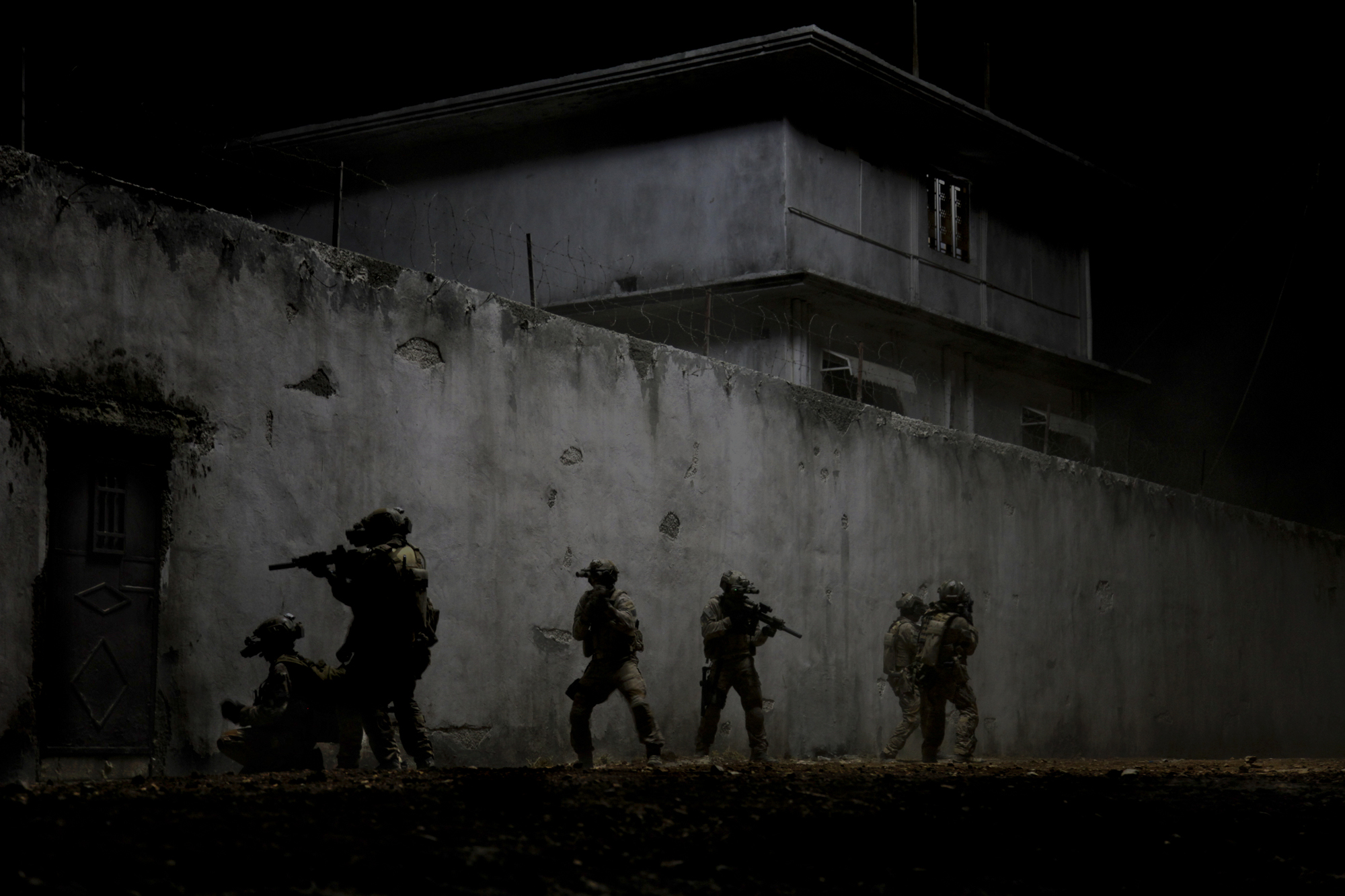
 Effective enough espionage procedural in the vein of Paul Greengrass’s United 93, to which it makes an appropriate bookend. It’s a grunt’s-eye view shot in the hyper-edited, faux-documentary style that continues to pass for “realism.” Dektoring is now twenty years old but shows no signs of letting up.
Jessica Chastain plays Maya, a mid-level CIA analyst who turns out to have the correct theory about where Bin Laden is located. Aside from ultimately being right, her character isn’t interesting nor is her struggle with her superiors, which plays like the stuff of a million inside-the-Beltway movies. Bigelow’s film only comes alive during the pure action scenes, for example when field officers attempt to locate one of Bin Laden’s couriers in a crowded Pakistani street or the final sequence in which the SEALs raid UBL’s compound.
I think Bigelow wants us to see Maya as a sort of Joan of Arc visionary, the only one with the tenacity to see the operaton through over a twelve-year timespan. Indeed, the final shot of the film seems to clearly reference Falconetti’s Joan, although it’s quite possible I was just bored by her that point and I’m reading way too much into it. A friend adds, “I haven’t rooted for a movie character to get laid since The 40 Year Old Virgin.”
 More
More
Paleo Retiree writes:
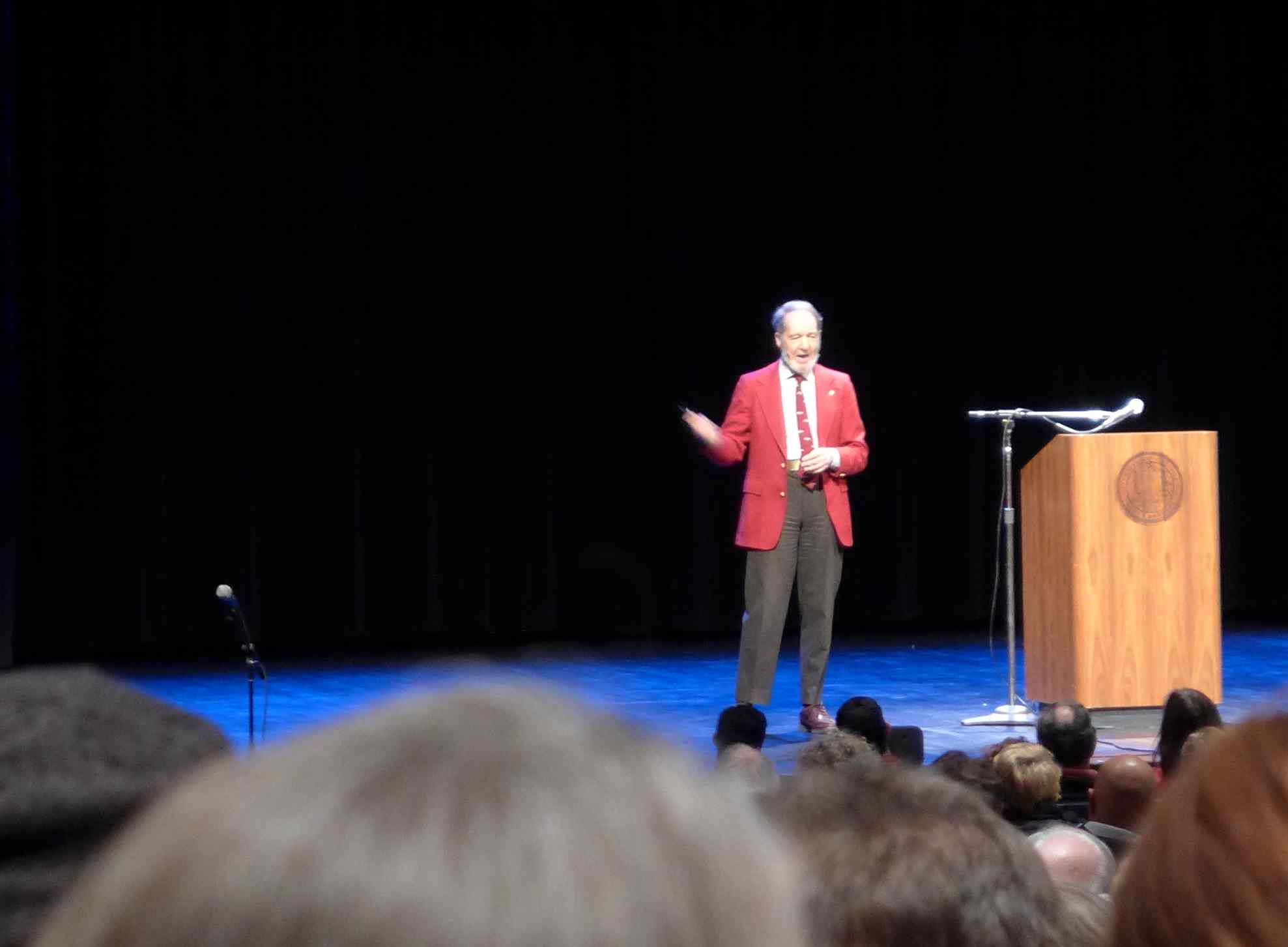
Short answer to the question posed in the title of this blogpost: I have no idea. But that’s not going to stop me from sharing some musings and hunches anyway.
Diamond is a bit of a puzzle. A much-celebrated scientist and author — he’s a prof at UCLA; he has spent long stretches doing fieldwork in New Guinea; his books (such as “Guns, Germs and Steel” and “Collapse: How Societies Choose to Fail or Succeed”) sell in the millions; he’s got a list of awards and prizes a mile long; and he’s a hero to the PBS-and-National-Geographic crowd — he’s clearly a substantial and knowledgeable guy. Yet to some (I’m among them) he’s also infuriating.
The main reason why: Although he’s clearly aware of genetics and evolutionary biology, he seems not just to refuse to accept the implications of both fields but to write in active defiance of them.
His main point in “Guns, Germs and Steel,” for example, is to argue that genetics plays no role — no role whatsoever — in how societies have developed. Where explanations for why some societies are throwing spears while others are launching drones go, you’d think any sensible person would be open — would want to be open — to a variety of factors: environment, genetics, luck, geography … But where Diamond goes, you’d be wrong. For him, all explanations are allowed — he even volunteers some fresh ideas having to do with geography — except for the genetic. For Diamond it’s always and everywhere important to maintain the belief that we’re all the same under the skin. He wants genetic explanations to remain unthinkable, in other words. Why should he be such a nitwit?
Until the other evening, when the Question Lady and I went to see Diamond speak (he’s promoting a new book, “The World Until Yesterday: What Can We Learn from Traditional Societies?”), I was playing with three possibilities.
1) Perhaps he’s one of those people who’s worth paying attention to only so long as he’s discussing particulars and specifics. Such people really do exist — I know a few of them. Maybe — despite how smart and experienced as he is — Diamond happens to be someone who, when he kicks the generality-level up a notch, turns into a dodo.
2) At least in his books for a popular audience, perhaps he’s more driven by politics than he is by science. For whatever reason, maybe he’s more devoted to maintaining the fiction of egalitarianism than he is to exploring the paths the evidence seems to suggest.
3) Perhaps he’s an opportunist. Peddling bland idiocies while cloaking his arguments in the language of evolutionary biology and genetics hasn’t worked out badly for him, after all. There’s always a market for squishy feel-good messages, and maybe now, what with harsh and cold discoveries in genetics and evo-bio coming fast and furious, it’s a particularly lively one. Maybe Diamond spotted the commercial possibilities in catering to this crowd. Maybe he realized that he could offer the drippier element in the educated-nonfiction-book-buying audience a chance to recharge their belief in the old pieties.
The talk The Question Lady and I attended was OK, if a bit of a snooze. I’m very interested in contrasts between tribal and civilized life — hey, I’ve been one kind of Paleo fan or another for many decades. And while about half of his facts were familiar to me, Diamond’s tales and information were focused and provocative. So long as he stuck to them, you felt like you were in trustworthy hands.
Incidentally, and à propos of not much but my interest in performers: As an onstage performer Diamond is a peculiar creature. With his trim figure, his white Abe Lincoln beard, his bright red sport jacket, and his very weird accent — Boston/Jewish, as it turns out — he’s like an elfin wizard-creature out of Tolkien. And he’s as pedantic as you’d expect a successful veteran prof to be. Even when he goes off-book he speaks like a term paper. He states and restates his points; his sentences are full of fillers like “conversely” and “in short.” (Which left me wondering: Are some people genetically destined to become professors?) But maybe the package is theatrically effective anyway. Maybe to his audience it conveys “I’m a serious and eccentric — yet also bizarrely lovable — intellectual.”
But, sadly, Diamond isn’t a galvanizing storyteller — in fact, his talk left me wondering if he uses assistants to help make his prose more lively and accessible than it would otherwise be, or if he has worked with some really virtuosic editors. And the message his worthwhile bits of info-crunchiness were embedded in was the usual ooze: Let’s not look down on so-called primitive people. They’re people too. And finally: Let’s all strive to be nice to each other. I admit it: my mind did do a little drifting, as it will when liberals are patting themselves on the back for the sweetness of their intentions.
What woke me up was something that slipped out of Diamond in passing. Asked some fate-of-the-earth type question by the usual earnest-and-concerned, worshipful fan, Diamond revealed that he took up writing the big books for the popular audience when he became a parent. Up until the arrival of the kiddies, he’d focused on the kinds of small and tight questions that concern your everyday hardworking scientist. Now that the little ones were here, he knew that it was time for him to set aside academic disputes and start worrying about the future instead.
As far as I could tell, Diamond was admitting flat-out that, right from the outset, he intended his big books to be do-gooding “message” books.
So much for my other explanations for his apparent disingenuousness. He turns out to be a much simpler puzzle than I’d thought. He’d simply come down with what afflicts so many people when they have kids: a bad case of the Worthies. Where his big books go, his main concern hasn’t been to share his knowledge and his thinking. It’s “What shall we tell the children?” My conclusion: maybe Diamond’s books are best taken as morality fables for overgrown kids.
Question Du Jour: How is that a few people who become parents continue to be fun and interesting nonetheless? Surely there’s a book in that topic.
FWIW: In case I’m not being clear, I think Jared Diamond is basically a smart and interesting guy. I don’t look down on tribal peoples, and I have no trouble whatsoever with the idea that we ought to make some effort to be nice to each other. I wish the future well too.
Bonus links
Sax von Stroheim writes:
Night Train to Munich (Carol Reed, 1940)

This isn’t a bad movie, but it suffers a bit because it isn’t a great movie, either, and it brings to mind too many other movies that are great (or nearly great): Hitchcock’s British work (especially The Lady Vanishes, to which it acts as a kind of sequel/remake), Michael Powell’s wartime pictures (especially The Spy in Black, which has more interesting characters), Fritz Lang’s contemporary espionage thrillers (especially Man Hunt, which has a more fully-formed film style), and the better movies Carol Reed would go on to make. This last is the worst of all, because Night Train lacks the kind of poetic/cinematic expression of the characters’ psychology that’s so central to Reed’s best work (the run of four movies from Odd Man Out to Outcast of the Islands). Here Reed is just playing at being Hitchcock, and while it isn’t a terrible impersonation, nothing in the movie gave me the sense that his heart was in it. I did enjoy the movie’s special effects: the climactic sequence is set on a gondola, and its quite nicely put together with rear projection shots and shots using a model.
 Blowhard, Esq.
 Callowman
 Sherbrooke
 Eddie Pensier
 Enzo Nakamura
 Epaminondas
 Fabrizio del Wrongo
 Fenster
 Brundle Guy
 Glynn Marshes
 Paleo Retiree
 Atypical Neurotic
 Question Lady
 Sax von Stroheim
 Sir Barken Hyena
 The Mistaken

