I have been waiting to see Mark Cousin’s 15-hour documentary The Story of Film: An Odyssey. Good news for me, and for you too if you are interested: it is now on Netflix streaming.
I watched the first episode last night and based on that I am looking forward to the next fourteen.
Cousins is an interesting host: at least so far just a disembodied voice, speaking with a soft, breathy brogue. And it is his own voice both literally and metaphorically–he promises to deliver his own take on things.
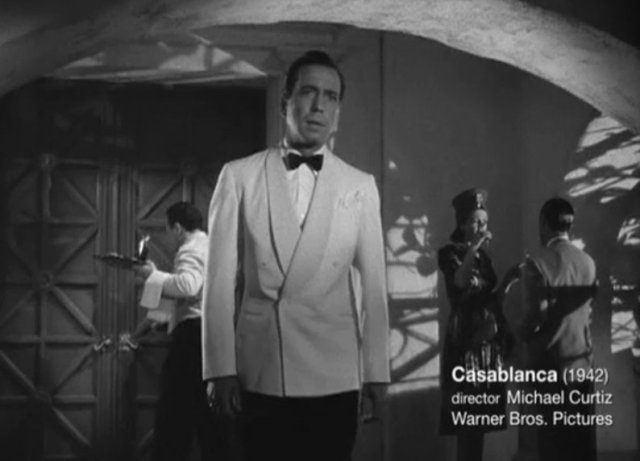
At first thought you guess that the story of film would be about scenes like this one, from Casablanca, full of yearnings, story and stardom?
Because Casablanca is a Hollywood classic. Ingrid Bergman’s lit like a movie star, highlights in her eyes.
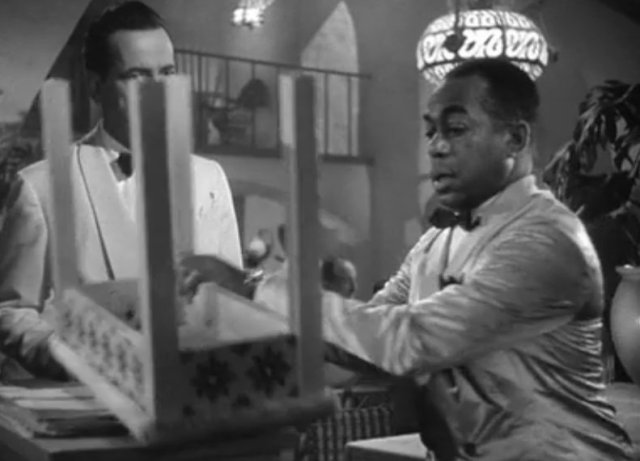
It’s all filmed in a studio set. (Sam puts his piano bench on top of the piano and wheels it away. Cue sad version of “As Time Goes By” theme.)
But films like Casablanca are too romantic to be classical in the true sense. Instead Japanese films like this are the real classical movies.
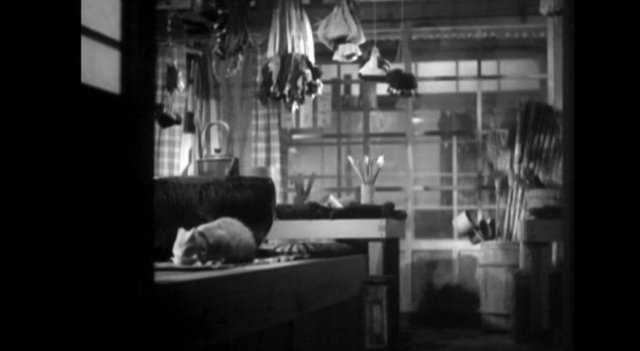
Romantic films are always in a rush, but this moment, in Record of a Tenement Gentleman, is a pause in the story. A cat, a chiming clock (long pause in narration to hear chiming clock and watch cat),
. . . . a kettle quietly coming to the boil, the almost square frame filled with smaller squares and rectangles.
Calm, emotionally restrained, like a little classical Greek temple. So Hollywood’s not classical. Japan is.
That’s throwing down the gauntlet, no? In the first minute of a 15-hour series he opts to take on Casablanca, the veritable poster child of favorite movies (it came in 6th in an AMC poll).
We’ll see if this idiosyncratic view continues. I note that A.O. Scott wrote that the series “stands as an invigorated compendium of conventional wisdom”, so I guess it is possible there will be less than first meets the eye over the next installments.
And indeed, after this heady introduction, the first installment was mostly a somewhat conventional retelling of the beginnings of film, from Edison to Lumiere to Melies to DeMille to Griffith. Cousins does include some nice academic-style discussion of the development of editing techniques to accomplish various tricks, which soon settled into vocabulary. But I was let down in that he failed to mention my first cousin, twice removed, who was co-director, with Cecil B. DeMille, of The Squaw Man, properly identified as the first feature length narrative film made in a Hollywood studio. Cousins credits the film to DeMille only.
But heck, DeMille went on to greater things and my relative sunk into the relative obscurity of character parts, and history is after all told from a victor’s POV.
I am mostly happy in 4/4 but like the odd time signature challenge.
Here are two of my favorites.
First, Blue Rondo a la Turk. This version is performed by Two Generations of Brubeck, which is Dave recording with his talented sons.
Nice how the 7/4 slides into a straight 4/4 blues and then back again.
And here is John McLaughlin doing something similar but more strongly flavored–The Dance of Maya, from the first Mahavishnu Orchestra album.
Here, McLaughlin starts out in 10/8, which is pretty easy to follow as long as you parse it out and think 3-3-4. Like Brubeck, he then breaks into at least a somewhat conventional blues riff. You want the blues to be forced back into a 4/4, as with Brubeck, but there’s something off about the move–it feels like there is a half beat missing or something. Where did it go? The answer, I guess, is that McLaughlin moved from a 10/8 (3-3-2) to a 20/8. That’s 6-6-6-2. Though, since the music is pretty fast, it feels more like 3-3-3-3-3-3-2, with each 3 being felt like a triplet on a single note, which is why when you get to the 2–oops, what’s missing?
This Mahavishnu version of McLaughlin was both musically and spiritually ambitious (I wonder what Philip Larkin made of him?) So after he does the dirge-like 10/8 and the more upbeat 20/8 he decides to crash them altogether and see how it sounds. Like some sort of storm, I think, made more dramatic by the recurring Rite-of-Spring like theme announced by Jerry Goodman on violin.
Here’s a time signature question for the commenters here with actual musical training.
You can take a 4/4 time signature and run triplets on each quarter note. It sounds a little waltz like, but you know you are moored in the overall 4/4 ness of the piece.
OK, so then you actually listen to a real 3/4 waltz. Is there a big difference between the 4/4 with triplets and a 3/4? In the case of the actual waltz, each 3/4 measure ends up being part of a four measure structure, returning you to the feel of 4/4 when considering the larger structure of the song. Is this always the case, or have composers nestled 3/4 measures into larger structures that are themselves three, rather than four, part? What would that sound like? Any examples?
Maybe where music is concerned we can deal with the non-four temporarily, but yearn in the end to return to its stability and resolution.
So then my next question is: why does drama seem to cohere in three parts, following the conventions of the three acts in a well-structured play? And even when we set these in larger frames, corresponding to measure and groups of measures in music, there remains a tendency to want to follow a rule of threes: trilogies. Do we default to 4 in music and 3 in narrative?
File this under questions nobody thought to ask — until they did: Who decided how long “it” has to be in order for “it” to be called a novel?
If you assume the answer’s a matter of form following function, you’d have a point. Length is determined, in part, by how much territory the novelist stakes out to tell his story. Start with multiple characters and a handful of plot twists, and you’re up to 70-90,000 words before you know it. Toss in some writerly nuance and it’s easy to add another 10-20K — and there you are, holding the standard trade paperback. Three hundred pages or thereabouts. Or, perhaps a more useful measure: 5-6 hours of consumer entertainment.
Turns out it’s an oversimplification, however, to think that consumer preferences or gawdhelpus “taste” was the sole, or even primary factor in establishing the 6 hour novel as the form’s norm.
‘Twas avarice & greed made me the 300-page literary form I am today!
People are rightly criticized for criticizing movies they haven’t seen, so I won’t set myself up as a critic of Django, which I have not seen and don’t plan to see.
I don’t know, it’s just that I have seen the trailer and I find the whole enterprise, in miniature form there, so tedious, so faux-shocking, so pre-adolescent, so self-referential-into-a-cul-de-sac that I can’t get it up to spend the time on the long form.
I’ve been down this road before. I doubted that I really wanted to see Kill Bill and Inglourious Basterds after those trailers but took the plunge, with later regrets, in those instances. Unless my curiosity or your comments get the better of me, though, not again.
This was not always the case with Tarantino ‘n me, for sure. I have to admit I really liked Pulp Fiction when it came out, though even then I had reservations about the content. Sure, the violence and the dialogue were both clever, but what works when challenging genre conventions doesn’t always work as well if it aspires to be victorious as a new genre. Every hero is, as they say, a bore at last.
A special exemption, IMHO, for Jackie Brown, which was earnest and honest in its throwbackness. But most of the rest I can do without.
Now, I am not going to criticize Django, as I said. But I will reference a little to-do over the use of the n-word in the film. It is used a lot, apparently, and Drudge has been making much of that fact in his unique fashion–i.e., not by saying anything directly but simply through the number and nature of linked articles. As a left-leaning journo on a Village Voice blog put it:
Drudge just puts the very fact out it there, apparently hoping that it illustrates two weary complaints of white conservatives: 1. That liberals are at best hypocritical and at worst the real racists; 2. That if white conservatives have to watch what they say, than everyone else does, too. The assumption is that Tarantino’s film is, by math, 100 or so times worse than, say, the Fox Nation commenter who just spews it once.
The blogger goes on to defend Tarantino, but he does so in an unusual way. He seems to want to make it out that Tarantino has some kind of Ken Burnsian obligation to history to use the word.
First, and most obviously, the film is set in a time when the word was, for white Southerners especially, practically a synonym for property. To not use it would have been the most distracting of compromises — a whitewash, if you will.
It also helps the the word gets the biggest workout from the leads: a former slave and a bounty hunter who deplores slavery.
This makes sense both in terms of plotting — the duo go undercover as slavers themselves in an effort to free Django’s wife from her own legal bondage — and in terms of verisimilitude.
Verisimilitude?! Did you ever think someone would resort to the v-word in discussing Tarantino? Is it really credible to maintain that using the word 100+ times in a Quentin Tarantino film is an effort to be respectful to history?
Ah, but I am not out to critique a film I have not seen. Perhaps I should see it. The Voice critic seems to think I should:
The film is complex, surprising, and somewhat great. Also, being Tarantino’s, it’s impossible to unpack sight unseen — or even after just one viewing.
Gee, I may have to see it more than once even. We will see. In the meantime, I remind myself of Confucius’ maxim: he who has tongue too firmly in cheek may find head up ass.
Chucho commented on my Desert Island Discs post, mentioning slyly that that old pagan Rowan Williams included a song by the Incredible String Band among the eight he would take to a desert island.
There are some artists just so much of their time (like Lew Lehr) that, however famous in the hothouse, they fade to obscurity quickly as things cool. Nowhere is that truer than the hothouse environment of the sixties. ISB was a pretty big deal Way Back in the 1960s*, among other things performing at Woodstock, where I think but cannot be sure that I saw them. Their somewhat idiosyncratic music made a lot of sense in the very specific period from 1967-1970. Outside of that period . . . not so much.
The band’s first outing was as a folk trio in 1966. Good stout British/Irish folk music but that was about that.
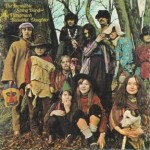
Less than a year later, in 1967, it was clear they’d gotten into the medicine cabinet, or something. Here’s the cover to The 5000 Spirits or the Layers of the Onion. They’d been reduced to a duo at this point of Mike Heron and Robin Williamson, sometimes accompanied by girlfriends and other merry associates.
And in 1968, which Wikipedia calls the band’s annus mirabilus, The Hangman’s Beautiful Daughter was released. As the cover indicates, the music inside was hip and it was hippie but it was also intended quite clearly to look back as much as look forward. And it is about as ripe as it gets. Love it or hate it–this is as far as the magic goes, IMHO. Many albums follow over some years of time but since the moment was gone, much of the magic was, too.
As Rob Young wrote in Electric Eden, his book about the tension between the past and the future in British music from this time:
Paradise is a kind of false-memory syndrome, a clinging refusal to let go of an illusory golden age. Elements are periodically amputated along the way in order to prevent aspects of the culture from becoming gangrenous, but when things are killed off, the voices of these ghost memories tend to linger. The British imagination seems peculiarly well attuned to their uncanny cries.
Steve Sailer has taken to writing recently on the Sixties himself, wondering where the crazed parts came from. The question is understandable: people who grew up in or near the era take the excesses to be a kind of sui generis thing. The world turned upside down, events taking a 180, you had to be there yada yada yada. But in truth, there are no 180s, really, in terms of history.
Of course, we may be tricked into thinking so. In fact, the way our minds work it is almost guaranteed that during a religious revival, enthusiasts will be experience events as a radical break. But connections can eventually be found, after the love has gone and a dispassionate view is possible. So Steve is right in looking to situate aspects of the sixties in terms of prior historical trends and events, like the German Wandervogel movement.
In the US, a great deal of the historical connections were smudged, and lost by the time the urge morphed into Laurel Canyon hipness or the surfer ethic. But you can’t miss the historical connections where the Incredible String Band is concerned. The English (more properly, Celtic) past is right in there, mixed in thickly along with the sitar, exotic harmonies and eastern influences. It made for quite a heady brew.
Had you asked me for my Desert Island Discs in the 1960s I think I would certainly have come up with one or more ISB numbers–probably First Girl I Loved.
What is the job poetry is supposed to do? This may be a definition shaped by unfashionably archaic standards, but I think it’s meant to do at least four things.
It should take us into the realm of myth – that is, of the stories and symbols that lie so deep you can’t work out who are the authors of them, the stories that give points of reference for plotting your way in the inner and outer world. It’s meant to celebrate; to clothe ordinary experience with extraordinary words so that we see the radiance in the ordinary, whether it’s in landscape or in love or whatever. It’s meant to satirise – to give us a sideways glance on familiar ways of talking or of behaving or exercising power, so that we’re not bewitched by what looks obvious and wants us to think it’s obvious. It’s meant to lament, to give us ways of looking at our losses and our failures that save us from despair and apathy.
If you listen to the Incredible String Band’s songs, you realise rapidly that they correspond with astonishing completeness to the requirements of poetry. Plenty of songs of that period managed the celebration or the lament, few could do the myth or the satire. Perhaps for a lot of us growing up in the late-60s and early 70s, there was a gap in the heart where this very traditional bardic, even shamanic, sense of poetry was looking for expression; and the ISB did just that. Forget the cliches about psychedelic and hallucinogenic vagueness: this was work of extraordinary emotional clarity and metaphorical rigour – an unusual combination. Lyrics stick after decades, “Every cell in my body has it all writ down”; “You know all the words and you sung all the notes, but you never quite learned the song”; “The caves where sleep the stars by day”.
And the literacy you might have needed to pick up all the allusions was and is intimidating – Sufism, Celtic myth, Biblical and Gnostic symbols. Combine this with a versatility in musical idiom worthy of Lennon and McCartney at their best, and you have a rare phenomenon: the contrapuntal intricacies of much of Be Glad For The Song Has No Ending, the Caribbean jog of the Hedgehog Song, the sly parodies of Bob Dylan in more than one piece.
For those of us who fell in love with the ISB, there was a feeling of breathing the air of a very expansive imagination indeed. It was all right to be enchanted – but not bewitched (see above) by colossal and antique symbols; all right at the same time to be thinking about the experiences of “ordinary” first loves and first betrayals; and all right to find the earnest nonsense of real hallucinogenic maunderings funny. There was no one quite like them; we liked to think it was a very grown-up taste, but that makes it sound too serious.
If I go back to the start, I’d have to say again that it was simply a discovery of poetry; and as such – risking the embarrassment that so regularly goes with my particular vocation – I’d also have to say that it was a discovery of the holy; not the solemn, not the saintly, but the holy, which makes you silent and sometimes makes you laugh and which, above all, makes the landscape different once and for all.
To be more of a completist, I will mention that there are some interesting ISB videos on You Tube, including a video of the Woodstock performance.
To be even more of a completist, here are the witty and telling lyrics to Way Back in the 1960s (1967):
*I was a young man back in the 1960s.
Yes, you made your own amusements then,
For going to the pictures;
Well, the travel was hard, and I mean
We still used the wheel.
But you could sit down at your table
And eat a real food meal.
But hey, you young people, well I just do not know,
And I can’t even understand you
When you try to talk slow.
There was one fellow singing in those days,
And he was quite good, and I mean to say that
His name was Bob Dylan, and I used to do gigs too
Before I made my first million.
That was way, way back before,
before wild World War Three,
When England went missing,
And we moved to Paraguayee.
But hey, you young people, I just do not know,
And I can’t even understand you
When you try to talk slow.
Well, I got a secret, and don’t give us away.
I got some real food tins for my 91st birthday,
And your grandmother bought them
Way down in the new antique food store,
And for beans and for bacon, I will open up my door.
But hey, you young people, well I just do not know,
And I can’t even understand you
When you try to talk slow.
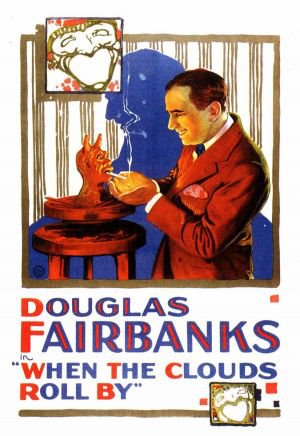
This Douglas Fairbanks project, the first directing effort of Victor Fleming, stands at the nexus of a number of popular art traditions. It dates from 1919, a year prior to Fairbanks’ swashbuckling debut in “The Mark of Zorro,” when Doug was less a superhero and more of an urban go-getter — a more athletic variant of the upbeat everyman Harold Lloyd was beginning to embody around the same time. The plot involves a little bit of everything, from romance to disaster epic to wild slapstick fantasy. It’s such a bizarre mash-up, in fact, that it almost feels like the antecedent of today’s “Crank” films; it works very hard to induce a state of heart-thumping whathefuckitude. [1]
Desert Island Discs is a BBC radio program, one that has been running since 1942 and is one of the longest running radio programs in the world. Various prominent types are asked to imagine themselves cast away to a desert isle and invited to come up with a list of eight musical selections they would take with them. They may also take one book and one luxury item, and are asked to pick one of the eight musical selections that they would save first from the waves.
Needless to say, the selections run quite a gamut owing to the many changes to the world, including to music, that have taken place since 1942. I suspect, too, that changes to the BBC have played a part in the gamut run.
The general idea that the media should elevate has a longer and stronger pedigree over there, with the result that even in 1979, deep into the rock era, one would be more likely to come across Sir Osbert Lancaster plugging for Gluck, Poulenc and Stravinsky than Marc Bolan plugging for Styx. On the pop side, Michael Palin, also interviewed in 1979, did in fact include the Beatles’ Things We Said Today, but in the end opted to save Elgar’s Enigma Variations from the waves first. I suspect there’s pressure to show one’s good taste (in which regard see the snippet from Tom Stoppard below).
Moving on to the current day, there’s an inevitable movement away from the idea of elevation, at least as regards the high-minded classics, but something of the BBC tone remains. The most recent interviewee was (clearing throat) the Rt Hon Eric Pickles, who plumped for Puccini. But it is increasingly the case that popular artists do show up as guests and as picks.
Pickles Plugs Puccini
Various technological and legal factors kept the archived shows from becoming available. Now over 1,800 of the over 2.900 shows are available for download at the BBC. It’s worth a visit, and not only for the downloads but because the website itself is designed to make for a fun tour. You can analyze the site chronologically, of course, by decade. But you can also plug in artists or musical selections to find references to them, and if you select a certain kind of interviewee (a pop musician, say, such as Eric Clapton), the site offers up suggestions for other musicians who have been interviewed (John Lee Hooker, Elvis Costello, Randy Newman).
It can be fun to see how taste works. Have you ever had the experience that someone other than you shares your tastes even though you take yours to be idiosyncratic or eclectic? Is there a shared sensibility that runs through certain kinds of artistic experiences that tilt them in the direction of persons x,y and z but not a, b and c?
For example. I am not a fan of Pink Floyd. Having been pro-psychedelia in the sixties and pro-progressive in the seventies, you’d think I would have been, but no. Yet Roger Waters’ picks totally resonated for me. Neil Young’s Helpless, Leonard Cohen’s Bird on a Wire, Ray Charles Georgia and Chet Baker’s My Funny Valentine have all at one time or another been special to me as specific songs, and not just because of the artists. There was even one selection by Waters (an instrumental number entitled Endless Flight from the Babel soundtrack) that grabbed me in the first few notes. I wondered why Waters and I would overlap to such a degree.
What goes through someone’s mind when being asked on the show, particularly given its long-term prominence in Britain? Do you select songs you listen to the most and don’t get tired of? That you admire the most? That you think will meet the BBC’s expectations?
Tom Stoppard’s lead character in The Real Thing (1982) had to grapple with this decision. The lead character, Henry, is an accomplished playwright and has been asked to be on the show. He would have appeared, and put on the spot, in 1982, at a time when the real show was interviewing a real theater person, the head of the Mermaid Theater Lord Bernard Miles.
Miles goes for Mozart
The esteemed Lord Miles selected a classical-heavy eight, with concessions to non-classics in the form of Art Tatum and Louis Armstrong–high-minded in their own way.
Poor Henry’s anxieties about his upcoming appearance follow:
HENRY: Yes, Charlotte will provide dips for the crudity. She knows where everything is. (Charlotte takes charge of the vegetables. Henry gets a fourth glass.) Sit down, have some buck’s fizz. I feel reckless, extravagant, famous, and i’m next week’s castaway on Desert Island Discs. You can be my luxury if you like.
ANNIE: I’m not sure I’m one you can afford.
MAX: What are your eight records?
HENRY: This is the problem. I hate music.
CHARLOTTE: He likes pop music.
HENRY: You don’t have to repeat everything I say.
MAX: I don’t understand the problem.
CHARLOTTE: The problem is he’s a snob without being an inverted snob. He’s ashamed of liking pop music. (Charlotte takes the vegetables out into the kitchen, closing the door.)
HENRY: This is true. The trouble is i don’t like the pop music which it’s all right to like. You can have a bit of Pink Floyd shoved in between your symphonies and your Dame Janet Baker – that shows a refreshing breadth of taste or at least a refreshing candour – but I like Wayne Fontana and the Mindbenders doing ‘Um Um Um Um Um Um’.
MAX: Doing what?
HENRY: That’s the title. (He demonstrates it.) ‘Um-Um-Um-Um-Um-Um’. I like Neil Sedaka. Do you remember ‘Oh, Carol’?
MAX: For God’s sake.
HENRY: (Cheerfully) Yes, i’m not very up to date. I like Herman’s Hermits, and the Hollies, and the Everly Brothers, and Brenda Lee, and the Supremes… I don’t mean everything they did. I don’t likeartists. I like singles.
MAX: This is sheer pretension.
HENRY: (Insistently) No. It moves me, the way people are supposed to be moved by real music. I was taken once to Covent Garden to hear a woman called Callas in a sort of foreign musical with no dancing which people were donating kidneys to get tickets for. The idea was that i would be cured of my strange disability. As though the place were a kind of Lourdes, except that instead of the front steps being littered with wooden legs, it would be tin ears. My illness at the time took the form of believing that the Righteous Brother’s recording of ‘You’ve Lost That Lovin’ Feelin” on the London label was possibly the most haunting, the most deeply moving noise ever produced by the human spirit, and this female vocalist person was going to set me right.
MAX: No good?
HENRY: Not even close. That woman would have had a job getting into the top thirty if she was hyped.
MAX: You preferred the Brothers.
HENRY: I did. Do you think there’s something wrong with me?
MAX: Yes. I’d say you were a moron.
HENRY: What can I do?
MAX: There’s nothing you can do.
HENRY: I mean about Desert Island Discs.
ANNIE: You know damned well what you should do.
HENRY: Cancel?
I think I would have some of Henry’s anxieties, not that anyone is asking me on the show.
Atheism is big these days. Have you noticed? And by “big” I don’t mean that a lot of people don’t believe in god (that’s been the case for a while); I mean that a lot of people are going around proselytizing for the non-church of atheism. You see this a lot on internet dweebgroups like Reddit, where many posters seem positively militant about their nonbelieving. Now, I’m someone who has always sort of leaned towards disbelief where higher powers are concerned. And yet this militant atheist stuff strikes me as being pretty weird. For one thing, I wonder if these kids realize that they’re being just as obnoxious as the do-gooding Christian busybodies they claim to detest. For another, there’s a strain of elitism in their proselytizing that I find off-putting. These guys actually think they’re smarter than everyone else because they’ve taken the supposedly bold step of casting off religion. Reminding them that Newton and Einstein both believed in a god of some kind, or at least in the possibility of such a thing, fails to impress them. They either believe that Newton and Einstein were just putting on believin’ airs or, well, they think they’re smarter than Newton and Einstein. (Where scientists go, these folks tend to favor Carl Sagan and Neil deGrasse Tyson, often with an intensity that rivals the love of teenage girls for Justin Bieber.)
[Note: As Peter Winkler’s helpful comment makes clear, there is considerable controversy regarding what Einstein actually believed (or didn’t believe). The stuff I’m seeing online indicates that he was more or less agnostic — he didn’t subscribe to the idea of a personal god, but he believed in an overarching order of the universe, which he thought might be synonymous with a god-like presence. He also seems to have been sympathetic to Buddhism. The bottom line is that he was not a self-satisfied atheist.]
Blowhard, Esq. writes:
Took the Amtrak from Orange County to San Diego over the weekend. On the way back home, I snapped this snap of Solana Beach. No wonder everyone wants to live in California.


Calm, emotionally restrained, like a little classical Greek temple. So Hollywood’s not classical. Japan is.








 Blowhard, Esq.
 Callowman
 Sherbrooke
 Eddie Pensier
 Enzo Nakamura
 Epaminondas
 Fabrizio del Wrongo
 Fenster
 Brundle Guy
 Glynn Marshes
 Paleo Retiree
 Atypical Neurotic
 Question Lady
 Sax von Stroheim
 Sir Barken Hyena
 The Mistaken
