Push Button

Fenster writes:

The 50s were a great time for push button.

Razors.

$(KGrHqN,!lUE-4ywfT7vBQBbq3Kkrg~~60_57

Auto transmissions.

DSC_0277a

A host of kitchen appliances.

‘n Caledonian Mahogany’s Elbows and green things in general . . .

But it’s not over.  The most recent Atlantic Monthly featured an ad for the Rabbit Push Button Electric Cocktail Mixer.

No more fretting over shaking or stirring.  Just push that newfangled button.

28820121564804520

Do you suppose this thing will look silly in a few years?  Do you find it silly now? Or does the resurgence in cocktails require new technical approaches?

Posted in Uncategorized | 6 Comments

How to Cook a Soft-Boiled Egg

Fenster writes:

Cooking a soft-boiled egg correctly is really quite simple.  However, the process has deep taproots so bear with me for a bit with some background about my father and grandfather.

The Backstory

My grandfather arrived in the United States from Germany around 1913, a young man from a solid middle class background.  Here, his Horatio Alger dreams ran backwards, and he spent most of his life working in a factory.  He did manage for a time to own a restaurant in New York City.

Hearing the story from my dad growing up, I had visions of 21 or The Stork Club.  In fact, the place was a tiny storefront eatery in Brooklyn, mit counter und four tables, where he slung hash behind the counter along with inexpensive wiener schitzel and sauerbraten.

Like this but more German

Like this but more German

From this experience sprung my father’s founding family myth: “I am the son of a chef!  And you are the grandson of a chef!”  Food, including the particulars of preparation, were a fairly big deal in our central Massachusetts house in the 1950’s.

But my grandfather’s influence over the soft-boiled egg extended beyond the simply culinary.  While for the most part a blue-collar factory worker, he retained the middle class mores and values from his German upbringing.  Thus my father grew up working class in environment but middle class in attitude and aspiration.  He was determined that we should recapture our lost status, and that meant one thing: go to college.

This was by no means assured in the town I grew up in, which broke both ways in terms of career paths.  So dad made sure we held as many unattractive, low-level jobs as possible, using the experience to remind us how easy it would be to end up like the mythical Joe Doaks the Ditchdigger, ever present as a threat to our future.

My brother and I at various turns worked on the town highway crew, as landscaping laborers, as supermarket baggers and on the line at a sprinkler factory.  I hated them all and learned nothing, except that I had better go to college.

There was one exception to this dreary list of part-time jobs: working as a short-order cook behind the counter at a local greasy spoon.  I was, after all, the grandson of a chef–or at least a counterman–and took to the job immediately.

Like grandfather like grandson

Like grandfather like grandson

I found I really liked the multi-tasking aspect of it: toast in the toaster, two eggs on the grill, over light, get some home fries crisping, remember two coffees one black one regular, new omelet order coming in–don’t forget toast from the first order!  Important skills to bring to correctly soft-boiling an egg.

The Recipe

Now just because your grandfather didn’t come from Germany, or was not a restaurateur, well, that’s no reason you can’t boil an egg right.  Just pay attention.

The key lies in proper time management, the kind of thing they don’t teach in college and that you can pick up best working behind a counter, or learning from one who has.

Look at it this way:  how much time does it take to soft-boil and egg, start to finish?  Take out small pan, add water, put on heat bring to simmer–figure that at 4 minutes if you’ve got, as you should, a gas range that can put out a nice blast of heat.
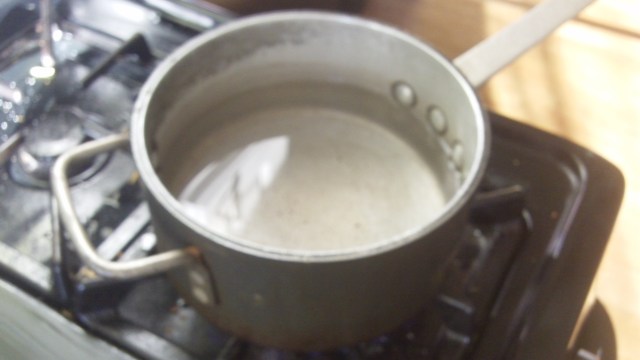
egg 001

Take out an egg, lower into simmering water and let it bubble away–figure another 4 minutes.

egg 002

That means you have eight minutes–a veritable eternity in short order country–to fix your egg correctly.

Now you go to the refrigerator and take out whatever else you want with your egg.  I am taking out shredded cheese, Trader Joe’s arugula and some sliced prosciutto.

egg 009

I sliced from the whole ham but you save time if pre-sliced!

I sliced from the whole ham but you save time if pre-sliced!

Also–very important–take out the ball of dough you keep in there.  So far less than a minute has gone by.

egg 003

[You don’t have dough in icebox?  No problem!  Do it some time previous, whenever, and just keep one in there, always.  Three parts flour to one part water, a pinch of salt and maybe yeast, and oh a little fat. I use the lard or schmaltz I keep in the freezer from when I cook chicken or pork but any fat will do.  Run through food processor until it balls up nicely and just put aside.  The dough-making process itself shouldn’t take more than a couple of minutes, but better to have it done in advance, and that you have the dough around whenever you need it.]

Put broiler on high.  Then take out your cast iron skillet and put on high heat on the rangetop.

[What no well-seasoned skillet?  Get one.  OK any pan will do but cast iron is great.]

Take a golf ball size piece of dough.

egg 004

Make sure it is floured so it is not sticky.  Roll it out quickly till is is about skillet-sized, adding flour as needed to keep it unsticky.  Don’t worry about how circular it is.  And anyways, after a few times it is a breeze to get about right in no time.  Takes me about 45 seconds to roll out.

egg 008

Then into the hot skillet.  If the skillet is quite hot, as it should be, you’ll see the dough start to bubble up in 15 seconds or so.  Once it appears cooked and dry on the bottom, and before it starts to char, turn it over and repeat on the other side.

egg 011

Now take the thing out and, pushing the skillet away, toss it directly on the gas flame.  Char–don’t burn!–on both sides, something that takes maybe 5-10 seconds a side, max.
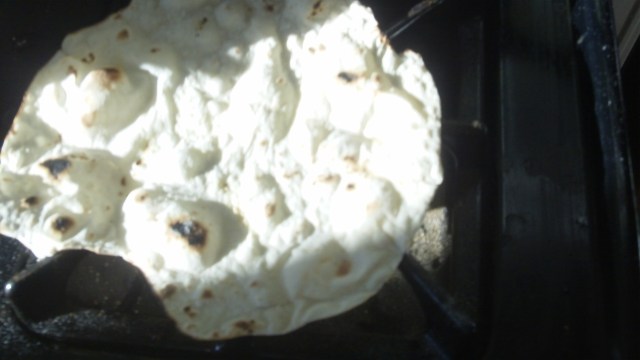
egg 012

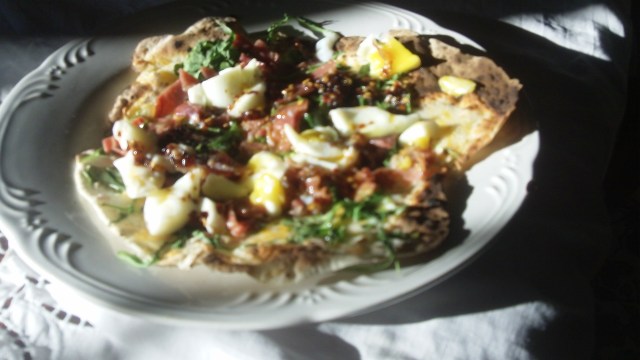
Then onto the counter, where we add, in order, cheese, arugula and prosciutto.  Again, less than a minute.  Then under the preheated broiler for maybe a minute, just enough time to sizzle the ham, wilt the arugula, melt the cheese and finish whatever additional charring the crust might need.  Don’t waste this last minute.  This is when you drain the egg, at its four minute mark, run it under cold water so you can handle it, and peel it.

Remove pizza-like contraption from oven, shmoosh soft-boiled egg on top.

egg 019

For a total experience, toss on some chiu chow chili oil.  It adds a wonderful flavor and heat, and makes for a terrific visual, what with the bright red of the chili oil set against the bright yellow yolk, the greens, the ham/melted cheese and the charred bread.

You don’t need the chili oil but it helps.  You can get Lee Kum Kee’s version at most Asian markets or online.

lee-kum-kee-chiu-chow-chili-oil-72-oz

Or you can make your own for a couple of pennies and pass on the $2.85 (Amazon) Lee Kum Kee.  That’s mine in the photo–recipe available on request.  It is killer.

egg 020

The result: a soft-boiled egg in the time it takes to cook it.

egg 022

Soft-boiled egg a la Montaigne

Soft-boiled egg a la Montaigne

The well trained counterman will always make efficient use of time.

Posted in Food and health, Personal reflections, The Good Life | Tagged | 7 Comments

Tarantino Remake News!

Fenster writes:

Over at iSteve, Steve Sailer speculates on a possible next project for Quentin Tarantino film: The Protocols of the Elders of Zion National Park.

In late 2008, following the horrifying defeat of gay marriage at the polls in California, fiances Samuel L. Jackson and Michael Madsen (the ear-cutting Mr. Blonde from Reservoir Dogs) uncover the secret plot by which Utah Mormons control the California media. In response, Jackson-Madsen assemble a team of gay lovers denied their sacred right to marry (couples hoping to head to the altar include Harvey Keitel-Robert DeNiro, Bruce Willis-Robert Forster, Steve Buscemi-Bo Svenson, Tim Roth-Eli Roth, Kurt Russell-Mickey Rourke, and Danny Trejo-Rutger Hauer). In a 75-minute finale that has audiences cheering wildly, the AR-15-toting heroes gun down each of the 360 members of the Mormon Tabernacle Choir execution-style, pausing only for long, insightful discussions about the old Kung Fu TV show.

That reminded me of a film with Tarantino roots still in the can from some years back, unreleased and maybe unreleasable.

Marimekko Gekko  (1998)

Director: Andre Gregory (stage)  Louis Malle (film)

Based on “Reservoir Dogs”, an original screenplay by Quentin Tarantino

Adapted for the stage and translated to Finnish by Aalvar Kaukkonen

Translated back to English by Dennis Hopper

Cast:

Mr. White              Dennis Hopper

Mr. Blonde            Dennis Hopper

Mr. Orange            Dennis Hopper

Mr. Brown             Dennis Hopper

Mr. Pink                 Dennis Hopper

Eddie                      Quentin Tarantino

Joe Cabot              Wallace Shawn

Policeman             Mark Fuhrman

After the success of Pulp Fiction and the award of the Nobel Prize to literature to the author, Quentin Tarantino, the following year, demand steadily grew for a stage adaptation for Tarantino’s earlier masterwork, Reservoir Dogs.  Tarantino refused to grant permission for such adaptations, with the result being underground stage versions and translations circulating around the globe for use in theater productions, usually outside the US (although the now-famous “bust” of an illegal Florida production starring Burt Reynolds is now legend).

Of all the bootleg versions, the most “buzz” was heard about one of the earliest translations, into Finnish.  (Aalvar Kaukkonen’s original Marimekko Gekko is still playing to packed houses in Helsinki).  Tarantino finally relented at the urging of his friend Dennis Hopper, who subsequently reconfirmed his Renaissance Man reputation by retranslating the play from the Finnish and adapting it for the US stage.

The result—an uncut filming of a dress rehearsal of the stage play mounted at the Dorothy Chandler Pavilion in Los Angeles— is both a must for Hopper fans and a marvel of modern theater technology as Hopper plays virtually all of the parts in the play/movie.  Mark Fuhrman is stunning as the captive policeman taunted by Mr.  Blonde (Hopper).  The fact that Fuhrman’s own ears were sliced off by Rodney King in a bar fight shortly before the production opened  lends a touch a pathos to his stage predicament, to say nothing of the plus in terms of verisimilitude (that word again!)

Joint Academy Award for Best Director went to Gregory and Malle in their finest stage/film collaboration since Batman—the Movie of the Play of the Movie of the Comic Book (1997).

Posted in Humor, Movies | Tagged | 1 Comment

Eyesore of the Month: Library of Birmingham

Blowhard, Esq. writes:

The architectural decadence of civic buildings continues. Here are a couple shots of the new library currently being built in Birmingham, England.

BirmLibrary1BirmLibrary2

Not only does the style clash with the surrounding context, but so does the scale. It looks like someone plopped down a stack of boxes in the middle of the city and wrapped them in some sort of Spirograph scrim.

The interior is just as bad.

5245671987_9c028b9e99_b

The circular layout looks like an attempt to ape the Guggenheim, although I don’t know if it’s one continuous ramp. All those escalators make it look like a cheap mall. Is the one below supposed to look wobbly or is that due to the odd perspective? What about the one up top leading to the creepy, leering author portraits? Not to mention the random, shotgun-patterned recessed flourescent lighting in the ceiling.

With buildings like this, thank God for Amazon Prime and a Kindle, right?

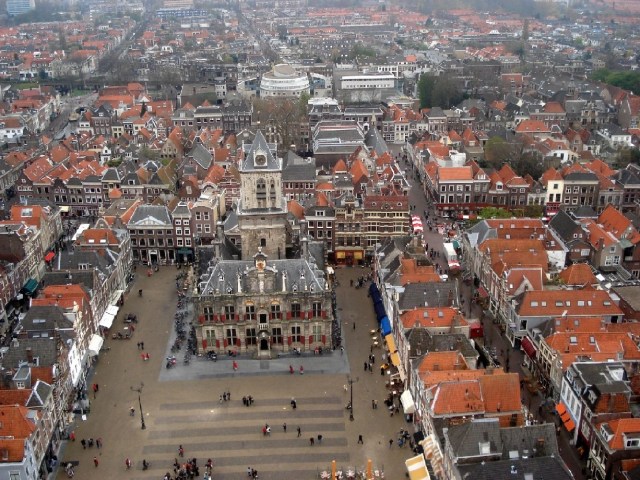
Delft

Posted in Architecture | Tagged , , , , , | 7 Comments

Juxtaposin’: Men and Their Tools

Fabrizio del Wrongo writes:

Posted in Sex, Technology, Television | Tagged , , , , | 1 Comment

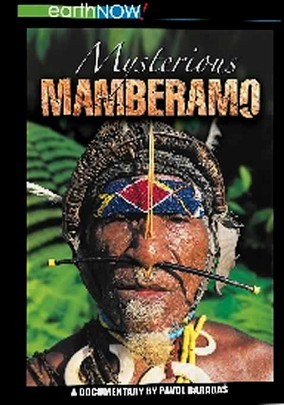
“Mysterious Mamberano”

Paleo Retiree writes:

pavol01

“Mysterious Mamberano” is one of several adventure documentaries available on Netflix Instant made by a Slovakian filmmaker named Pavol Barabas. I’ve watched and enjoyed them all. This time Barabas and a couple of buddies set out to go down the Mamberamo River in Irian Jaya (ie., the western half of what most of us think of as New Guinea). There are corrupt officials to bribe and deceive, landing strips in the midst of jungles to be braved, rafts to be hauled, oozy cliffs to be ascended, rapids to be navigated …

The footage of landscape and water and the time spent with near-untouched tribespeople are perfectly amazing. This footage isn’t remotely like the ultra-glossy, let’s-marvel-at-the-wonder-of-it-all stuff of so many NatGeo nature documentaries. This is Handicam stuff shot in rough conditions. It looks like what a lot of crappy, routine days in the jungle probably really look like.

But the movie isn’t meant to be about the wonder of it all. Instead, it’s about the nutty adventure-for-the-sake-of-adventure trip itself. It’s about a small group of obsessed, determined white men penetrating into the heart of what are presented unashamedly as darkest primeval forests; confronting lizards, insects, snakes, malaria, and pain; experiencing the ecstasy of the wilderness and the wildlife; enduring the challenges of making peace with suspicious tribespeople and of subsisting on unfamiliar foodstuffs.

In all the above ways, Barabas’ documentaries have some similarities to Werner Herzog’s. Watching them, though, I was reminded less of Herzog’s films than of European photo magazines, with their mixture of visual features on slaughters in Africa, sexy white models cavorting in front of dark-as-the-night tribespeople, insanely risky Alpine assaults, etc. Barabas doesn’t try to equate the mania of European conquerors with art-making, as Herzog does. Instead his films are records of his own crazy adventures. The craziness — and the point — is in the trip itself, not in the filmmaking.

The genuinely shocking part of Barabas’ movies comes from the fact that he (and presumably his European fans) are unapologetically into values that we blanded-out Americans no longer permit ourselves: the thrill of the exotic, contrasts between civilization and nature, between civilized people and, well, er, primitives …

This particular Barabas yarn ends anticlimactically; halfway through the quest a raft capsizes and all the photographic equipment is k.o’d, so we aren’t able to see the actual descent down the river. I had a good time watching the film nonetheless. I also had a good time after the film was over savoring a lot of indignant comments about the movie on Netflix. About half the viewer-reviews are from right-thinking intellectual types who attack the movie for not offering an undergraduate-anthro-major, all-cultures-are-equal view of the place and the people. How dare Barabas present the New Guinean forests as places of myth and fear? How dare he treat them as a setting for Europeans with a drive to prove themselves? And — sin of sins — how dare he experience and present the tribal folk he encounters as strange and exotic? Doesn’t he know better? (Answer: Hey, right-thinking Americans, the rest of the world doesn’t give a damn about what you consider to be correct and fair.)

As exotica-besotted as the film admittedly is, though, I detected less condescension in Barabas’ view of the natives than I often do in a lot of PC views of indigenous people. He seemed to like and respect them, and to have a nice rapport with them. And for the life of me, I couldn’t see how encountering Barabas and his buds was going to spoil the natives in any way. Still, here they are, on very raw video, in all their physicality and spirit, tiny dark creatures wearing nose-bones and feathers, wielding wooden spears and bows-and-arrows, covered in mud and eating slugs. Are we really not supposed to notice (or mention) that they’re stone-age people?

Posted in Movies | Tagged , , , , , , , | Leave a comment

Linkathon

Paleo Retiree writes:

Posted in Art, Politics and Economics | Tagged , , , , , | Leave a comment

“Thomas Graal’s Best Film”

Fabrizio del Wrongo writes:

tgbf

Swedish film pioneer Mauritz Stiller is known mainly for his connection to Greta Garbo; it was he who brought her to MGM. But in the 1910s and early ’20s he was a major force in movies, perhaps the era’s only Scandinavian director who could challenge Victor Sjostrom in terms of sophistication and artistry. Stiller’s surviving output suggests that he favored two types of movie: the poeticized nature parable of “Johan” and “Gunnar Hedes Saga,” and the urbane, suggestive comedy epitomized by his 1920 “Erotikon.” “Thomas Graal’s Best Film” belongs to the latter category. Released in 1917, it’s a reflexive, curlicued farce set within the world of silent filmmaking, and for fans of romantic comedy it may come as something of a revelation.

Continue reading →

Posted in Movies, Performers | Tagged , , , , , , , , , | 6 Comments

Enough? Not Enough?

Paleo Retiree writes:

Real money, eh? Upper-middle class life vs. middle-middle class life … I grew up thinking that a little more money than my parents had might grant me access to many of the good things in life — better art, more ease and style and travel, higher-quality chitchat. I imagined that, with a little extra dough, I’d be able to enjoy the fun of being middle-class plus get to enjoy more leisure and better trimmings. But what I discovered was that the “people with real money” world often turns out to be (by my I suppose sentimental middle-class standards) supercold, beyond neurotic, amazingly self-interested, and emotionally harsh. The houses, the entertainment, the clothes and such really are prettier … But the human price you have to pay to inhabit that world is often ‘way too high for me.

Nothing against a little extra money, of course.

Posted in Personal reflections | Tagged , , , , , | 3 Comments

Interfaith Dialogue

Fenster writes:

Following up on Fabrizio’s atheism post.

Worth looking at the numbers.

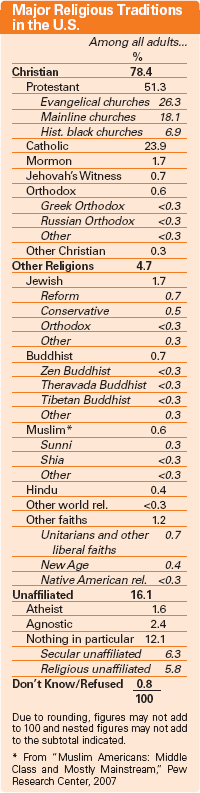
Here is Pew’s assessment of religious affiliation in the United States.

major_religious_traditions

The unaffiliated make for a large number–over 16%, or 10 times the number of Jews or Muslims and over 20 times the number of Muslims or Buddhists or Hindus.

Most of the unaffiliated are casually so.  Only 1.6% describe themselves as atheist and 2.4% as agnostic, with the balance (12.1%) “nothing in particular”, with this split almost evenly between “secular unaffiliated” and “religious unaffiliated.”  So Bill Maher probably goes too far in making his claims about the large number of actual non-believers, since a lot of these folks are not so much active non-believers as they are just indifferent.  But these are still big enough numbers.  There are still way more actual self-described agnostics and atheists than Jews or Muslims or Mormons or Buddhists.  And it seems likely that some number of the casually unaffiliated are objectively atheists or agnostics, but just don’t want to use the words to describe themselves.

As The Economist recently pointed out, those of little or no express faith have not had an easy time of it in the public square, given the tendency to distrust non-believers.  That does not condone obnoxious behavior on the part of organized atheists, like the Times Square billboard this Christmas season.

american-atheists2

But I still generally agree with Maher that non-belief needs more respect.  Whether this is the way to do it is another question.

Some of this relative exclusion of the other is just human nature.  Believers tend to reach out first to other believers.  Further, believers of somewhat like minds will reach out to one another before they reach out to others whose faiths are further afield.  Interfaith dialogue in this country is by and large an Abrahamic religion kind of thing.

After the Newtown shooting, Morning Joe hosted an interfaith discussion including a bishop, a rabbi and an imam.  That’s a pretty common format, expressing the desire to be ecumenical at least among one’s extended religious family.  And that three-way dialogue seems to be the most common format overall–a Google search reveals three-way Abrahamic conclaves here, here, and here.

What’s interesting about this given the Pew numbers is the relative absence in interfaith dialogues not only of non-believers but also adherents to other, non-Abrahamic faiths.  According to Pew, there are more Buddhists than Muslims in the United States, and Hinduism is not far behind.  Why not at least include them, and continue to stiff the non-believers?

Perhaps we just have not yet mastered the doubletalk required for interfaith discussions to include religions that come from an entirely different space?  Maybe, but we could probably stretch the doubletalk if we needed to.  But do we need to?  Maybe not.  It seems to me more likely that the relative absence of Buddhists and Hindus reflects the fact that conflicts on those religious borders have not yet risen to the point that they need to be managed.

And isn’t that what interfaith dialogue really is: an effort to manage potential conflict? After all, interfaith dialogues are not the most intuitive thing.  If you believe x and someone else believes y, the simplest and most direct course is for you to defend x and question y.  Yes, you can try to find least common denominator similarities among different religions, but it is hard to truly reconcile them.

It’s like the push for multiculturalism: as long as you have two cultures bristling up against one another, there will be a felt need to tamp down inevitable conflicts via beliefs and habits that are strongly counterintutive.  But perhaps necessary and useful.  That’s why I gave one cheer to multiculturalism on 2Blowhards some years back.  Ideas don’t have to be logical or consistent for them to be useful or helpful in fixing vexing social conundrums.

Here is a rabbi on HuffPost telling it like it is.  C’mon, let’s face facts, he argues–interfaith dialogue mostly doesn’t work.

(M)ost of we time we are satisfied with mouthing a few noble, often-repeated sentiments. Thus, we affirm the importance of mutual understanding, tolerance and dialogue; we assert that all human beings are created in the image of God; we proclaim that despite our differences, all of our traditions preach love of humankind and service to humanity. Nothing is wrong with these sentiments, of course; in conceptual terms, I believe in them all. But if we don’t dig beneath the surface and focus on substance rather than rhetoric, they mean very little. . .  interreligious dialogue truly touches us when we can discuss what we all know to be true but what we rarely say: that, in some ways at least, we all believe in the exceptionalism of our own traditions.

Just so.

But does this make the exercise useless?  That depends on what its true function is.  Participants may expect revelation and synthesis, having based their participation on such hopes.  If so they will be disappointed.  It is probably more correct to say that we engage in these things to stop us from following the internal logic of our faiths, and in turn causing social harm.  In that sense interfaith dialogue can be said to work even if it doesn’t feel too good.

Posted in Philosophy and Religion | Tagged | 1 Comment