Juxtaposin’: King Press

Fabrizio del Wrongo writes:
9270

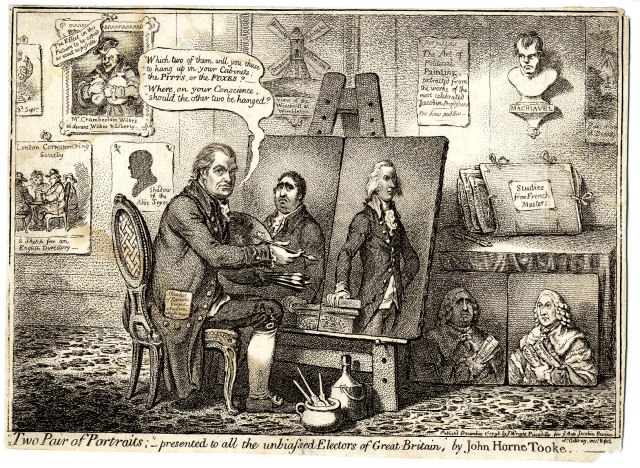
The Parliament of this period has become historically famous as the unreported Parliament. Such reports of the debates as reached the public ears were almost unintelligible. Two magazines there were, namely, the London and the Gentleman’s, which professed to give reports, but they only spoke with bated breath. Dr. Johnson in the pages of the Gentleman’s wrote the reports of the so-called Senate of Lilliput, and not daring to assign to each speaker the speech that he delivered, he gave merely the names of the debaters in a catalogue. His materials were scanty, and he eked them out by indulging in imaginative flights. He was even charged with fabricating bad arguments which he put into Sir Robert Walpole’s mouth. This was a state of things that plainly could no longer be endured, and several journals began to cater for their readers with better reports than any yet attempted. That they were very inaccurate is only natural under the conditions that prevailed. Wedderburn — better known afterwards under the title of Lord Loughborough — once remarked of a speech of his that was reported in the newspapers in this sarcastic vein: “Why, to be sure, there are in that report a few things which I did say, but many things which I am glad I did not say, and some things which I wish I could have said”. His experience, no doubt, was that of many others. Moreover a door was left open to a subtle species of corruption. Woodfall, for example, who was for his feats as a reporter nicknamed “memory Woodfall,” is said to have been paid £400 a year for reporting in the Morning Chronicle the speeches of Fox and Sheridan better than those of Pitt and Dundas. And Woodfall was one of the most distinguished of his class. The profession of a journalist was still one which was held and long continued to be held in very low repute. But however that may be, parliamentary reporting suddenly became a burning question. It was in 1771 that Colonel Onslow called the attention of the House to the fact that its debates were being reported in the newspapers, and he moved that the resolutions — which in 1728 had been passed upon the subject — be read. By these resolutions the newspaper reporting of debates was declared to be “an indignity to and breach of privilege of the House,” and offenders were ordered to be punished. In the course of discussion an ex-Speaker, Mr. Onslow, asserted the Parliamentary law and custom very clearly; reporting in the newspapers was, he said, “a modern practice completely unprecedented, and in direct violation of the privileges of the House of Commons “. The Colonel’s motion was carried, as might have been expected from the temper of the House. The next day he rose again in his place, and complained that the Gazetteer and the New Daily Advertiser had published a misrepresentation of his speeches. The printers of the papers, Thompson and Wheble, were thereupon directed to attend the House. Wilkes and Tooke now saw their opportunity and prevailed upon the printers to disobey the order. Then the House passed a resolution that an address should be presented to the King, praying him to issue a royal proclamation to order the arrest of the offenders. His Majesty — who in a letter to Lord North had called the printers ”miscreants,” and affirmed that “this strange and lawless method of publishing debates in the papers should be stopped” — was only too glad to comply with the request. Yet, in defiance of both King and Parliament, the reports were merrily continued, and in the following month the Colonel called the attention of the House to the fact that six more papers, the Morning Chronicle, the St. James’s Chronicle, the London Packet, the Whitehall Evening Post, the General Evening Post, and the London Evening Post, were publishing reports. A hot discussion followed, and, perhaps, the very first example of the use of obstructive tactics in the House. Twenty-three divisions were taken, and the debate was not closed until the morning sunlight was streaming through the windows. ”Posterity,” said Burke, in a speech in which he afterwards referred to the debate, “will bless the pertinacity of that day.” Then followed a series of events which were hardly less dramatic than those which had occurred in connection with Wilkes and his expulsion. Verily the times seemed out of joint. The printers of the incriminated journals were urged to persevere by the Bill of Rights Society, which provided them with funds. Then the printer, one Miller, of the London Evening Post, was summoned to the House; he refused upon the ground that he was a Liveryman of the City, and a messenger who had been sent to fetch him was himself arrested for assault. Brought before the Lord Mayor Crosby and Aldermen Oliver and Wilkes, who were sitting as magistrates at the Mansion House, the messenger was declared to have been legally arrested. Then Crosby and Oliver were ordered to attend in their places in the House, and were accompanied thither by great demonstrations of applause. At Westminster a riotous mob assembled and approaches to Parliament were blocked; Lord North’s carriage was wrecked, and the brothers Charles and Stephen Fox were pelted and rather roughly handled. The signing of the warrant for the arrest of the messenger of the House was declared a breach of privilege, and Crosby and Oliver were committed to prison; an event which Gibbon characteristically described as the sending of “two wild beasts … to the menagerie in the Tower “. The news of the committal was received by the people with a burst of indignation. On the Tower Hill the figures of the obnoxious persons were carried in carts, beheaded by a chimney-sweep and committed to the flames. Oliver and Crosby were received with every mark of honour in the City, and the Corporation presented them and Wilkes with silver cups in memory of the zeal they had displayed in the protection of the printers. Wilkes seized the opportunity to emphasise his Radical proclivities by choosing the death of Julius Caesar as a design for his cup, and the following lines from Churchill for an inscription: —

May every tyrant feel
The keen deep searchings of a patriot’s steel.

— C.B. Roylance Kent

Trump’s attacks on the press have been aimed at what he calls the “mainstream media.” Six of the seven U.S. outlets in our study—CBS, CNN, NBC, The New York Times, The Wall Street Journal, and The Washington Post—are among those he’s attacked by name. All six portrayed Trump’s first 100 days in highly unfavorable terms. CNN and NBC’s coverage was the most unrelenting—negative stories about Trump outpaced positive ones by 13-to-1 on the two networks. Trump’s coverage on CBS also exceeded the 90 percent mark. Trump’s coverage exceeded the 80 percent level in The New York Times (87 percent negative) and The Washington Post (83 percent negative). The Wall Street Journal came in below that level (70 percent negative), a difference largely attributable to the Journal’s more frequent and more favorable economic coverage.


— Thomas E. Patterson

Posted in Books Publishing and Writing, Media, Philosophy and Religion, Politics and Economics | Tagged , , , , , , , , , , , | Leave a comment

Linkage

Paleo Retiree writes:

Posted in Linkathons | Tagged , , , , | 4 Comments

For the Bright Side of the Painting I Had a Limited Sympathy

Fabrizio del Wrongo writes:

File-'Edgard_Poë_et_ses_oeuvres'_by_Lix_and_Dargent_6

In no affairs of mere prejudice, pro or con, do we deduce inferences with entire certainty even from the most simple data. It might be supposed that a catastrophe such as I have just related would have effectually cooled my incipient passion for the sea. On the contrary, I never experienced a more ardent longing for the wild adventures incident to the life of a navigator than within a week after our miraculous deliverance. This short period proved amply long enough to erase from my memory the shadows, and bring out in vivid light all the pleasurably exciting points of color, all the picturesqueness of the late perilous accident. My conversations with Augustus grew daily more frequent and more intensely full of interest. He had a manner of relating his stories of the ocean (more than one half of which I now suspect to have been sheer fabrications) well adapted to have weight with one of my enthusiastic temperament, and somewhat gloomy although glowing imagination. It is strange, too, that he most strongly enlisted my feelings in behalf of the life of a seaman, when he depicted his more terrible moments of suffering and despair. For the bright side of the painting I had a limited sympathy. My visions were of shipwreck and famine; of death or captivity among barbarian hordes; of a lifetime dragged out in sorrow and tears, upon some gray and desolate rock, in an ocean unapproachable and unknown. Such visions or desires – for they amounted to desires – are common, I have since been assured, to the whole numerous race of the melancholy among men – at the time of which I speak I regarded them only as prophetic glimpses of a destiny which I felt myself in a measure bound to fulfill.

— Edgar Allan Poe

Posted in Books Publishing and Writing | Tagged , , , , | Leave a comment

Architecture Du Jour

Blowhard, Esq. writes:

Modernism: Making every place the same place for over a century.

Posted in Architecture | Tagged , , , , | 2 Comments

The Art of the Opening Title: True Detective, Season 1

Blowhard, Esq. writes:

A new series where I share some of my favorite TV opening titles. Sometimes I love the show, sometimes I don’t, but I think each montage captures the spirit and tone of the show in an entertaining way. A good title sequence is like the foyer of a building, or the steps from street level into a museum: it separates you from the everyday and welcomes you into a different world.

Posted in Television | Tagged , , | 2 Comments

Amazon’s Bricks and Mortar

Blowhard, Esq. writes:

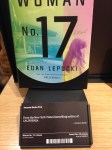
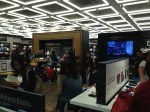
After laying waste to meatspace retail book sellers, Amazon has bizarrely decided to get into the game. Their first NYC store opened over the Memorial Day weekend so I headed down there to check it out. My overall impression: if this was an airport bookstore, it’d be the best of its kind. Considered as a regular bookstore it’s decent-ish, but I doubt I’ll be spending much time there.

The store is located in The Shops at Columbus Circle, an upscale mall in the Time Warner Center that also houses a Whole Foods, various luxury fashion retailers, and some of the most expensive restaurants in the city. The store’s space, I’m told, used to house a Borders. It’s on the third floor opposite Thomas Keller’s Bouchon Bakery.

The first thing that jumped out at me is that there are relatively few titles for sale and each book is faced. No spines are visible.

The cumulative effect of the store layout — small stock, Amazon branding, use of reader reviews, and what I think is the Kindle Bookerly typeface for the signage — is a little disorienting. “Wow, am I inside the Internet? Is this how the characters in TRON felt when they first entered the game?” I thought, more than a few times.

It quickly becomes apparent that what’s being sold is Amazon’s metrics more than the books themselves.

The cost of each book depends on whether you’re an Amazon Prime member. Prime members get the Amazon.com discounted price while everyone else pays retail. There are three or four stations located around the store for you to check the price.

As you would expect, numerous Amazon gadgets and higher-end electronics are also on sale. I took the third picture in the series below from an area at the front of the store where the Kindles and Fires are prominently featured.

Amazon’s cheapo Basics are also available.

A mild attempt is made to give the store a Third Place vibe.

The view from the store of Columbus Circle and Central Park South is pretty nice.

You can pay with the Amazon app, but a friend who tried to do so said it didn’t work.

I opted for the regular checkout. There are about six of these stations at the point of sale. I walked up to one and started jabbing my finger at the screen, figuring it was a self-checkout, when one of the employees came over to inform me that I couldn’t use it by myself. When you pay with the credit card connected to your Prime account, you automatically get the Prime price.

I’m in the Columbus Circle area a lot, so it’s nice to have a bookstore nearby to browse. Also, sometimes two days is an excruciating amount of time to wait for a purchase to be delivered so, as an American, I’m delighted whenever anyone caters to my need for immediate gratification, particularly when that immediate gratification involves deep discounts. But given that the stock is limited to only very popular titles in a small number of basic categories, I don’t foresee spending much time there. Maybe if I must have the hot bestseller everyone is talking about and don’t feel like waiting for it, then I can see the advantage. Other than that, though, it doesn’t have much to offer me.

Which raises the question: What’s the point of this? What does Bezos hope to accomplish? In interviews his representatives have cited books as being part of Amazon’s core identity and others have said the point is to sell Prime subscriptions and Amazon’s various gadgets. Seems reasonable, I guess. But can’t they sell their gadgets anywhere, say Target or Best Buy? How many shoppers are going to go in expecting to pay $20 for a book only to plunk down another $100 for Prime? As for loving books so much, I’d rather they focus on persuading publishers to cut ebook prices, or even get them to bundle ebook versions with hard copies, the way many Blu-rays now include codes for digital downloads. My theory is that Bezos feels guilty about putting book retailers out of business, so these stores are an attempt to atone for that, but given that 1) I know next to nothing about his psychology and 2) there are plenty of other ways to be charitable, I don’t think my theory is any better.

As I left the store mulling over these questions, it had become so full that they were holding people back so it wouldn’t get too crowded inside.

A gentleman tried to and the very polite security guard told him that he would have to wait in line. He apologized for not noticing, laughed at everyone standing there, and said to no one in particular, “Here’s the thing: you can get all this stuff online. I know, it’s crazy!”

Posted in Books Publishing and Writing | Tagged , , , | 7 Comments

Realism, Race and Class Versions

Fenster writes:

Elements of the alt-right consider themselves to be ‘race realists’.  Generally, this view relies on genetics as a partial way to explain human differences, and on the fact that  natural selection can operate at a fast enough rate in human populations to select for differences over relatively short time spans.  Not all people who buy a genetic explanation are race realists, of course, but race realism depends on a Darwinian view of things.

The left definitely does not like race realism and tends not to like bringing genetics into discussions of human difference.  But just because the left cannot articulate a genetic view of difference does that mean it is unwilling to admit to it in disguised form?

Consider, from the left, Jonathan Capehart’s interview of Justin Gest, a professor at George Mason University.  Gest makes a seemingly compassionate argument about white working class supporters of Trump.  No, we should not just look at them through the simple lens of racism.  We must look deeper, and come to grips with the fact that these people feel silenced and ignored.  And that those feelings are not unwarranted.

But note how the article ends.  Gest concludes:

The only way of addressing their plight is a form of political hospice care.  These are communities that are on the paths to death. And the question is: How can we make that as comfortable as possible?

Gregory Clark’s 2007 book A Farewell to Alms suggested that the Industrial Revolution broke the Malthusian trap in a pretty brutal and Darwinian way.

In Britain, however, as disease continually killed off poorer members of society, their positions in society were taken over by the sons of the wealthy. In that way, according to Clark, less violent, more literate and more hard-working behaviour – middle-class values – were spread culturally and biologically throughout the population. This process of “downward social mobility” eventually enabled Britain to attain a rate of productivity that allowed it to break out of the Malthusian trap. Clark sees this process, continuing today, as the major factor why some countries are poor and others are rich.

As Steve Sailer pointed out in reviewing the book, Clark does not tackle the question of genetics head-on.  But as Sailer suggests, recent work on the speed of human cultural evolution is consistent with a genetic reading of Clark’s points.  And in any event, Clark’s thesis is plenty Darwinian.

So is Gent a class realist?

The left as a intellectual force and the Democrats as a political force have been debating since the election what’s the matter with Kansas.  And Ohio, and West Virginia, and so on.  There is a lot of mea culpa discussion out there about finding a way back to these stranded sources of historic Democratic support–or at least a better “message”.

But there is another thread out there, too, apparent in Gest’s conclusion.

And might there not be something to be said for that view, if not as morality at least as realist description?  The habits, values and behaviors of the deplorables may not be consistent with where the world is headed.  And if you are inclined to the Darwinian view of things, where the world “is headed” is not primarily a function of morality but of adaptive fit in a changing ecological niche.

Posted in Politics and Economics | Tagged , , , | 2 Comments

Architecture and Color

Paleo Retiree writes:

Posted in Architecture | Tagged | Leave a comment

Trillin X 2

Fenster writes:

Two takes on Calvin Trillin.  Food and killing.

Continue reading →

Posted in Politics and Economics, Uncategorized | Tagged , , , | 1 Comment

Sokal Redux?

Fenster writes:

When making sense no longer makes sense it is very tempting to stop making sense, this urge itself a form of sense-making.  In 1984 the interrogator tells Winston Smith that two and two can equal five if the state says so.  But on this point Dostoevsky has the better take: “the formula two plus two equals five is not without its attractions.”  People can be drawn to a lack of sense as moths to a flame, if the alternatives are less palatable.

In this regard, consider the rich night soil that is the modern postmodern mind.  It is a fecund thing but it lies shallow on the earth, discouraging the deep rootedness that would provide for sturdy growth and favoring instead the rapid spread of a kind of mental kudzu across the landscape.  It is hard to hold this kind of thing in check, and no good solution has yet to be found.  The limited success to date has come from a kind of “fighting fire with fire”, as with the famous Sokal Hoax.

When Sokal wrote his debunking piece in 1996 the kind of postmodern writing at which he took aim took the form of gibberish, and his spoof was structured as meaningless tripe.  As you will recall it was waved through the gates of the journal Social Text by the peer review watchmen and the rest is, alas, mostly only history.  The Sokal Hoax caused delight in some quarters and consternation in others but it hardly stopped the kudzu spread.

In part this hardiness is a function of adaptation.  In some measure meaninglessness has given way to meaning again and this is, in a way, a kind of progress.  A lot of writing nowadays may be nutty but it is getting explicable.  It is trying to say something.

Here’s an abstract from a recent issue of Social Text:

Pedro Almodóvar’s The Skin I Live In is a film whose glossy surface belies its investment in history—cinema’s history, Spain’s history, transnational history. It tracks a correspondence among cinema, transsexuality, and medium specificity through the trope of transgenesis: skin has been manufactured by the film’s plastic surgeon to cover the character upon whom he has also forced a sex change. The transgenic skin is also produced extratextually, by way of a digital effect that implicates cinema’s analog-to-digital transformation. Both of these technological transformations—the cinematic and the biological—carry with them ethical and political implications, which are explored in the film. For this purpose, the article contends that Almodóvar brings his own cinematic language to its limit, particularly around his representation of transsexuality, as if to point us toward the limit that a politics of representation has reached in our increasingly biopolitical environment. The article argues that the film’s digitization of artificial skin functions as an anchor for a complex imagining of the sociopolitical contexts that bind identity to history. The surface of the skin, as deployed in the film, melds political and cinematic memory to resurrect traces of repressed histories and absent bodies, allowing Almodóvar to build a transtemporal and transnational allegorical universe that moves against the grain of the loss of history that cinema’s digital transformation purportedly represents.

Hold on, one more:

Considering the question of the recovery of marginalized voices in the archives, this article reflects on the problem of finding and interpreting the personal responses of African Americans to the assassination of President Abraham Lincoln in 1865. Black freedom was central to the post–Civil War nation, yet direct black voices remain submerged, available most often in public sources like newspapers and sermons or in scant and skeletal personal writings. The most vivid black voices are to be found in more troublesome sources: those mediated by sympathetic whites who recorded the words and actions of African Americans. Such sources lack a crucial dimension of experience found in the more voluminous direct personal responses of Lincoln’s white mourners: the persistence of everyday life (matters of labor, health, romance, leisure) in the face of shock and grief, an absence that stems from the particular motivations of white observers. Scholars must also reckon with the question of how to present these methodological challenges to our readers and how to shape both the content and structure of our narratives to move marginalized voices to the center. In sum, ventriloquized voices in the archives must not be dismissed but must instead be approached with rigor and imagination.

Sorry, last one:

This article cross-reads the 2005 trial of Chai Soua Vang, a Hmong American man who was convicted of murdering six Caucasian hunters in Wisconsin, with the 2008 film Gran Torino, a story of a Korean War veteran who mentors a Hmong American teenager. An examination of the trial transcript and journalistic coverage of the Vang case illustrates a need to establish a history of racial violence in order to explain the altercation in the woods. This need assumes that a history of racism must be identified in order for a word to be considered racist and that acts of violence can be explained only through that corresponding history. This article uses speech act theory to problematize that assumption, arguing instead that the power of hate speech rests in its ability to displace history rather than affirm it. Coverage of the case demonstrates this displacement, as Vang is positioned via multiple and contradicting contextual frames. In turn, Gran Torino, which this article reads as a response to the Vang case, illustrates how codes of conduct shift depending on who is in the position to dictate them, and how words that historically signify a racial threat can also erase the very histories that give those words meaning. Thus, the film offers an explanation for why Vang’s claim to racial victimization could not hold.

While these abstracts give off a certain forbidding air there seems little question but that the authors are trying to do more than display their knack for unintelligible prose.  They are taking aim at things.  Hallelujah they are starting to make sense!

Thus it is that as the kudzu adapts and morphs a new generation of weed retardant is called for.

A updated version of the Sokal Hoax arrived in the form of the article “The Conceptual Penis as a Social Construct” by Jamie Lindsay and Peter Boyle, which appeared in the peer-reviewed journal Cogent Social Sciences.  This is the article that made the connection between the penis and climate change, a connection that had somehow been overlooked until 2017.

Once again, the abstract:

Anatomical penises may exist, but as pre-operative transgendered women also have anatomical penises, the penis vis-à-vismaleness is an incoherent construct. We argue that the conceptual penis is better understood not as an anatomical organ but as a social construct isomorphic to performative toxic masculinity.  Through detailed poststructuralist discursive criticism and the example of climate change, this paper will challenge the prevailing and damaging social trope that penises are best understood as the male sexual organ and reassign it a more fitting role as a type of masculine performance.

Yes, this is a rich stew of words but, like the Monkees, it’s got something to say! Perhaps a conversation is possible. If and we can see which sensemaking is the most sensible.

Posted in Education, Uncategorized | Tagged , | 4 Comments