Naked Lady of the Week: Alison Tyler

Blowhard, Esq. writes:

atcover

Porn star Alison Tyler’s Amazonian proportions recall Lynda Carter as reimagined by R. Crumb. Maybe that’s why she played Wonder Woman in a recent porn parody? (Link NSFW, natch.) Feminists are always going on about how anorexic models create unrealistic body image expectations, so I, for one, am glad that Tyler is repping for thick girls.

Nudity after the jump and lots of hardcore at the tube sites. Happy Friday.

Continue reading →

Posted in Sex, The Good Life | Tagged , , | Leave a comment

“Love & Friendship” Pre-review

Fenster writes:

It is always a kind of special event, albeit in a low key, when a new Whit Stillman film opens.  He’s done only four since 1990: the WASP trilogy of Metropolitan, Barcelona and The Last Days of Disco (now out in a nice boxed set) and the related but different Damsels in Distress.  His new film, Love & Friendship, is being released today.

Since it is 9:00 AM as I write this I have not had the opportunity to view it but I will comment nonetheless, less to review it and more to remind people that it is out.  Of course actually seeing films or reading books should not stand in the way of good criticism, which, as viewers of Metropolitan will agree, can stand apart from the source material itself.

Tom: I don’t read novels. I prefer good literary criticism. That way you get both the novelists’ ideas as well as the critics’ thinking. With fiction I can never forget that none of it really happened, that it’s all just made up by the author.

That said, those with the good sense to appreciate Stillman’s quirky sensibilities will probably want to see the film.  Perhaps an actual review will appear in this space later, courtesy of Fenster or a co-blogger here.

Love & Friendship marks a departure of sorts for Stillman in that it is an adaptation, in this case of a short novel by Jane Austen that was unpublished in Austen’s lifetime.  It’s a period piece, too, which also marks a difference from his earlier work–unless of course you wish to consider a work like Metropolitan a period piece.  That film was set in a New York City of “not so long ago” and has all the archness and starchness of a bygone era.

But while the new film will be a departure in some ways it promises in others to be of a piece with his earlier work.  Stillman’s films overall are restrained and mannered, very much in an 18th century sort of way.  Indeed, Stillman expresses that he is very much an 18th Century Man in this recent NPR interview.

There are many many things I like about the 18th century.  I like the architecture. I like the music.  I like dress. I like the aspirations, many of the aspirations.  I like the thought, the political thought from the period . . .  I like a lot of the literature.

The NPR interview is worth a listen.  Stillman, like his characters, is polite, articulate and well-mannered to a fault.  Yet he put my in the mind of Oscar Wilde’s quote “only the shallow know themselves.”

Yes, Stillman knows his characters and can be brilliant at portraying their brittle exteriors while only hinting at what may lie beneath.  But what lies beneath? He creates highly structured social worlds populated by attractive young people.  One is easily seduced into thinking that the superficial exteriors must mask some real depths–of motivation, of character, of passion.  But maybe that’s not the case.  Maybe his characters are just as shallow as they appear.

Stillman himself appears to apprehend his own creations in this way.  Discussing the Chris Eigeman character in his first films–the “talkative live wire, the group leader” who is “challenged and overthrown” by others in his set.  He’s a snob, and part of a group that “could seem” snobby.  But at the same time he’s “nice” to the outsider character that the audience might identify with.  “He seems like he’s going to be the bad guy but actually he’s nice to our hero.”

That’s basically it.  He seems not-so-nice but maybe actually he’s kind of nice.  Perhaps this is as deep as it gets, and as deep as Stillman can take it.

Stillman has not been a stranger to Austen in his other work.  In Metropolitan several of his young WASPs discuss Austen in lit-crit terms, with one remarking snidely that one of her novels consisted of children play acting.  That was in a way an indirect reference to the polished goings on in Metropolitan itself.  We will now get to see the real thing.


Posted in Movies | Tagged , , , | 3 Comments

Quadrangulation

Fenster writes:

Peggy Noonan today quotes a cabbie shouting from his cab that he supports Trump because he is “neither left not right”. But wait, didn’t Clinton finish this job off in the 90s with his fabled “triangulation”? Yes, Clinton did an excellent job in his own way of difference-splitting for political gain. But in retrospect his accomplishment seems to be more that he created a new elite consensus. Triangulation can be extended to include another corner, creating a rectangle, with Trumpism another form of triangulation in a populist direction.

trumpism

Posted in Politics and Economics, Uncategorized | Tagged , , , , | Leave a comment

Notes on “Drunk Stoned Brilliant Dead”

Fenster writes:

Drunk Stoned Brilliant Dead is a documentary film chronicling the life and death of the highly influential humor magazine National Lampoon.

tombstone (1)

It is worth viewing but don’t expect all that much humor.  It is not a revue or a series of snippets, like, say a film in The Best of Saturday Night Live series.  It is for the most part a straightforward documentary chronicling the life and times of this interesting publication, and the many influences it has had on American culture since its founding in 1970.

It makes sense that it would not be a series of sketches highlighting the humor.  After all, National Lampoon was (at least in its first incarnation) a magazine.  Film can show a graphic, like a cartoon or photo, but the humor in National Lampoon was at its heart pretty dense stuff.   A lot of writing.  A lot of detail.  You had to pay attention.  You had to read.  The film gives this density some glancing blows but for the most part it just marches on, chronologically, moving from year to year to year and commenting on the flow of characters and styles.

For me it was a lot of fun to watch the story unfold.  I read a lot of National Lampoon in the 1970s, and knew roughly of the narrative arc: brainy Harvard duo Kenney and Beard morph from the Harvard Lampoon to a national magazine almost by chance; immediate success because of the no-holds-barred approach to humor; the magazine spawning related media like the revue Lemmings, radio shows and eventually films.  And the eventual draining away of its energy, a combined result of exhaustion, drugs, changing attitudes, genre depletion and the collision with Hollywood.  The latter problem is well-explained here–how are you going to keep them down on the farm, at an odd little print magazine, when Big Media and Big Money and Big Fame come calling?

Some of the film plays a little too much like inside baseball.  It will mostly be completists who will care what the effect on design was when Peter Kleinman replaced Michale Gross as art director.  But small issues like this aside, the film is fun as nostalgia for those who know something of the subject from experience, and it ought to be informative to a younger demographic which is less familiar.

My son, for instance.  When he saw I had the movie he remarked that sure he knew National Lampoon.  “They did those movies.”  Drunk Stoned Brilliant Dead demonstrates nicely how much more they did than “those movies”.

Moreover, a glance at the current humor scene will demonstrate quite clearly how much of National Lampoon we still have with us.  This is a mixed blessing of course.  The Lampoon’s ultra-ironic approach to all subjects was and is tremendously appealing, especially to youth and especially to smarty-pants types that figure they are better than everyone else.  That’s the Harvard influence–Kenney and Beard may have been brilliant but they were also awful snobs.  If you have ever yearned for some escape from–even for a brief respite from–a diet overly rich in irony you have the Lampoon very much to blame for your condition.

And here’s another irony: while the influence of the Lampoon remains very pronounced in American humor today, much of its material would be absolutely verboten today.  The goofy sex stuff may live on in diluted form in Judd Apatow films, but a good deal of the sexual, racial and political humor that was embraced by the smart set back then falls into the category of what Blowhard Esq. calls “couldn’t do it today.”  It is pretty shocking in retrospect to see just how outrageous a good deal of the material actually was.  It causes you to reflect on how our current era has magically managed to combine anything goes with a new Puritanism.

Posted in Humor, Movies, Uncategorized | Tagged , | 10 Comments

UR: The Only Kind of Jokes We Like Are Problematic Ones

Blowhard, Esq. writes:

x64SYrR

The anti-SJW meme is a thriving folk art. (HT: Paleo Retiree for turning up the link.) A few examples:

Posted in Politics and Economics | Tagged , | 1 Comment

An Interesting Lesson in Female Psychology

Fabrizio del Wrongo writes:

from-russia-with-love-richard-chopping-artwork-cover-james-bond-007

Kerim forked up a strip of fish and tore at it with his teeth. He drank down a half a tumbler of raki. He lit a cigarette and sat back in his chair. ‘Well,’ he said with a sour grin, ‘we might as well talk about me as about anything else. And you must be wondering “How did this big crazy man get into the Service?” I will tell you, but briefly, because it is a long story. You will stop me if you get bored. All right?’

‘Fine.’ Bond lit a Diplomate. He leant forward on his elbows.

‘I come from Trebizond.’ Kerim watched his cigarette smoke curl upwards. ‘We were a huge family with many mothers. My father was the sort of man women can’t resist. All women want to be swept off their feet. In their dreams they long to be slung over a man’s shoulder and taken into a cave and raped. That was his way with them. My father was a great fisherman and his fame was spread all over the Black Sea. He went after the sword-fish. They are difficult to catch and hard to fight and he would always outdo all others after these fish. Women like their men to be heroes. He was a kind of hero in a corner of Turkey where it is a tradition for the men to be tough. He was a big, romantic sort of fellow. So he could have any woman he wanted. He wanted them all and sometimes killed other men to get them. Naturally he had many children. We all lived on top of each other in a great rambling old ruin of a house that our “aunts” made habitable. The aunts really amounted to a harem. One of them was an English governess from Istanbul my father had seen watching a circus. He took a fancy to her and she to him and that evening he put her on board his fishing boat and sailed up the Bosphorus and back to Trebizond. I don’t think she ever regretted it. I think she forgot all the world except him. She died just after the war. She was sixty. The child before me had been by an Italian girl and the girl had called him Bianco. He was fair. I was dark. I got to be called Darko. There were fifteen of us children and we had a wonderful childhood. Our aunts fought often and so did we. It was like a gipsy encampment. It was held together by my father who thrashed us, women or children, when we were a nuisance. But he was good to us when we were peaceful and obedient. You cannot understand such a family?’

‘The way you describe it I can.’

‘Anyway so it was. I grew up to be nearly as big a man as my father, but better educated. My mother saw to that. My father only taught us to be clean and to go to the lavatory once a day and never to feel shame about anything in the world. My mother also taught me a regard for England, but that is by the way. By the time I was twenty, I had a boat of my own and I was making money. But I was wild. I left the big house and went to live in two small rooms on the waterfront. I wanted to have my women where my mother would not know. There was a stroke of bad luck. I had a little Bessarabia hell-cat. I had won her in a fight with some gipsies, here in the hills behind Istanbul. They came after me, but I got her on board the boat. I had to knock her unconscious first. She was still trying to kill me when we got back to Trebizond, so I got her to my place and took away all her clothes and kept her chained naked under the table. When I ate, I used to throw scraps to her under the table, like a dog. She had to learn who was master. Before that could happen, my mother did an unheard of thing. She visited my place without warning. She came to tell me that my father wanted to see me immediately. She found the girl. My mother was really angry with me for the first time in my life. Angry? She was beside herself. I was a cruel ne’er-do-well and she was ashamed to call me a son. The girl must immediately be taken back to her people. My mother brought her some of her own clothes from the house. The girl put them on, but when the time came, she refused to leave me.’ Darko Kerim laughed hugely. ‘An interesting lesson in female psychology, my dear friend.’

— Ian Fleming

Posted in Books Publishing and Writing, Sex | Tagged , , , | 2 Comments

Steve Miller

Fenster writes:

Steve Miller is a protean fellow as a musician.  Blues artist, psychedelic pioneer, pop craftsman and now feted at Lincoln Center under the broad umbrella of jazz.

miller

This caused me to reflect on a blog post Fenster wrote in 2004.

The Revolution Will Not be Televised

According to today’s Wall Street Journal, Bob Weir and Steve Miller have both become members of the Bohemian Grove, that sinister cabal of world puppetmasters (check it out: a web search on “Bohemian Grove” and “conspiracy” yields over 17,00 hits).

Weir is, of course, a former member of the Grateful Dead, the ultimate psychedelic band, musically and literally (see: Electric Kool-Aid Acid Test). Miller, while best known for mainstream 80s rock hits like The Joker, cut his teeth as a bandleader in the San Francisco Summer of Love era, where he headed the Steve Miller Blues Band and penned psychedelic, generationally-inflected blues anthems like Children of the Future (“we are children of the future; wonder what in this world we are going to do, going to do . . .”)

Run the world, apparently.

Running the world will be something of a new experience to these rockers, but it’s doubtless the culmination of a long-held dream. Plus, frolicking naked in the woods ought to come pretty natural.

The Journal reports that the Grove has started something of an affirmative action program for younger people, given that the average age of members is over 60.

Mr. Miller is 61.


Steve Miller in blues phase 1968

Children of the Future.  1968.


Pop craftsman.

Posted in Uncategorized | 8 Comments

“The Hateful Eight” Partial Review

Fenster writes:

Here, I wrote a “non-review” of Django Unchained.  As I wrote then, I’d fallen for Pulp Fiction and felt compelled to return to Tarantino, repeatedly, looking for that sugar high.  But most all of his later work I found goofy-to-execrable. I concluded on a less than conscious basis that his later films must be flukes.  Yeah, that’s the ticket.  A long string of flukes.  But by the time of Django, I had decided enough was enough, and that I would just not go.  And so I wrote a non-review.

But as it happens my impulse control is poor so I found myself, almost against my better judgment, watching Django somewhat later and finding once again, no surprise, that it was yet another of those odd Tarantino one-off flukes.

I fought with myself again on the release of The Hateful Eight.  It was showing in a grand old restored movie house nearby in 70mm and I was tempted for that reason alone.  As Blowhard Esq. wrote in his review of Django here, Tarantino’s visuals can be impressive and the 70mm experience appealed.  But I held firm.

But then there it was a few days ago, staring up at me from the rack at the local library.  All I had to do was walk out the door with it and pop it into my DVD player.  So I succumbed.

What did I like?  The opening visuals, accompanied by a Morricone score, were majestic.  After that, I settled back to see if it would be another fluke.  From what I saw it was.  But I didn’t complete the journey and hence this partial review.

Reviewing Django, Blowhard Esq. accused Tarantino of weak storytelling and wrote this:

(The) third act contains Tarantino’s worst scene since his segment in Four Rooms in which Django convinces the world’s dumbest slave traders to free him by retelling what we’ve seen for the previous 30 minutes.

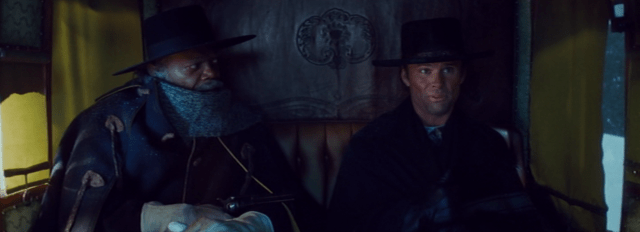
Just so.  Tarantino’s labored efforts to story tell are on ample display here, too.  There’s a scene in the stagecoach near the outset where the ex-confederate Mannix (Walton Goggins) recognizes Marquis (Samuel L. Jackson) and commences, in a strangled Southern accent, to tellin’ the story of Marquis’s misdeeds during the Civil War.
h81

Note image in original 70mm format!

It is common in drama to squeeze needed backstory into what seems like natural exposition but here Mannix goes on . . .  and on . . .  and on.  TIME OUT!  BACKSTORY ALERT!  Tarantino uses this extended backstory technique a few more times, too, in the haberdashery, with equally labored results.

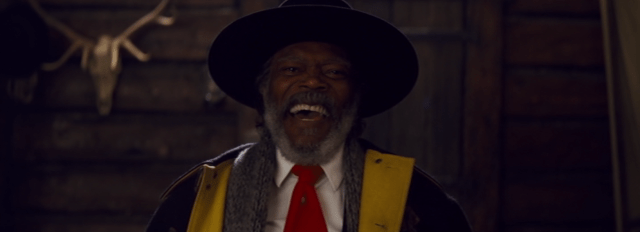
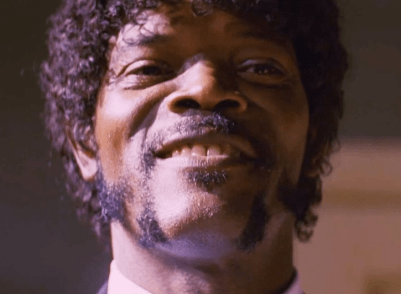
Now, I am one who likes words in movies and am not put off, when they are employed artfully,  if they are clearly visible as artifice.  I liked that a lot about the Tarantino-inflected Bone Tomahawk.  And for sure that tendency is on display here.  But what was original and fresh in Pulp Fiction is by now trite and repetitive.  We even have a Samuel L. Jackson rant lifted in tone and spirit directly from Pulp Fiction.
h82

I never did give that boy that blanket.
 

h83

I will strike down upon thee with great vengeance and furious anger.

The first time I tried to watch the film I fell asleep part way through, before any violence.   I tried again the next night and once again nodded off.  Third time a charm, I hoped.  But even on night three I couldn’t make it much past the first killing, of the Bruce Dern character.  So far, mostly bloodless and mostly charmless.

But then later that third night I found myself waking to the film in progress. I thought to rouse myself to go to bed.  I glanced at the screen in time to see two or maybe three heads exploding like bloody pumpkins.  I can’t be sure about the number or sequence since I was half asleep.  But the sudden violence of the visuals, combined with my dreamlike state, prompted in me a feeling of strong revulsion.

I saw the trailer to Scanners when it came out, the one that includes the scene of the exploding head, and it got under my skin enough in a dreamlike way that I was afraid to see the film.  Haven’t seen it to this day.

scan

I am able to view the stills however.

So kudos to Tarantino in a way for creating imagery capable of such a strong emotional reaction, at least for someone half-asleep and prone to dream consciousness.

But I will not finish the movie.  It goes back to the library today.  I may not have sworn Tarantino off altogether but this is progress.  I am in recovery and taking it one day at a time.

I note though that he may be doing a gangster movie set in Australia.  Maybe it will be good.  I liked Pulp Fiction.

Posted in Movies, Uncategorized | Tagged , , , | 9 Comments

Eddie’s Spirit Chronicles: Balcones Baby Blue Corn Whisky

Eddie Pensier writes:

20160424_203618.jpg

I first tasted Balcones Baby Blue at the marvelous Seven Grand whisky bar in downtown Los Angeles. The friendly and knowledgeable barkeep Paul was a big fan but warned me not to get too attached to the stuff: bizarre things were afoot at Balcones.  Recriminations, temper tantrums, and attacks both physical and verbal led to the ouster of founder Chip Tate from the Waco, Texas distillery, right about the time I was enjoying my dram of Baby Blue in LA. I resolved to keep a cool critical distance from it.

It was not to be.

This is a glorious, unique whisky: the taste and flavor are sui generis. It’s made entirely from blue corn, and while the blueness is not apparent anywhere but the label, it’s certainly the first whisky I’ve ever had that smells like what’s in it: corn. The strongest aroma notes are fresh corn, Karo syrup, popcorn, and Kellogg’s Frosted Flakes. It’s such an amazing smell that you may find yourself nearly forgetting to drink it, preferring to just keep your nose mushed into the glass.  Then the silky yellow-orange whisky beckons to you and you take a sip. Guess what: more corn! But this time it’s cooked corn: cornbread, corn pudding, corn waffles, corn glazed doughnuts (I choose to believe they exist), jonnycakes with maple syrup…you get the picture.

Baby Blue  also features a cracker of a finish: just enough burn on the tongue and throat leaving behind a nutty-creamy richness and more of those incredible imaginary corn baked goods. The spirityness is more pronounced than you might expect for 46% abv, and you’ll be tasting this for hours after you’ve swallowed the last drop.

If Baby Blue intrigues you, there are other products in the range: a cask-strength version called True Blue (I was not as impressed with this as I was with Baby), and a smoked version called Brimstone, which calls the bluff of any and every whisky that has ever dared to use the word “smoky” in its description: this is basically an alcoholic campfire. There’s also an odd spirit called Rumble, distilled from honey, figs and sugar. It’s sort of rummy, sort of brandylike, not exactly a hot mess but not something I’m searching for either.

As expected for a company in flux, Balcones’ distribution is spotty. Wine-searcher has a list of outlets, and as always it’s best to call ahead to ensure they actually have it. I bought mine (and my backup bottle) at Beacon Wines & Spirits in Manhattan. Australians can order from MyBottleShop.com.au. *

*MyBottleShop’s Facebook page, over the past month, features dozens of horror stories from customers about miscommunications, delays, wrong bottles being shipped, and all-around ghastly service. Having said that, I myself have ordered from them four times and never had a problem. Caveat emptor as always.
Posted in Food and health, The Good Life, Uncategorized | Tagged , , , , , | 2 Comments

Recipe Du Jour: Green Chile Chicken Tacos

Blowhard, Esq. writes:

greenchilechickentacos

Ingredients:

1 batch of green chile seasoning mix, recipe below
1 1/2 to 2 pounds boneless, skinless chicken (breasts, thighs, or some mix of the two)
1 package of corn tortillas
1 small red onion
1 bunch of cilantro
Extra virgin olive oil

Green chile seasoning:
1 Tbs New Mexico green chile powder
1/4 tsp garlic powder
1/4 tsp onion powder
1/4 tsp red pepper
1/4 tsp oregano
1/2 tsp paprika
1 1/2 tsp cumin
1 tsp salt
1 tsp pepper

Directions:

  1. Rinse the chicken and pat it dry with paper towels. Coat the chicken with olive oil and the green chile seasoning mix. Grill until done. If you don’t have a grill, preheat the oven to 350, line a rimmed baking sheet with foil, and bake for approximately 20-25 minutes, until the juices run clear. (Check after 20 minutes.) Let the chicken rest about 15 minutes before cubing.
  2. Dice the red onion and chop some cilantro.
  3. Heat up the tortillas. I like to put them right on a burner so they blacken a little or you can heat them in a cast iron skillet. You can use one or two tortillas per taco, up to you.
  4. Spoon some chicken onto each tortilla, top with the onion, cilantro, and your favorite hot sauce or salsa.
Posted in Food and health, The Good Life | Tagged , | 2 Comments