“Woman on the Run”

Fabrizio del Wrongo writes:
okeefe-sheridan_opt

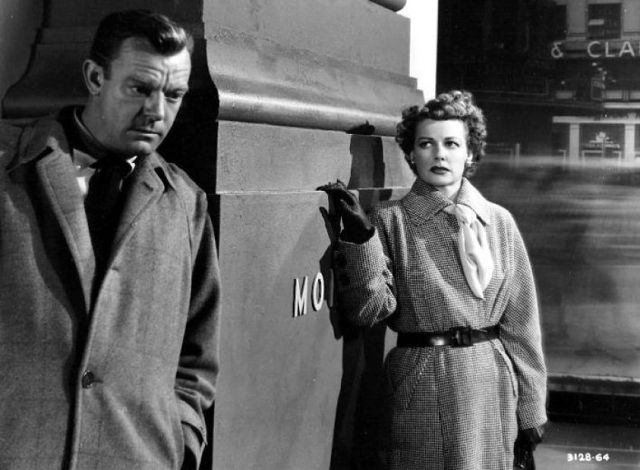
This 1950 noir, directed by Norman Foster, and written by Foster and Alan Campbell, from a story by Sylvia Tate, is intriguing for the way in which it uses its thriller premise to mine the complexities of a relationship. The movie opens in standard noir fashion: with Frank Johnson, played by Ross Elliott, wrongly accused of a murder. But when the cops pay a visit to his wife Eleanor, we enter unexpected territory. Here the movie assumes Eleanor’s point of view, and it’s quickly apparent that she and Frank are on the skids. She thinks he’s finally skipped out on her, and she doesn’t seem to care if he returns. Yet she doesn’t believe Frank is guilty, and she’s too wised up — too cynical — to cooperate with the law (she has no respect for it). So Eleanor launches her own investigation. And when she exits her apartment through a rooftop skylight, she’s like a character in a Jacques Rivette movie — a fugitive from the everyday.

As Eleanor visits Frank’s old haunts, questioning those who know him, an image of Frank — and of his relationship with Eleanor — begins to cohere. Our experience of this image parallels Eleanor’s: As we discover Frank, she rediscovers him. Despite the movie’s genre trappings, this process of rediscovery causes it to resemble classic comedies of remarriage, such as “The Awful Truth” and “The Palm Beach Story,” movies in which couples are forced to break their routines in order to regain their mojos. As do many rom-com couples, Eleanor and Frank own a little dog. It’s a comic reminder of their shared, and sometimes divided, interests.

Ann Sheridan, in one of her last major film roles, plays Eleanor with the perfect mix of resignation and defiance. We sense how her willfulness contributed to the failure of her marriage, yet we also come to understand the role it plays in Frank’s rescue. As Eleanor collects clues, neutralizing irritations with perfectly timed wisecracks, we realize that her capacity for forbearance, cultivated as an unsatisfied wife, is an essential part of her detective’s toolkit. In a triter movie Eleanor would save her relationship by changing in some essential way — by becoming a new person. Here she does the opposite: she reinvests in what’s already present. As conceptions of marriages go, this is an uncommonly shrewd one, and “Woman on the Run” is an unusual noir in that it doesn’t focus exclusively on female (“Mildred Pierce,” “Caught”) or male (take your pick) preoccupations. In fact, it strives to unite them.

Unfortunately, Foster doesn’t have the sadistic instincts necessary to bring off the screenplay’s blatant suspense elements. An alternative offer of romance presented by Dennis O’Keefe’s ostensible reporter isn’t hot or suggestive enough to make you feel the danger it presents to Eleanor’s marriage, and Frank’s dependence on heart medication fails to instill the race-against-time anxiety for which it seems designed. But Foster’s handling of the procedural and character material offers ample compensation, as does the canny employment of the San Francisco setting. Seasoned cinematographer Hal Mohr provides a no-nonsense series of location and studio representations of the city, which culminates in a setting that seems outside of time and place: a fantastical seaside amusement park. With its swooping roller coasters and clanking, novel machinery, the park is an exaggeration of the vertiginous city, and a suitable metaphor for the fraught ground of marriage.

Related

  • The ace digital media company Flicker Alley will soon release a Blu-Ray of “Woman on the Run.”
Posted in Movies, Performers, Uncategorized | Tagged , , , , , , , , | Leave a comment

Quote Du Jour: Orwell on “Fascism”

Blowhard, Esq. writes:

george-orwell

It will be seen that, as used, the word ‘Fascism’ is almost entirely meaningless. In conversation, of course, it is used even more wildly than in print. I have heard it applied to farmers, shopkeepers, Social Credit, corporal punishment, fox-hunting, bull-fighting, the 1922 Committee, the 1941 Committee, Kipling, Gandhi, Chiang Kai-Shek, homosexuality, Priestley’s broadcasts, Youth Hostels, astrology, women, dogs and I do not know what else.

Yet underneath all this mess there does lie a kind of buried meaning. …By ‘Fascism’ they mean, roughly speaking, something cruel, unscrupulous, arrogant, obscurantist, anti-liberal and anti-working-class. Except for the relatively small number of Fascist sympathizers, almost any English person would accept ‘bully’ as a synonym for ‘Fascist’. That is about as near to a definition as this much-abused word has come.

But Fascism is also a political and economic system. Why, then, cannot we have a clear and generally accepted definition of it? Alas! we shall not get one — not yet, anyway. To say why would take too long, but basically it is because it is impossible to define Fascism satisfactorily without making admissions which neither the Fascists themselves, nor the Conservatives, nor Socialists of any colour, are willing to make. All one can do for the moment is to use the word with a certain amount of circumspection and not, as is usually done, degrade it to the level of a swearword.

— “What is Fascism?,” 1944

In certain kinds of writing, particularly in art criticism and literary criticism, it is normal to come across long passages which are almost completely lacking in meaning. Words like romantic, plastic, values, human, dead, sentimental, natural, vitality, as used in art criticism, are strictly meaningless, in the sense that they not only do not point to any discoverable object, but are hardly ever expected to do so by the reader. When one critic writes, “The outstanding feature of Mr. X’s work is its living quality,” while another writes, “The immediately striking thing about Mr. X’s work is its peculiar deadness,” the reader accepts this as a simple difference of opinion. If words like black and white were involved, instead of the jargon words dead and living, he would see at once that language was being used in an improper way. Many political words are similarly abused. The word Fascism has now no meaning except in so far as it signifies “something not desirable.”

— “Politics and the English Language,” 1946 

Posted in Politics and Economics | Tagged , | 5 Comments

More on Free Speech

Fenster writes:

As I have written before I am not a free speech absolutist.  This is part of a broader pattern, since I aspire to be an anti-absolutist in all things.

Or most all things.  I would not want to be overly absolutist in my anti-absolutism.

But on free speech I do come close to absolutism, and my default tendencies are in favor of more, and robust, speech.   Since I see free speech as fragile and threatened, especially on college campuses, I typically pay attention to dust-ups.  I also pay attention to the debate itself.  It’s good to debate free speech, if only to see what the other side is up to.  Perhaps good arguments can be made against free speech, or at least clever ones.

So here in that regard is a very worthwhile debate on the issue, courtesty of IQ2.

IQ2 performs a valuable public service in sponsoring debates on major topics.  Two teams of two square off to argue yes or no on a stated proposition.  It is pretty old school in format, redolent of the Ivy League and Firing Line.  But that’s welcome in this day and age, when presidential debates turn on penis size,

Trump-penis

talk shows devolve to mud wrestling and the debate form itself is being hacked.

In the properly constrained format of a civil debate, much rides on the framing of the proposition.  In this case, the question was “free speech is threatened on campus.”

That is, I think, a good way of putting it, at least for the affirmative side.  You don’t have to argue there is no free speech on campus, and you don’t have to even argue that free speech is being actively throttled by institutional action.  You just have to argue that it is threatened.

The affirmative side here is handled by the attorney and civil liberties advocate Wendy Kaminer and the semi-apostate though still left-oriented black linguist John McWhorter.  The negative side is handled by Shaun Harper, the director of a center and education at Penn, and Jason Stanley, a philosophy professor at Yale.

It is worth viewing if you are interested in seeing how both sides present their cases under the polite assault of the other side, and in the judgment of both live and online audiences.  The live audience is asked to vote (affirmative, negative, undecided) at the outset and then again at the end, with the winner being the side picking up the most points.

Spoiler alert: the affirmative side won both the live and online audiences, and decisively.  Of course, too much can be made of who wins something like this.  The live audience can be packed, voters can game the system and there is a large self-selection problem with the entire concept.  I mean what kinds of nerds would spend two hours actually watching this stuff?

But to me at least the fact that the affirmative side won had the ring of truth to it.  Going in the vote was split, with about half in favor or the affirmative and with negative and undecided each getting a quarter.  At the end, while negative stayed about the same around one-quarter, affirmative rose from half to two-thirds, courtesy of a shift in the undecideds.  So affirmative gained in the process of the debate.  But underlying the before-to-after shift is a strong tilt for the affirmative, which can be fairly read, I think, as a strong endorsement of the value of free speech.

Such is the power of the idea of free speech that even the negative team effectively endorses it.   The negative team argues in effect that all that is happening on campuses is the exercise of free speech by people that didn’t have to strength to use it before.  Truth to power, that argument.

The problem with this line of argument is that it is not hard to counter.  First, affirmative can argue that they, too, favor robust speech on the part of marginalized populations–but that that is not what we are witnessing.  Cases are presented of institutional power directed against speech as well as the overall chilling effect on campus climate.  Negative argues that the few cases mentioned by the other side are outliers; affirmative directs negative to the many cases documented by FIRE of overly aggressive speech codes, as well as their overly aggressive implementation.

So I liked very much that the affirmative side won.  What I particularly liked was what it might be saying about the smarty-pants types who watch this kind of thing.  The audience for IQ2 offerings is, I would reckon, pretty elite, even elite academic.  Just the kind of people who you might expect to swallow the “who whom” PC line.  But the clear majority here appears to be more stalwart than that.

At least that’s the case in the privacy of the voting booth.  They may send out a different signal over the water cooler tomorrow.  That’s not positive.  But I would rather see support for free speech among this crowd, even if muted, than the opposite.

Posted in Politics and Economics | Tagged , , , | Leave a comment

Classical Off-notes

Fenster writes:

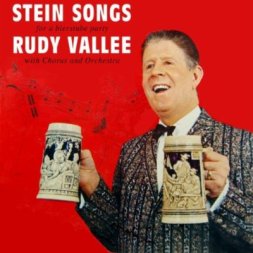
Bit by bit I find myself returning to classical music.  I was never an expert but I was enough of a fan in my youth.  Back then it was not uncommon for classical music to form at least a small part of a well-rounded education.  And families spread the word as well.  My father preferred 101 Strings

101

and German party songs

stein

mit Schnitzelbank naturlich

but we had our share of the classics too.  We had several of the Reader’s Digest “World’s Greatest Music” LPs, including #1, which consisted of selections from Bizet, Rimsky-Korsakov, Rachmaninoff and, of course, Dukas.  The Sorcerer’s Apprentice got a lot of play.

wgm

When rock and roll came in, it delivered a severe body blow to the popular music it displaced, and it took me several decades before I could listen to Richard Rodgers without thinking of the treacly versions I’d grown up, recycled for the TV.  I paid less and less attention to the classics but neither did I reject them.  They just went into a kind of remission.  I bought a half decent set of classical LPs and dabbled in the classics when CDs came in.  But over time the thread was mostly lost.

My daughter’s turntable has caused me to pull out the old LPs.  And I even realized, belatedly, that my iPod had caused me to ditch my CD player, and that I had another cache of those in the basement, including things like Mozart’s complete piano concerti.  I am working my way back through the catalogue and using that experience to pull from the essentially unlimited stock of classics at my local library.  It has been an unexpected pleasure.

One thing that surprised was how entire chunks of music, not in rotation for several decades, sprung back to life quickly.  The Rachmaninoff in the Reader’s Digest LP above for instance: you know that one:

It was like I had the entire recording in my head, and it was triggered when the music started up.

Another joy: Mozart.  In my callow youth I liked Mozart well enough but never quite got him, never quite understood all the fuss about the Mostly Mozart festival.  It was the Sixties: give me the Sturm und Drang any old time.  Now?  Mozart’s Symphony 41  (Jupiter), which I had on LP and admired well enough, strikes me in the current day as perfection and nothing but perfection.  How does he manage to take all that restraint that characterizes his era and pack all that passion into it, especially in the last movement?

Music in the Classical era had moved away from intense counterpoint in favor of accessible and beautiful melodic material.  Here, Mozart pulls of a high wire act, fashioning a fugue out of the various melodic elements that were put into play over time.  I was happy to get lost.

Posted in Music | Tagged , , | 6 Comments

Architecture and Color

Paleo Retiree writes:

Posted in Architecture | Tagged , | 1 Comment

Linkage

Blowhard, Esq. writes:

Posted in Linkathons | 1 Comment

Music Du Jour: Vince Guaraldi’s “Jazz Impressions of Black Orpheus”

Blowhard, Esq. writes:

jazzimpblackorph

I’ve been exploring West Coast cool jazz and bossa nova a lot the past couple of months. This is one my favorites so far. You can listen to it here.

Posted in Music | Tagged , , , | 1 Comment

Juxtaposin’: Donald Trump

Blowhard, Esq. writes:

GeneralTrump

“Trump is Hitler!” says the Washington Post on 2/21/16.

“No, Trump is Charlemagne!” responds the Washington Post on 2/22/16.

“Where’s Charlemagne When We Need Him?” wonders the New York Times in 2012.

Posted in Politics and Economics | Tagged , , , , , , | Leave a comment

Notes on “Kumiko, The Treasure Hunter”

Fenster writes:

This was a hard movie to like, in large part because the main character Kumiko is so hard to like.  Impossible, probably, but tell me if you felt a glimmer or two.  I did not, at least during the movie.

Kumiko is a youngish Japanese woman who becomes fixated on a scene in the film Fargo in which a briefcase of money is buried in the snow.  She takes the fiction to be fact and undertakes a voyage to claim the treasure.  That’s what I knew when I saw it, and so I thought while the movie might have dark elements it might also have some Coen-like black humor along with interesting characters and odd plot twists.

As to character: Kumiko goes beyond dark humor.  She is depressed, lethargic and out-of-touch with life.  And as to plot: there is precious little.  The viewer does not know it at the outset but from the first frame Kumiko is doomed.  No learning takes place.  No Achilles heel is discovered that triggers tragedy.  No saving grace is found.  Step by unrelenting step Kumiko heads down, inexorably.

The film’s disdain for convention was to me off-putting.  I kept waiting for something–anything–to happen that would derail the poor girl’s deluded, one-dimensional descent.  But no.  True, the filmmakers in a sense avert their eyes at the end for decorum’s sake but make no mistake: this girl is helplessly falling from the sky from the start and we are the observers as she invents a story for herself during her freefall.

But did I like the movie?  Well, as I say, it was a hard movie to like.  But yes, at least after the fact, as I noticed it had gotten under my skin.

I wrote about The Revenant, another movie about wandering through a cold landscape, that is was not as good as it looked.  Here, the opposite it true.  The Oscar baiting Revenant makes a big to-do about not very much.   His son, the Indian presence, the bear and so on and so forth.  All in the name of . . . what?

Kumiko may not have the classic trappings of tragedy but it is a tragedy nonetheless, and one that in its stark simplicity feels somehow true, despite the ludicrous plot premise.  Poor Kumiko has no idea how very far she is from anything real.  She has no chance of making it, and to present her story in any other way would be false to her, and to all of those who are fumbling in the darkness, millions of miles from anywhere and not able to grasp how far from grace they are.

Posted in Movies | Tagged | 1 Comment

Architecture and Color

Paleo Retiree writes:

Posted in Architecture | Tagged , | Leave a comment