
Sir Barken Hyena writes:
It pains me to use this title. I adore Eno, he’s been a huge influence on me, both as a teacher of sorts, and as an artist. Another Green World is practically the founding document for the musical territory I’ve played in, and along with his influence on so many other artists, from Bowie to Jon Hassell, well, you just can’t overestimate his importance. And his curiosity and open mind are to be imitated.
And yet, he has let a disease loose on the world that has to be killed.
It’s not a disease of his own concoction, he picked it up in art school in the 50s and 60s, and passed the contagion along, made more virulent by exposure to the bright lights of pop culture, and fame. And I don’t think he actually completely believes in the disease himself, but that’s how his message has been received. The disease goes something like this: “You don’t need anything but you’re own inborn resources to create great art.”
Now, what could be wrong with that? It sounds so positive, so confidence building. It’s your oyster baby, run with it! If art is about individuality, and these days it certainly is, then what do you need others for? What do you need skills and knowledge for, it’s about pure imagination, pure creativity and drinking deeply from your inner spaces.
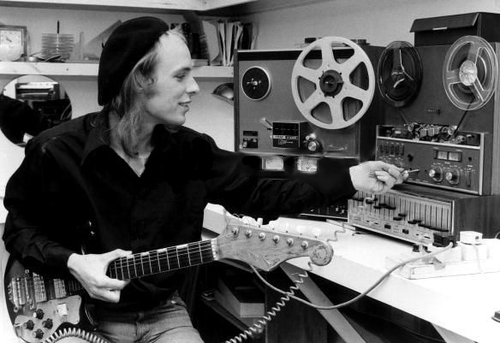
Free at last
The problem is that this is not how Brian Eno actually made his art, nor is it how anyone has ever made art. Artists are born into a cultural scene beyond their making, and their work results from the tensions and attractions between that scene and their own personality. If a style could be simply erected sui generis by the simple expedient of ignoring your surroundings then the whole of art history would have been different.
In fact, what Eno did was not much different from what any creative person, in any time, has done. Leonardo wrote about splattering paint and then looking for familiar things in it to fill out with drawing. He doesn’t seem to have needed to create a fancy term like “aleatoric processes” to get the press excited about it though. Many more examples can be found. Artists have always needed strategies for juicing the creative process. So things like Eno’s Oblique Strategies, though interesting are nothing at all new.
But what’s more is that Eno and his generation drew deeply on the fund of all previous art. In spite of his famous “I am not a musician” pronouncement, I guarantee you that Eno in 1972 knew exactly how to play a C major chord, and could correctly call it that. The musicians he worked with at the time have confirmed this. Really, he was just a producer in the mold of Phil Spector who had his own idiosyncratic methods that got a cool result. Spector never said “I am not a musician” though it would have meant about the same thing if he had.
But all that escapes the tender young mind of a wannabe 16 year old musician. So along with many of my generation I started out thinking “This is what I have to do”. And so I did, and man did I try. But it turns out my inborn resources came up a bit short. I set my sights on Genius and came up with Not Bad. Eventually I tired of this game and just started to do what I really liked doing, which is playing instruments and making quirky little ditties with them. So now in middle age I’m learning to play chords, scales, arpeggios…and I’ve learned some Bach on the piano. This experience of delving into our heritage and making it my own by playing it with my own hands has been the most exciting experience of my artistic life.
And so maybe I can be of some use to the 16 year old wannabes out there who are coming up in a world where the Brian Eno Disease is endemic. By all means be creative and open minded. But be open minded enough to admit that you don’t know anything, and that people before you have done things that you need to know about, to understand, to build on.
Speaking of which, building on the past is the key point. Up until the Disease got the upper hand, art was viewed like a fruit tree. Year after year it gave fruit, and the fruit had it’s own seeds, which hybridized and made the next generation. And so on and on over the centuries a rich orchard grew up.
Then the Disease came along and cut down the trees and used the wood to build things, marvelous things, things we stood around and gaped at. But too late, we found out there weren’t any more seeds, and no more fruit, and all that’s left is to break up the things they built and use the wood for something else, and little by little it’s whittled down to nothing.
We see this with sampling. I’m not getting into the issue of legitimacy, just saying that when an artist uses a loop from a 70s soul record, he’s not leaving anything for the next guy, the way the 70s soul musicians left something for him. What are they going to do, sample his sample, and cut it down further? New stuff has to be injected into the round or it just dries up and blows away.
But the good news is that it’s clear what needs to done now. It’s time to replant the orchard. No need to wait for the complete collapse of civilization to get started.

 Blowhard, Esq.
 Callowman
 Sherbrooke
 Eddie Pensier
 Enzo Nakamura
 Epaminondas
 Fabrizio del Wrongo
 Fenster
 Brundle Guy
 Glynn Marshes
 Paleo Retiree
 Atypical Neurotic
 Question Lady
 Sax von Stroheim
 Sir Barken Hyena
 The Mistaken
 Uncouth Reflections
Excellent tree metaphor. Modernism (or “anti-traditionalism” or whatever you want to call it) does seem like a disease…
LikeLike
Fascinating post. Love this: “Artists are born into a cultural scene beyond their making, and their work results from the tensions and attractions between that scene and their own personality.” Yes. I also think that we have more historicity than previous generations of artists, more consciousness of what we are doing. After all, Bach went unrecognized for a long, long time before composers like Beethoven and Mozart started rediscovering what he’d been doing.
LikeLike