
Paleo Retiree writes:
At my previous place of blogging I often marveled at what I called “nonsense brackets” — the tendency many graphic designers have these days of inserting parenthesis marks or brackets into their work for no grammatical/linguistic reason. (See here and here for examples of my musings.) They do it instead for visual heightening and because, with its overtones of computer code, the move confers coolness on their work.
Fun, if in a dismaying way, to see the trend making its way further into the mainstream. The other day, for instance, I went out to pick up some food and found that Ralphs, a west coast grocery chain, has embraced the trend whole hog.
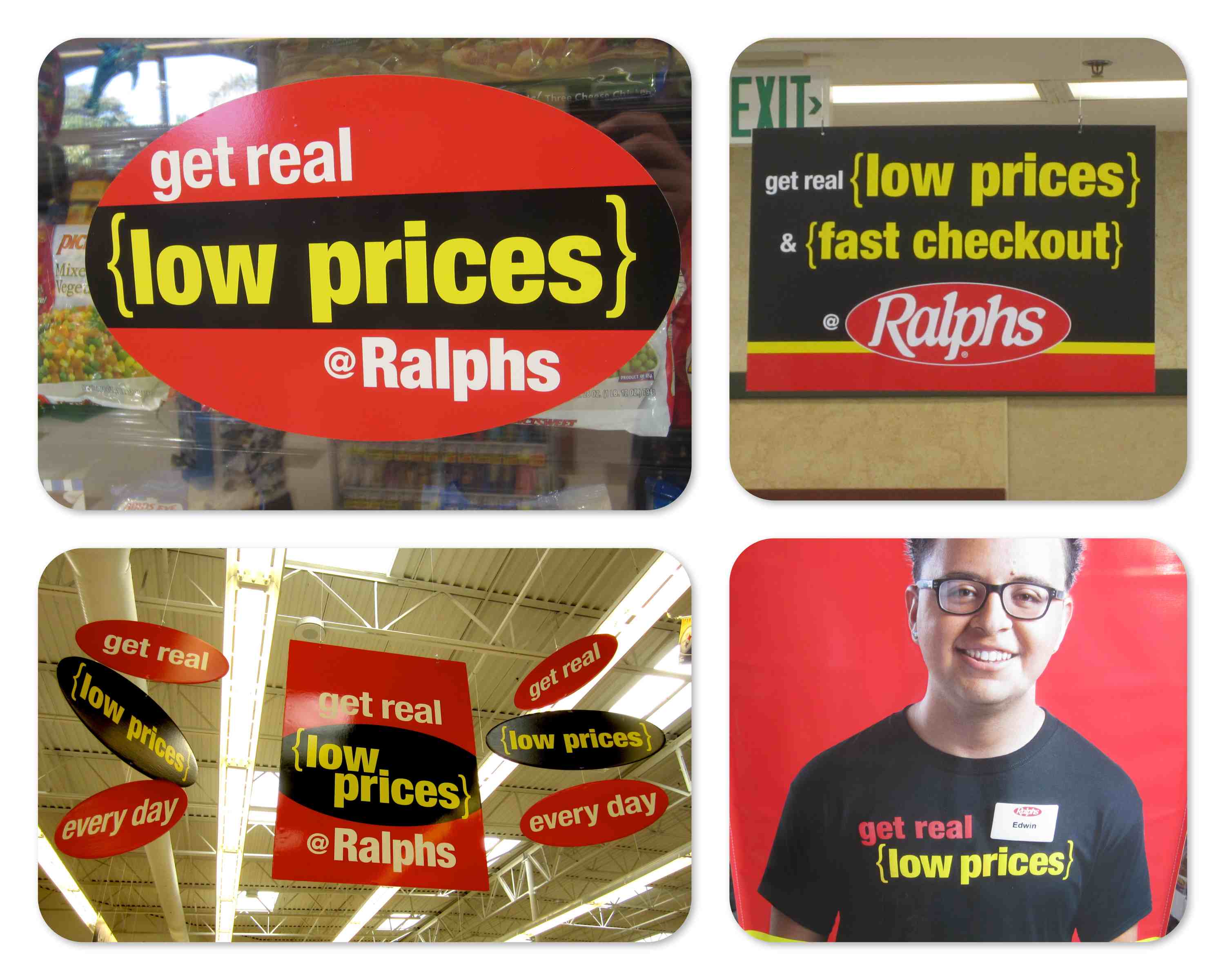
Hats off, I guess, to the people doing the graphics for Ralphs for succeeding in making what were once edgy tropes seem perky and inane. Such, come to think of it, were probably their marching orders. Middle America likes perky and inane, and if you want to sell to them …
I’ll call attention to four things in the collage above.
- The nonsense brackets. Was I right or was I right in my hunch that we’d only be seeing more of the damn things?
- The use of the “@” sign. Hey, aren’t we up 2 date?
- The use of highlighter yellow. More about highlighter yellow and its omnipresence in current popular culture in a future posting.
- The grinning, eager-to-help, beta loser. (That’s not a real person at the store, by the way. It’s a guy in a poster. But the workers in the store really do wear that t-shirt.) Young men today, lost amidst their digital gadgets, eviscerated of their manliness yet apparently happy about their fate. And our popular culture celebrating this state of affairs. Sigh.
I don’t know what to make of this mess except to marvel at how common it’s become for computer-things to be foregrounded in commercial art, and at how for-granted we take this fact. You’ve probably noticed the number of TV ads that imitate/steal-from the iPad with its swipes and its pinching effects, for another example.
As far as I can tell, popular culture these days exists in order to exalt the digital gadgets with which popular culture is now created. Bizarre, and ‘way too self-reflexive and endlessly-recursive for my tastes. But I’m sure I’m missing many things here. What are your theories about what it all signifies?

 Blowhard, Esq.
 Callowman
 Sherbrooke
 Eddie Pensier
 Enzo Nakamura
 Epaminondas
 Fabrizio del Wrongo
 Fenster
 Brundle Guy
 Glynn Marshes
 Paleo Retiree
 Atypical Neurotic
 Question Lady
 Sax von Stroheim
 Sir Barken Hyena
 The Mistaken
 Uncouth Reflections
I immediately thought of you when I saw this insane collection of superfluous punctuation marks:
http://mlb.mlb.com/network/shows/?id=25775158
The show itself contains good information, but it’s impossible to watch it without your blog voice muttering in my head.
LikeLike
Wow, that image … My head hurts. Am I the only person who finds these layout/designs really cluttered?
LikeLike
“As far as I can tell, popular culture these days exists in order to exalt the digital gadgets with which popular culture is now created.”
{Funny and perceptive.}
LikeLike
L{O}L.
LikeLike
I saw a billboard featuring this campaign last week and immediately thought of your old post.
And shouldn’t that be “get really” instead of “get real”? But I guess the use of the California/teenage slang “get real” reinforces the whole “Can’t you see we’re hip!” thing they’re going for.
LikeLike
And I hate yellow highlighter. Looking forward to your thoughts.
LikeLike
“Hip, but in a nice, unthreatening, really very square way.”
LikeLike
Ack, it really does look like code. I have to stare at that crap all day, now I have to see it at the grocery store? And it won’t even compile and run! I’m going to be reflexively debugging grocery store ads now, well that’s just awesome!
LikeLike
“Debugging grocery store ads” is great.
LikeLike
<>
Well, since they’re no longer needed for reproduction . . .
LikeLike
whoops, was trying to quote —
“Young men today, lost amidst their digital gadgets, eviscerated of their manliness yet apparently happy about their fate.”
LikeLike
A lot of them seem to be eager to purchase sexbots.
LikeLike
I know it is just graphic design and just fun ‘n all. But the brackets do put me in mind of the postmodern tendency to overuse parentheses, before, after and in the middle of words.
According to a NYT article:
”They show that there are discontinuities in the discourse,” said H. Aram Veeser, of the English department at Wichita State University in Kansas, using a bit of lit-crit jargon to explain another bit. ”The parentheses are a way for the word to deconstruct itself on the page,” he continued. ”It shows the word fragmenting into its different meanings and parts.”
Teresa Ebert, a conference organizer who teaches English at the University of Rhode Island, called the parentheses ”a denaturalizing term”; they are part of ”resistance post-modernism” and ”transgressive strategies” aimed at the status quo. In other words, the parentheses are in and of themselves a challenge to conventional and dominant assumptions, a way of catching the reader’s eye and making him think again about meanings he had always taken for granted.
LikeLike
Pingback: More on digital culture affecting (infecting?) mainstream design | Uncouth Reflections
I always assume that the use of quotation marks around non-quotes should be replaced with a more accurate word, like “allegedly”
LikeLike
Pingback: Father Knows Best: Deep-Fried Edition « Patriactionary