
Fenster writes:
The ever-mysterious Question Lady asks how you handle people who disagree with you politically. Fenster wrote in response:
I used to engage, and even argue, more than I do now. That is for two reasons. First, I found that engagement didn’t change much, that it tended to estrange those close to me, and that even if I did change a mind it wouldn’t change as much of the world as my feistiness was seeking for validation. Second, while I believed it was important to point out error, experience proved how often I was myself off-track, and in time I reflected, however uncouthly, that modesty in opinion was also a good policy.
To elaborate on that last point.
It has been noted that the idea of the narrative has migrated from the literary realm and has invaded politics. See this nice Poynter article for a view of the situation.
The Poynter article contains a quote from the London Review of Books which encapsulates the situation nicely:
Back when I was at university, the only people who ever used the word ‘narrative’ were literature students with an interest in critical theory. Everyone else made do with ‘story’ and ‘plot’. Since then, the n-word has been on a long journey towards the spotlight – especially the political spotlight. Everybody in politics now seems to talk about narratives all the time; even political spin-doctors describe their job as being ‘to craft narratives.’ We no longer have debates, we have conflicting narratives. It’s hard to know whether this represents an increase in PR sophistication and self-awareness, or a decrease in the general level of discourse.
We all know the power of the narrative. Our brains are wired to make sense of things, even when the events themselves are complex, disordered and ambiguous. It is one of the things we do best and is a glory of cognition.
The only problems is how often we are wrong, especially when the sensemaking is taking place under pressure, complexity and ambiguity.
Take these poor Romney staffers drowning their sorrows in a hotel bar near the Boston Convention Center after their candidate’s concession speech. In Byron York’s telling:
“I am shocked, I am blown away,” said Joe Sweeney, of Milwaukee, Wisconsin. “I thought I had a pretty good pulse on this stuff. I thought there was a trend that was going on underground.”
“We were so convinced that the people of this country had more common sense than that,” said Nan Strauch, of Hilton Head, South Carolina. “It was just a very big surprise. We felt so confident.”
“It makes me wonder who my fellow citizens are,” said Marianne Doherty of Boston. “I’ve got to be honest, I feel like I’ve lost touch with what the identity of America is right now. I really do.”
Poor dears. And I mean that sincerely. They got it bad and it ain’t good.
A similar situation unfolded this election relative to polling. Sure, some of the polling analysis was done by bought and paid for spinsters like Karl Rove, who was apparently crunching numbers frantically on Fox even after Ohio was called, determined as he was to have events fit his narrative.
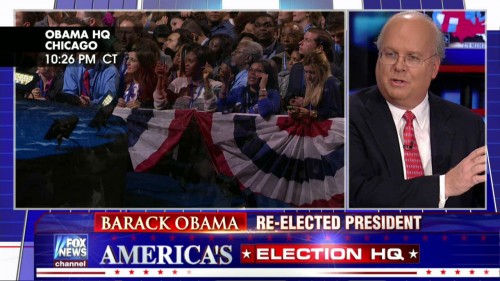
But there was a lot of disagreement, too, between the seemingly independent pollsters. Even some of them apparently fell under the spell of the narrative, finding underground currents where there were none. As this Chronicle article points out, the quants won out over the narrative folks where prediction is concerned.
Me, I am not a quant person. I’ve always been a qual person and, in part to compensate for lack of quant chops have a well-developed sense of the narrative. I am typically good at making at least some sense of a situation and finding useful ways to persuade and articulate. That skill has helped me much as a career as an administrator and executive, explaining complex situations to Boards, presidents and staff, mostly in higher education.
But long reflection does suggest that great care must be taken with the narrative.

 Blowhard, Esq.
 Callowman
 Sherbrooke
 Eddie Pensier
 Enzo Nakamura
 Epaminondas
 Fabrizio del Wrongo
 Fenster
 Brundle Guy
 Glynn Marshes
 Paleo Retiree
 Atypical Neurotic
 Question Lady
 Sax von Stroheim
 Sir Barken Hyena
 The Mistaken
 Uncouth Reflections
Personally, I was hoping for a Romney win, if only for the sake of giving someone else a shot, but seriously; how much do you have to be detached from reality to be SURPRISED that Obama won? I mean, it was a tossup election, so by definition, Obama had a fifty per cent chance of winning. It’s no wonder Romney lost, if his people were as out of touch as that. “Narrative” indeed.
LikeLike
I think the trend towards narrative is about myth-making. Perhaps the last century of rationalism – if that’s what it’s been – has left people tired and ready for easy answers. Myth explains the unexplainable. So it’s a kind of reaction to scientism, possibly. Certainly the rise of fantasy as a form since Star Wars points that way.
LikeLike
Personally, I was hoping for an Obama win and I’m a quant. Far from being surprised by the win, for the last couple of months I’ve been telling other Obama supporters that he is clearly in the lead. The lead is small but has been there for some time according to the best of the quants. The funny part is that I didn’t even know who Nate Silver was until 30 days ago. But I was aware of his work and the work of other objective quants for some time.
Obviously, Romney supporters would tend to disregard those numbers. I’m sure I would do the same and would be coming up with alternative narratives if Romney had the lead based on the data, but he never really did. (He did come very close after the first debate).
What I found most interesting was the insistence of “the mainstream media” that the race was tied or “too close to call”. I felt that many of those same people knew what the best objective numbers indicated, but it wasn’t in their interest to promote that. Their interests were best served by promoting a tied horse race and nothing was to be gained my indicating a lead by either candidate.
At the same time, while the media folks were heavily invested in the tied horse race, the quantitative analysis was fully reflected in the various maps and charts. The same “swing states” were recognized by all outlets and if you listened carefully to the pundits, you could figure out how the data had them leaning. But if you didn’t listen carefully, it was always “too close to call”.
Many of the political junkie types (e.g. Politico) have been telling us just how accurate the analysis of the electorate has become during this cycle. Nate Silver at the NYTimes became the recognized leader during this election cycle and his quantitative based predictions turned out to be accurate across the board except perhaps for a senator in Wyoming or something.
Whether it is a football game, a battlefield or an election, the participants on both sides need to believe not only in the righteousness of their cause, but also in their ability to prevail. A narrative, a strategy, a game plan – some path to victory has to be defined and believed by the players if the conflict is to be enthusiastlcally joined. That’s what good frontline leadership provides. While In the back offices, the staffs crunch the numbers and provide the data based intelligence that increasingly wins the day, if only because we’ve gotten so effective at processing such stuff.
LikeLike
Thank you for posting this — really interesting!
LikeLike
Maule:
Thanks for the excellent and thoughtful response.
Not being a gearhead I perhaps missed the obviousness of the Obama numbers. I simply “followed the narrative”. Ouch.
It is not that I didn’t pay any attention to the polls, In fact, I did look at the numbers on Real Clear Politics almost daily. The question is one of interpretation.
As I understood the fight, if there truly was one, between independent pollsters, it had to do with the ability of Silver and others to look through the national numbers, which seemed often on RCP to validate Romney strength, to state races which suggested more for Obama. At least that is how I understood the narrative relative to the poll debates–I myself crunched no numbers.
I agree also that there is a conflict between truth and usefulness in most things. Working the army up for a fight often requires myths, propaganda and plain untruths to accomplish desired objectives. And maybe the three poor losers in the bar were grunts in the campaign who were destined to be cannon fodder by the end. But the impression given by the close of the campaign–at least the narrative of it!–was that the entire Romney team, including both of the candidates, were caught somewhat flat-footed. And I am not sure Rove would have made such a fool of himself on TV if he secretly knew Obama would win. Also, what of the folks who put themselves way, way, way out on a limb announcing a Romney landslide–people like George Will and Dick Morris. It doesn’t seem credible to me that they were *just* spinning, and knew deep down inside that Obama had the numbers. I think they also got snookered by the narrative.
LikeLike
Yes, anyone, on either side, who predicted a landslide win by either Obama or Romney was just plain out of touch. Yes, you have to get the troops fired up, but one wouldn’t think that telling them that an easy win is in the cards would be the way to do it. When Churchill tried to get his people fired up, he promised “Blood, toil, tears, and sweat” not an easy victory. Personally, I think that the Republicans believed their own propaganda. I mean, look at how discouraged all the Republican pundits are, when in fact nothing has really changed. After all, they retained the House, and actually picked up a few state legislatures. It was not a particularly good election for Republicans, but it was nothing compared to 1932 or 1974 or 2008.
LikeLike
Yes, anyone who predicted a landslide either way was fooling themselves.
Big business has been grappling with this issue for a long time. Classically, businesses have been driven by some combination of vision and compelling narratives. But they operate by the numbers and their performance is measured by the numbers. The typical scene played out every day at all levels goes something like,
The Narrative; Okay, here’s where we are, here’s the opportunity and here’s what we need to do to succeed/win/compete/survive”.
then….
The Numbers; “Okay, let’s run the numbers on the scenario, confirm that it will work, and do it”
During much of my career, I was often one of the staff people who would go “run the numbers”. There were always two distinct ways to go about it.
Usually, the task was to confirm and justify the narrative. That is, find some supporting data, spin it as required, and develop a data-driven version of the narrative. It required data and quantitative skills but it also required creativity and most important, loyalty to the people pushing the narrative. If one was good at it, Execs would carry you around in their vest pockets, “That’s my data guy, give him whatever he asks for”. Yes, numbers can lie, data can support conflicting conclusions and everything can be spun.
The other way to go about it was to take an objective look at the data. Apply it to the assumptions, apply it to the problems, the opportunities, and various plans of action. It required data, quantitative skills, as well as creativity. Here you have to be willing to take shots at whatever narratives are out there. You may even have to question basic principles, widely held beliefs, the very culture of the organization. Your loyalty can and will be questioned from time to time. You may have to move on if your findings aren’t acceptable to the principals. This was enormously satisfying work and in the end, greatly appreciated and enriching. The truth can set you free.
Anyway, both approaches were legitimate. As the data guy, it was important to remain conscious of which role you were playing.
Organization, armies, and campaigns certainly use narratives to drive and motivate the teams. When the chips are down, the narrative is even more important when you need to keep driving forward.
But the trend for some time has been to be more data driven, to sense and respond, to fly by wire – all these terms have been used to describe our ability collect massive amounts of data at the point of contact, process it and respond immediately to it. Later, the same date is mined, modeled, and analyzed to figure out what actually happened and decide what to do next. When done well, it can win the day.
Everyone was talking about the ground games by the two campaigns. On the Obama side, it wasn’t just getting the vote out. It was using data to drive tactics that went at the recruitable undecideds, that got the right people out to vote in important precincts, counties and states. They started last year in doing this in a way that closely modeled David Plouffe’s successful efforts in 2008 The ground game was first a data game that drove the actions on the ground. As you can tell, I was a bit of a fan.
The irony is that Romney seems to me to be a complete numbers guy. I recently heard someone describe his style at Bain to be one where he would put the numbers together and pitch them with the belief that his audience would find the narrative self evident. He seems to be that exceptional type of executive leader who is smart enough and geeky enough to master the data and the numbers as well as the vision and strategies, or in this case the policies, positions, and party planks. While Obama had Plouffe. Romney had Steve Schmidt (?) who seemed to be all things to all inner circle efforts but perhaps not enough in the right places.
The behavior of the pundits, proxies and advocates running up to the election seemed to me consistent with what they felt they needed to do. Even Rove’s blow up on Fox seemed to me on one level to be an effort to put a winning face on everything as long as polls were open anywhere in the country. On another level, he spent 10s or perhaps 100s of millions of other peoples’ money on the campaign and he had no interest in looking like anything other than the bar room brawling, chained dog that he is to those same people. I love George Will and disagree with almost everything he says. He clearly acted as a Romney advocate throughout the election cycle so on election day, spin he did. He is definitely an old school narrative type, so maybe he was truly caught up in it. Dick Morris is a shill.
But in any case, once the final battle has begun, loyal soldiers and their leaders don’t look back until the battle is over. That’s just he way it has to be I think.
LikeLike
Wrong narrative. The narrative is; the economy is doing well, the debt can go on forever, taxing the rich will solve all our problems, Obama is bipartisan (cf picture with Christie), the feds fixed everything from Sandy, republicans hate single women, access to abortion/birth control is more important than any other issue, the feds can solve all your problems, there is no voter fraud, Obama cares about you, the Arab spring overthrew dictators and brought in democrats like us, the Wizard of Oz is real. Republicans thought a majority of voters could see reality. They were wrong. The problem now is a majority of the country no longer views the government as legitimate. These are the Romney voters and the “missing” 6-9 million voters who Obama convinced that voting doesn’t matter. This story never ends well.
LikeLike
Maule:
Exceptional, thanks.
LikeLike
Thank you. I needed that.
LikeLike
Corrections:
I meant to say “Stuart Stevens” rather than “Steven Schimdt (?)” in my second post.
I meant to say “Thank you. I needed to get that out” rather than just “…I needed that”
LikeLike