
Fenster writes:
I am basically a higher education person, more comfortable in an institution than out on my own, and more comfortable in a non-profit, mission-based organization than in a for-profit one. I recognize this to be a matter of temperament and make no special claims about better and worse, other than the claims that I cannot help but make due to my temperament.
But I have also been professionally curious and, having started out in higher education, also spent time in other sectors. I remember when I made my way back to higher education after more than ten years as an investment banker that I felt that I had died and gone (back) to heaven. I was a decent investment banker but simply lacked the killer instinct to be really good at it.
But though I returned to the land of the Eloi I nonetheless had spent appreciable time among the Morlocks, and felt that, if nothing else, a dose of Morlock thinking might be helpful in Eloi-land. When I would point out the obvious–that higher education might be many wonderful things but it was also a business–my comments would typically be met with a kind of blissed-out astonishment. Why, didn’t I know that the oddly decentralized and ungovernable university model has a far longer history than the profit-driven corporation, and that it therefore has the upper hand in terms of proving evolutionary worth? It is an oddly compelling argument, all the more odd since it is Burkean in its essence, and higher education people strongly resist being characterized as conservative.
Of course all irony disappears under the microscope. The answer to this riddle is that higher education people are conservative at their core. Not conservative politically, of course, but conservative where it counts–on the home front, in the defense of the institutions that house and feed them, and that give them status and prestige.
And therein lies the problem. All well and good to say that all higher education must possess some magic mojo descended from Peter Abelard, some distilled essence of otherness. And for sure there are aspects of learning, both teaching and research, that rightly cause education to resist full-scale corporatization. But, to return to my lessons from my time with the Morlocks, who can deny that universities have also become big business? There’s a business model. There’s money coming in and coming out. There’s the need for competitiveness.
Most of all, there is the near-universal quality of higher education in the current era. You don’t need to resort to Bell Curve style arguments to grasp a simple truth: that in an era of near-universal education, huge sections of the institution will be less like a medieval university than a corporate training center. That’s just inevitable, and it is always amusing for me to observe how frantically many faculty attempt to deny the obvious, and to drag up ideal models as a way to defend their places in a higher education world with deep, deep ties to reality.
The size and scale of higher education, therefore, guarantee its diversity of aims, approaches and underlying rationales. It becomes constricting to consider it all of a piece, especially because of the nagging tendency to fall back on a small piece (the medieval ideal and its legitimate descendants) for the whole (the whole mehgillah from history at Harvard to a radiology assistant program at a local community college).
So now comes Joseph Aoun, the very capable and wise president of Northeastern University.
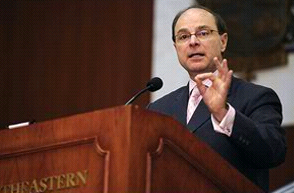
Here is his contribution to the recent heated discussions over whether change is finally, finally making its way to the sheltered groves of academe. His answer: yes, change is coming and it will be transformative.
It is in one sense a ballsy move for the President of an earthbound entity, one whose constituencies are now just beginning to move out from the shadows of denial into what they fear will be a much too sunny future. But Aoun’s remarks do touch on the central points that higher education leaders (if that term is not too much the oxymoron) will have to grapple with in the not distant future.
Here is an important passage, one in which he speculates on the effects of MOOCs (Massively Open Online Courses):
Most significantly, MOOCs are causing higher education to shift from a vertically integrated model to a horizontally integrated one. For centuries, higher education has been a vertical enterprise: Its core functions — knowledge creation, teaching, testing, and credentialing — all have been housed within colleges and universities. MOOCs disrupt this model by decoupling teaching and learning from the campus on a mass scale.
This shift will accelerate as MOOCs continue to take hold. As more people use massive online courses to assemble new educational pathways, the companies that provide them will likely turn to outside partners such as private testing firms to administer exams to large numbers of students, detaching assessment from colleges and universities. Next, credentialing will be separated from colleges as well, as students press providers to offer degrees or other formal validation of the knowledge and skills they’ve acquired. Still more external players may get involved in the credentialing process, such as state agencies or professional associations.
Before long, higher education will look very different than it does today. Vertically integrated universities will continue to exist, but they’ll be joined by a variety of horizontally integrated competitors with the ability to perform the same core function for many more people. In short, the monopoly that colleges and universities have on advanced learning and degree granting will be dismantled. Ultimately, this will cause even more aspects of higher education to be scrutinized.
And all of this seems to be happening at quite a clip. MOOCs are a very recent pheonomenon, as are the entities, like Coursera, that house them. Ah well, said the skeptics a few months back, it is one thing to offer a course but it is something else altogether to figure out how to legimately give credit for it, or to assemble them into something resembling a degree. Well, now we have the first steps toward credit, and degrees and such are not far behind.
Aoun cannot help but make some concessions to his role as president of an earthbound university. One, of course, deals with the possible effects on diversity, if MOOCs and such end up offering a plain vanilla view of accomplishments and qualifications that conflicts with the prevailing holistic view in the industry. The other is that MOOCs could result in a two-tiered system:
. . . .one tier consisting of a campus-based education for those who can afford it, and the other consisting of low- and no-cost MOOCs. This stratification could be reinforced if the colleges and universities that offer massive online courses reserve degrees for the graduates of their physical campuses and provide lesser credentials for their MOOC graduates — in effect, creating a “luxury” brand and an “economy” brand.
The only problem I have with this formulation is that we already have a system that is stratified. Although the current system is stratified into many gradations, not just two, there is no doubt they are arrayed on a prestige continuum of sorts. But because of the strength of the institutions to place institutional needs as a top priority, we are stuck with a stratification in which many students pay a high four year cost for an education that includes a lot of things that, for them, may not add appreciable value. All the more reason for a big unbundling. Let the folks who want to go to Williams go there. Let others do other things in a freer, less institutionally-constrained, environment.

 Blowhard, Esq.
 Callowman
 Sherbrooke
 Eddie Pensier
 Enzo Nakamura
 Epaminondas
 Fabrizio del Wrongo
 Fenster
 Brundle Guy
 Glynn Marshes
 Paleo Retiree
 Atypical Neurotic
 Question Lady
 Sax von Stroheim
 Sir Barken Hyena
 The Mistaken
 Uncouth Reflections