
Fenster writes:

I have been waiting to see Mark Cousin’s 15-hour documentary The Story of Film: An Odyssey. Good news for me, and for you too if you are interested: it is now on Netflix streaming.
I watched the first episode last night and based on that I am looking forward to the next fourteen.
Cousins is an interesting host: at least so far just a disembodied voice, speaking with a soft, breathy brogue. And it is his own voice both literally and metaphorically–he promises to deliver his own take on things.
At first thought you guess that the story of film would be about scenes like this one, from Casablanca, full of yearnings, story and stardom?
Because Casablanca is a Hollywood classic. Ingrid Bergman’s lit like a movie star, highlights in her eyes.
It’s all filmed in a studio set. (Sam puts his piano bench on top of the piano and wheels it away. Cue sad version of “As Time Goes By” theme.)
But films like Casablanca are too romantic to be classical in the true sense. Instead Japanese films like this are the real classical movies.
Romantic films are always in a rush, but this moment, in Record of a Tenement Gentleman, is a pause in the story. A cat, a chiming clock (long pause in narration to hear chiming clock and watch cat),
. . . . a kettle quietly coming to the boil, the almost square frame filled with smaller squares and rectangles.
Calm, emotionally restrained, like a little classical Greek temple. So Hollywood’s not classical. Japan is.
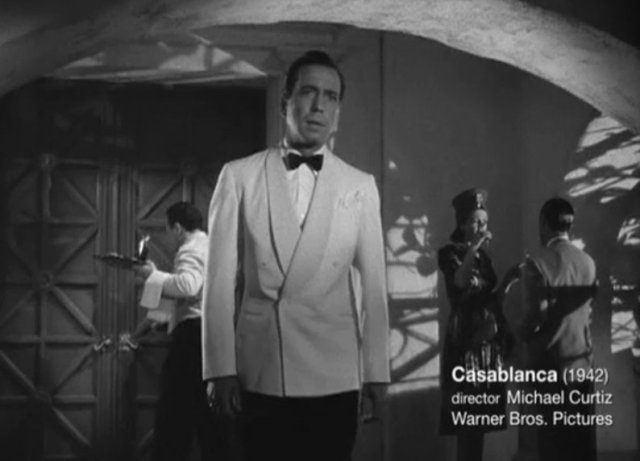
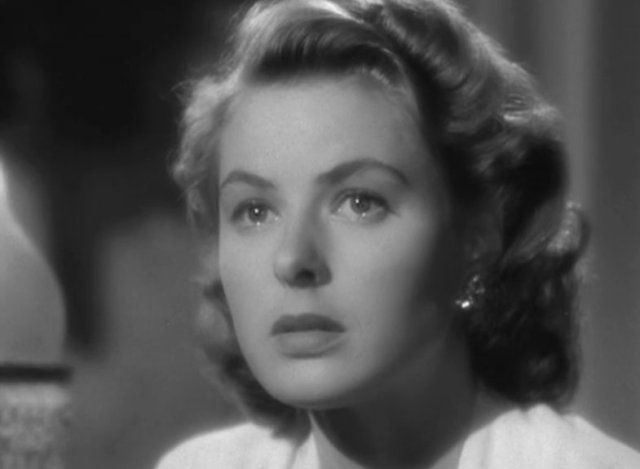
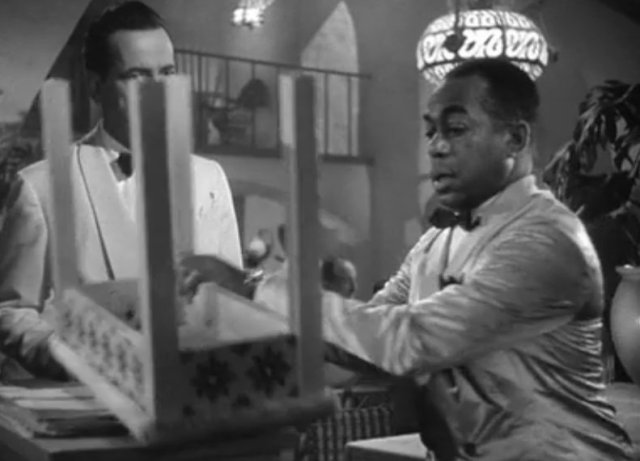

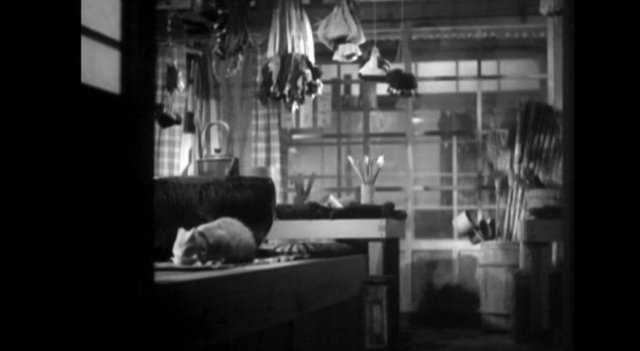
That’s throwing down the gauntlet, no? In the first minute of a 15-hour series he opts to take on Casablanca, the veritable poster child of favorite movies (it came in 6th in an AMC poll).
We’ll see if this idiosyncratic view continues. I note that A.O. Scott wrote that the series “stands as an invigorated compendium of conventional wisdom”, so I guess it is possible there will be less than first meets the eye over the next installments.
And indeed, after this heady introduction, the first installment was mostly a somewhat conventional retelling of the beginnings of film, from Edison to Lumiere to Melies to DeMille to Griffith. Cousins does include some nice academic-style discussion of the development of editing techniques to accomplish various tricks, which soon settled into vocabulary. But I was let down in that he failed to mention my first cousin, twice removed, who was co-director, with Cecil B. DeMille, of The Squaw Man, properly identified as the first feature length narrative film made in a Hollywood studio. Cousins credits the film to DeMille only.
But heck, DeMille went on to greater things and my relative sunk into the relative obscurity of character parts, and history is after all told from a victor’s POV.

 Blowhard, Esq.
 Callowman
 Sherbrooke
 Eddie Pensier
 Enzo Nakamura
 Epaminondas
 Fabrizio del Wrongo
 Fenster
 Brundle Guy
 Glynn Marshes
 Paleo Retiree
 Atypical Neurotic
 Question Lady
 Sax von Stroheim
 Sir Barken Hyena
 The Mistaken
 Uncouth Reflections
Oscar Apfel? Interesting!
Sounds like he’s using “classical” to mean “pure of form” rather than “great” or “historically important.” Still, using Ozu to beat up on Hollywood is pretty shallow (not to mention too clever by half). Even by Japanese standards, Ozu is a stylistic outlier. Keeping all that in mind, what is the point he’s trying to make with the comparison? The American movies are stoopid? For the purposes of most people who are interested in movies, Michael Curtiz and studio filmmaking of the ’40s are plenty “classical.”
I was not aware of this series. Will have to check it out. Thanks for tip.
I did notice a while back that Kevin Brownlow’s wonderful series “Hollywood” is available in its entirety on Youtube. That one is definitely worth a look. Not available on DVD (or streaming).
Here’s the first episode:
Godard’s “Histoire”, FWIW, gave me a migraine.
LikeLike
Yes, it was Oscar all right. Too bad he was left on the cutting room floor of the show.
Still and all, I’ve never seen The Squaw Man and it was interesting to see Cousins include a number of scenes. Also funny that he used it to illustrate a problem common the early cinema given the lack of experience with the new vocabulary. As he points out, when you suggest a direction in a scene (Bogart looking right to Bergman), you need to make it symmetrical in the cut (Bergman looks left to Bogart). He shows a scene from Squaw Man in which a guy falls off a mountain on the left side of the screen with the mass of the mountain to the right. But when the film next cuts to the base of the mountain he lands to the right of the screen, with the mass of the mountain to the left. A rookie mistake for the rookie industry, and therefore forgivable. Or maybe that’s why deMille chose not to work with Apfel again . . .
LikeLike
Yeah, Bordwell has done a lot of work on that. I seem to remember his using 1917 as the date at which American movies really started to feature tightly matching sight lines, continuity cutting, etc.
LikeLike
You are right he means classical not classic–but a close reading of what he says and how he says it indicates he is intentionally (I think) fudging the meanings.
LikeLike
If he likes that scene from the Japanese movie, he should check out the opening sequence of Back to the Future.
LikeLike