
Sax von Stroheim writes:
Two new movies, both good, by any reasonable objective standard, in that they seem to successfully achieve what they set out to achieve. But one betrays a fear of commitment, a fear of failure, while the other risks kitsch to reach something sublime.
Tabu (Miguel Gomes, 2012)

This way to whimsical poignancy
It may seem ungenerous of me to criticize this small, idiosyncratic, formally playful movie for a fear of taking risks, but that’s, ultimately, how it came across to me: the whimsy and the formal playfulness standing in for a need to actually commit to making a movie – a commitment that leaves you open to failure, to looking foolish, but also makes it possible for the kind of success that doesn’t feel contrived or calculated. Gomes indicates emotion rather than attempting to express it, giving Tabu the same push-pull feel of some of Wes Anderson’s movies. Having said that, this is much better than most cover-your-ass film festival favorites: it has a sense of humor, some good performances, and a few genuinely poignant moments. I suspect high brow cinephiles have embraced it, in part, because it remains “aesthetically correct” while still delivering some basic movie pleasures.
Life of Pi (Ang Lee, 2012)
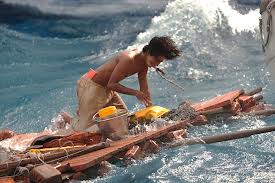
More survival movie than feel good fantasy
A big budget, effects-driven movie, based on a popular novel that might have been chosen for Oprah’s Book Club. It’s never far from being kitsch, and could be aptly described as Avatar meets the Tree of Life. I think it ends up not being kitsch, though, because (a) Ang Lee’s direction is nuanced and sensitive and (b) it’s really fucking terrifying. This is a rare kind of movie today: a fantasy movie that looks squarely at mortality: by the end it feels closer to the Liam Neeson survival movie The Grey than it does to standard Holiday feel-goodery. Tangentially, I really appreciated that it seemed to take religion seriously, and without any kind of condescension.
 Blowhard, Esq.
 Callowman
 Sherbrooke
 Eddie Pensier
 Enzo Nakamura
 Epaminondas
 Fabrizio del Wrongo
 Fenster
 Brundle Guy
 Glynn Marshes
 Paleo Retiree
 Atypical Neurotic
 Question Lady
 Sax von Stroheim
 Sir Barken Hyena
 The Mistaken
 Uncouth Reflections
I don’t know if it really takes religion seriously. The big payoff line (“will make you believe in God”) is Pi telling the visitor that religion is basically a story we tell ourselves to avoid facing unpleasant reality. That’s not a very sophisticated version of “the opiate of the people.”
LikeLike
Well, I think you can take something seriously without necessarily endorsing it or agreeing with it. However, I think more is going on in “Life of Pi” with regard to religion than just “what the final twist means”. For example, we’re supposed to see Pi’s brother’s and father’s anti-religious view to be limited: they’re cutting themselves off to the kind of experiences that Pi is able to have (the mystical visions he has on the boat, for example). The movie also seems to suggest that it isn’t so much that the story with the tiger is more pleasant, but that it’s more true.
LikeLike