
Fabrizio del Wrongo writes:
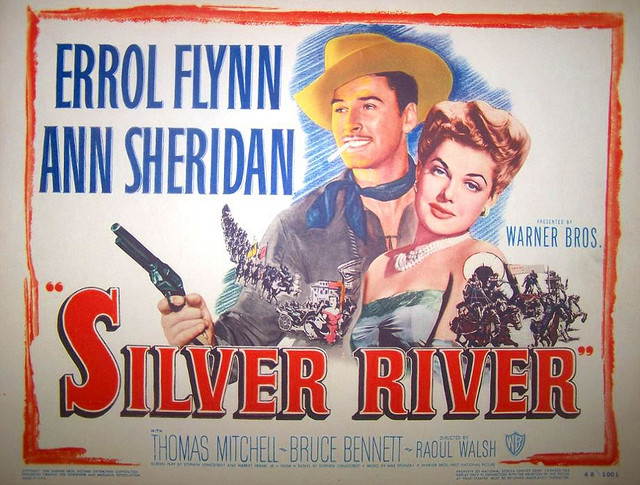
I watched this mid-period Raoul Walsh western a while back on the recommendation of co-blogger Sax von Stroheim. It stars Errol Flynn as a disgraced Union officer who’s decided to live in a purely selfish manner. In doing so he becomes the hub of a mining town, the center of its thriving economy. He founds the saloons, becomes the largest shareholder in each of the local silver mines, even opens a bank when it becomes clear that he controls all the cash in the area. Fittingly, Walsh shoots the early war and pioneer material in his ’30s freeform style, with a lot of camera movement and action staged throughout the frame. Later, once Flynn and his town have become established, the movie becomes more visually staid, more like a conventional ’40s product. It’s an effective visual strategy, one which ushers the viewer through the movie’s basic themes in an organic, unfussy way. But what I found most fascinating about “Silver River” was its manner of condensing and dramatizing basic economic relationships – the movie is like a miniature representation of American capitalism, with all its benefits and drawbacks highlighted. Flynn is pretty fascinating too; he allows his natural roguishness to suggest a deeper amorality, with slyly subversive results. (The performance makes you wish he’d played more villains.) Unfortunately, “Silver River” loses something when it allows the Thomas Mitchell character, Flynn’s lawyer, to become its moral center (he preaches to the audience). And a subplot implicating Flynn in a murder is never fully developed. But for much of its running time this western makes good use of moral ambiguity.

 Blowhard, Esq.
 Callowman
 Sherbrooke
 Eddie Pensier
 Enzo Nakamura
 Epaminondas
 Fabrizio del Wrongo
 Fenster
 Brundle Guy
 Glynn Marshes
 Paleo Retiree
 Atypical Neurotic
 Question Lady
 Sax von Stroheim
 Sir Barken Hyena
 The Mistaken
 Uncouth Reflections