
Paleo Retiree writes:
Another in my ongoing series of snapz of the absurd places Americans see fit to place (and tolerate) advertising.
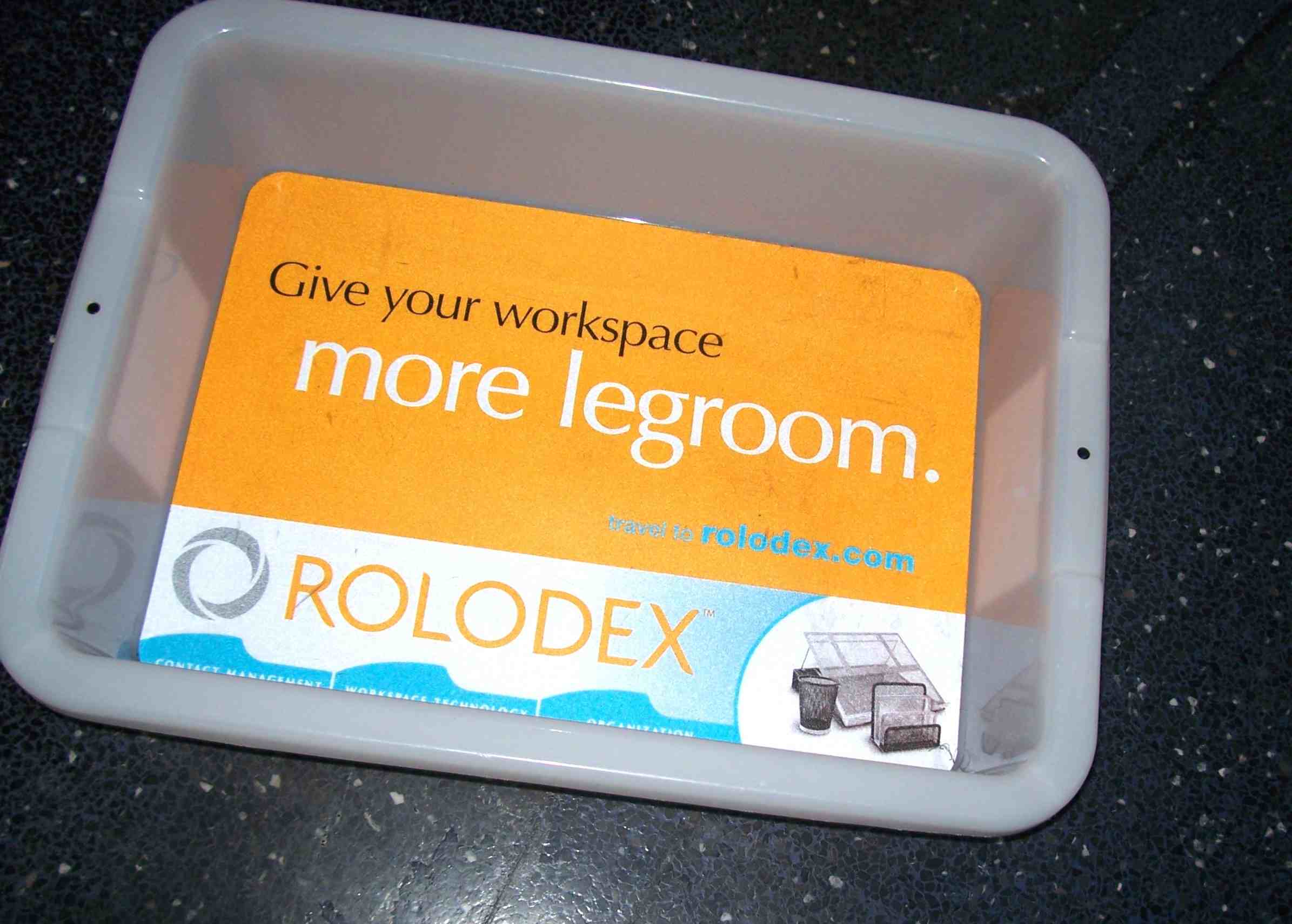
Explanation: That’s a photo of an ad at the bottom of one of those plastic trays into which you dump your carry-on items in order to go through TSA screening before getting on an airplane. A few questions I find myself pondering:
- Whoever owns the bottom of that tray in a legal sense, as far as we flyers are concerned our interaction with it is mandated by law, so it’s intuitively government property. Are we now OK with the notion of plastering ads all over government property? If not, where do we draw a line that says: “It’s OK to stick ads on this kind of official property but not OK to stick ads on that kind of official property”? What reasoning will be used to decide where to draw such a line? Or is everyplace now fair game? Will we soon be seeing ads on the back of the shirts that soldiers wear? On the walls of the Lincoln Memorial? If not, why not?
- This particular space — the bottom of a tray that we use because of federal regulations regarding commercial flying — didn’t even exist prior to a few years ago. In other words: the idea of slapping an ad there didn’t emerge slowly, over a decent span of time. Someone pounced on it really, really quickly, perhaps even at the moment that the idea for the space itself was hatched. Is that an appalling or an inspiring fact?
- If we’re to fly, we currently have no choice but to interact with these trays. In other words: Our federal government is forcing all commercial air passengers to spend at least a brief amount of time taking in a Rolodex ad. Is that an appropriate way for our government to be exerting its influence? And: If a powerful, unavoidable entity like the federal government is going to oblige us to wade through a tedious process like TSA screening, wouldn’t it be the decent thing to spare us the commercial messages?
Keep it classy, America. Why do more Americans not protest the kinds of small insults that we’re routinely subjected to?
Previously. And before that.

 Blowhard, Esq.
 Callowman
 Sherbrooke
 Eddie Pensier
 Enzo Nakamura
 Epaminondas
 Fabrizio del Wrongo
 Fenster
 Brundle Guy
 Glynn Marshes
 Paleo Retiree
 Atypical Neurotic
 Question Lady
 Sax von Stroheim
 Sir Barken Hyena
 The Mistaken
 Uncouth Reflections
Nobody likes going through airport security; you’d think a company would not want to be associated with that negative experience…
LikeLike
Great point. Hey, Rolodex: Whassup?
LikeLike
One wonders whether that particular ad placement was their intent, or some third-party doing it on their behalf… If the latter, I’d fire them.
LikeLike
Yeah. Gotta wonder if anyone at Rolodex is even aware of the existence of the ad.
LikeLike
Exactly; they might be unhappy to learn their ads are being placed thus.
LikeLike
Americans over the past 20 years have come to crave clutter in their visual experiences. Look at all that CGI junk encrusting every digital pixel in the new Star Wars movies. Video games are like that too, and these days that’s a large part of the visual culture for younger people. Or magazine covers with dozens of grab lines, always with bullet points, parentheses (as you’ve pointed out), and other wing dings just to add extra clutter to what is already obviously a list of contents.
Or the clutter of the now ubiquitous “feeds” in Facebook, YouTube, etc. It’s like you can see all the individual chunks of a stream of internet vomit dripping down your screen.
Or product packaging — each surface is a standalone ad, with reams of text about Our Company’s Story, graphics on food packages about How Your Food Gets From Farm To You, straight out of a 1950s science reel for schoolchildren, and a list of codes more baffling than a map legend about whether it’s gluten-free, dairy-free, safe for children 2+ or 4+ or 6+, non-toxic, hypo-allergenic, rated M for mature because of gore or violence or sex or whatever else.
Information overload, man. My only explanation for the current love of visual clutter, like a mid-century drive-in restaurant or Victorian graphic design, is that people are in a low-arousal state and want to be kept that way. They want to continually take in bits of “content” that are not exciting separately, and are not combined to produce a large cathartic effect either. In high-arousal times, people want their ordinary lives punctuated by something exciting, then returning to normalcy (until the next bang).
Like being hungry or satisfied most of the day, and eating a couple of mouth-watering meals vs. continually snacking on not-too-tasty food-bits.
LikeLike
There’s a lot to that, and it’s really well described too. A couple of related things that have occurred to me — 1) the question of ornament. So many of our surfaces are blank and empty, and texture-free. They’re devoid of visual interest …so maybe one purpose a lot of advertising serves is simply supplying some sort of visual/graphic/textural appeal. We aren’t surrounded by appealing materials, let alone satisfying handmade craft work. Lacking those yet craving, as most people do, visual stimulation maybe many people are relatively content to accept the ads. 2) General degradation. When everything is already shitty and overcommercialized, what diff does it really make if/when some new little bit of life gets splattered with it?
So many cultural questions seem to me to have to do with self-respect … Eating well … Maintaining a lively and fresh brain … Keeping your poise amidst the whirlwind generally … I’m no taste fanatic and I like interacting a bit with whatever the culture happens to be bringing along. But I really can’t imagine living on the cultural diet a lot of Americans subsist on.
LikeLike
You find yourself wishing that the middlebrow concept of “Good Taste” would make some sort of comeback, after its untimely death in the late 1960’s. There was a lot wrong with that concept, but there was a lot right with it, too, and as Allan Bloom put it, even if there is something wrong with a concept, you don’t replace something with nothing, which is what we seem to have done.
LikeLike
Pingback: More Ads Everywhere | Uncouth Reflections
Pingback: Ads Everywhere: A Continuing Series | Uncouth Reflections
Pingback: Ads Everywhere | Uncouth Reflections