
Paleo Retiree writes:
The Question Lady and I were in town — that’d be New York City — a year ago, when Hurricane Sandy hit. It was quite a little adventure. For one thing, the hurricane itself was sort of a dud, at least from where we sat. Aside from some wonderfully ominous lighting effects and some weirdly colored clouds, you could have been forgiven for thinking that you were enduring a bad-but-not-terrible rainstorm, nothing worse. But then the power went out.
If you weren’t following the news closely at the time: A Con Ed power station on 14th St. was flooded, shorted out and took down all of the power for the lower half of the island of Manhattan, from (if I remember right) 33rd St. on south. That’s the part of town where we live. The power stayed off for anywhere from four days to several weeks.
We weren’t in any danger, and by no means did we suffer flooding or losses the way people in some areas of the city did. (My dental hygienist, for instance, who has an apartment out in the far reaches of Queens, still hasn’t returned to it.) But we were majorly inconvenienced. No electricity meant no elevators, no lights, no heat and no water. For days! To use a toilet, we had to walk 25 blocks to visit a restaurant. (We timed our eating and snacking very carefully.) Most stores in our neighborhood were closed. Street lights and stop lights were dark.
For a day, it was a giddy, topsy-turvy disruption in the usual routine. Kind of refreshing, really: shake it up, baby. Fun, even. I could have spent hours watching cars and buses negotiate intersections without the help of stoplights, for instance. How many crashes would there be? New York City has a lot of cars and trucks, as well as a lot of very aggressive drivers … but with the application of care and consideration, damned if the traffic didn’t flow OK. Maybe there really is something to this “self-organization” thing after all.
Plus: a crisis brings out the best in New Yorkers. Although when life is going smoothly Manhattanites can be brusque and rude, when there’s a crisis a lot of big hearts go on display. In the aftermath of Sandy, people struck up friendly, concerned conversations with complete strangers; uptown restaurants welcomed what everyone called “exiles” from downtown and let them use tables — and avail themselves of restrooms and wi-fi — for hours; cabbies drove residents around the darkness of nighttime lower Manhattan with no complaints. We were touched by many generous actions and gestures. People really went out of their way for each other, and doesn’t life need more of that?
After the first day had passed, though, the adventure got more and more tedious. How many times do you really want to end the day by lugging home a backpack full of bottled water? With no lights and no TV, how to kill the hours before bed? Bathing — or at least giving the pits, feet and crotch a quick rinse — in cool water poured from plastic bottles got to be a serious drag. We were very glad when life returned to normal.
On the anniversary of Sandy, I thought I’d share some snaps that I took during the hurricane and its aftermath.

People were both blasé and jolly during the run-up to the storm. Everyone followed advice and loaded up on batteries and water (as well as peanut butter, strangely enough), but there was also a lot of casual laughter and jauntiness. Hey, we’re New Yorkers — we deal with big annoyances on a daily basis. It’s just what we do. So bring the fuckin’ hurricane on, wouldya? Even as Sandy began to blow, people were visiting restaurants and getting on with life.

Once the power went down, though, things really did start to seem pretty serious. All over the city, emergency-service crews of many kinds came out. Generators were set up outside important buildings and roared for days. When military convoys started rumbling around, things were starting to feel a little too much like a Roland Emmerich movie for comfort.

Even so, some kind of normal life went on. People still needed to eat and excrete, bathe and sleep. If your job was in a part of the city where the power was still on, you reported to work. A lot of young women went around town in their supercutest boots. Even in an emergency fashion counts, you know?

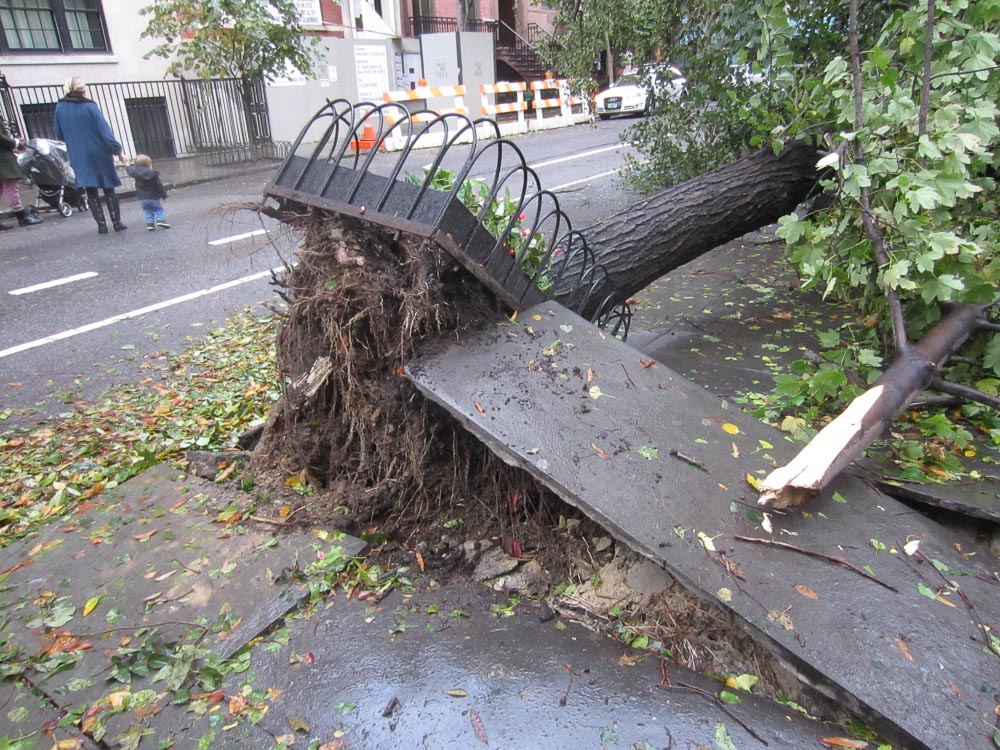
After the hurricane passed, the Question Lady and I took a stroll to see what kind of physical damage had been done. We saw no windows that had been blown out, but branches and trash were everywhere. A few trees had been knocked over too.

Minor inconveniences of many kinds cropped up. Cash could be hard to find. Food wasn’t as conveniently available as usual. A few heroic bars managed to serve booze despite all the challenges, though.
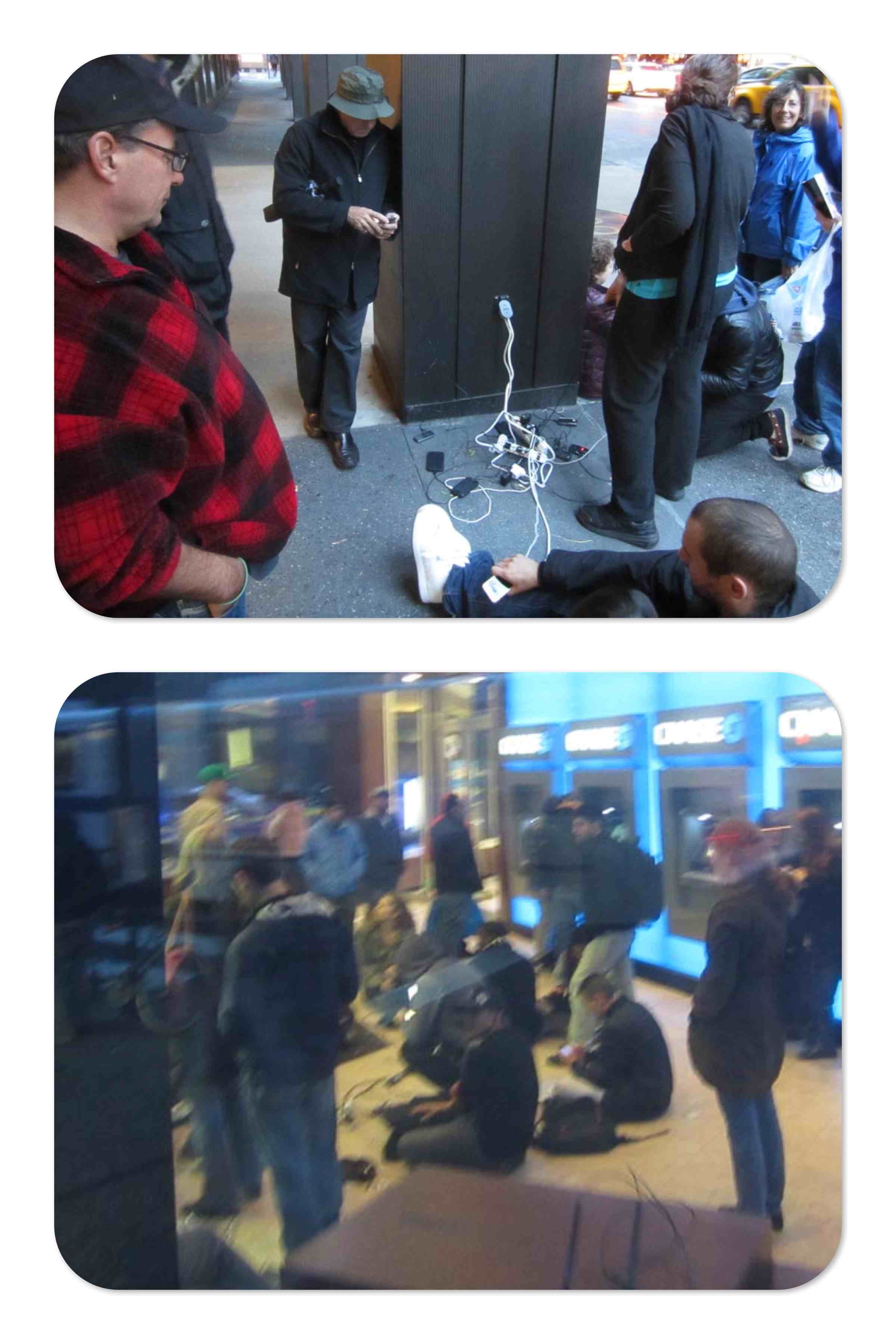
It’s the Age of the Smartphone, of course, and, as much as I generally look at them with distaste, I had to admit that smartphones seemed to be excellent tools in an emergency. A smartphone gave access to the news, and contact with the rest of the world. Smartphones even functioned pretty well as flashlights. But that left owners with a big challenge: How to charge their devices when their buildings had no power? Many businesses in the parts of town that did have power let strangers use their outlets. There was lots of laughter and bonding going on at these charging stations.

Lights were few and far-between in lower Manhattan. A few buildings ran their own generators, and car and truck headlights supplied some passing illumination. But generally speaking, once the sun set the city was dark dark dark. The effect was quite beautiful, if in an “Escape From New York,” dystopian way. After a few nights of walking around endless dark streets with nothing but flashlights to provide a little illumination, one did start to get nervous. How long would it take rough elements from other parts of town to figure out that we’d be easy prey? We were lucky: the power returned to our blocks before such a thing happened. But neighborhoods that had to do without power for longer than ours did in fact experience an upsurge of crime — break-ins, muggings, etc.

The Question Lady and I spent our days taking long walks around parts of town we hadn’t visited recently. One day we spent an afternoon at the Museum of Modern Art. The video-art show was a dud, leaving me wondering, “How many people really spend more than a minute looking at video-art installations?” By contrast, the Japanese design show (curated by the wonderful Takashi Murakami) was a lot of fun. Most important: The museum’s bathrooms were chic and clean.
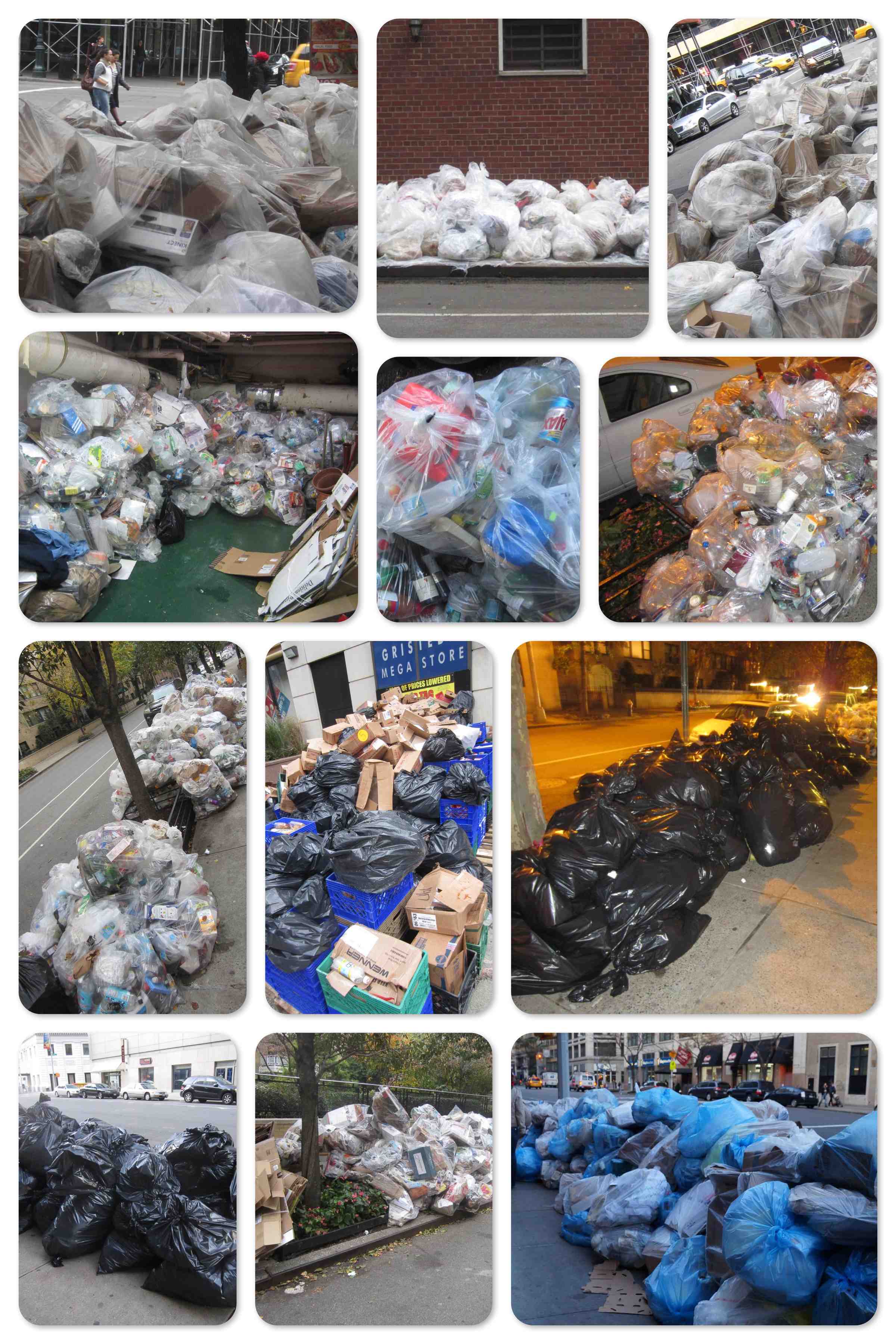
News reports about the emergency generally did a good job, it seemed to us. The one thing they didn’t convey quite as vividly as they might have, though, was the presence — the omnipresence — of garbage. Everywhere you looked there were heaps of garbage, and more of them every day. Lesson: When the usual garbage-gathering of a big city comes to a halt, waste piles up really quickly.

We were pretty tired of it all by day #5, when, around noon, the power finally returned. It was without a doubt the only time in my life I’ve witnessed people jumping up and down in relief and joy at the sight of traffic lights flickering on.
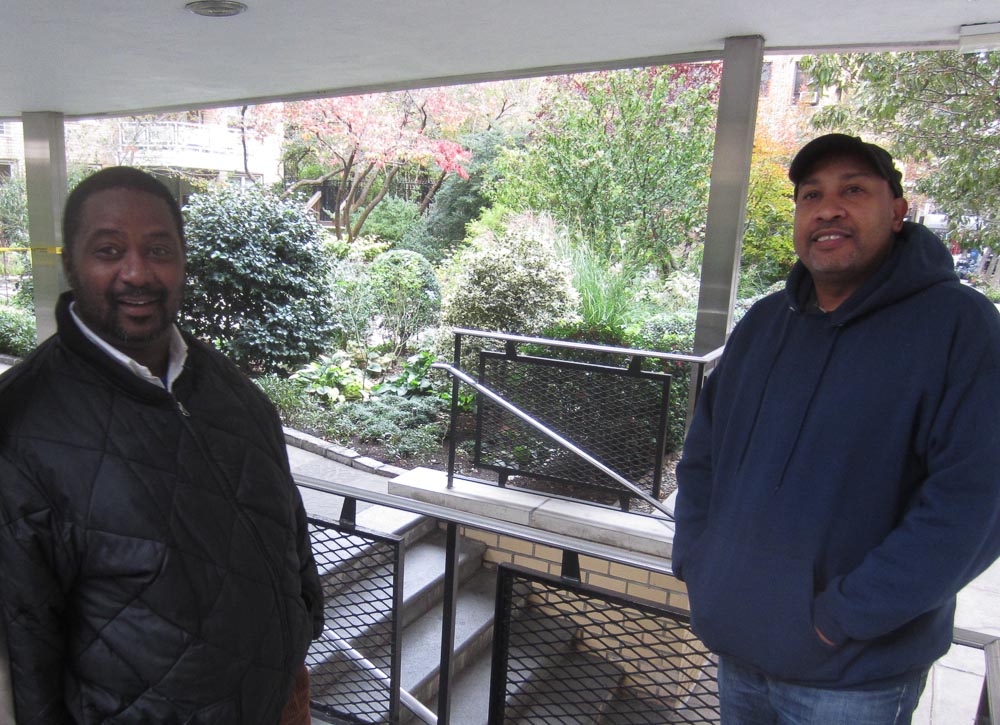 A little tribute to the doormen, superintendants and workmen/repairguys who keep the city’s innumerable buildings running. Loads of them made heroic efforts during this genuinely tough stretch. The guys in our own building pulled ultra long hours, checked in on elderly residents, kept everyone apprised of the latest news, and pitched in in whatever unpredictable ways the moment called for. They went the extra mile, and they did it because that’s just what you do in situations like this. Like 9/11, Hurricane Sandy was a vivid reminder of how much the rest of us depend on these good and hard-working people.
Related
- Some dramatic before-and-after pix.

 Blowhard, Esq.
 Callowman
 Sherbrooke
 Eddie Pensier
 Enzo Nakamura
 Epaminondas
 Fabrizio del Wrongo
 Fenster
 Brundle Guy
 Glynn Marshes
 Paleo Retiree
 Atypical Neurotic
 Question Lady
 Sax von Stroheim
 Sir Barken Hyena
 The Mistaken
 Uncouth Reflections
One of our favorite pubs, the Heartland Brewery at the South Street Seaport, was wrecked by Sandy. The entire Seaport was pretty badly hit. When we were there last March about 70% of the stores were closed. The Fulton Street strip was deserted.
LikeLike
Sad. One of our favorite (informal, bistro-style) restaurants here in the Village is going out of business too — the owner explained to us that she’d never been able to recover from Sandy. She didn’t lose just the week’s business — all her food got wiped out and had to be replaced, so it was more like a month’s worth of expenses that she lost. And her insurance company has evidently not been any help. Too bad — it’s been a nice part of the neighborhood. These “black swan”-type events, eh? Can’t be foreseen, but they really have an impact. Our restaurant probably would have made it if it hadn’t been for Sandy.
LikeLike
“No lights, but we’ve got liquor” — dang kids these days can’t come up with any new blackout jokes…
I recall seeing a retrospective on the ’77 blackout where somebody supported your idea about a little crisis bringing out the good in New Yorkers: “Son of Sam made New York City feel like a small town.”
LikeLike
Some jokes are classics, I guess.
LikeLike
Didn’t your water work? Do NYC buildings use pumps to get the water to the upper floors, or are there local pumping stations, and yours was blacked out? Not having a working toilet would be the biggest inconvenience. Did the water stop running instantly, or only after a few hours?
I live on the top floor of a building on top of a hill, and our toilets and taps always seem to work even if the power’s out. This is mostly a low city (3-8 stories), though, and water pressure is maintained by tapping the water out of huge reservoirs on peripheral hills. Presumably we would run out of water, too, if a power outage persisted very long.
LikeLike
We’re in a tallish apartment building — we were told that it takes electricity to pump water into and through those things. (Manhattan is more or less completely flat, so gravity isn’t going to be doing much work for you.) No water in the apartment at all for nearly five days. No shower, no toilet, etc. HUGE inconvenience, as well as a huge incentive to get out of the apartment and spend most of the day in parts of town that did have power and water. Ah, the fine art of timing meals so that we’d be someplace with a working toilet whenever nature called …
Come to think of it, the whole adventure was one reminder after another of how dependent we city-dwellers are on the basics: power, water, sewage, food, waste, cops … And in a big city, none of that happens without a lot of human intervention. I read somewhere that a big city can survive a shutdown of its major systems for only about eight days. After that, things apparently start to fall apart in serious ways. Can’t remember a source for that assertion, sadly, but by day five I was starting to feel that I understood what was meant.
LikeLike
Pingback: When Hurricane Sandy Hit New York
I love the applause when the traffic lights lit up again. And it’s always been a challenge to find a safe and decent publish washroom in that town … Someone should make a map. (Maybe they have.)
LikeLike