
Fabrizio del Wrongo writes:
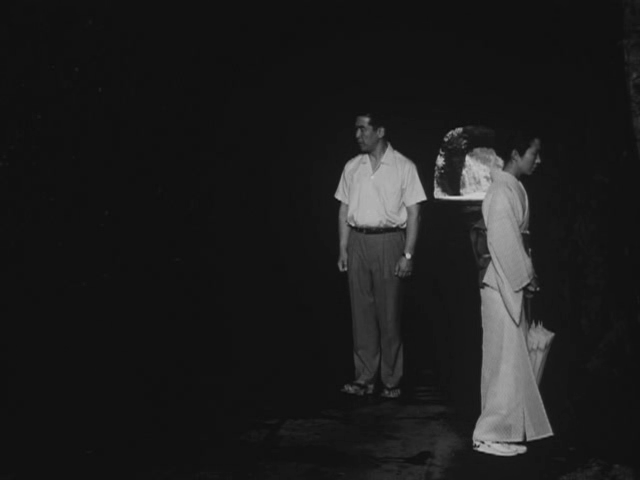
“The Stranger Within a Woman,” from 1966, is an unsettling late Naruse that feels a bit like one of Bergman’s ’50s films, especially in its use of the flashback as a structuring device. The plot concerns a middle-class man who inadvertently kills his friend’s wife during a bout of kinky sex. Predictably, this strains the relationships between him, his wife, and the friend. Naruse downplays the thriller aspects of the story in favor of emphasizing the way in which the event galvanizes the instincts — both moral and practical — of each involved character. Nothing ends up being resolved, yet it’s fascinating to watch Naruse shift point of view and force story elements to collide in evocative, unexpected ways. More than once it reminded me of one of Hitchcock’s most underrated films, the 1929 “The Manxman.” I’m not sure what was going on in Naruse’s life during this period, but the movie he made right after this one, “Hit and Run,” is another quasi-thriller with macabre overtones.
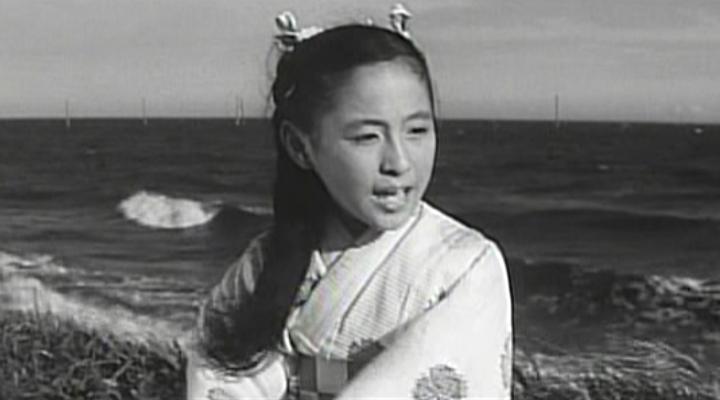
The 1960 “Autumn Has Already Started” has an Ozu-esque title but the pessimism and focus on money are typical Naruse. In it, a widow and her son move from the country to live with their relatives in Tokyo. The mother is forced to take work as a geisha while the son develops a friendship with a girl who performs chores in the mother’s workplace. This leads to problems, as the boy’s play activities begin to overlap with the mother’s very adult occupation. As the movie progresses we see less of the mother; she gets into a relationship with a patron, and he wisks her away. The boy compensates by spending time with an older male relative, who is kind but ultimately more interested in carousing with friends. The scenes between the children are sweet without being maudlin. In the movie’s most memorable bit they go to the waterfront in a taxi, then get lost on the desolate, desert-like beaches. In another bit the boy rushes to the home of the girl to impress her with his pet rhinoceros beetle. Upon arriving he discovers that her family, like his mother, has packed up and moved. Heartbreaking. These scenes have a tenderness and a respect for youthful POVs that recalls “The 400 Blows” — though Naruse is free of Truffaut’s mythologizing tendencies. The movie makes good use of the Tokyo locations. You really get a sense of the city and its surroundings. It’s notable that the opening and closing shots involve busy city streets; images of the characters carefully picking their way through traffic sensitize you to the danger inherent in urban locations. Perhaps these shots are also premonitions of Oshima’s 1969 “Boy,” a movie with a similar — and a more firmly hammered down — set of themes.
Related
- Dan Sallitt discovers a connection between “The Stranger Within a Woman” and Chabrol.

 Blowhard, Esq.
 Callowman
 Sherbrooke
 Eddie Pensier
 Enzo Nakamura
 Epaminondas
 Fabrizio del Wrongo
 Fenster
 Brundle Guy
 Glynn Marshes
 Paleo Retiree
 Atypical Neurotic
 Question Lady
 Sax von Stroheim
 Sir Barken Hyena
 The Mistaken
 Uncouth Reflections
It broke my heart just to read about that “show the beetle” scene. Childhood is exceedingly hard to remember clearly, let alone channel with any delicacy into art. And somehow I have never seen a Naruse film (I don’t know how I managed that). This gave me an acute sense of what I’m missing.
LikeLike
Hulu+ has a bunch of his movies available to stream, though I don’t think these are among them. He’s a giant who for some reason has been slow to gain a toehold in the West. A lot of his stuff simply hasn’t been available. In recent years filmbuffs on the internet have done incredible work finding and subtitling his work.
Some good info here:
http://mubi.com/cast_members/9221
LikeLike
Pingback: “Untamed” | Uncouth Reflections