
Eddie Pensier writes:
Kenneth Branagh’s film of Mozart’s opera is the first filmed directly for the screen (Ingmar Bergman’s classic version was initially made for Swedish TV). Branagh made several decisions as a filmmaker that would drastically affect the outcome of his project: He commissioned a new English translation of the libretto by actor/writer/polymath Stephen Fry; he decided to cast actual singers in the leading roles, rather than actors with their voices overdubbed; he updated the setting to Europe during World War 1; and he completely stripped the opera of its famous Masonic symbolism.
The last is a big, big problem. Flute stripped of symbolism is a Flute that is twee and nonsensical. Branagh wants to make grand sweeping statements about war and peace, but without an overall thematic structure, the work falls to pieces. It’s interesting and a little distracting to watch Branagh’s vision stagger from gritty war film to ludicrously surrealist fantasy. There are, to be sure, some amazing visuals in the movie: the Queen of the Night’s entrance atop a tank; the scenes of stomach-churning trench warfare during the overture. But the lack of unity makes this a very difficult movie to digest in one sitting. The characters of the Three Ladies and Three Genies are poorly dealt with: their appearances prompted out-loud “What the hell”s from me, so badly were they integrated into the filmed version of events.
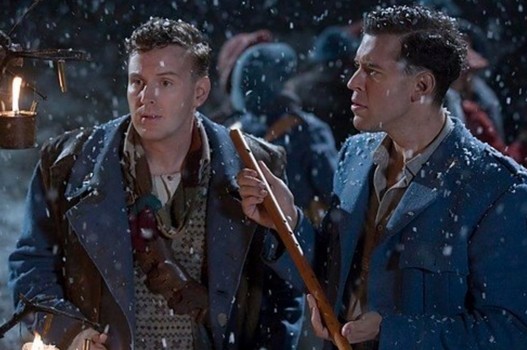
Benjamin Jay Davis and Joseph Kaiser as Papageno and Tamino in Branagh’s The Magic Flute.
I’ll admit to a bias against opera in translation. However, Fry’s new text is overall pretty good and singable. (It also, mercifully, leaves out the casual racism and sexism that, while funny to audiences in Mozart’s era, cause cringes even among conservative operagoers today.) James Conlon conducts the Chamber Orchestra of Europe in a sprightly and animated rendition of the score.
How are the singers? Mostly good, sometimes great. Joseph Kaiser is a light lyric tenor with a more than passing resemblance to a young Russell Crowe. He plays Tamino with an appealing open freshness, and is a good enough actor that he could have a career in legitimate cinema should he choose it. Amy Carson looks beautiful (perhaps helped along by Branagh’s obvious penchant for shooting her while she’s soaking wet) and has a pleasant voice that is slightly strained in the topmost ranges.
René Pape is probably the opera world’s foremost basso, and he plays the role of the solemn Sarastro as well as anyone ever has (here he’s the chief of a war hospital, rather than a high priest). Weirdly, the role of the Speaker is also sung by Pape…not sure why. His English diction could have used a little help, but otherwise he was a textbook Sarastro.
For me the standout was the awesomely demented Lyubov Petrova as a leather-clad Queen of the Night. Petrova fearlessly attacked the Queen’s two arias, with their famously difficult coloratura and high Fs (that’s REALLY goddamned high), and presented a Queen who was perhaps less purely evil and more Tiger Mother than is the norm. She’s a beautiful woman who barely looked older than Carson, her supposed daughter. I’d pay money to see her sing pretty much anything.
The weak link was a spastic, mugging, weak-voiced Benjamin Jay Davis as Papageno. I had to seriously resist the urge to skip through all his scenes.
Musically, this is a top-notch Flute. Dramatically and cinematically, I’d advise skipping it. But it’s on Netflix if you decide to check it out.
Related
- Want to watch a brilliantly sung Flute in a legit opera-house production? Try this one from the Met, conducted by James Levine and designed by David Hockney.

 Blowhard, Esq.
 Callowman
 Sherbrooke
 Eddie Pensier
 Enzo Nakamura
 Epaminondas
 Fabrizio del Wrongo
 Fenster
 Brundle Guy
 Glynn Marshes
 Paleo Retiree
 Atypical Neurotic
 Question Lady
 Sax von Stroheim
 Sir Barken Hyena
 The Mistaken
 Uncouth Reflections
Smart review. I had a ball with this movie, even though I thought it was too bonkers to work in a conventional way. Branagh seems more interested in making a Great War movie than in bringing in a passable version of the opera. He makes good and interesting use of every war-movie convention you can think of. And, stylisically, it’s as bold as a ’20s silent — though Branagh has the considerable advantage of CGI. I agree that Petrova as the Queen of the Night is a lot of fun. I had no idea it was on Netflix! I had a hard time tracking it down a couple of years ago.
LikeLike
I really wish Branagh had stuck to the nutty-magical-surrealist tone all the way through and ditched the war gimmick. That would have made a fabulous and fun movie, without the feeling that he was trying to make A Serious Statement.
There were some sort of dramas involving distribution: it was only released in the US last year, despite being around in Europe for years.
LikeLike
Pingback: On Kenneth Branagh’s The Magic Flute
Love the Hockney “Flute” and the Bergman, and also had no idea the Branagh is on Netflix. Headed over there now. Rewriting the dialogue is worth doing — the story and dialogue are so dumb. But, man, the music: Tamino’s “Portrait Aria” (fave version: http://www.youtube.com/watch?v=0a9Evm-6GXQ). And I’m sure you’ve already seen this … http://www.youtube.com/watch?v=AjzkuTiHM-I
LikeLike
Now there’s a person of class and taste! I worship Nicolai Gedda, possibly even more than Fritz Wunderlich. Definitely one of the greatest Taminos ever. Good idea for a future post.
The Portrait Aria is deceptive: it’s not hard in a technical sense, but it is hard to sing well. Mozart unkindly forgot to include places for his tenor to breathe, so a performer with perfect phrasing is even more important here than it is elsewhere (which is pretty important).
LikeLike
Pingback: Fritz Wunderlich, Five Ways | Uncouth Reflections
Pingback: The Best of UR 2014 | Uncouth Reflections