
Fabrizio del Wrongo writes:
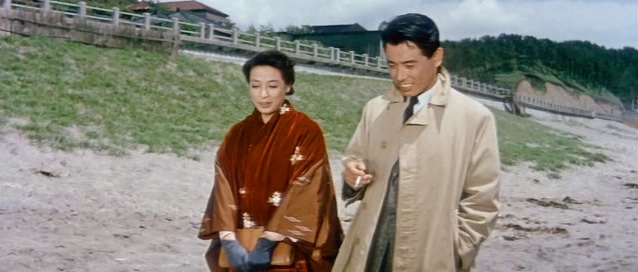
The 1958 “Summer Clouds” is a sprawling but tightly structured work, one that has an almost mathematical precision to it. Chikage Awashima plays Yae, a war widow doing what she can to sustain herself, her son, and her mother-in-law on a private farm on the outskirts of a minor Japanese city. She’s devoted to working the land and to supporting her two siblings — both have families on neighboring farms — but her yearning for independence keeps burbling up, especially when she meets a handsome reporter named Okawa (Isao Kimura). He interviews her for a story, then becomes involved with Yae’s efforts to locate a wife for her nephew. Eventually he helps her land a job writing stories for a local paper, a development that causes her to consider abandoning the farming lifestyle — though Okawa’s marriage stands in the way of Yae’s ultimate happiness.
The way director Mikio Naruse and screenwriter Shinobu Hashimoto weave the characters’ individual and familial stories into a dense narrative network is masterful, though it may grow a bit tedious to those not stimulated by Naruse’s formal gamesmanship. (The movie has one pace and one tone, and it’s over two hours long.) Naruse likes to elide major plot points, forcing the audience to glean them from subsequent conversations — “Summer Clouds” is almost all conversation — or even from the way in which one shot butts up against the following one. This impulse doesn’t seem to derive from a desire to obscure; no thread is left dangling. What it does do is lend a searching, almost thriller-ish quality to the experience of watching the picture, as it’s usually not immediately apparent how a given character, theme, or story element will fit into the larger scheme. (I constantly felt as though I was trying to resolve a diagram in my mind, and when a piece of the plan was made apparent, the resulting flash of understanding felt like a small reward.) This emphasis on mechanics has the twin side effects of thinning the impasto of melodrama and emphasizing those aspects of the movie that Naruse wants us to home in on — namely the characters’ interdependence, which is at turns vivifying and tragic.
Thematically, “Summer Clouds” is concerned with Japan’s transition from a rural, agrarian society to one based on industry and personal services. On top of new mores, the movie’s farmers are dealing with legal reforms restricting the inheritance of land, and these disrupt the already complicated set of rules governing traditional familial relations. The nominal head of the clan, Yae’s older brother Wasuke, has been particularly damaged by these rules, yet he remains fiercely devoted to them. (He’s the counterweight to Yae’s incipient modernism.) Played by Ganjiro Nakamura, the wiley coot from Ozu’s “Floating Weeds,” Wasuke has an old man’s attachment to custom and a child’s susceptibility to self-gratifying capitulation: when his plan for succession is ruined, his opposition collapses as quickly as it does when his ostracized middle son cajoles him with an offer of free sake.
Throughout the film Naruse intersperses scenes of the characters negotiating urban life with images of their toiling in the fields. They’re literally and figuratively caught between two worlds. This is especially true in the case of Yae, whose affair with Okawa brings her into repeated contact with a former college friend — a sort of doppelgänger — who works as a hostess for her commercially prosperous husband. (Fittingly, he owns a theater that screens Western movies.) A polished, fine-featured actress, Awashima certainly looks like she should be strolling through a town rather than squatting in a rice paddy, and Naruse underscores this disjunctive quality when he shows her using modern mechanical field machinery rather than the oxen employed by her more traditional siblings. The film’s final image, showing Yae trudging behind a manual plow, is one of those loaded-to-capacity cappers of which Naruse is so fond. Not only does it tweak the motif of Yae using modern tools (has she sold her machines?), it resolves the romantic and familial strands of her story in one bold gesture. This being Naruse, the pessimism of the moment lingers long after the image has faded.

 Blowhard, Esq.
 Callowman
 Sherbrooke
 Eddie Pensier
 Enzo Nakamura
 Epaminondas
 Fabrizio del Wrongo
 Fenster
 Brundle Guy
 Glynn Marshes
 Paleo Retiree
 Atypical Neurotic
 Question Lady
 Sax von Stroheim
 Sir Barken Hyena
 The Mistaken
 Uncouth Reflections