
Paleo Retiree writes:
Welcome to installment two in my short series about documentaries about movies, a genre that I 1) currently happen to find very lively, and 2) watched a bunch of examples of recently. (Installment one is here.) Today:
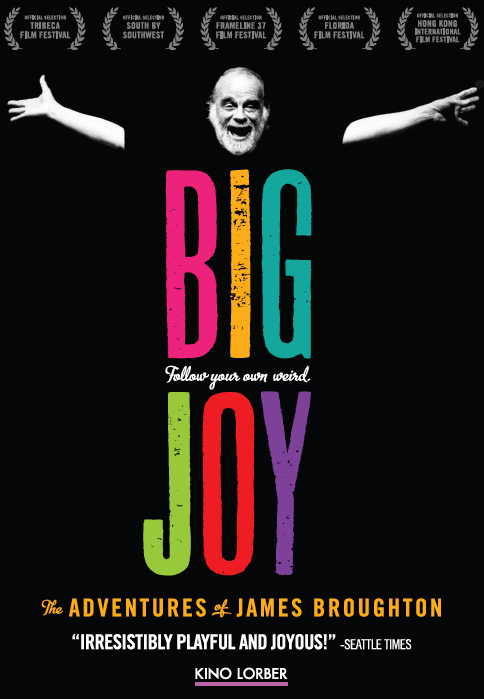
Big Joy
2013 doc about the San Francisco filmmaker and poet James Broughton, who died in 1999. I always found Broughton to be silly, minor and not very inspired — one of the weakest of the American avant-garde filmmakers — and the doc hasn’t changed my mind. But I enjoyed watching it make the case that Broughton was a significant cultural figure as well as a wise fool, a sophisticated childlike clown whose silliness embodied and conveyed a deceptively deep Zen-like wisdom about sexuality and creativity.
Broughton himself was quite a figure. From a privileged, WASPy California family, he was forever fighting feelings of worthlessness and wrestling with his gayness, yet he was also able to attain moments of zany bliss when he fought free and was able to feel fully himself. Handsome and instinctively flirtatious, he started out as a poet, discovered filmmaking in the late 1940s, had an early relationship with the critic-to-be Pauline Kael (who got pregnant and had a child by him), made a mark with some early shorts in the dream/mythical Cocteau mode, but then gave it all up and returned to California and poetry. Eventually he blew through his family money, took up teaching, married and had two more kids, went back to making movies, and became a guru figure and inspirational symbol to Bay Area hippies — part bard, part imp; part D.H. Lawrence, part Minnie Mouse; part poet of nature and sex, part campy mischief-maker. But he felt depressed, so, in his early 60s, he bailed out of his marriage and spent the rest of his life with a much younger man. Take that, heteronormativity.

Broughton, young and old
Like many driven creative people, James Broughton may have been an angel of inspiration and productivity but he was also a disaster of a parent. Why do these people have kids? They’re always neglectful and/or tyrannical parents. The emotional devastation that self-centered creative people can leave in their wake is often impressive and heart-rending. The wife Broughton abandoned gets tearful — decades after the event — when she recalls him leaving her, and Broughton’s son talks about his dad shruggingly and fumblingly, as though he simply doesn’t have much to say because he never really knew him. Broughton’s two daughters declined to be interviewed for the film.
The film itself, directed by Stephen Silha and Eric Slade, does an excellent, stylish and sympathetic job of telling Broughton’s story. It’s especially informative about the San Francisco Renaissance — a boho scene in San Francisco that preceded the better-known Beat and hippie eras. It’s more appreciative of Broughton, and especially of Broughton as a gay-lib icon, than I can get on board with — translation: the movie is itself very gay. (And its view of the pain Broughton caused his loved ones is that it was unfortunate but that Broughton’s achievement justifies it, a view I have real reservations about.) But could a film like this one have gotten made without the lopsidedness and partisanship? Movies — even docs made with today’s relatively cheap and convenient tools — take an awful lot of work. Watching credits roll, I’m often hyper-impressed by not just the research that’s been done but by the lawyering-and-permissions achievements too; a documentary director I once chatted with told me that obtaining rights and permissions was half the work of making her movies. As easy as many of these new docs are to watch, the making of them still requires huge heaps of motivating fire.
We watched the film on Netflix Instant; I see that it’s available on the iTunes Store too. Next up in my series: “Pablo,” about the influential graphic designer Pablo Ferro, legendary for the title sequences he created for movies such as “Dr. Strangelove” and “The Thomas Crown Affair.”
Related
- “Big Joy”‘s website.
- An interview with the directors.
- There’s a lot of Broughton-related material on YouTube, including two of Broughton’s better-known films, “Erogeny” (NSFW) and “This Is It.”
- Fabrizio recommends some docs.

 Blowhard, Esq.
 Callowman
 Sherbrooke
 Eddie Pensier
 Enzo Nakamura
 Epaminondas
 Fabrizio del Wrongo
 Fenster
 Brundle Guy
 Glynn Marshes
 Paleo Retiree
 Atypical Neurotic
 Question Lady
 Sax von Stroheim
 Sir Barken Hyena
 The Mistaken
 Uncouth Reflections
There was one of Broughton’s film’s I thought was very good. I think it was The Bed, but I’d have to check my lists. You are right though that most of his stuff is not terribly great: just a bunch of repetitive hippy dippy frolicking in the nude, if I recall correctly.
LikeLike
The SF Renaissance was an interesting movement. They were better at making actual art than the Beats. Ever read any Robert Duncan?
LikeLike
I like Gary Snyder too, but I don’t know where he fits. Not a fan of Kerouac and Ginzberg.
LikeLike
Pingback: Docs About Movies 3: “Pablo” | Uncouth Reflections
Pingback: Docs About Movies 4: “Side By Side” | Uncouth Reflections