Architects That Don’t Suck: David M. Schwarz

Blowhard, Esq. writes:

In this first installment of Architects That Don’t Suck, I’d like to highlight the work of Washington D.C.-based architect David M. Schwarz. Hey, whaddya know — not all contempo architects specialize in gleaming modernist geegaws. Some builders out there actually respect context, history, and beauty all while subsuming their ego to the larger needs of the project. I dig the variety of styles, colors, and materials Schwarz uses. Kudos also to the developers who had the sense to commission these works.

Related

Posted in Architecture | Tagged , , , , | 1 Comment

9/11 Memorial Visit: Calatrava’s Transportation Hub & the Memorial Pools

Blowhard, Esq. writes:

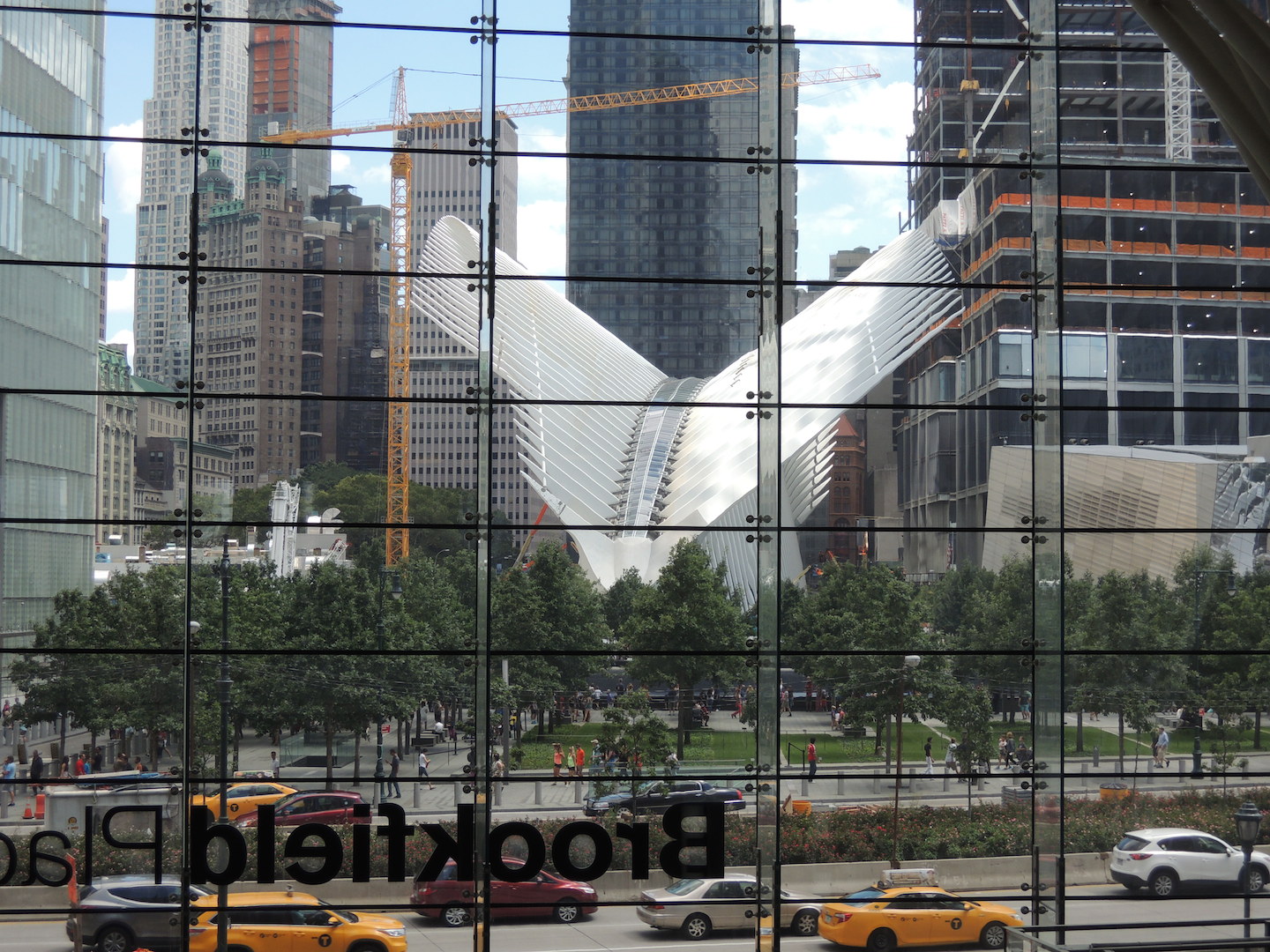
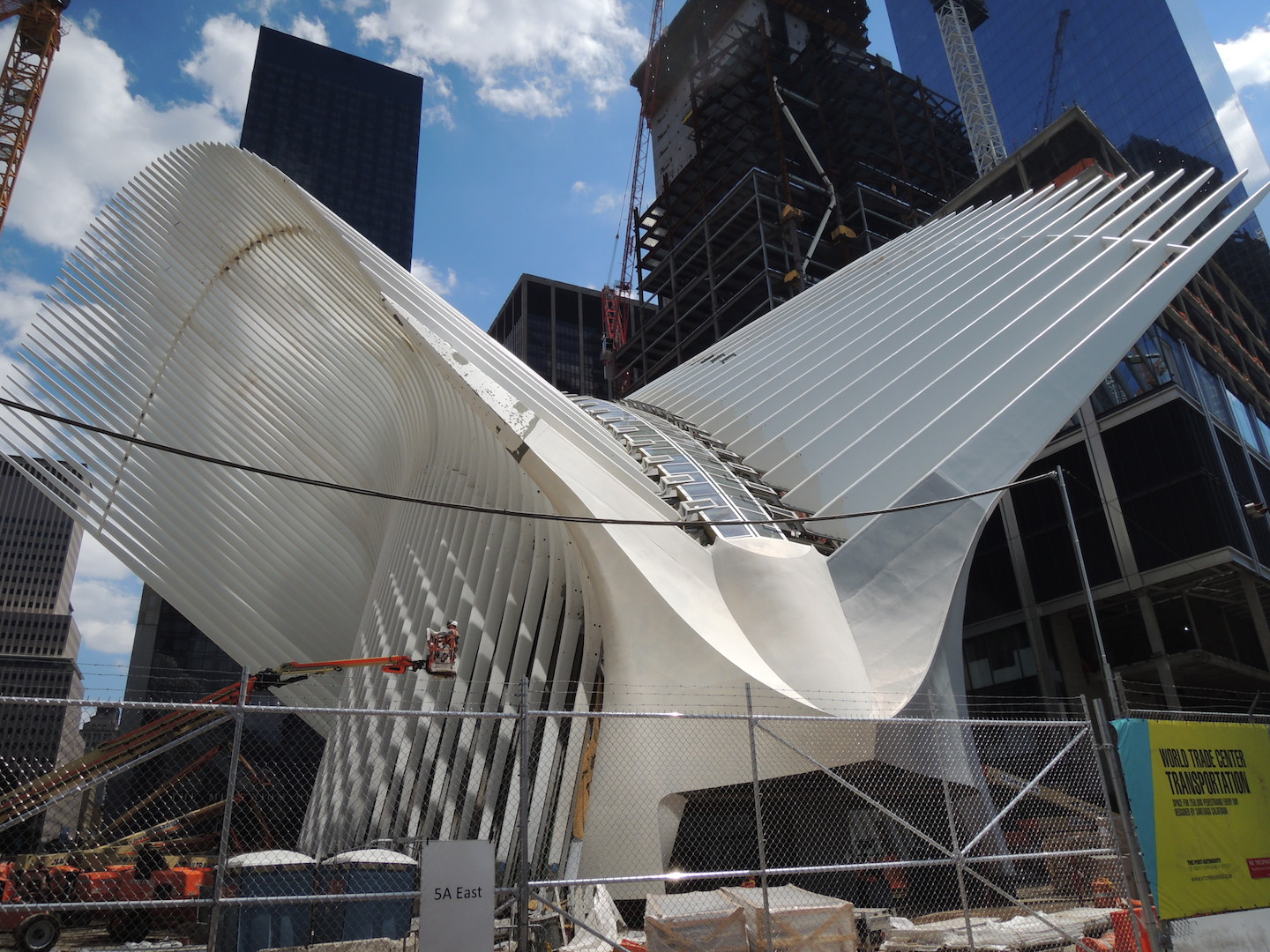
In part one of our 9/11 Memorial Visit, Paleo Retiree did an excellent job analyzing the disaster that is the park. In my tour I’d like to focus on the two main set pieces of the area: Santiago Calatrava’s still-in-progress Transportation Hub and the Memorial Pools. What do the monuments convey? How do they fit into the surrounding urban fabric? First, let’s take a look at the Calatrava. We started at Brookfield Place — a tony mall with a very good food court. It’s supposed to recall a dove taking flight but the way it’s oriented makes it look like bony mosquito trying to suck on those trees.

calatravahubcover

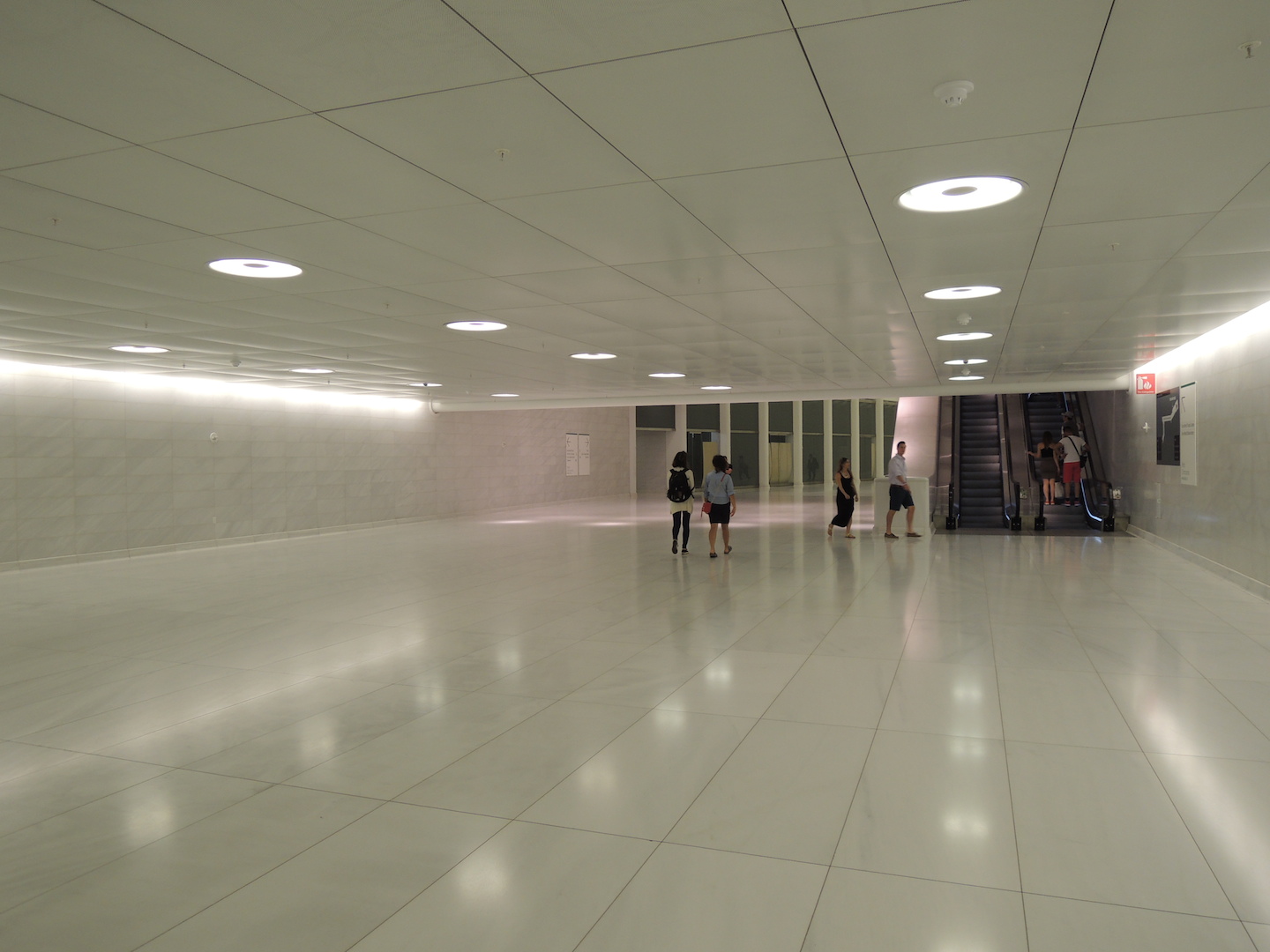
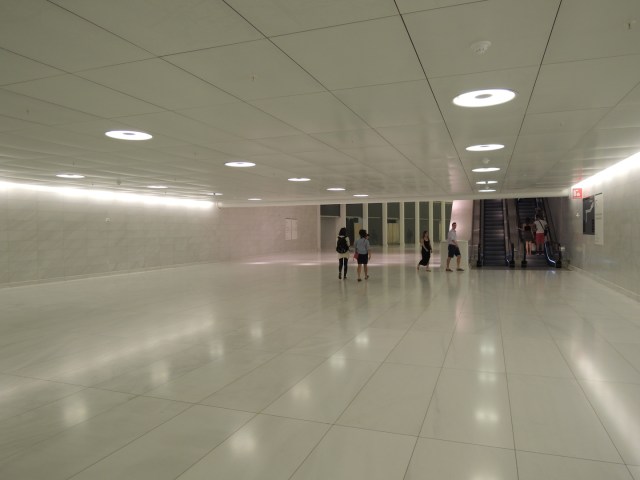
The only interior portion designed by Calatrava that’s currently finished is the underground concourse that connects Brookfield Place to the PATH trains. The actual interior the transport hub above is still under construction, but we’ll get to that in a moment. After descending an escalator we arrived in the gleaming white concourse that looks like something out of THX 1138.
concourse1

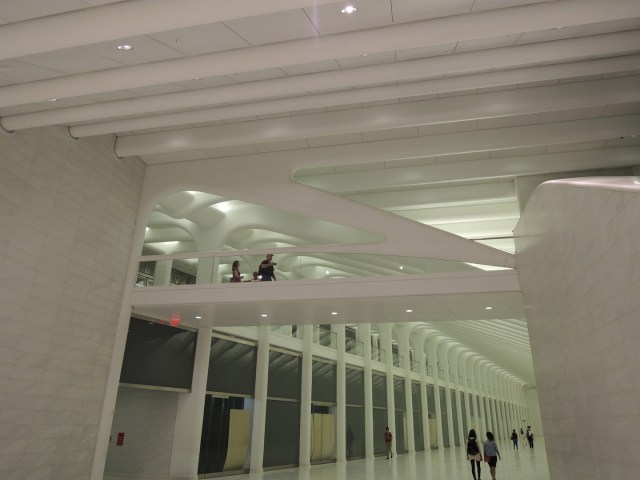
The ceiling is low here, but a few more feet ahead and the space opens up.
concourse2

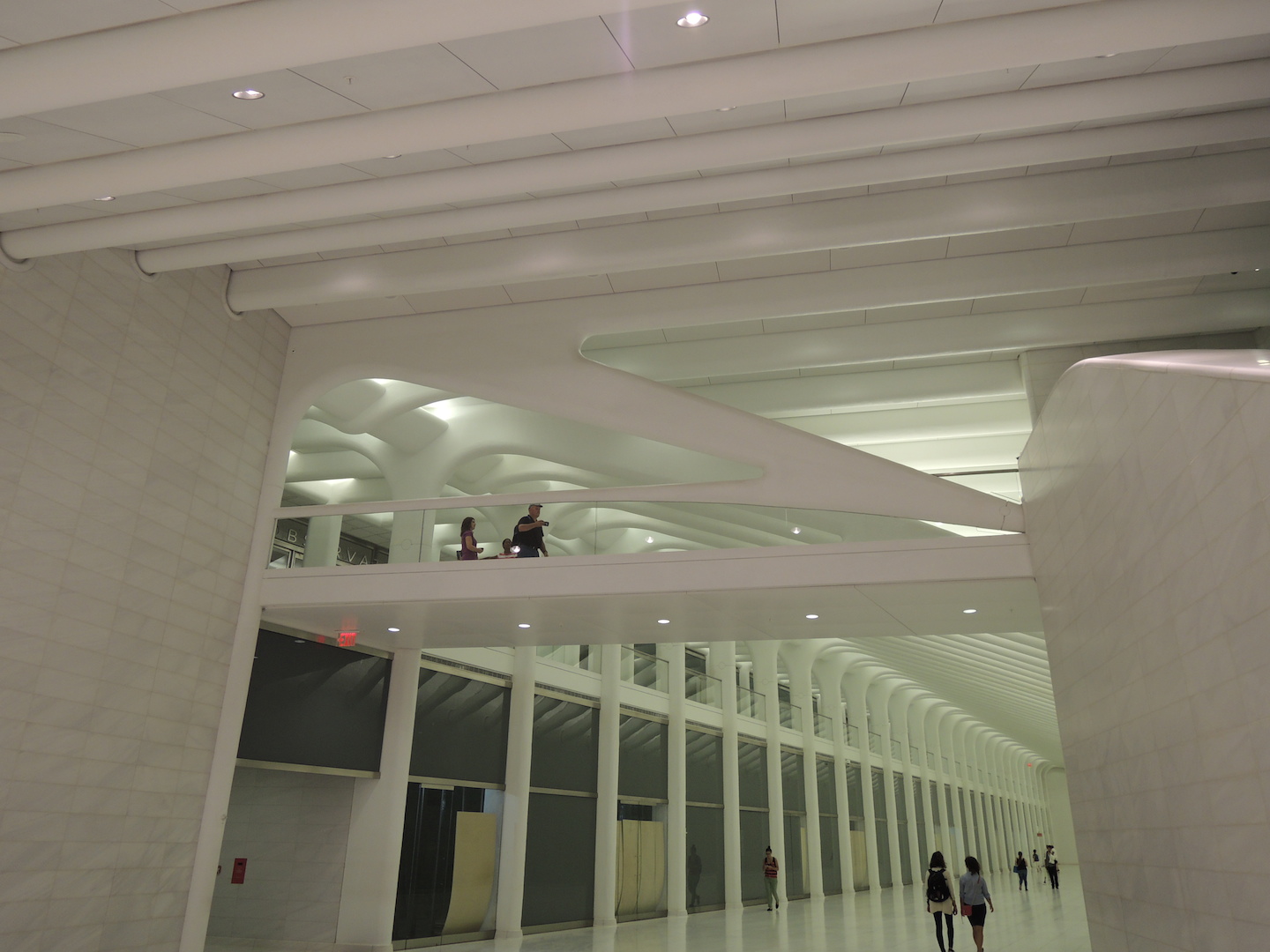
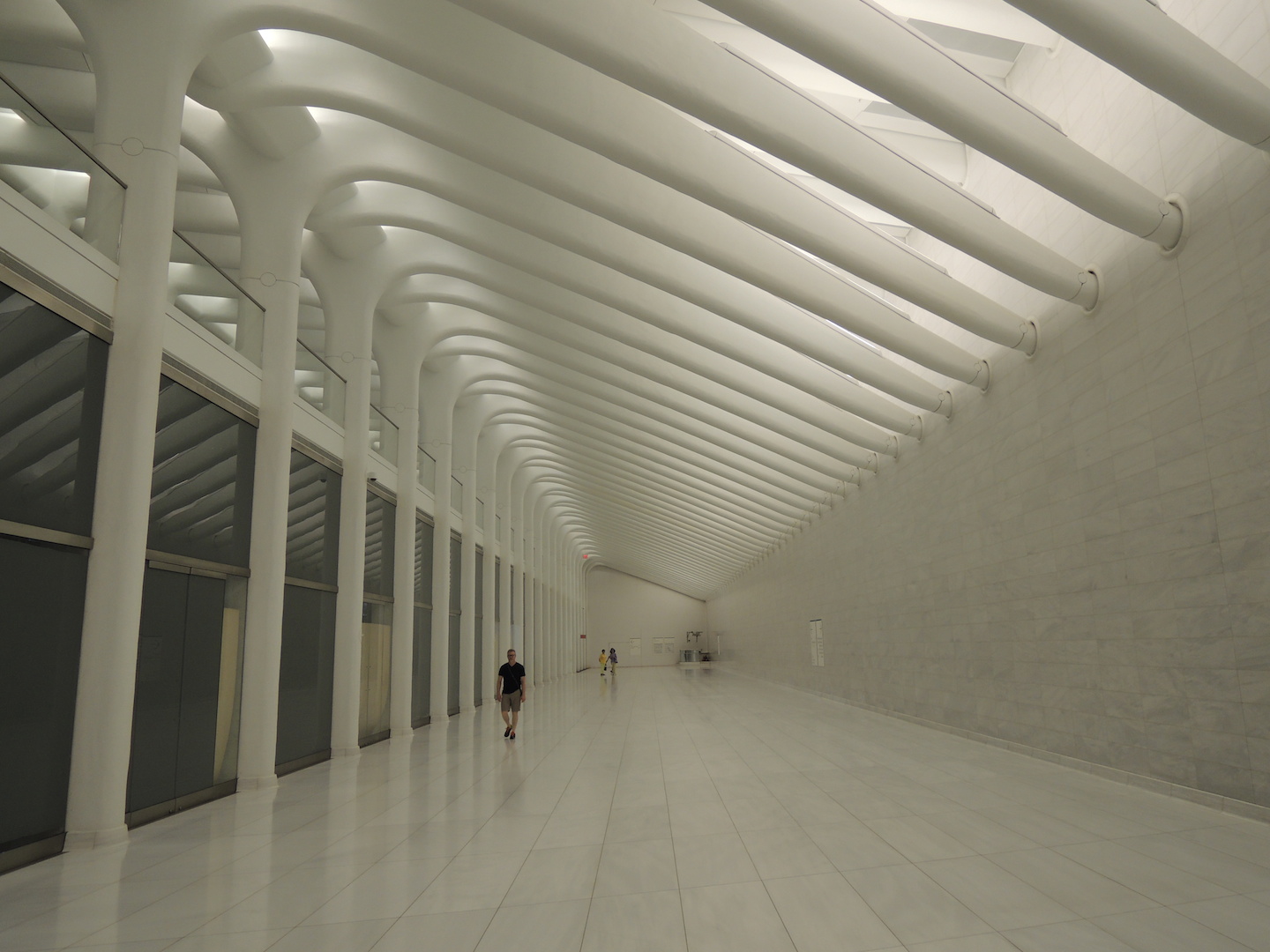
Calatrava sure digs those curving white spires, doesn’t he? The ribbing on the left reminds me of the exposed spinal column on a rotisserie chicken.
concourse3

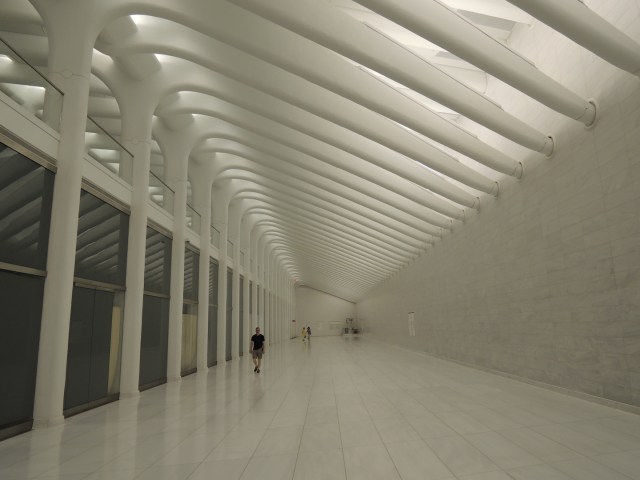
I’m guessing the upper balcony on the left will be the scene of a lot of high-class fashion magazine and music video shoots (assuming they still make music videos), but after you admire the impressive engineering there isn’t much else for the imagination to latch on to. Here are some more details from the space from different angles. All these communicate to me are “white,” “swoopy,” and “structural.”

After this space you make your way through some construction areas before emerging into the PATH train station. Then we made our way up an escalator and around some construction barriers to see the transport hub up close.
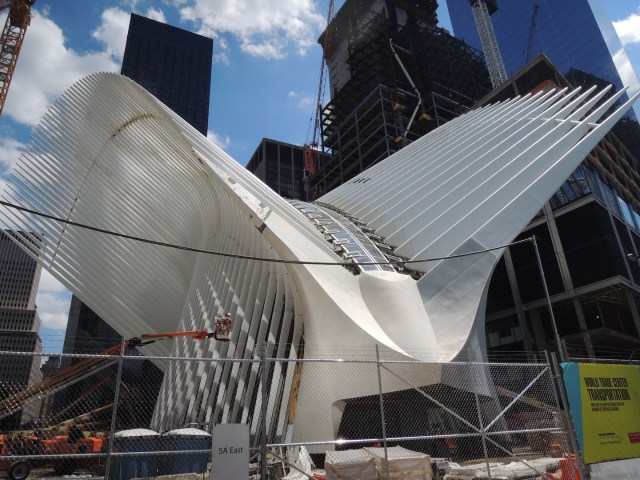
calatravahub1

Good Lord, what an appalling thing. Even up close it reads “skeletal insect” to me. Again, what’s with the excessive whiteness? And what’s so special about swoopy-doopiness? Does this have anything to do with New York? Couldn’t you just as easily transpose this to London, Dubai, Beijing, or Tokyo? Keep in mind, this is essentially a railway station, but it has more in common with corporate public art than architecture as it’s traditionally been understood. For the sake of comparison — to consider the opportunity cost — let’s look at the two most beloved railway stations in New York’s history, the Grand Central Terminal and the old Penn Station:
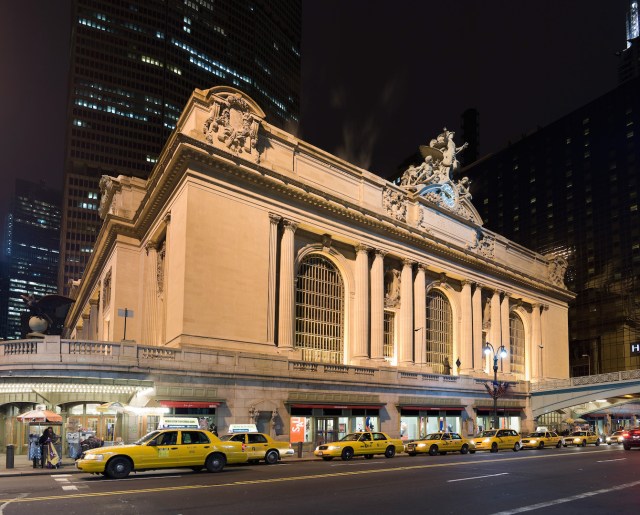
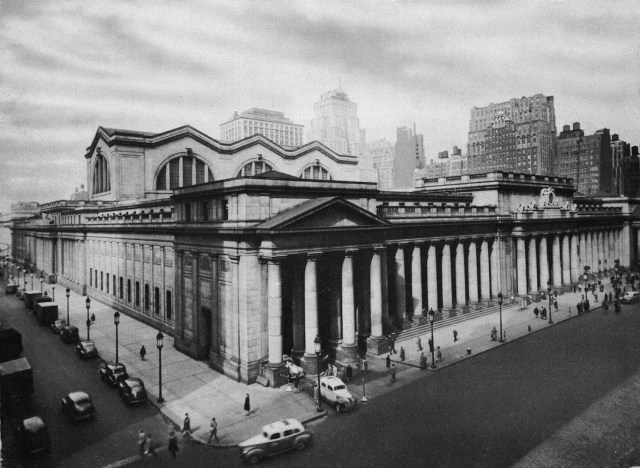
Grand_Central_NightPenn Station

Below is the area that will eventually be the main entrance to the Transport Hub.

calatravahub2

It looks like the wing is going to brush up against that building. From this angle I couldn’t help but think of one of the jets slamming into the towers.

calatravahub3

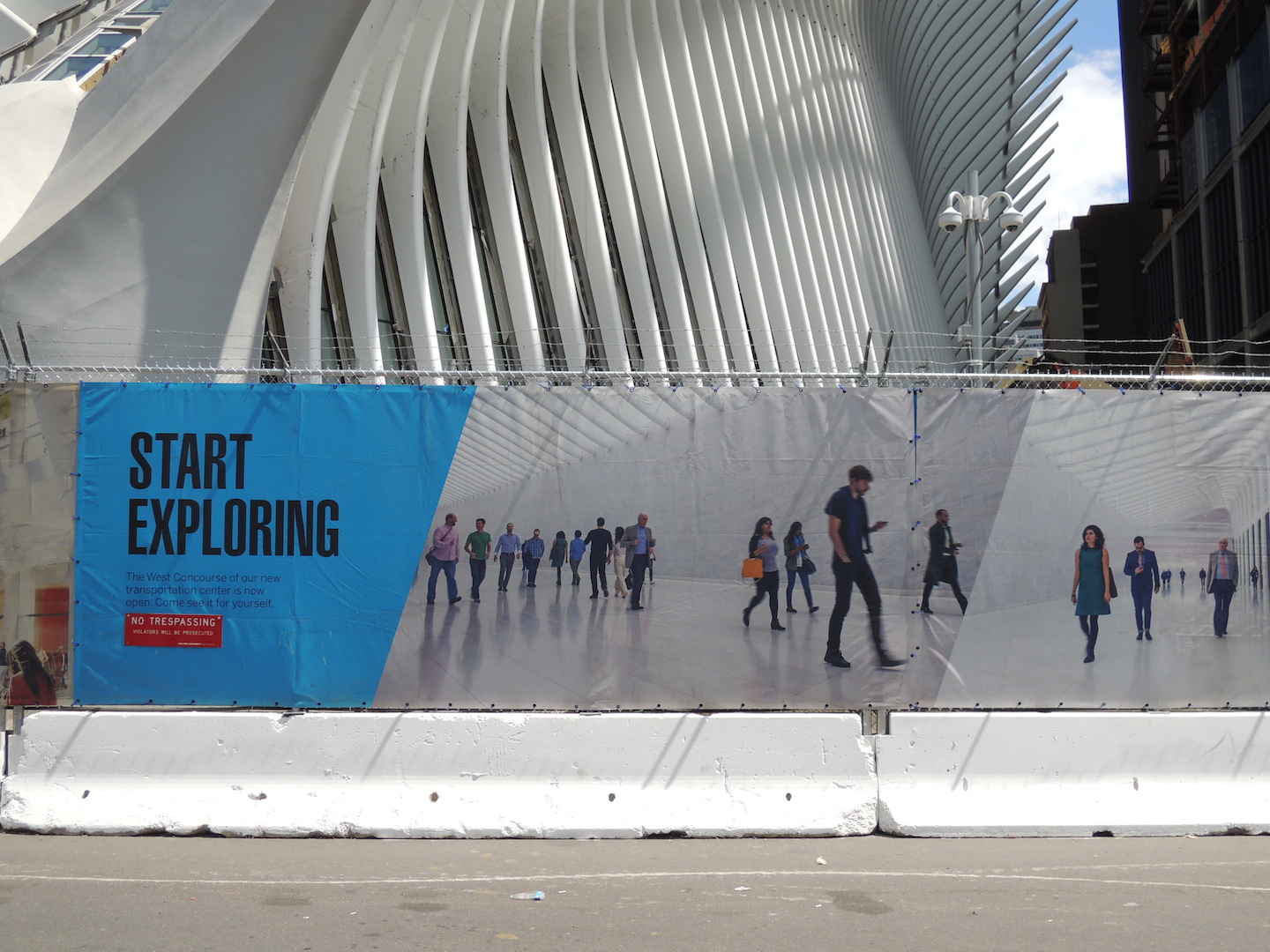
Notice how in this “Start Exploring” banner, which is a reference to the concourse above, everyone seems to be rushing through it or looking at their phone.
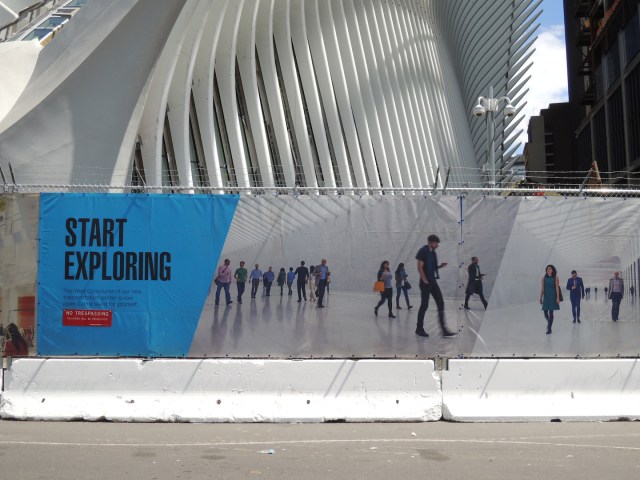
calatravahub4

No surprise to learn that, for all the awesomeness, the showpiece space will eventually be retail — in other words, a flashy shopping mall. In this New York magazine piece, during which Calatrava is likened to both Stanley Kubrick and God, our starchitect proudly notes the space he reserved for a new Apple Store. Grand Central Terminal, which this project’s fans and sponsors like to compare the Transport Hub to, while it may have retail space, didn’t originate as a shopping mall. Here is what the interior will eventually look like.
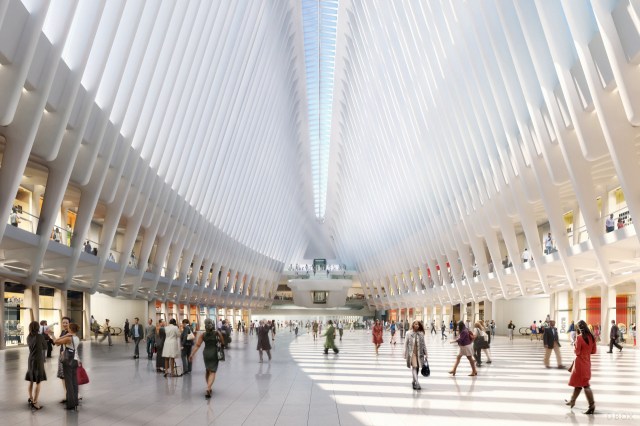
Next, across the street from the Calatrava, there’s the 9/11 Memorial Park and Memorial Pools. In a comment on his post, Paleo Retiree said that he found the Pools to be “grotesque, vulgar and maudlin” to which I’ll add “morbid, undignified and unintentionally insulting.” They reminded me of the lachrymose outpouring after the death of Princess Diana. I understand that it’s supposed to symbolize hope and rebirth, but all of that plunging water reminded me of the towers falling or the people who jumped. And why on Earth is everything falling into a black abyss? These are not Memorial Pools, they’re Memorial Drains. It’s like everything is being flushed down two enormous toilets.

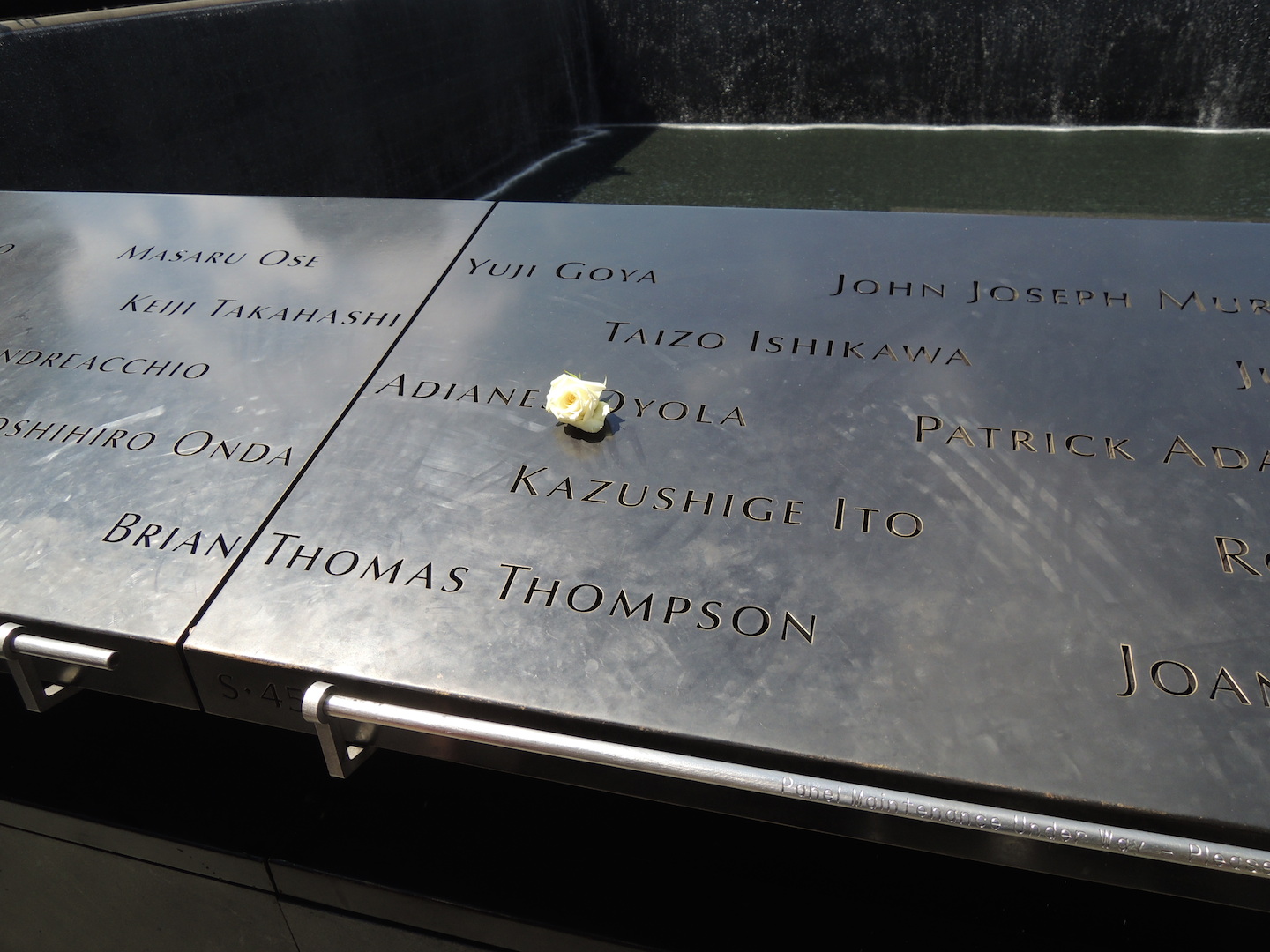
It was a big event, and a big tragedy, but when you recall that the Vietnam War Memorial or the WWII memorial in D.C. are tiny by comparison, it all seems wildly excessive. No disrespect meant to the victims or their families, of course. In a nod to Maya Lin’s Vietnam Memorial (Lin was also on the 9/11 Memorial Jury), the victims’ names are listed on the parapets around the Drains, er, Pools.
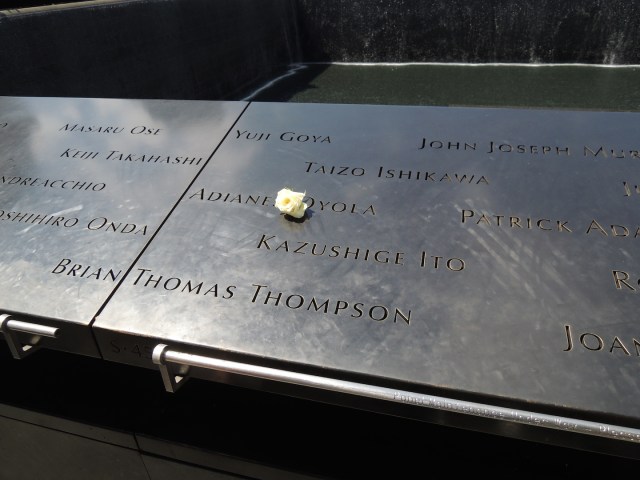
wtcvictims

Turning the two tower footprints into massive fountains, er, Drains, er Pools is the kind of concept that sounds great on paper, and perhaps even looked good in the mock-ups, but is a disaster when executed. Situating them in a plaza without any shape or sense of space, across from a sculptural $4 billion boondoggle-cum-glorified mall, and surrounding them with blinding glass towers all strike me as massive architectural mistakes that will take the city decades to recover from.

But hey, what do I know? The emotional pull of the area might be sufficient in the minds of the public to turn this Memorial Park into one of the most beloved spaces in the city.

Related

Posted in Architecture, Travel | Tagged , , | 6 Comments

9/11 Memorial Visit: The Crap Space Angle

Paleo Retiree writes:

Blowhard, Esq. and I recently spent a few sunny hours exploring the 9/11 Memorial in lower Manhattan. We weren’t interested in touring the museum, so (aside from rolling our eyes at its fashionably toppled-over exterior form) we skipped it. What we intended to experience were mainly two things: Santiago Calatrava’s World Trade Center Transportation Hub, the site’s architectural showpiece; and the memorials themselves, reflecting pool/waterfalls (destruction! renewal!) that have been created within the footprints of the destroyed towers. The Calatrava and the holes are both worth making some remarks about, but what I found myself most struck by was the park itself. (Officially, it isn’t a park, it’s a plaza.)

Blowhard, Esq. will post his reactions to (and thoughts about) the Calatrava and the holes soon. Today, I’m going to treat myself to some rants, observations and jokes about the park, er, plaza, which encompasses the superblock that the Twin Towers stood in. In a word: it struck me as a stellar example of Crap Space. The handy-dandy lesson here is that Crap Spaces — my pet term for dead urban spaces — don’t have to be just leftover stray things that no one gave any thought to; they can be hyper-designed, hyper-intentional creations too.

Continue reading

Posted in Architecture | Tagged , , , , , , , , , | 34 Comments

More on Triggers

Fenster writes:

I wrote about campus trigger warnings here.  The subject has staying power, fascinatin’ some, amusing others, outraging even more and bringing out the inner hero in all too many.

There’s that article in The Atlantic by psychologist Jonathan Haidt and Greg Lukianoff, head of the campus free speech group FIRE.  They argue that sheltering kids from things they find scary is bad for their health and should be opposed on those grounds.

It is interesting, though I am not sure if it is wise, that the admirable Lukianoff has looked to diversify his free speech argument–usually argued on principle alone–by pushing it into the realm of science, leaning on cognitive whiz Haidt to frame the issue in scientific terms.

Maybe, though I am always leery in these slippery, value-laden areas of the social sciences to lean too hard on science.  There was also that recent piece in Vice that told us, lo these many millennia, that parenting is not good for you.  Who knew?  But so says SCIENCE!

Maybe Haidt is right.  An argument on science, though, is unlikely to win the day, except for some overly intellectualized readers of The Atlantic.

Now comes Megan McArdle, another writer I tend to agree with most of the time.  She is correctly skeptical of the trigger phenomenon but adds a fillip that might take the argument in a different direction.

While sympathetic with the Lukianoff/Haidt “bad for your health” take, her argument takes up the issue of the shifting goals of higher education.  You probably know the argument: in the good old days colleges built character and now they are all about getting a job.  And that nowadays students are just consumers.

OK, maybe it was never so idyllic in the good old days but McCardle is doubtless correct when she writes that “cultural and economic shifts have pushed students toward behaving more like consumers in a straight commercial transaction, and less like people who were being inducted into a non-market institution.”

So they are looking as much for an enjoyable experience–on their terms, as consumers–than they are for enrichment, or character-building.  Consumption not “induction”.  And that that is not good, somehow.

That as well seems right to me.  But what do I know?  Question your instincts.

Haidt is one of those smarty-pants (like his pals Danny Kahneman and Steven Pinker) who knows full well that our first instincts are not always to be trusted.  So maybe we should question the consensus that colleges are “supposed to” accomplish high-minded things.  Who says?

Beware that word “supposed”, or at least try to remember to pinch yourself when you hear it.  Here is how McCardle herself employs it:

A university education is supposed to accomplish two things: expose you to a wide variety of ideas and help you navigate through them; and turn you into an adult, which is to say, someone who can cope with people, and ideas, they don’t like.

That thinking just trips right off the tongue, don’t it?  Fun to read, fun to say, fun to think.

But perhaps, to use a term that has itself jumped the shark, a consumer experience in one’s college years is not a bug but a feature.  After all, as McCardle herself notes:

Mass education, and the rise of colleges as labor market gatekeepers, have transformed colleges from a place to be imbued with the intangible qualities of character and education that the elite wanted their children to have, and into a place where you go to buy a ticket to a good job.

We need critical thinkers in our culture for sure.  But how many?  Perhaps it is the very mass quality that McCardle points to that in an odd way legitimizes the consumer orientation of most (not all) higher education.  Maybe we need to train more people to be consumers than we do critical thinkers.  Maybe the development of higher education along consumer/credential lines is not an error but an adaptive strategy.

Posted in Education | Leave a comment

R. Crumb Du Jour

Blowhard, Esq. writes:

gofuckyourself

Feel free to download this and deploy it in Facebook threads as needed. You’re welcome.

Posted in Art | Tagged , | 1 Comment

Architecture Du Jour

Blowhard, Esq. writes:

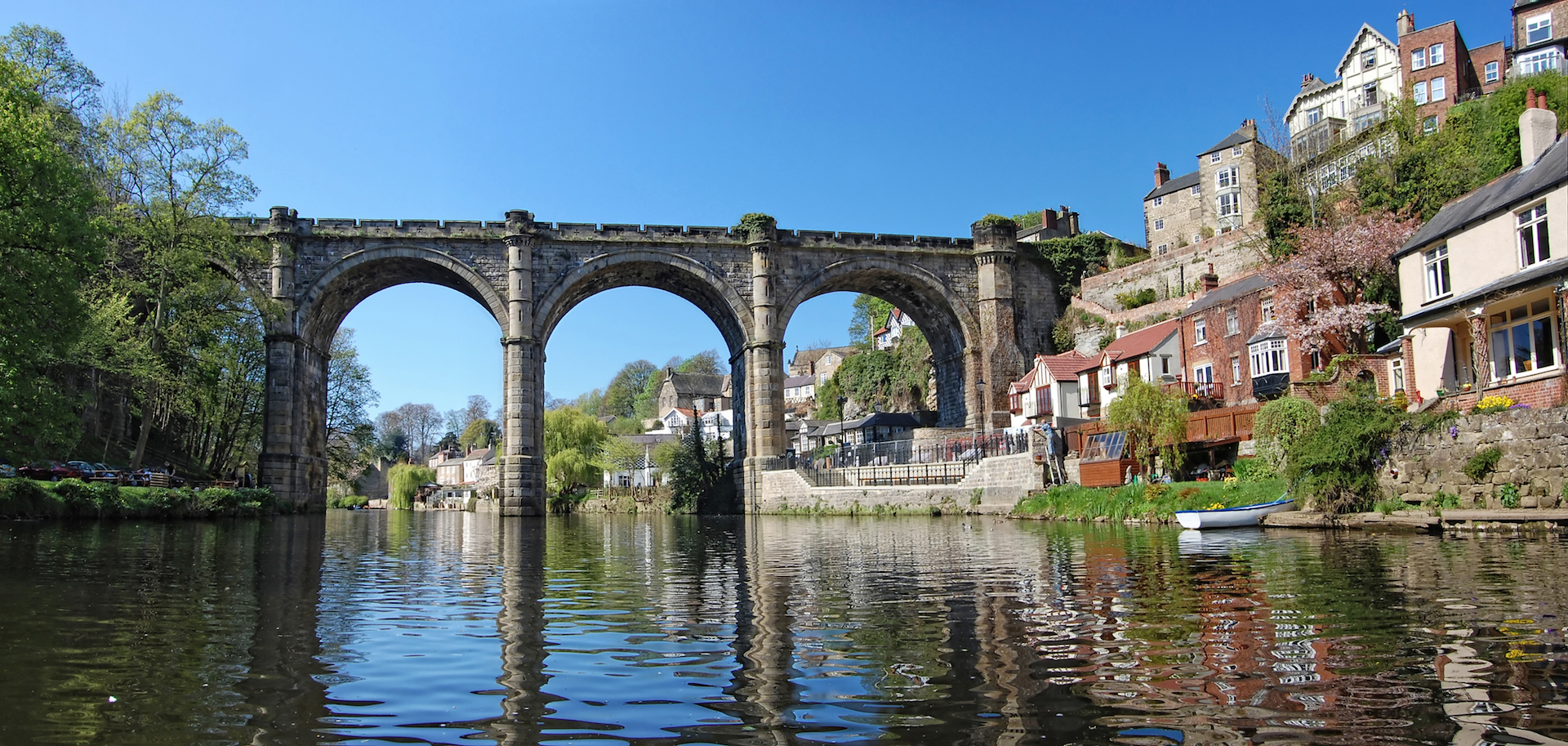
Knaresborough is a historic market and spa town in North Yorkshire, England, four miles east of Harrogate. This elegant stone viaduct over the River Nidd was completed in 1851 and built through the picturesque town to carry a branch of the Leeds & Thirsk Railway. The four-span bridge stands 78ft high above the water, each span measuring 56ft 9in across. The viaduct was designed to blend with the architecture and character of the town.

Click on the image to enlarge.

Posted in Architecture | Tagged , | 2 Comments

“Seinfeld” Notes

Blowhard, Esq. writes:

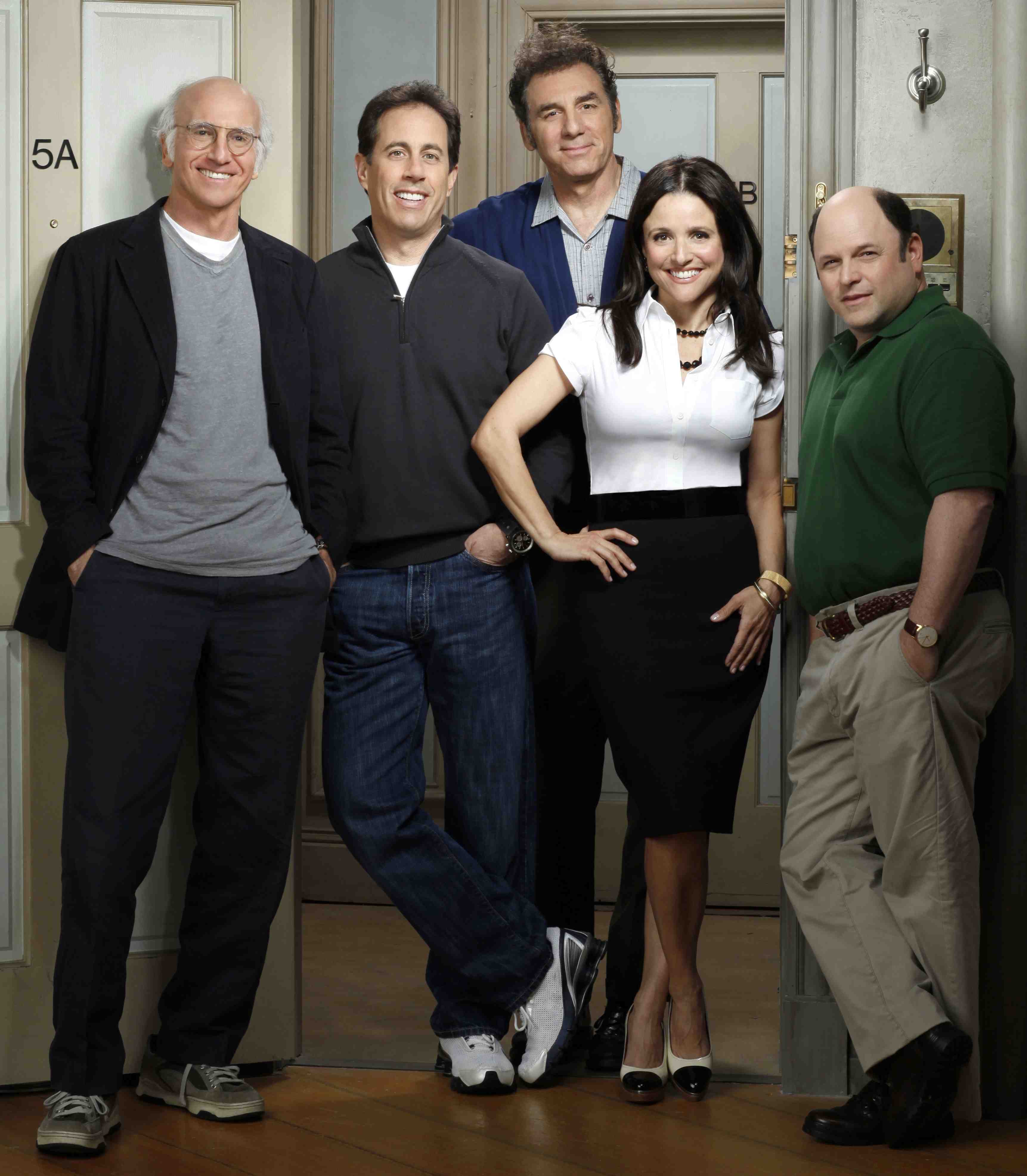
the-sienfeld-cast-2013

A few thoughts and observations after watching all nine seasons of SEINFELD, which were recently released on Hulu Plus.

1. A lot of episodes focus on clothes and fashion: the puffy shirt, the red dot on the cashmere sweater, George getting the suit on sale, Bania’s Armani suit, Elaine working for a clothing catalog (the urban sombrero, etc), Kramer’s cologne being ripped off by Calvin Klein, George’s cotton Yankee uniforms, Jerry’s suede jacket with the pink striped lining, Larry David playing the mysterious man wearing a cape, Morty Seinfeld and his raincoats, Puddy and his silly fur coat, the Bro/Manziere, Sue Ellen and her bra, Jerry dating the girl who only has one dress, Kramer and his skinny jeans. Not a plot point, but I remember Michael Richards’s wardrobe making a bit of an impact during the original run. I’m sure I’ve forgotten other examples. Even the very first episode of CURB YOUR ENTHUSIASM is about David buying a pair of pants with an unsightly tent at the crotch that makes it look like he has an erection.

2. Jerry and the gang breaking up with people over silly quirks (the Low Talker, the Close Talker, Man Hands) became one of the show’s trademarks but those episodes didn’t stick out or feel as numerous to me. Maybe because I’ve seen them so many times? Are they inordinately popular in the syndication rotation?

3. George is the real star of the show and Jerry is the straight man sidekick. CURB is basically the George character getting the spin-off he deserves. I still haven’t come across an explanation for why they made George Italian when he’s clearly the most neurotic Jew who ever lived. He makes Woody Allen look like an Episcopalian minister.

4. The show is pretty unabashed when it comes to making fun of Alexander’s and Wayne Knight’s less-than-desireable looks. George is constantly described by himself and others as “short, stocky, and bald” and Newman’s apartment has that poster of a hot fudge sundae on the wall, which the show’s directors framed him beside. They frequently paired both of them with women who were out of their league, but that was part of the joke.

5. It’s kind of a bitter “fuck you” to the audience, but I liked the finale.

6. Hard to say which episode was my favorite. The two times I remember laughing the hardest are from Kramer lines — when he quits dancing around what everyone is trying to be diplomatic about and bluntly delivers the truth. The one that comes to mind is when George is dating the woman who would be hot but for her big nose. (Notice too how they’re talking about a jacket — another clothing reference I forgot.)

Another scene that sticks out in my memory — because it’s so Jewish — comes in the Bania Armani suit episode. Bania argues soup isn’t a meal but Jerry thinks it is. Jerry is talking to Elaine about it and they’re arguing back and forth about whether soup constitutes a meal. What kind of soup? Was it hearty? Did he eat bread with it? It’s a great example of legal reasoning. If anyone wants to know why there are so many Jews in the law, I’d show them that scene.

Still, I can’t say those were my favorite episodes. I guess this is a kind of a bullshit cop out answer, but my favorite thing about the show is the chemistry between the group. That’s why the show is so watchable — it comes on and you wanna settle in no matter which episode it is. Some episodes are funnier or spawned more pop culture references than others, but it doesn’t really matter which one I’m watching.

7. The show is also great for basically being the reason why Seinfeld and Howard Stern feuded for years. The episodes of Howard where Gilbert Gottfried mocked Jerry’s act and delivery are among the hardest I’ve ever laughed in my life.

8. Another thing I appreciated, which it has in common with THE SIMPSONS, are all the great secondary characters, some of which only appeared in one episode. The world it created feels richer. It’s also a good example of something Sax has pointed out — you don’t shoot for world-building, it’s a consequence of good storytelling.

9. This 3.5 hour interview with Jason Alexander at the Archive of American Television is very much worth watching if you’re a fan of the show. Funny to learn how Alexander learned the marine biologist speech an hour before he delivered it and the take we see in the episode was the first he ever performed it.

Related

Posted in Television | Tagged , , , , , , | 9 Comments

Architecture Du Jour: Cold Spring, NY

Blowhard, Esq. writes:

Fabrizio took me on a tour of the Orange County area of the Hudson Valley this weekend and we ended the day in Cold Spring. The central part of the village, which is on the National Register of Historic Places, has a number of charming 19th-century buildings. Lots of vibrant color, too.

Related
Posted in Architecture | Tagged , , , | 4 Comments

Alas, That They Are So

Fabrizio del Wrongo writes:

0896599280.interior05

DUKE ORSINO

Come hither, boy: if ever thou shalt love,
In the sweet pangs of it remember me;
For such as I am all true lovers are,
Unstaid and skittish in all motions else,
Save in the constant image of the creature
That is beloved. How dost thou like this tune?

VIOLA [disguised as a boy]

It gives a very echo to the seat
Where Love is throned.

DUKE ORSINO

Thou dost speak masterly:
My life upon’t, young though thou art, thine eye
Hath stay’d upon some favour that it loves:
Hath it not, boy?

VIOLA

A little, by your favour.

DUKE ORSINO

What kind of woman is’t?

VIOLA

Of your complexion.

DUKE ORSINO

She is not worth thee, then. What years, i’ faith?

VIOLA

About your years, my lord.

DUKE ORSINO

Too old by heaven: let still the woman take
An elder than herself: so wears she to him,
So sways she level in her husband’s heart:
For, boy, however we do praise ourselves,
Our fancies are more giddy and unfirm,
More longing, wavering, sooner lost and worn,
Than women’s are.

VIOLA

I think it well, my lord.

DUKE ORSINO

Then let thy love be younger than thyself,
Or thy affection cannot hold the bent;
For women are as roses, whose fair flower
Being once display’d, doth fall that very hour.

VIOLA

And so they are: alas, that they are so;
To die, even when they to perfection grow!

— William Shakespeare

Posted in Books Publishing and Writing | Tagged , | Leave a comment

Naked Lady of the Week: Radka

Fabrizio del Wrongo writes:

r-cover

This green-eyed, honey-complexioned Slovakian is a favorite from a few years ago. She’s got a lovely, wide-open face and a body that’s about as dramatic as the rolling Slovakian countryside. The trimmed bush is, for me, particularly appealing.

Are the women of the region in and around the historical Moravia the most beautiful in the world? I’m partial to Slavic women, so maybe I’m biased, but the girls of present-day Slovakia, Ukraine, and the Czech Republic strike me as outstanding. We’ve featured a number of them on UR.

These photos derive from MetArt, MetModels, Femjoy, and DOMAI. Nudity below. Enjoy the weekend.

Continue reading

Posted in Photography, Sex, The Good Life | Tagged , , , , | 1 Comment