Justice for John Harvard

Fenster writes:

The United States District Court has held in favor of Harvard University in the case dealing with allegations of discrimination against Asian-American students.  The Chronicle story reporting the case is here.  The text of the decision is here.

Continue reading

Posted in Uncategorized | 2 Comments

My Trip to Porto

Fenster writes:

I am about to leave for a trip to Portugal and Northern Spain.  I had been especially looking forward to visiting Porto.  I had heard a lot about the great architecture to be found and must have blithely assumed it would be to my taste. My taste runs to urbanist, better old than new.  And it runs actively away from modernism, sprinting from brutalism.

So I grabbed a slim and convenient “wallpaper guide” to Porto put out by the art and design oriented publisher Phaidon and started planning my trip.

phaidon

The “art and design” focus of the publisher should have been a giveaway.  Little did I know that “Porto is famed for its modernism”. Indeed, if one follows the guide, there is really nothing of interest in the city that is not modernist in one fashion or another.  That includes the galleries, the hotels, and even the food scene.  The guide gives a passing nod to the historic part of the city, scurrying to recommend only one “museum piece diner” in that section of town.

portocafe

Charming

But it is in the architecture department that the guide really struts its stuff.  Below are photos of essentially all of the sites highlighted by the guide.

White buildings must be, for a certain kind of white person, stuff that they like.


Posted in Architecture, Uncategorized | Tagged | 4 Comments

Notes on “Lifeguard”

Fabrizio del Wrongo writes:

Lifeguard

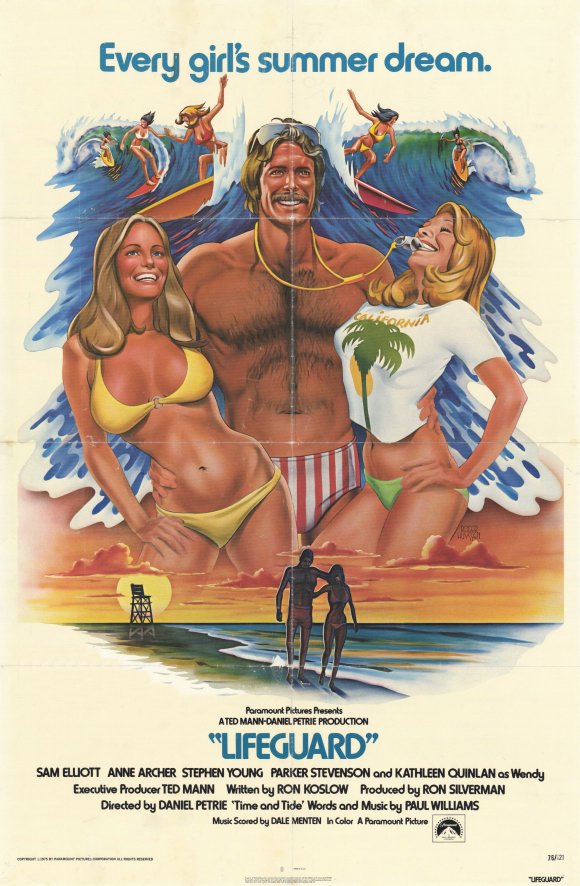
The 1976 “Lifeguard” plays like a major-studio version of a CIP quickie. Its pleasures are CIP pleasures: unthought-out scenes of everyday people doing everyday things set against a backdrop that’s the more titillating for its relatability, its human scale. Unfortunately, it’s too consciously meaningful to be wholly effective. It’s drive-in material with an earnest, TV-movie sensibility. Sam Elliott plays Rick, the handsomest lifeguard on the Socal scene. He’s so leonine that you sense he can save bathers just by staring at them. In his early 30s, he’s tired of fending off Playmates and underage adorers. Perhaps its time to wash off the sand and make a go of it in the straight world. If the movie had taken the POV of Rick’s summer helpmate, played by Parker Stevenson, it might have found a way to make Rick work. The character is a male fantasy, a semi-absurd ideal, like Bodhi from “Point Break” or Wooderson from “Dazed and Confused.” We don’t want to see him grow up. We don’t want to see him analyzed either. Because they place him at the center of their movie, writer Ron Koslow and director Daniel Petrie are forced to take a stand on his philosophy — and it’s not a philosophy that benefits from scrutiny. There’s desperation in their attempts to make Rick an avatar of lifeguarding duty, of lifeguarding as a way of life, and dishonesty in the way they have Rick lay hard truths on the characters played by Stevenson and Kathleen Quinlan while avoiding those truths in his own life. (They don’t critique the self-delusion inherent in the latter; they celebrate it.) Despite Elliott’s considerable natural nobility, he slumps under the burden of all that canned nobleness. By the end of the movie, the whole conception seems a tad false. And yet it remains genial, even charming. The high-school reunion scene might be the best one I’ve seen in a movie aside from the similar scene in “Something Wild.” (It’s a nice touch that Quinlan’s teen resembles a younger version of Rick’s ex.) I wouldn’t be surprised if “Lifeguard” inspired aspects of “Baywatch.”

Posted in Movies | Tagged , , , , , , , | Leave a comment

Weekend Linkage

Paleo Retiree writes:


Posted in Linkathons | 3 Comments

Notes on “War and Peace”

Fabrizio del Wrongo writes:

28891id_008.0

I spent much of the 431-minute running time of Sergei Bondarchuk’s 1966 “War and Peace” wondering if spectacle, in and of itself, can be considered a kind of art. “War and Peace” doesn’t work as drama, as history, or as philosophy. And while it’s faithful to the general shape of Tolstoy’s novel (sometimes overly so), it mangles its meanings, and doesn’t even attempt to evoke its delicacy or naturalism. For Bondarchuk, a movie is a succession of set-pieces. Connective tissue isn’t his thing. When he wants to communicate an idea, he does it in voice-over, in Tolstoy’s words, with the camera tracking the character to whom the words are meant to apply. It’s primitive, like the title cards that pop up in silent movies to thematize a character or situation. But the great silent directors used their titles sparingly and with precision. Bondarchuk seems to resort to the voice-over whenever he realizes that the material he’s filmed hasn’t provided adequate information; it’s a crutch. All of that said, I would heartily recommend “War and Peace” to anyone who appreciates movies. As Pauline Kael pointed out, the grand spectacle — the oversized director’s folly — can be the most vital type of movie, because it activates our senses and expands our notions of what movies can do. Bondarchuk is consciously taking on Griffith and Gance — he’s trying to make the biggest movie of all time, to tell stories in new ways. The Soviet government provided him with a budget worthy of a national-defense initiative (the Battle of Moscow took two years to film) and gave him armies to play with. Who can resist the lure of such grandiosity? Fortunately, Bondarchuk has a supremely acute eye. Almost no image is underplayed (this is both a virtue and a vice). If the movie suggests another art form, it’s painting. There are Turners and Bruegels and countless versions of those high-angle battle scenes popular in the 17th and 18th centuries. There isn’t much to say about the performances. I rather liked Bondarchuk in the role of Tolstoy’s surrogate, Pierre, though I’m not sure why, and the movie fumbles the character’s progression from Continental misfit to Russian New Man. Ludmila Savelyeva, the ballerina who plays Natasha, the incarnation of the Russian spirit, looks like a combination of Audrey Hepburn and Anna Karina, and she gives one of those tremulous, edge-of-hysteria performances that remind you that young women can be captivating and frightening in equal measures. The ballroom scene in which she makes her society debut is probably the best in the picture, and she is very charming doing a peasant dance in the section set in the hunting lodge.

Posted in Movies | Tagged , , , , , , | 1 Comment

Notes on “Robinson Crusoe”

Fabrizio del Wrongo writes:

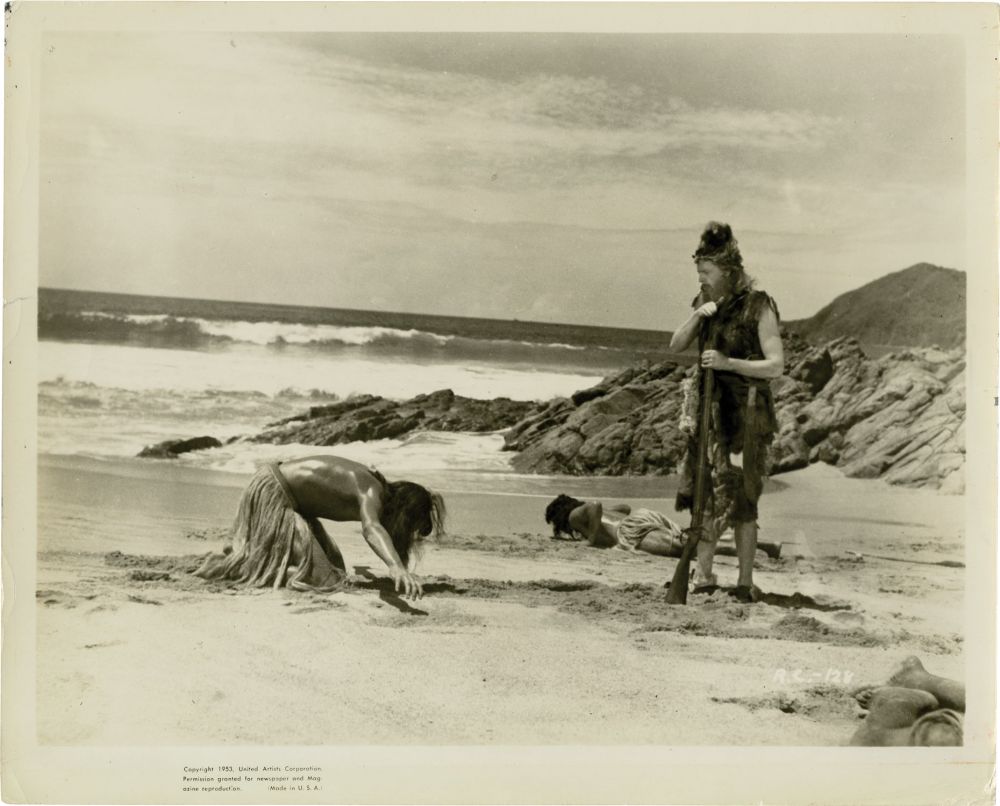
Luis Buñuel’s 1954 “Robinson Crusoe” may be my favorite movie adaptation of a great novel. Buñuel’s dry, elliptical handling of the material highlights its fabulous qualities without kicking it into the realm of fantasy. (Buñuel is the rare filmmaker capable of underplaying exaggeration.) When the weary, sea-tossed Crusoe first appears upon his island, he plucks an egg from a bird’s nest. Its shell neatly opens, revealing a chick. Not soggy and strained-looking, like a newborn chick, but fluffy and yellow, like a chick born days prior. The movie is alive with such miracles; Buñuel seems to be asking us to see Crusoe’s survival as miraculous — to see existence as miraculous. Crusoe, a kind of mad saint, like the holy man of Buñuel’s later “Simon of the Desert,” discovers God, then agriculture and animal husbandry, and finally war. He also rediscovers slavery (he’d previously been in the slave trade), before rejecting it in favor of a feudal type of fellowship. Crusoe’s man Friday obeys him, like a vassal, but he also consoles him. The two men have a relationship that goes beyond friendship; they’re codependent. Every movie about a man stranded on an island has two chief subjects: loneliness and the mysteries of civilization. Buñuel rarely strays from these themes. The sequence beginning with Crusoe’s rueful consideration of a woman’s dress, and ending as the camera pulls back from the castaway, drunk and alone in his hovel, is one of the great expressions of loneliness in movies. And the sequence depicting the death of Crusoe’s dog, his lone companion, taps into our collective memories of canine suffering. Who feels more alone than a man who has lost his dog? As the duration of Crusoe’s stay on the island exceeds 20 years, his loneliness leads him to cruelty: he’s shown gleefully feeding ants to sand mites. The scene seems intended to connect to the adjacent scenes showing cannibals devouring captives in a remote part of Crusoe’s island. As in all Buñuel, and as in the Defoe novel, cruelty is never far from the reality of our daily lives. It’s what makes our humanity necessary.

Posted in Movies | Tagged , , , , | 1 Comment

Linkage

Paleo Retiree writes:

Posted in Uncategorized | 1 Comment

Hidden History of the Puritans

Fenster writes:

Rogers Smith, in his paper “Beyond Tocqueville”, argues that America has a hidden history of illiberalism that has been papered over by the generally victorious pro-Enlightenment side.

Analysts of American politics since Tocqueville have seen the nation as a paradigmatic “liberal democratic” society, shaped most by the comparatively free and equal conditions and the Enlightenment ideals said to have prevailed at its founding. These accounts must be severely revised to recognize the inegalitarian ideologies and institutions of ascriptive hierarchy that defined the political status of racial and ethnic minorities and women through most of U.S. history.

Victors write the histories, and in so doing they can be expected to make their current ascendance inevitable, and, in turn, to do some narrative injustices to the losing side. Thus it is a bit jarring to see Marilynne Robinson, in the current New York Review of Books,  argue that what Smith would take to be the dominant, winning side has its own hidden history: a neglected Puritan New England.

Continue reading

Posted in Politics and Economics, Uncategorized | Tagged , , , , , | Leave a comment

Weekend Linkage

Paleo Retiree writes:

Posted in Linkathons | 2 Comments

Weekend Linkage

Paleo Retiree writes:

Posted in Linkathons | 2 Comments