
Blowhard, Esq. writes:

The Old Post Office Pavilion, Washington, D.C.
Click on the image to enlarge.
Blowhard, Esq. writes:
The Old Post Office Pavilion, Washington, D.C.
Click on the image to enlarge.
Eddie Pensier writes:
Amahl: “Are you a real king?”
Balthazar: “Yes.”
Amahl: “Have you regal blood?”
Balthazar: “Yes.”
Amahl: “Can I see it?”
Balthazar: “It is just like yours.”
Amahl: “What’s the use of having it, then?”
Balthazar: “No use.”

Three guys, just like you and me.
Sir Barken Hyena writes:
One of my favorite times in music was when the newly birthed Punk movement started to blend with straight forward pop. XTC is one of the best of this stream, here they are at what I think is their peak, 1982’s “English Settlement”:
Frontman Andy Partridge’s lyrics are always worthy of attention:
Hey, hey, the clouds are whey
There’s straw for the donkeys
And the innocents can all sleep safely
All sleep safelyMy, my, sun is pie
There’s fodder for the cannons
And the guilty ones can all sleep safely
All sleep safelyAnd all the world is football-shaped
It’s just for me to kick in space
And I can see, hear, smell, touch, taste
And I’ve got one, two, three, four, five
Senses working overtime
Trying to take this all in
I’ve got one, two, three, four, five
Senses working overtime
Trying to taste the difference ‘tween a lemon and a lime
Pain and pleasure, and the church bells softly chimeHey, hey, night fights day
There’s food for the thinkers
And the innocents can all live slowly
All live slowlyMy, my, the sky will cry
Jewels for the thirsty
And the guilty ones can all die slowly
All die slowlyAnd all the world is biscuit-shaped
It’s just for me to feed my face
And I can see, hear, smell, touch, taste
And I’ve got one, two, three, four, five
Senses working overtime
Trying to take this all in
I’ve got one, two, three, four, five
Senses working overtime
Trying to taste the difference ‘tween a lemon and a lime
Pain and pleasure, and the church bells softly chimeAnd birds might fall from black skies (Whoo-whoo)
And bullies might give you black eyes (Whoo-whoo)
And buses might skid on black ice (Whoo-whoo)
But to me they’re very, very beautiful (England’s glory)
Beautiful (A striking beauty)And all the world is football-shaped
It’s just for me to kick in space
And I can see, hear, smell, touch, taste
And I’ve got one, two, three, four, five
Senses working overtime
Trying to take this all in
I’ve got one, two, three, four, five
Senses working overtime
Trying to tell the difference ‘tween the goods and crimes
Dirt and treasure
And there’s one, two, three, four, five
Senses working overtime
Trying to take this all in
I’ve got one, two, three, four, five
Senses working overtime
Trying to taste the difference ‘tween a lemon and a lime
Pain and pleasure, and the church bells softly chime
Fenster writes:
Paleo links to a Guardian article proclaiming Patricia Highsmith as the screen’s new It Girl.
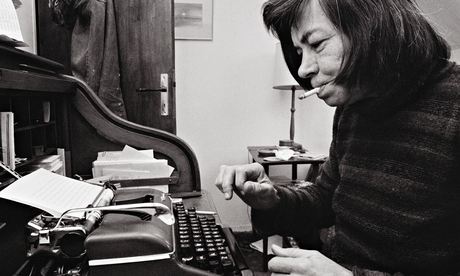
Va-va-voom!
Reminds me of a couple of blog postings of mine from exactly 10 years ago saying much the same thing. This was pre Fenster’s stint at 2Blowhards, at his first blog–i.e., for sure you didn’t read them. They exist only in the internet archives now, so I reprint them here.
It’s a good time to be Patricia Highsmith, or at least it would be if she weren’t dead. The late, unlamented, unlovable writer of thrillers is riding high, zeitgeist-wise. It’s really not much of a comeback since she was never much of a cultural icon in her native country in the first place. But there’s a bio of her life on the shelves and more of her work is making it to the screen. Highsmith, a native of Texas, transplanted herself to Europe and it is there that her work has gathered the greatest acclaim. A glance at the Internet Movie Database reveals that, after Hitchcock’s 1951 filming of her Stangers on a Train, most screen and TV adaptations have been European–French and German, mostly. Old Europe seems to have taken to her dark sensibilities. Post-Strangers, she continued to turn out a series of fairly nasty noirish novels, including five featuring that clever sociopath, Tom Ripley. It’s Tom who seems to have become lodged in our consciousness at the moment.
That talented chap has made it to screen four times so far. The Talented Mr. Ripley, the first of the Ripley books, was filmed first by Rene Clement in 1960 (as Plein Soleil), with Alain Delon in the title role, and then again in 1999 by Anthony Minghella, with Matt Damon as Tom. The third book in the series, Ripley’s Game, was first filmed by the German Wim Wenders in 1977 (as The American Friend), with Dennis Hopper in the title role, and then again in 2002 by the Liliana Cavani, with John Malkovich as Tom. Another Ripley novel, Ripley Underground, is now in production (under the title White on White), directed by Roger Spottiswoode, and with Barry Pepper as Tom.
Interesting, I think, that while Tom has been played, appropriately enough, by an American in four out of five of these films, the directorial impetus has been predominantly European: Clement is French, Wenders German, Minghella English and Cavani Italian. Spottiswoode, though an old Hollywood hand, is Canadian. It also is worth noting that the recent film Swimming Pool, which features a main character with Highsmith sensibilities (and consequent lack of charm), was directed by yet another Euro–Francois Ozon.
The Ripley of the moment is Malkovich. His 2002 model, while applauded at various festivals, never quite made it into full-fledged theatrical release, and was just released to DVD. It is worth seeing, as both Nathan Lee and Anthony Lane have noted, in The New York Times and The New Yorker, respectively.
I first encountered Tom, with quite a start I should add, around 1977 when The American Friend came out. While Wenders took certain liberties with Highsmith, transporting the central action from sunny Southern Europe to a dark, dank Hamburg, Dennis Hopper made for a wonderful Ripley. He didn’t seem to be acting the part of the out-of-control sociopath–maybe because he wasn’t. But he wasn’t exactly Highsmith’s Ripley.
In comparison, Malkovich seems, as Lane indicates, made for the part. His cool, mannered Ripley stands in contrast to Hopper’s crazed version, and while Hopper has an undeniable manic energy, Malkovich seems truer to Highsmith’s vision. Both are preferable to the Damon version, who had far too many regrets about sex and death to qualify as a first-rate sociopath (Jude Law could have handled the part more effectively).
There’s a wonderful moment–if I may call it that–at the end of the new Ripley’s Game in which Ripley’s patsy Jonathan takes a bullet for him. As Jonathan lies dying in Ripley’s arms, Jonathan smiles, perhaps because he has found some meaning in the ridiculous game Ripley has fashioned. Ripley looks at Jonathan incomprehendingly, as if Jonathan were a faithful dog willing to die to protect his master. Ripley seems to be wondering: what in the world must be going through that undeveloped canine brain of yours?
“Why did you do that?”, he asks Jonathan. And he really wants to know, really doesn’t know the answer. Jonathan dies without answering. And once again, Tom lives to fight, steal and cheat another day while mere humans, with recognizable human emotions, don’t make it. It’s a pretty bleak vision.
And on the subject of Highsmith, there’s another recent movie in which the influence of her work is apparent. It’s the French quasi-thriller Man on a Train. The similarity in name to Strangers on a Train must have been intentional, since this recent film, like the Highsmith original, has its own version of “criss cross” immortalized in Strangers. But there is a little Ripley in this as well. The idea of a sick, sensitive European being swept off his feet by an apparently amoral American is straight from Ripley’s Game. There’s also the theme in Highsmith of Americans being from Mars and Europeans from Venus, to use the modern metaphor. Wenders in particular did a good job of rubbing Europe hard up against America, and that theme is also in Man on a Train. In this instance, though, the American criminal is not really an American, but a Frenchman, played by Johnny Hollyday. Still and all, there’s more than a tip of the hat to Ripley in the parallel, and more than a little bit of an American in Hollyday’s part.
Hollyday was, after all, a kind of French Elvis in the sixties, and has that kind of iconic status in Gallic terms. And the part he plays is self-consciously “American”, what with his references to “Nevada” and his leather jacket.
Indeed, the first minutes of the film, which are priceless, give the game away. Hollyday’s aging hipster/bank robber arrives in a small, out of the way, French town to the sounds of western guitar music. Immediately you realize that this is a Western, retold for Europe. Hollyday steps off the train, as thousands of lone gunmen have stepped off similar trains in towns way out west, as the camera pans across a line of bicycles where the horses ought to be.
Hollyday swaggers into town looking for . . . he’d head for the saloon, right? Well, not in Europe. In this little French town, he steps into a pharmacy. The first words spoken in the film are not uttered over a whiskey, but over a headache medication that the local pharmacist says they are out of: “Sorry, we’re out of Trinitrin.”
Welcome to Venus!
Paleo Retiree writes:
Sir Barken Hyena writes:
I hope no trigger warning is needed for this, but it’s about Isla Vista.
One thing that I would hope we can agree on is that the mental health profession has failed this country. Most of these shooters have been on psychotropics, or were seeing mental health professionals. I’m not saying drugs were the cause, and I’m not saying we need Minority Report style prescience in predicting future atrocities. However, the proliferation of these ghastly incidents indicates – at the least – that the system has failed to protect the public, which along with treating their patients must surely be among their primary functions.
Why are so many taking these drugs now? From conversations in various places I see many of us have taken these drugs and had some troubling reactions. I myself took an anti-depressant for about 6 months, following the end of my wife’s chemo for breast cancer. And it helped me too, I was in shell shock afterwards and didn’t know it.
But it also loosed something in me, and I found myself blowing up at work, something that never happened before. And it was unsettling because a part of me knew I was totally wrong but I felt a kind of righteous satisfaction at my anger that propelled it. And I was detached, watching it from a distance, even feeling the anger at a distance. This is something I hadn’t felt before, ever, and while I thankfully can’t peer into the minds of these shooters, some of the vibe that comes off of their words and videos seems to emanate from a similar place. I quit the pills once I caught on to this and haven’t had a problem since.
If psychotropics can make a (please don’t laugh) normal bloke like me feel detached from reality, what might they do to someone truly ill like Eliot Rodger? It’s a good question and I for one have doubts that the medical profession can answer that question.
If you are for, or against gun control, you know where to go, who to donate to, who to vote for. Same goes for those feminists inclined to action of some sort.
Some of which might help, I don’t know. But until we all, whether pro- or anti-gun control, Right or Left, hold our noses and link hands and demand some action from the mental health profession on this epidemic of madness and legally prescribed drugs I don’t think we’ll ever be able to turn the corner on this.
Sir Barken Hyena writes:
Lark’s Tongues in Aspic live 1973 with legendary nut Jamie Muir at the percussion station.
Paleo Retiree writes:

“Daddy, what’s a film camera? And why are they so cheap?”
Eddie Pensier writes:

Opening tableau of John Dexter’s production of Poulenc’s Dialogues of the Carmelites, from the Metropolitan Opera
Francis Poulenc’s Dialogues of the Carmelites is a strange opera, and not an easy one. It weaves complex themes of devotion, martyrdom, fear, and politics around the storyline of a Carmelite convent during the French Revolution. It’s very talky, and the action, such as it is, is pretty minimal. But it has a final scene that might be the greatest in the history of musical theatre.
The nuns have been sentenced to death by the Revolutionary Tribunal. and are gathered in the square awaiting execution. They begin singing a hymn.
Salve, Regina, Mater misericordiæ,
vita, dulcedo, et spes nostra, salve.
Ad te clamamus exsules filii Hevæ,
Ad te suspiramus, gementes et flentesin hac lacrimarum valle.
One by one, they walk up to the scaffold, and one by one, their voices are cut off by the grotesque sound of the guillotine, until only one voice remains. It belongs to Constance, the chirpy optimist of the convent. Her ascent to the scaffold is interrupted by a moment of terror. Blanche, a troubled noble girl whose motives for taking the veil were always murky, and who escaped before the arrest and sentencing, emerges from the crowd at Constance’s moment of despair. They embrace (the orchestra breaks into bright, happy major-tonal chords here), and Constance resumes her walk to the blade (orchestra resumes stomach-churning chant). Blanche herself then offers her life, singing the last verse of Veni Creator Spiritus:
Deo Patri sit gloria,
et Filio qui a mortuis
Surrexit, ac Paraclito,
in saeculorum saecula.
Amen.
Curtain.
It’s difficult to overstate the emotional impact of this scene. Even if you have nothing invested in the story of “a bunch of nuns who get their heads chopped off” (as I once flippantly described it to a friend), between the stoicism of the women meeting their fate and the sheer coup-de-thêatre-ness of the religious singing being violently interrupted by the slicing blade, you’re more likely than not to be in tears at the end of it, or at least extremely shaken up. The fact that the guillotine sound effect is usually amplified to the best of the venue’s capabilities makes it even more unnerving.
This video is from the Metropolitan Opera’s famous John Dexter production of the late 70s. It’s a great example of a production that can present interesting and innovative visual ideas while still maintaining respect for the work’s spirit (the opera was only about 25 years old at the time). Jessye Norman plays Madame Lidoine.
Here’s another video of the scene, even starker and more abstract. The women simply line up, step forward one by one, and then collapse. The provenance of the production is unknown to me, but seeing the nuns’ faces as they approach death with serenity, anger, fear, or simply insecurity, is shattering. All these singers deserve acting awards.
I need to go watch some cartoons now.
Related
Blowhard, Esq. writes:

Click on the image to enlarge.
 Blowhard, Esq.
 Callowman
 Sherbrooke
 Eddie Pensier
 Enzo Nakamura
 Epaminondas
 Fabrizio del Wrongo
 Fenster
 Brundle Guy
 Glynn Marshes
 Paleo Retiree
 Atypical Neurotic
 Question Lady
 Sax von Stroheim
 Sir Barken Hyena
 The Mistaken
 Uncouth Reflections