
Blowhard, Esq. writes:
 Jean Harlow in Charles Brabin’s THE BEAST OF THE CITY
Click on the image to enlarge.
Blowhard, Esq. writes:
Jean Harlow in Charles Brabin’s THE BEAST OF THE CITY
Click on the image to enlarge.
Paleo Retiree writes:
Back here I raved about Jeepney, a funky-chic Filipino restaurant in NYC’s East Village. Fun to see that Vice magazine has also discovered the pleasures of Jeepney:
I’m patting myself on the back for having visited several of the other places also featured in that clip: Chinatown’s Nom Wah Tea Parlor, and Pouring Ribbons, a very creative nouveau cocktail place in the East Village. They’re both great.
Fenster writes:
From my father’s old slides–sky over central Massachusetts, 1950s.

Glynn Marshes writes:
As of this minute, Miley Cyrus official (Vevo) Youtube video for her song “Wrecking Ball:”
1,977,185 “likes” — but —
965,637 “dislikes”
Awful lot of hatin’ for a song that charted as well as that one did.
Paleo Retiree writes:
UK-specific but a nice intro to the Monetary Reform point of view on our current financial travails.
Related
Glynn Marshes writes:
A marvelous malapropism, buried like a bloggy easter egg in an article that . . .
… calls on science fiction writers to join the revolution: sci fi novels are way too gender binary, yo.
I want more writers to stop defaulting to binary gender in their SF—I want to never again read entire anthologies of SF stories or large-cast novels where every character is binary-gendered. I want this conversation to be louder.
First in an on-going series.
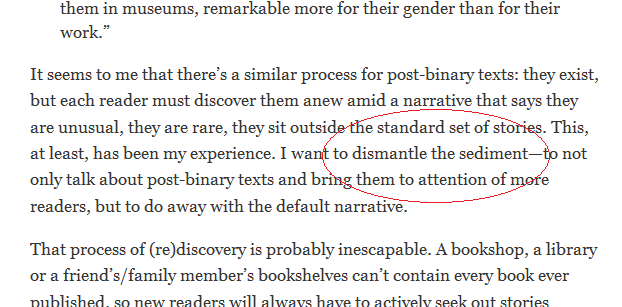
Totally stealing that.
Via Monster Hunter author Larry Correia, who responds here with characteristic glee, writing that it’s fine for writers to work their pet causes into their stories — as long as they do it with skill.
Have you ever gone into Barnes and Noble, went to the clerk at the info desk, and said “Hey, I really want to purchase with my money a science fiction novel which will increase my AWARENESS of troubling social issues.”? No? This is my shocked face.
Readers hate being preached at. Period. Even when you agree with the message, if it is ham fisted and shoved in your face, it turns you off. Message fic for message fic’s sake makes for tedious reading. Yet, as this stuff has become more and more prevalent, sci-fi has become increasingly dull, and readership has shrank [sic].
Of course, the literati won’t be happy until everything is boring ass message fic and nobody reads sci-fi anymore, because then they’ll be super special snowflakes.
Correia notes however that message fic wins nice awards. Who woulda thunk.
Fabrizio del Wrongo writes:
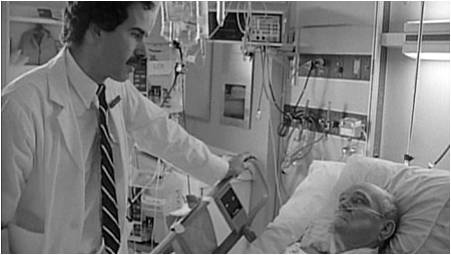
“Near Death,” which concerns the final days of patients consigned to an intensive care unit, provides Frederick Wiseman with what might be his ultimate subject. Certainly it’s hard to imagine a topic more rife with the sort of people-fed-through-the-grinder-of-protocol material to which Wiseman has always been drawn. For six grim hours the movie shows us individuals — the patients as well as their families — negotiating the end through circular conversations, impotent gestures, and questions that are so obviously futile they inspire an understanding pitched somewhere between empathy and revulsion. There’s a Sisyphean monotony to the way in which the doctors and nurses go about their work, and as you watch them toggle between caring bedside manners and no-nonsense shop talk you might find that you’re both impressed by their emotional versatility and shocked by their seeming imperviousness. (Both are outgrowths of their professionalism.) Are these men and women primarily serving the patients or their soon-to-be-grieving families? Part of what makes the movie such a hard watch is its effectiveness at showing how the dying slowly turn into props in their loved ones’ rituals of letting go; breathing apparatus are installed or pulled out depending on a wife’s mood, a son’s bright idea. Wiseman treats all of it in the same dispassionate way. Moving between care rooms and the surrounding halls and offices, he captures a gray non-world in which time is measured in nervous strategy huddles and doses of morphine. Repeatedly he returns to an image of a sleeping old man, slumped anonymously against a hallway wall. Was this footage captured during a single moment and then strategically spliced into the film? Or is this guy really there all the time, forever waiting on some answer or update? “Near Death” might be the closest the arts have come to evoking Purgatory.
Related
Paleo Retiree writes:
Rafa may have been playing hurt, but Stan was on fire. That supersolid, ever-dangerous one-handed backhand of his was a special marvel.
God bless the tennis (and video-editing) nuts who prepare these highlight clips and upload them to YouTube.
Blowhard, Esq. writes:
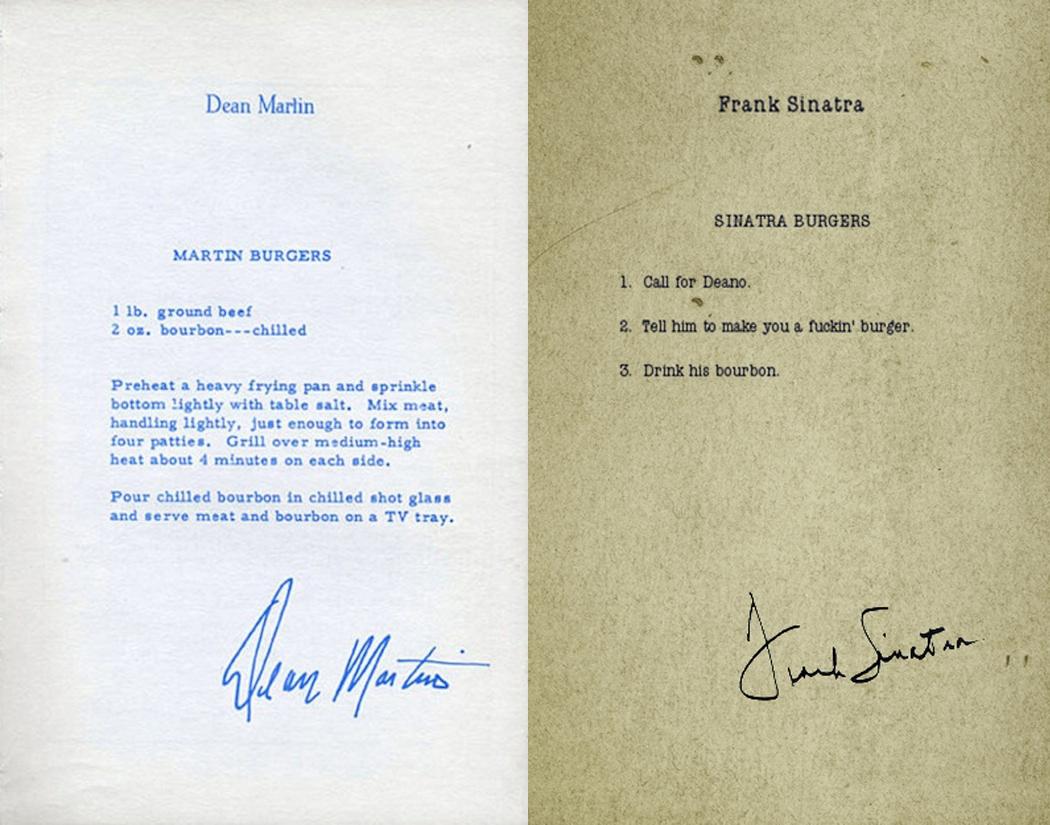
Click on the image to enlarge.

 Blowhard, Esq.
 Callowman
 Sherbrooke
 Eddie Pensier
 Enzo Nakamura
 Epaminondas
 Fabrizio del Wrongo
 Fenster
 Brundle Guy
 Glynn Marshes
 Paleo Retiree
 Atypical Neurotic
 Question Lady
 Sax von Stroheim
 Sir Barken Hyena
 The Mistaken
 Uncouth Reflections