Superheroes in Therapy

Sax von Stroheim writes:

Continuing my series of reviews of superhero comic books that I bought out of a combination of (a) their being on sale, (b) a modest amount of curiosity about them, and (c) my own incurable superhero comic book addiction, we come to Gail Simone and Adrian Syaf’s Batgirl. Gail Simone is one of those writers who is always being described as a “fan favorite”, which seems to mean that her Twitter followers (there were 45,551 of them when I checked this morning) outnumber the people who actually buy her comics (36,666 people paid for a copy of the latest issue of Batgirl). I like her writing—it reminds me a lot of the comics I liked best as a teenager—but if I’m being honest, the most interesting thing about her is that she’s one of the few women writers who has consistently written superhero comics for DC. (Even in a subculture known for its “women problem”, DC seems to be a particularly inhospitable place for women).

Remind me to write about why I hate these contemporary superhero comic book covers...

Remind me to write about why I hate these contemporary superhero comic book covers…

Continue reading

Posted in Art, Books Publishing and Writing | Tagged , , , | 6 Comments

Grammar Catastrophe Du Jour

Eddie Pensier writes:

Grammar Catastrophe Du Jour

The early bird does not employ a spell-checker, apparently.
Taken at the Sydney flagship of Myer, Australia’s largest department-store chain.

Posted in Books Publishing and Writing, Language, Photography | Tagged , , , , | Leave a comment

“Va, Pensiero” Five Ways

Eddie Pensier writes:

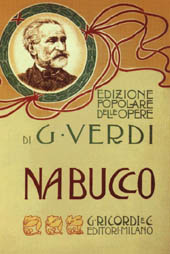
Verdi’s Nabucco isn’t performed much nowadays, with the notable exception of its one huge mega-hit tune: “Va, Pensiero”, also known as the Chorus of the Hebrew Slaves. It’s sung by the Israelites who mourn their homeland and the destruction of the Temple while they are prisoners of the Babylonian king Nabucco (Nebuchadnezzar).

Va, pensiero, sull’ali dorate;
va, ti posa sui clivi, sui colli,
ove olezzano tepide e molli
l’aure dolci del suolo natal!

Del Giordano le rive saluta,
di Sionne le torri atterrate…
O, mia patria, sì bella e perduta!
O, membranza, sì cara e fatal!

Arpa d’or dei fatidici vati,
perché muta dal salice pendi?
Le memorie nel petto raccendi,
ci favella del tempo che fu!

O simile di Sòlima ai fati
traggi un suono di crudo lamento,
o t’ispiri il Signore un concento
che ne infonda al patire virtù.

(Fly, thought, on wings of gold;
go settle upon the slopes and the hills,
where, soft and mild, the sweet airs
of our native land smell fragrant!

Greet the banks of the Jordan
and Zion’s toppled towers…
Oh, my country, so beautiful and lost!
Oh, remembrance, so dear and so fatal!

Golden harp of the prophetic seers,
why dost thou hang mute upon the willow?
Rekindle our bosom’s memories,
and speak to us of times gone by!

Mindful of the fate of Jerusalem,
give forth a sound of crude lamentation,
or may the Lord inspire you a harmony of voices
which may instill virtue to suffering.)

The chorus immediately became not only popular for its plaintive tune but its deeply felt words by librettist Temistocle Solera. It became an anthem for supporters of Italian unification, and Verdi did not discourage this. It was spontaneously sung by mourners following his casket through the streets, and became a patriotic favorite. (As late as 2009, there were calls to make it Italy’s official national anthem.) Since then it has become part of Italy’s (and Europe’s) collective consciousness.

Here are five ways to experience the many moods of “Va, pensiero”:

*As a straightforward and heartbreaking performance (with encore!) version by the Metropolitan Opera Chorus and Orchestra under James Levine, from 2002. (Vintage fans may prefer this audio-only version by Toscanini, who conducted it at Verdi’s official funeral.)

*As a football chant.

*As a jazz quintet.

*As an accordion solo performed by Gigi Stok.

*As a theremin solo performed by Thomas Grillo.

*(Bonus: As a karaoke, so you can try singing it yourself if you’re feeling a bit risorgimento.)

Posted in Music | Tagged , , , , , , , | 3 Comments

Architecture Du Jour

Blowhard, Esq. writes:

Speaking of Cuba, please enjoy this gallery of Cuban interiors by the photographer Michael Eastman.

Click on the images to enlarge.

There’s more of Eastman’s photographs of Cuba here and here.

Posted in Architecture, Photography | Tagged , , | 2 Comments

Tonight . . . Let it be Middlebrau

Fenster writes:

I recently wrote about where I was when I heard that Kennedy was shot: in a high school assembly awaiting a recital by a famous violinist.  Classmates from the era and I struggled to put a name to the memory.  Was it Artur Rubinstein?  Yes, many of us recalled.  That was until I posted that memory here and Bryan reminded me in Comments that (oops) Rubinstein was a pianist.  Bryan also pointed out that Rubinstein would never have consented to play in a high school assembly.

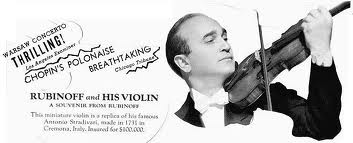
So back to work the class went after the correction, with people asking friends and relatives if they could put a name to our collective memory.  Eventually, the sister of one of my classmates nailed it.  It was not Artur Rubinstein the pianist but David Rubinoff the violinist.

What can I tell you?  The names are similar.  A bunch of suburban New England goyim one Jew in the whole school we didn’t know from Rubinstein.

So who is this guy?  Do you remember David Rubinoff?  I drew a blank, as did my classmates.  But thanks to the Wonder of the Internet, you can find out a lot about the guy.  He was indeed quite famous in his time, the Liberace of the violin.

rub
Born in Russia, he was drawn to the United States by Victor Herbert, who discovered the 14-year old at the Warsaw Conservatory.  After success as a soloist for the Pittsburgh Symphony and as a guest conductor in the United States and abroad, he hit the big time when Rudy Vallee helped him land a regular spot on The Eddie Cantor Show.  That was big.  In time he played at the White House for Presidents Hoover, Roosevelt, Eisenhower and, yes, Kennedy.

And consider his performance at the Grant Park Music Festival in Chicago, an annual event since 1935.  While current Grant Park outdoor concerts today draw about 10,000, the early ones drew the biggest concert crowds in American history, probably through Woodstock.  Lily Pons holds the record for attendance at a single concert there: 300,000 in 1939.  Rubinoff was not far behind, at an estimated 225,000.  That’s over half the size of Woodstock.   Yet Rubinoff is, like Lew Lehr, largely down the memory hole.  Like Lehr, who went down the memory hole with the newsreel, Rubinoff went down with radio.

But that’s not all there is to it.  There’s also the fact that the fine arts no longer command the high ground in American culture in the same way they once did.  It’s not just the decline of the medium of radio that put Rubinoff in the shadows.  It’s the general decline of Middlebrow culture.  A current version of Rubinoff in the internet age is almost unthinkable.

Terry Teachout has written eloquently and often on the decline of Middlebrow.  Ruefully, too.  Here is one of his clearest statements of his double-sided feelings of progress and loss.

Teachout and I both grew up near contemporaries in age, both growing up in relatively small towns where inklings of the wider, more cultured, world were first made available on shows like Omnibus, Leonard Bernstein’s Young People’s Concert or even Ed Sullivan.  That world is gone, as Teachout acknowledges.

. . . though whether it stays dead permanently was taken up by Fenster at 2Blowhards some time back, too . . . is this a case of genie out of the bottle forever or a pendulum swing?

Posted in Music, Personal reflections | 6 Comments

How Well Do You Know Your Shit?

epiminondas writes:

Take the test and find out how well you have your shit together…

Posted in Humor | 5 Comments

“Rise: Blood Hunter”

Paleo Retiree writes:

rise

Not-great but we-watched-it-all-the-way-thru-anyway erotic vampire revenge thriller, directed by the Venezuelan-born Sebastian Gutierrez. Lucy Liu plays an LA Weekly reporter who’s unhappy about having been turned into a vampire, and who sets out to track down the cult that did her wrong. It’s one of those discombobulated movies that seems to have its reels mixed up, but Liu is a weirdly compelling lead performer — not that great an actor and not that good-looking in a conventional sense, but so steely, determined and crazy-seeming that she’s kinkily fascinating to watch anyway. Despite the narrative jumble, the movie has a lot of near-camp-level juiciness and flamboyance (this is a good thing, IMHO); the performers have a great time taking wild chances; a couple of scenes hit some pretty thrilling erotic high notes; and among the film’s supporting actors are Carla Gugino and Cameron Richardson, two of the sexiest, most glamorous performers in today’s Hollywood. Why neither one is a major star is completely beyond me.

Related

  • Guttierez has made a couple of scrappy, small-scale camp movies that are a lot like Pedro Almódovar’s high-spirited early comedies: “Women in Trouble” and “Elektra Luxx.” Guttierez has an exuberant visual sense, a love of the irrational and a great rapport with his actresses, who respond with a lot of daring, sensuality, silliness and charm.
  • An interview with Sebastian Guttierez.
  • Carla Gugino!
  • Cameron Richardson!
Posted in Movies | Tagged , , , , , , , | Leave a comment

Uninhibited Sexy Fun? Or the End of All Good Things?

Paleo Retiree writes:

http://vimeo.com/80118132

Posted in Music, Performers, Women men and fashion | Tagged , | 11 Comments

speaking of architecture…

Glynn Marshes writes:

You guys following the articles on Havana by Michael Totten?

From The Once Great City of Havana:

Yet the bones of Cuba’s capital are unmatched in our hemisphere. “The Cubans of successive centuries created a harmonious architectural whole almost without equal in the world,” [Theodore] Dalrymple wrote. “There is hardly a building that is wrong, a detail that is superfluous or tasteless. The tiled multicoloration of the Bacardi building, for example, which might be garish elsewhere, is perfectly adapted—natural, one might say—to the Cuban light, climate, and temper. Cuban architects understood the need for air and shade in a climate such as Cuba’s, and they proportioned buildings and rooms accordingly. They created an urban environment that, with its arcades, columns, verandas, and balconies, was elegant, sophisticated, convenient, and joyful.”

and

In Havana, exquisite European architecture stretches block after block after block after block for miles in every direction.

It’s all crumbling however.

Tons of pics at the link.

First article in the series here.

Posted in Architecture, Politics and Economics | 2 Comments

Quote Du Jour

Blowhard, Esq. writes:

baldsleechbook

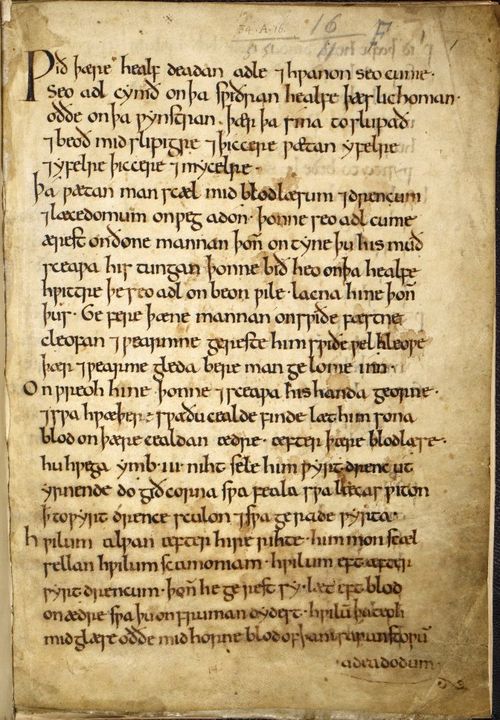
Anglo-Saxon medical recipes corresponding to Book 2, chapter 59 of Bald’s Leechbook

If a horse or other cattle is elf-shot, take docks seed and Scottish wax and let a man sing twelve masses over them and put holy water on the horse or cattle. Have the herbs always with you. For the same affliction, take an eye of a broken needle, give the horse a prick with it in the ribs. No harm shall come.

— How to cure a horse or cow that was shot by an elf, as described in Bald’s Leechbook, a 10th century English medical manuscript. Download it here. More on Anglo-Saxon medicine here.

Posted in Animals, Philosophy and Religion | Tagged , , , | 2 Comments