
Sherbrooke writes:
Here’s Josephine Baker, in a hat, and — other things.

Sherbrooke writes:
Here’s Josephine Baker, in a hat, and — other things.
epiminondas writes:
Everyone has the fantasy wish of going back in time for a brief visit. But assuming you had only one trip you could take, where would you go? I’ve thought about this quite a lot. Obsessively, actually.
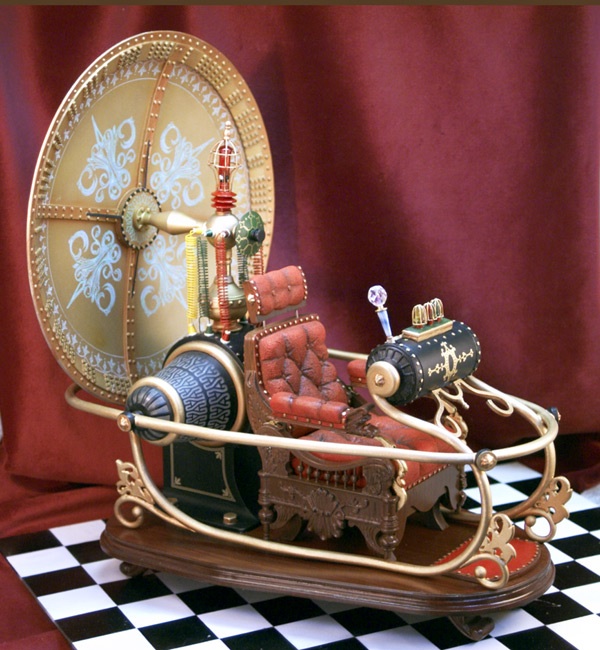
Some of my choices: fifth century B.C. Athens, Paris in 1750, London in 1850, Florence in 1500, New York City in 1932, Charleston in 1860, Edo (Tokyo) in 1850, Constantinople in 1200, Baghdad in 900, Vienna in 1825, Babylon in 1200 B.C., Thebes in 1800 B.C., Buenos Aires in 1910…and Rome at the time of Augustus: 10 B.C.
Now if I could only go on one trip, it would be ancient Rome. I would do all the touristy things, like taking in a gladiator match at the Colosseum, watching a chariot race at the Circus, taking the waters at the Baths of Diocletian, hearing a recital at the Theater of Marcellus, and attending a sacrifice at one of the numerous temples. And if it really came down it, I would try to arrange a trip that would put me in Rome in time to see the Triumphal Procession of some victorious general or emperor. Put me down for one ticket, please. Round trip, coach would be fine. I’ll be staying about a month.
Until someone figures out how to build a time machine, this is pure fantasy. However, there is an ongoing project called “Rome Reborn“, an international initiative which seeks to eventually provide detailed virtual “fly-throughs” of ancient Rome at various stages in its history, from about 1000 B.C to its final period of decline up to around A.D. 550. This project began over ten years ago and will continue for many more years. It may never be completed. Here’s the latest version…
Other people are also jumping into the act. Here’s a fly-through of just the Roman Forum with even greater detail:
Paleo Retiree writes:
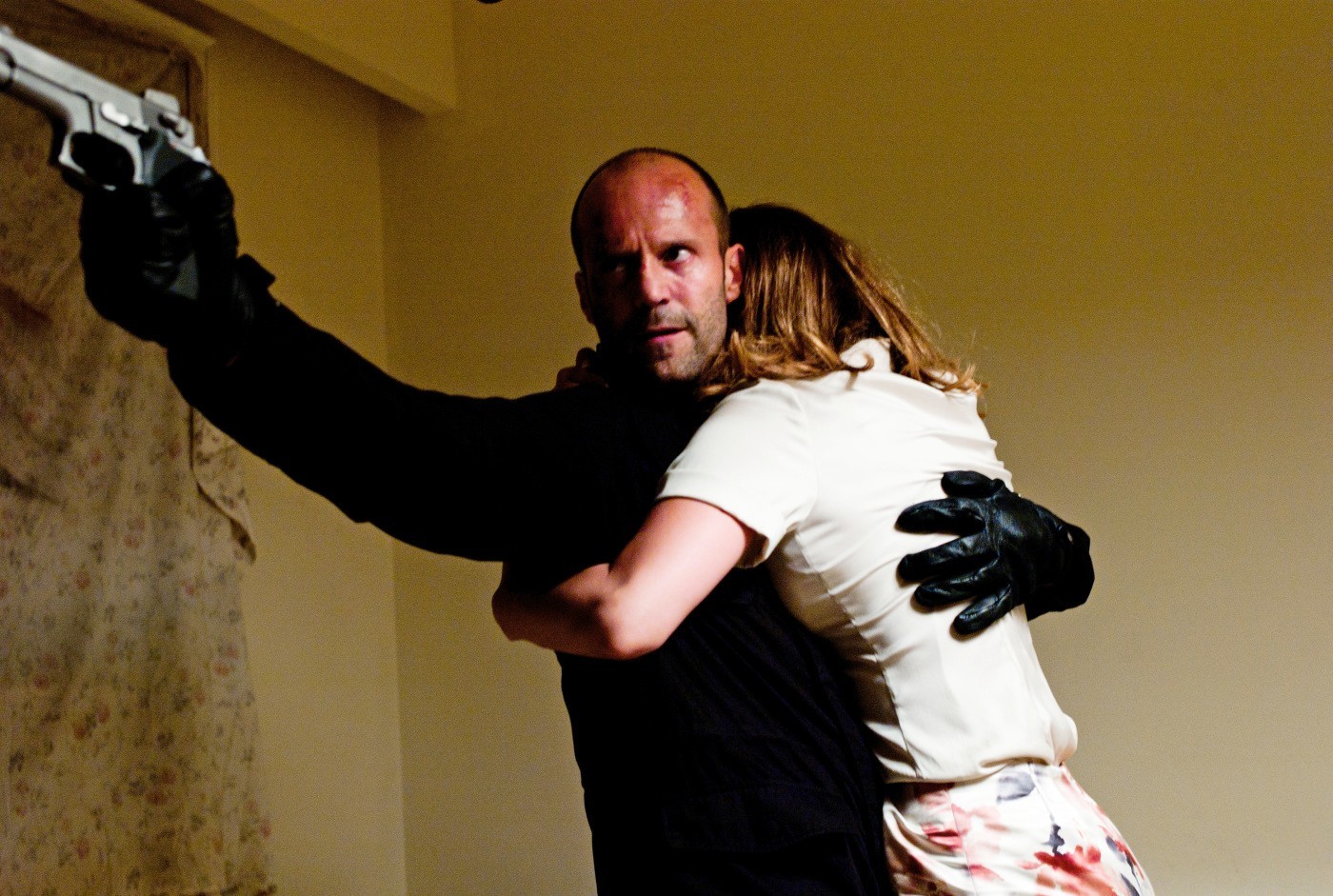
Jason Statham and J-Lo directed by Taylor Hackford, in an adaptation of one of Donald Westlake’s “Parker” novels. For me the film straddled the line between “an OK watch” and “an unfortunate misfire.” It’s full of lively action and color — fun high-life/lowlife settings in New Orleans and Palm Beach, and loads of terrific actors in minor roles. But it isn’t very satisfying. With his battering-ram head, his physical prowess and his growling taciturnity, Statham must have seemed like a plausible choice for Parker, but he doesn’t work out very well; portraying an unstoppable, sociopathic, all-dick archetype (embodied in earlier movies by Lee Marvin, Jim Brown and Mel Gibson), Statham winds up looking like a boy playing at being a man. Masculinity today, eh? With J-Lo, it seems that you’re either amused by her childishly bad, cartoonish overacting or you aren’t — in this case, what the heck, I was tickled by it. Hackford can deliver a terrific movie when his trademark juicy-flamboyant realism is appropriate — I loved “Ray,” his recent biopic about Ray Charles. But here his approach seems all wrong, as though he was determined to deliver conventional payoffs of a kind the material isn’t much good for but was clueless about the quirkier potential the material is teeming with. FWIW, I’m one of those people who considers Westlake’s Parker novels to be genius. They feature an absurdist bluntness and matter-of-factness that’s like a fusion of Don Siegel and Robert Bresson; they’re reductionist and brutal to a comic/horrifying extreme; yet they’re also droll, devil-may-care, make-it-up-as-you-go-along shaggy-dog crime yarns.
Related
Fabrizio del Wrongo writes:
Blowhard, Esq. writes:
 The beautiful sign of the El Rey Theater in Los Angeles, CA.
Related
epiminondas writes:
What if you received time in a bottle? You open the bottle and you get to see something from your distant past that you only had memories of. But now, you get to see it unfold in front of you again. One man had this experience…
Fabrizio del Wrongo writes:
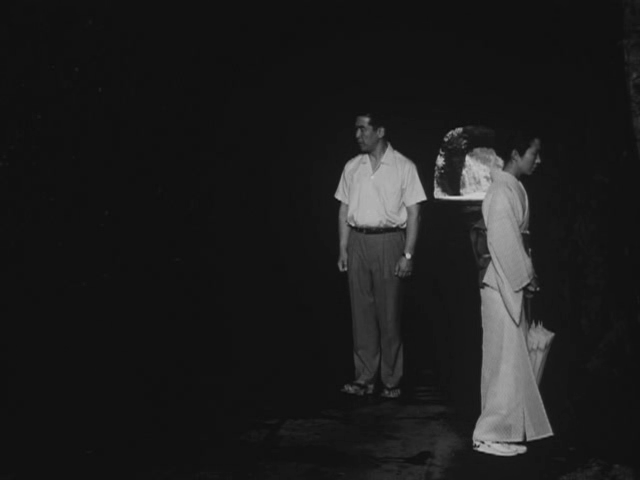
“The Stranger Within a Woman,” from 1966, is an unsettling late Naruse that feels a bit like one of Bergman’s ’50s films, especially in its use of the flashback as a structuring device. The plot concerns a middle-class man who inadvertently kills his friend’s wife during a bout of kinky sex. Predictably, this strains the relationships between him, his wife, and the friend. Naruse downplays the thriller aspects of the story in favor of emphasizing the way in which the event galvanizes the instincts — both moral and practical — of each involved character. Nothing ends up being resolved, yet it’s fascinating to watch Naruse shift point of view and force story elements to collide in evocative, unexpected ways. More than once it reminded me of one of Hitchcock’s most underrated films, the 1929 “The Manxman.” I’m not sure what was going on in Naruse’s life during this period, but the movie he made right after this one, “Hit and Run,” is another quasi-thriller with macabre overtones.
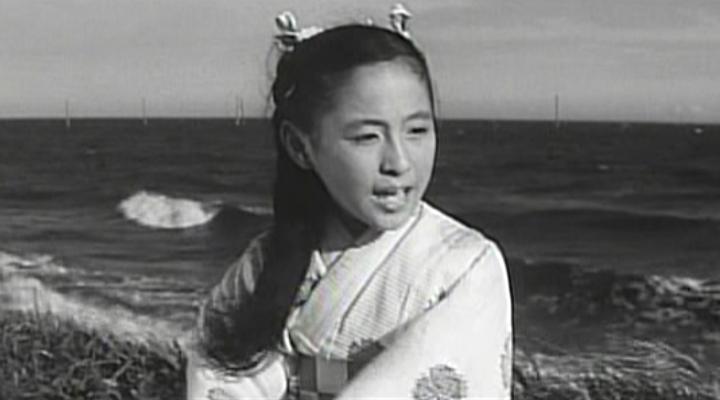
The 1960 “Autumn Has Already Started” has an Ozu-esque title but the pessimism and focus on money are typical Naruse. In it, a widow and her son move from the country to live with their relatives in Tokyo. The mother is forced to take work as a geisha while the son develops a friendship with a girl who performs chores in the mother’s workplace. This leads to problems, as the boy’s play activities begin to overlap with the mother’s very adult occupation. As the movie progresses we see less of the mother; she gets into a relationship with a patron, and he wisks her away. The boy compensates by spending time with an older male relative, who is kind but ultimately more interested in carousing with friends. The scenes between the children are sweet without being maudlin. In the movie’s most memorable bit they go to the waterfront in a taxi, then get lost on the desolate, desert-like beaches. In another bit the boy rushes to the home of the girl to impress her with his pet rhinoceros beetle. Upon arriving he discovers that her family, like his mother, has packed up and moved. Heartbreaking. These scenes have a tenderness and a respect for youthful POVs that recalls “The 400 Blows” — though Naruse is free of Truffaut’s mythologizing tendencies. The movie makes good use of the Tokyo locations. You really get a sense of the city and its surroundings. It’s notable that the opening and closing shots involve busy city streets; images of the characters carefully picking their way through traffic sensitize you to the danger inherent in urban locations. Perhaps these shots are also premonitions of Oshima’s 1969 “Boy,” a movie with a similar — and a more firmly hammered down — set of themes.
Related
Blowhard, Esq. writes:
 The cover of Flash for Freedom! by Frank Frazetta.
Related
Fenster writes:
I am not sure I fully buy the notion of memes as self-replicating counterparts of self-interested genes. At least I would want to understand better the means by which those presumably selfish little idea critters hop from host to host looking for an angry fix.
If there is a kind of idea out there that persuades me there is something to the meme meme, it is the earworm idea. You know, those songs, or snippets of songs, or hooks, or phrases, or whatever that get lodged in your head. And you can’t seem to get “them” out.
Now I may not always have a song in my heart but I always, always have one rattling around in my brain. And they most often take the form of earworms, little pieces of music picked up somewhere along the way that just come and go as they please.
The more we understand the brain, the more it appears that the unconscious parts of our brain make a lot more of our decisions than we think. Relevant synapses flash not when we decide in favor of the Philly Cheesesteak, but, suspiciously, right before. Memes, you say?
So with earworms. The things I think I like may never make the playlist.
What does gets stuck there? Well, here’s a recent example.
Aaarrrgghhh! I object! I hate Debbie Boone, and I despise that sappy song. Yet ever since her commercials for Lifestyle Lift, You Light Up My Life wafts in and out of my mind whenever it damn well wants, and “it” seems to want to be there a lot recently.

So does this mean “I” really like Debbie Boone? Or maybe that a rogue Boone-meme has taken up shop in my brain and is barking out orders?
And then Scheherazade snuck in somehow. That Rimsky-Korsakov chestnut was one of the first classical pieces I listened to, and I’ll grant it is nothing if not memorable. But if Strauss referred to himself as a first-rate second rate composer, my conscious mind has always thought of Scheherezade as second-rate second-rate music.
There’s theme one:
And theme two:
And theme three:
All introduced in the first three minutes, all recycled endlessly endlessly in every possible variation in tone, over and over. If nothing else, it is sticky. I guess I must actually love it, deep down?
It’s not always this bad. Actually, much of the time I end up liking what makes the playlist.
For instance, this wah-wahish lick from Steely Dan recently took up residence for several weeks. Not the whole song, just the lick. My conscious mind approves.
Or this sprightly introduction to Belbeukus, by the somewhat obscure 60s band Rhinoceros. Aw, heck, the whole song is less than two and a half minutes–if you’ve gotten this far, listen to the whole thing.
My conscious mind approves. Another area of agreement between my meme master and me.
My apologies for any meme spreading.

 Blowhard, Esq.
 Callowman
 Sherbrooke
 Eddie Pensier
 Enzo Nakamura
 Epaminondas
 Fabrizio del Wrongo
 Fenster
 Brundle Guy
 Glynn Marshes
 Paleo Retiree
 Atypical Neurotic
 Question Lady
 Sax von Stroheim
 Sir Barken Hyena
 The Mistaken
 Uncouth Reflections