“Copperhead”: An Interview With Bill Kauffman

Paleo Retiree writes:
copperhead-poster1-405x600

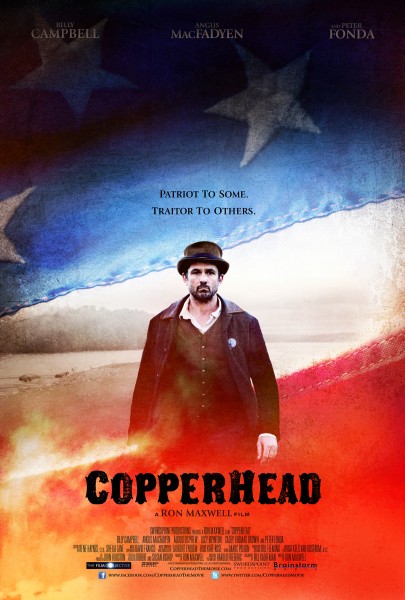
The movie I’ve most been looking forward to this year is “Copperhead,” which opens in many cities this Friday. That’s partly because it was directed by Ron Maxwell, who has made two of the movies that real Civil War buffs most adore: “Gettysburg” and “Gods and Generals.” (Get ’em both for less than ten bucks.) It’s partly because it promises to be one seriously unusual Civil War movie — it doesn’t center on the question of slavery, for instance. But my anticipation mostly has to do with the scriptwriter: Bill Kauffman, who has been known so far (if not well-enough known) for his unorthodox books of history and his impossible-to-pin-down (in a good way) political journalism.

Based in Batavia, NY (in Western NY State, midway between Rochester and Buffalo), Kauffman has been a most unusual public presence for a couple of decades now.  One illustration (among many possible) of this: His writing has appeared in both The Nation and The American Conservative. Part anarchist, part paleocon, part small-town advocate, part regionalist, part pacifist, he brings an expansive, generous temperament to bear on his topics that transcends the usual categories in a most wonderful way. If you’re tired of the usual left/right fistfights — and who isn’t? — Bill’s work will come as a breath of very fresh air.

Since interviewing him for my old blog (you can find links to that interview at the end of this one) I’ve struck up a friendship with Bill. I took advantage of it to drop him a note and ask if he’d answer some questions for the blog about the new movie. He graciously agreed.
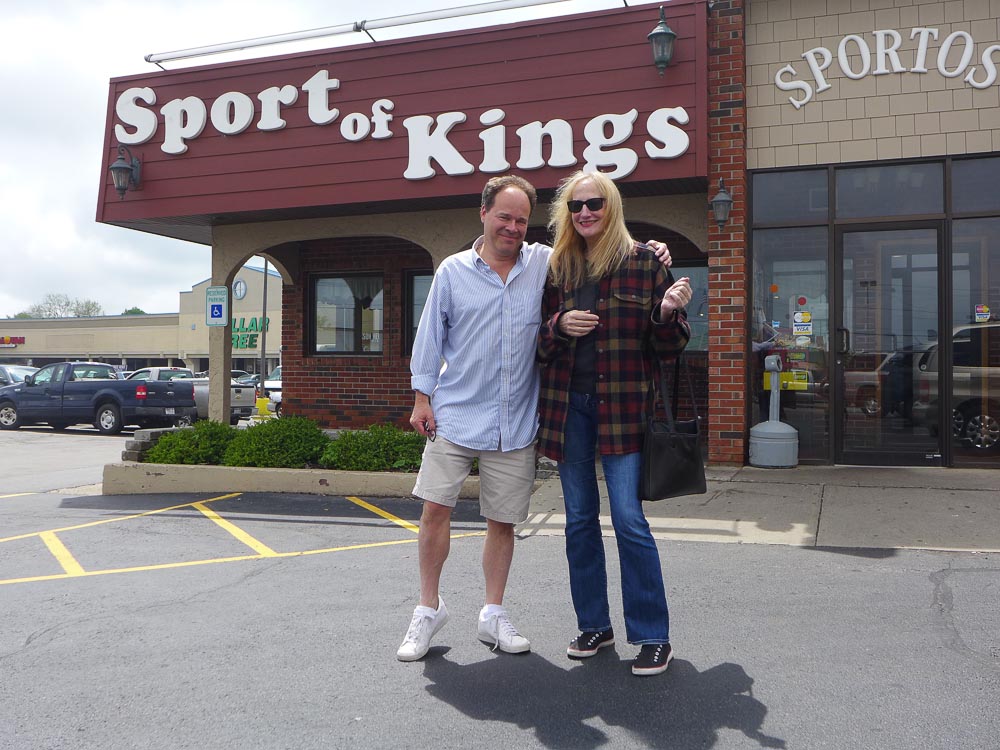
Bill Kauffman and The Question Lady in Batavia

Bill Kauffman and The Question Lady in Batavia

Paleo Retiree: So you’ve gone and made a Civil War movie that isn’t about Lincoln, or about the nobility of marching off to die to end slavery. Do you want people’s heads to explode?

Bill Kauffman: Ah, jeez, maybe we should have run this by the Ministry of Culture, huh? Instead of focusing on the Great Men who decide to send the sons of other men off to kill and die in wars, our interest was in the men who fight — and the men who choose not to fight — and the communities they leave behind.

PR: What is the picture based on?

BK: Our story has an excellent if slightly eccentric literary pedigree: it’s based on the 1893 novella of the same title (the film subtracts the “The”: no articles for us, thank you) by Harold Frederic, the pride of Utica (along with Annette Funicello and Roscoe Conkling), who was also a bigamist, New York Times London correspondent, and author of “The Damnation of Theron Ware,” which F. Scott Fitzgerald called the best American novel written before 1920. (Coincidentally, the year “This Side of Paradise” came out.) Frederic published a volume of Civil War stories focusing on the Upstate New York homefront. Edmund Wilson said these stories “differ fundamentally from any other Civil War fiction I know.” No fanfare, no fustian, no “Dixie” Southern romanticism or “Battle Hymn of the Republic” Northern righteousness. Just clear, unsentimental, often heartbreaking stories of the people left behind. The homefront is always the forgotten casualty of our wars.

PR: In your work you’ve always called attention to regional figures — regional authors, historians, characters generally. Why?

BK: I was lucky in that I grew up with a sense that my place (Batavia, Genesee County, Upstate New York) mattered. Others might think it a flavorless dump, but to me it had charm and magic and mystery. Every story you could ever hope to tell was on these streets, in these fields. So I became an obsessive reader of regional literature, not only my own but of authors from other regions: Sarah Orne Jewett, Wendell Berry, Sinclair Lewis, Edward Abbey, Mary Wilkins Freeman, Hamlin Garland, Howard Frank Mosher — every state, every region.

PR: There’s a lot of fizz these days around issues related to regionalism — the talk (some of it wild and irresponsible, some of it very interesting) about secession, the locavore movement in cooking and eating … What do you make of it?

BK: The local color movement flourished in the 1880s and again in the 1920s, but my sense is that regional cultures are reasserting themselves today as a revolt against nationalism and globalism — soul-sucking forces. There is no “American” culture except as the sum of regional cultures, as Grant Wood often explained.

PR: I have an uninformed hunch that the main political dynamic these days has nothing to do with left and right and everything to do with the forces of centralization vs the forces of decentralization. Fair? If so, why now?

BK: Of course I agree on the obsolescence — no, the perniciousness — of the left/right, liberal/conservative, Red/Blue divide. Or should I say straitjacket. Or prison cell from which no thought is permitted to escape. Localist v. globalist (or nationalist) and decentralist v. centralist provide a sharper angle of vision, though even here I prefer to blur the lines of demarcation. People are casting about for better, more human-scale ways of ordering and living their lives. That’s all to the good.
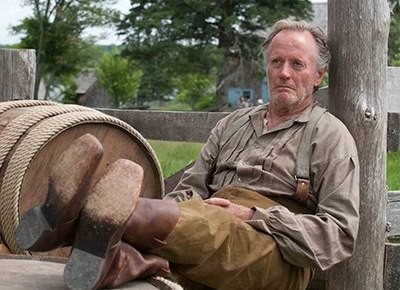
Peter Fonda in "Copperhead"

Peter Fonda in “Copperhead”

PR: What has your own interest in movies been? I know you’re a ’70s movie buff. What did you love about them?

BK: There’s never been an era in which movies sang America like they did in the early ’70s. It’s as if for a few brief years the artifice fell away to reveal the country underneath. Just listing the films makes me feel as if I’m standing in the middle of a cornfield or sitting on a creekbank.

PR: What were/are some of your favorites from that era?

BK: What do I love? “The Hired Hand.” “Tomorrow.” “The Beguiled.” “Ulzana’s Raid.” “Bad Company.” “Pat Garrett and Billy the Kid.” “Thunderbolt & Lightfoot.” “The Outlaw Josey Wales.” “Jeremiah Johnson.” “Charley Varrick.” “Junior Bonner.” “Last American Hero.” “The Cowboys.” “Dirty Mary, Crazy Larry.” Warren Oates. Jeff Bridges. Sam Peckinpah. Clint Eastwood. Kay Lenz. Paul Le Mat. Peter Fonda. (I’m thrilled that Peter Fonda is in “Copperhead.” In fact, a couple of mise en scènes with Peter are homages to his father.) The list goes on and on. Hell, I even like ’70s movies everyone else hates: “Zabriskie Point.” “Vanishing Point.” “Bring Me the Head of Alfredo Garcia.” “Big Wednesday.”
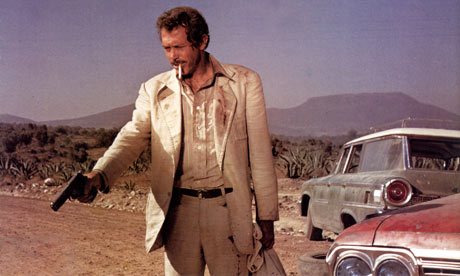
Warren Oates in "Bring Me the Head of Alfredo Garcia"

Warren Oates in “Bring Me the Head of Alfredo Garcia”

PR: Movies were such a different thing then than what they are today.

BK: There was an open, a searching quality to a lot of those movies. Even films I’m not fond of — “Five Easy Pieces,” “Nashville” — ask questions, or frame questions, in provocative ways, and they don’t pound you over the head with the answers. I was just a kid then trying to figure out how I could get to Buffalo or Rochester to see “Scarecrow” or “Fat City,” but I was aware that somewhere people were talking about these movies, engaging with them, arguing with them. I like to think they’ll do the same with “Copperhead,” which may be its most evident ’70s quality.

PR: In “Copperhead,” do you and director Ron Maxwell opt more for asking questions or giving answers?

BK: Ron and I abhor message movies. God, they’re dreary — ABC Afterschool Specials without the camp. So in “Copperhead,” we present Abner Beech (Billy Campbell), an Upstate New York farmer, circa 1862, who is also a classic Jeffersonian Democrat, and thus antiwar. He has his say — always difficult in time of war, when freedom of speech contracts along with the Bill of Rights — but so does the town’s wisest pro-war, pro-Lincoln eminence, the blacksmith Avery (Peter Fonda), whose character we reinvented.

PR: How closely do you follow the novel?

BK: Frederic’s novel focused primarily on Abner; we light up the background, so that the entire community is a character, or welter of characters. We have zero interest in rearguing the Civil War, or telling viewers what they should think about the war; we dispose of the prowar/antiwar argument early on, giving each side its say, and so the story becomes the ways in which this war, like all wars, rives and rends the community, and changes the people at home in unalterable ways. I can imagine this film being made in 1973; in 2013 its creation is almost a miracle.

PR: How did you and Ron Maxwell cook up the idea for the movie?

BK: We met back in the mid-’90s, I think, and hit it off. About 2008 we started working on a film project — set in 1820s-’30s Kentucky — that hasn’t yet made it into production. (Though hope springs eternal.) In spring 2010 Ron was giving a talk in New Canaan, Connecticut, on the subject of his Civil War movies. We had breakfast the next morning, together with producers Bob and Susan Bishop and our daughters Daisy Bishop and Gretel Kauffman (who have non-speaking roles as the Giggling Girls — star turns, I’d say!). Our breakfast chat revealed that Ron and I had both read and been fascinated by Frederic’s novella “The Copperhead,” and, well, the seed took. I wrote a first draft in perhaps a month or two, but many were the rewrites, especially since the film’s plot diverges from the novel’s about halfway through and the twain don’t meet till the final scene.

PR: What was your involvement in the process? Once you got the script in shape, was it over?

BK: Ron and the producers, Bob and Susan, were great about keeping me in the loop, though decisions about casting and location and budget and such were beyond my bailiwick. I was on the set (in the King’s Landing Historical Settlement near Fredericton, New Brunswick, Canada) for about four of the seven-week shoot. I had a blast, though on the set of a well-planned movie — as this was; Ron is very efficient — a screenwriter’s tasks are not burdensome. We did write a handful of scenes on location, though, or tweak dialogue, and that was a “Get Me Rewrite!” kick for me.

Ron Maxwell shooting "Copperhead"

Ron Maxwell shooting “Copperhead”

PR:  What’s Ron Maxwell like?

BK: Ron’s a voracious reader, really cerebral with a great talent for storytelling. The central plot twist in the film, for instance, is his idea, and it’s a good one. He’s in charge but not at all dictatorial or imperious. I’m obviously a tyro in this field, but cast and crew told me it was among the most harmonious sets they’d ever worked on.

PR: This is your first fiction since “Every Man a King.” After all the nonfiction that you’ve published, what was the experience of getting back to fiction like for you?

BK: Yeah, it’s been 24 years since “Every Man a King,” though I like to think there’s an imaginative (though not fictive!) element in my other books. Writing is writing: I mean, composing “Moby Dick” is different than laboring on a technical manual for toasters, but if one is engaged in the work he’s drawing upon the same skills. Maybe it’s because “Copperhead” fits with my — God I hate to sound like an Author — uh, body of work, but it didn’t feel like any kind of departure to me.

PR: What was it like to work in dramatic form, where the words-on-the-page don’t count for as much as they do in a book or an article?

BK: I did, of course, have to learn the grammar of film. I’ve read screenplays since I was a kid at Batavia Junior High School. (Its library carried two film scripts: “David Holzman’s Diary” and the Robert Redford-Michael J. Pollard motorcycle movie “Little Fauss and Big Halsy.”) I’m gonna paraphrase here from my introduction to the just-published volume including Frederic’s novella and my screenplay: Before writing “Copperhead” (and “Dick & Julia,” the as-yet unproduced screenplay), I undertook a tutorial in writing for the screen. My reading consisted of James Dickey’s (unfilmable) script for “Deliverance,” which revealed the literary possibilities of the form; Paul Schrader’s “Taxi Driver,” a film I have loved warily since boyhood; Graham Greene’s “The Third Man”; Robert Towne’s “Chinatown”; Cameron Crowe’s “Almost Famous”; and Quentin Tarantino’s “Reservoir Dogs.” I also wanted to read a screenplay by a good writer for a bad film; I chose “Missouri Breaks” by Thomas McGuane, who scripted two movies I admire from those halcyon early ’70s: “Rancho Deluxe” and “92 in the Shade.” (I blame Marlon Brando’s self-indulgent jokiness more than McGuane’s script.) And Ron Maxwell, who adapted his earlier Civil War pictures from novels, was also really helpful.

PR: What’s it been like watching the actors bring your work to life?

BK: Watching the actors vivify the characters was astonishing. I was impressed not only by their creativity but their work ethic. A really impressive cast. When you see the film I think you’ll agree.
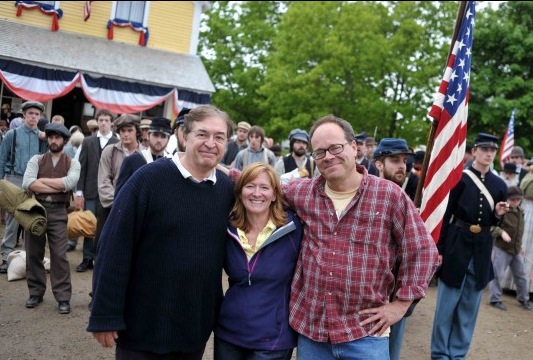
Bill Kauffman (on the right), with Ron Maxwell and TK

Bill Kauffman (on the right), with Ron Maxwell and executive producer Susan Bishop

PR: You’ve done a non-typical Civil War movie, and you’ve written a bunch of what I think of as “alternative histories.” So I can’t resist asking you about your own view of the Civil War. I’m no scholar but I’ve been interested, and the book I’ve found most persuasive has been Gore Vidal’s novel about Lincoln. If you were to write your own alternative history of the Civil War, how would your account go?

BK: Yeah, Vidal’s Lincoln is the best Civil War novel I’ve read. I also recommend highly John W. DeForest’s “Miss Ravenel’s Conversion from Secession to Loyalty” (1867). DeForest coined the phrase “the great American novel” and damned if he didn’t almost write it himself.

My view of the war is … well, let’s say Whitmanesque, in the “I contain multitudes” sense. The failure to emancipate the slaves without bloodshed is the great moral and political failure of American history.  I live in the cradle of abolition — the Liberty Party was born just down the road from us — and those early abolitionists of the 1830s and ’40s are among my heroes. They had an anarchistic tinge; they insisted upon using moral suasion rather than the cold grey hammer of the state. Their political strategy was to pass a series of “personal liberty laws” in the Northern states: in effect, nullifying the fugitive slave acts and inviting runaways to safe haven. The idea was that this would bleed the Upper South of her slaves and achieve a de facto emancipation. Alas, most people in the North were rather less enthusiastic about this plan. But these men and women — deep-dyed in the American anarchist and pacifist grain — I prefer infinitely to those sanctimonious ghouls singing “glory glory alleluia” while over half a million men died.

I also admire the antiwar Democrats for holding high the Bill of Rights in time of war. The wisest of them — mostly those in the Upstate NY Van Buren Democrat tradition — understood that slavery was way past due for extirpation. And I’m even fond of the old Whigs trying desperately to hold the Union together as she crumbled. I wish we didn’t live in an age when men feel compelled to assert their moral superiority to our forebears: from Lincoln to Vallandigham, from Frederick Douglass to Alexander Stephens, I think of them as my ancestors.

PR: Any desire to do more movie work? Eager to give directing a try?

BK: I have a coupla screenplays in the works; I’d love to do more films. So much of our history is unplowed ground. I’d like to write a film or book with my daughter, too; she’s 19, and she’s so much better a writer than I was at that age. She and I are fooling around with a low-budget horror movie script. As for directing, you’d really have to beat the bushes to find someone less technically proficient than I am. As Clint said (by way of John Milius, I believe) in “Magnum Force,” a man’s got to know his limitations.
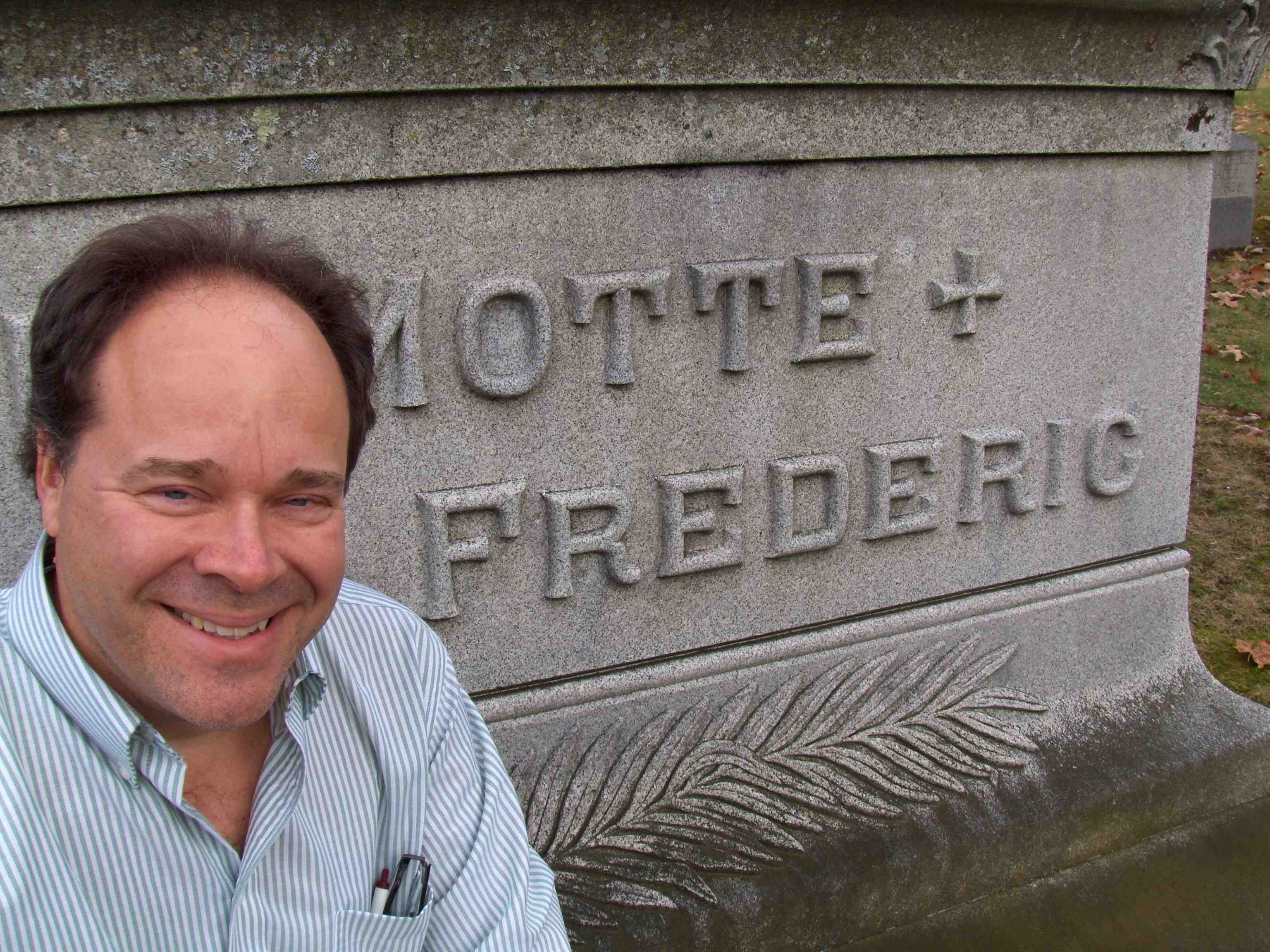
Bill Kauffman visits the grave of Harold Frederic

Bill Kauffman visits the grave of Harold Frederic

Related

See you at the movie theater.

Posted in Books Publishing and Writing, Interviews, Movies, Politics and Economics | Tagged , , , , , , , | 12 Comments

“Copperhead”

epiminondas writes:

If you know anything about this film, let’s hear it.  Sounds interesting.

Posted in Movies | 3 Comments

Eating in Louisville

Paleo Retiree writes:

louisville_trip_2013_06_louisville_t-shirt002

The Question Lady and I recently returned from a week-long stay in Louisville, Kentucky, our second time there. She had a date to perform her dynamite one-woman show at the wonderful Bard’s Town Theatre, and we decided to make a real visit of the trip.

Have you been? We love the place. It has numerous beautiful and/or enjoyably-funky neighborhoods; there’s loads to do and explore; the regional-confidence level is gratifyingly high; the downtown is alive; and the cultural scene is flourishing along a nice continuum from stuffy-trad to genuinely-pretty-edgy. Lots of charm, and of a sweetly lackadaisical kind that makes me feel very beguiled and content. I wouldn’t wish June (let alone July or August) on anyone — the temperatures regularly hit the muggy mid-90s. But we’d happily spend a few spring or autumn months every year in Louisville. Here’s a little collage of views along the city’s hip E. Market St.

louisville_east_market_collage01

Continue reading →

Posted in Food and health, The Good Life | Tagged , , , , , , , , , , | 12 Comments

“The Living Skeleton”

Fabrizio del Wrongo writes:

living skeleton

This seaside spook-fest from 1968 shows what can be done with a few good images and a flair for sustained moods. The screenplay, by Kyuzo Kobayashi and Kikuma Shimoiizaka, has something to do with a gang of modern-day pirates, a creepy preacher, and identical twin sisters. From a traditional storytelling perspective it doesn’t add up to much yet the movie is effective from start to finish; it’s heavy with the eldritch mood one expects of a brine-and-fog horror story. (“Night Tide” and “The Fog” are two better-known examples of this sub-genre.) Working on his first and last movie project, director Hiroshi Matsuno displays an instinct for wild close-ups as well as a knack for ‘scope composition; he’s especially good at using shadows and set elements to partition the frame into areas of concentrated interest. (The black-and-white cinematography, by Masayuki Kato, is consistently striking.) But the movie’s effectiveness probably derives more from its even-keeled tone than from any other element. Regardless of the situation served up by the screenplay — they run the gamut from rumpled sexiness to “Scooby Doo” silliness — the picture never lists or leans. Even the crummy effects sequences, amateurish by any standard, work because they’re integrated with the rest of the material and put across with utter seriousness. In this the “The Living Skeleton” bears a passing resemblance to the work of Jean Cocteau, whose movie magic tricks had a poetic reality that never failed to transcend their hokiness.

“The Living Skeleton” can be streamed via the Criterion channel on Hulu+.

Related:

  • Here’s a nice blog write-up.
  • Another.
  • The folks at Criterion have released the movie on disc as part of their Eclipse series. It’s packaged with a few of Shochiku’s other horror offerings, two of which — “Goku, Bodysnatcher from Hell” and “The X from Outer Space” — are also available on Hulu+. I enjoyed both movies, especially “Goku,” which is like a schlock-horror take on the 1939 “Five Came Back.”
Posted in Movies | Tagged , , , , , , , | 1 Comment

I Can’t Even Remember What It Was I Came Here To Get Away From: An Interview With Lloyd Fonvielle

Blowhard, Esq. writes:

lloydcasino

Lloyd Fonvielle

If you’re a regular visitor here, you’ve probably seen one of us mention friend-of-the-blog Lloyd Fonvielle before. I met Lloyd about a year and a half ago on Facebook where he’s a lively and generous presence. We struck up an on-line friendship and when I was in Vegas last year (see the interview for Lloyd’s provocative thoughts on Vegas), I got to meet him for a night of rowdy conversation and great food on The Strip.

On the publication of his most recent e-book, Missouri Green (which is free this weekend, by the way), it occurred to me that it’d be a good time to propose a Q&A about his life and work. After moving to New York City in the early ’70s, Lloyd spent years in the Hollywood trenches experiencing show business first-hand. Lloyd’s led a varied and productive creative life that’s fascinating in its own right as well as revealing of the times he’s lived through. He currently lives in Nevada where he runs a lively blog, and writes and publishes crime and western fiction. Lloyd agreed to the interview, and we had a great time swapping emails. Here’s an edited transcript of our conversation.

Continue reading →

Posted in Art, Books Publishing and Writing, Interviews, Movies, Photography | Tagged , , , , , , , , , , , , , , , , , , , , , , , , , , | 8 Comments

“Swimming Pool” (1969)

Paleo Retiree writes:

swimming_pool

The 1969 Alain Delon/Romy Schneider/Maurice Ronet/Jane Birkin movie, co-written by Jean-Carriere Carrière and directed by Jacques Deray. Sexy/playful/ sinister erotic games in a villa near St. Tropez, and pure bliss for me. Delon is a vain, jaded, prettier-than-any-woman child-man; Schneider is his glamorous lover, appalled yet fulfilled by him, and more attached to him than she knows is good for her. Ronet is an ex-lover of Schneider’s who — accompanied by his bewildered and, needless to say, unreasonably sexy teenage daughter (Birkin) — stops by for a visit.

It’s a stunningly confident and virtuosic film: Glossily beautiful people, decor, settings and photography; oblique, sleekly enigmatic storytelling; serene, quiet, and subtle staging and shooting … In genre, the film is like one of those Harold Pinter / Joseph Losey films about bored, unhappy married couples, only “Swimming Pool” doesn’t turn bitchy, cold and nasty in the educated-English way; instead, it’s richly sensuous and (though a jolt of coldhearted / clinical “Liaisons Dangereuses” – style psychological penetration does enter into the mix) entrancingly sexy. In fact, it’s one of the most confident and sizzling expressions of ’60s French star power and high style (those eyes! those bodies! those tans!) that I’ve ever watched.

swimmingpool-delon-schneiderDon’t expect much in the way of American-style action: For most of the movie you’re doing little but observing gorgeous people pose, move about semi-naked, smoke and eat, interact suavely (while remaining stylishly in command of tons of supercharged subtext), play decadently with erotic dynamite, and occasionally get down to some lazy-but-hot, impossibly chic sex. (How do the French maintain their fatalistic poise even while making l’amour?) Delon and Schneider’s roles are cheeky variants on their own public personae, a naughty move that adds another layer of luscious, narcissistic flirtiness to the whole experience.

Watching the film is like spending an indolent afternoon sunbathing amidst great-looking, half-dressed people while sipping cocktails and leafing through the best issues that Paris Match ever published. I watched “Swimming Pool” feeling like a happy, starstruck and thrilled teenager. It’s everything I hoped movies — and adult life, come to think of it — would turn out to be. What’s French for “Vavavoom!”?

Related

  • I also loved the 2003 François Ozon film of the same name. (Same title, same South-of-France setting, and both films qualify as sexy psychological suspense. Otherwise, though, they’re quite different.) Both films are available on Netflix Instant.
  • I’m working on a theory that Jacques Deray, who specialized in crime pictures, and who was influenced by American movies in a more straightforward and commercial way than the New Wave filmmakers were, is a majorly underappreciated auteur, at least in the English-speaking world — the French seem to have been aware all along that he was awfully good. (A great quote from Deray: “I have always defended the thriller, because it is a spectacle of the highest order.”) But, in all honesty, I haven’t yet watched enough of his movies to make that argument responsibly. Still: what a picture his 1973 “The Outside Man” is!
  • Read a bit more about Jacques Deray. Here’s an informative obit.
Posted in Movies, Sex | Tagged , , , , , , | 6 Comments

“Predator”

Fabrizio del Wrongo writes:

predator

Bro, you got an extra canister of camouflage makeup? I’m all out.

“Predator” is reminiscent of the Ford-Nichols “The Lost Patrol”: its slimness, seemingly lunkheaded at first, is what makes it feel kind of daring. The screenplay, by Jim and John Thomas, uses a familiar action-movie set-up as a lure for the sci-fi-cum-horror hook: just as you’re getting acclimated to the “Rambo”-like plot, the picture ambushes you. You might say the movie operates in a way that mirrors the titular beastie’s manner of taking down its prey — it materializes out of the jungle, then zaps you silly.

The characterizations are flat but vivid; they’re built up from anatomical details (mainly chins and biceps) and mostly sidestep the wateriness of backstory. In fact, nearly every character feels like a side detail pulled from the edges of some bigger, more complicated production. This goes even for Schwarzenegger’s Dutch, a cartoon sketch of a commando with things like “cocky” and “determined” scribbled in its margins.

Working on his first big-time film, director John McTiernan finds a style that gives form to the fear and anxiety that are the story’s main drivers. He’s especially fond of compositions that are stepped in depth, sometimes rack focusing between individual elements in order to make your eye feel worked to its limit. (The cinematography is by Donald McAlpine.) When combined with the natural overabundance of the jungle setting this amounts to a kind of makeshift expressionism — a satisfying blend of location, perception, and state of mind. When the movie switches to the villain’s point of view the expressionistic inclination becomes more explicit. We see what the creature sees — a bugged-out world of rainbow-striated heat impressions (it’s a bit like pop Brakhage).

All of this is so efficient that it’s easy to forget what’s less than satisfying in “Predator.” A female character adds almost nothing to the movie; her presence just detracts from the vaguely homo mood induced by all those guns and forearms. And the final sequence, in which Dutch fights the baddie mano-a-monstruo, is impressive but somehow incongruous. It feels like part of a more conventional movie.

Related:

  • There’s ample evidence that Arnold is something of a dick, but at least he doesn’t take himself too seriously.
  • The end feels like a separate movie in part because it was shot separately, after a lull in shooting necessitated by the decision to create a new creature from scratch. This is discussed in this nice making-of documentary. It must be said: The design of the creature, by the great Stan Winston, is among the most memorable in movie history.
  • Get to dah choppaaaaa!
Posted in Movies | Tagged , , , , , | 9 Comments

“Baby Face”

Blowhard, Esq. writes:

Baby-Face

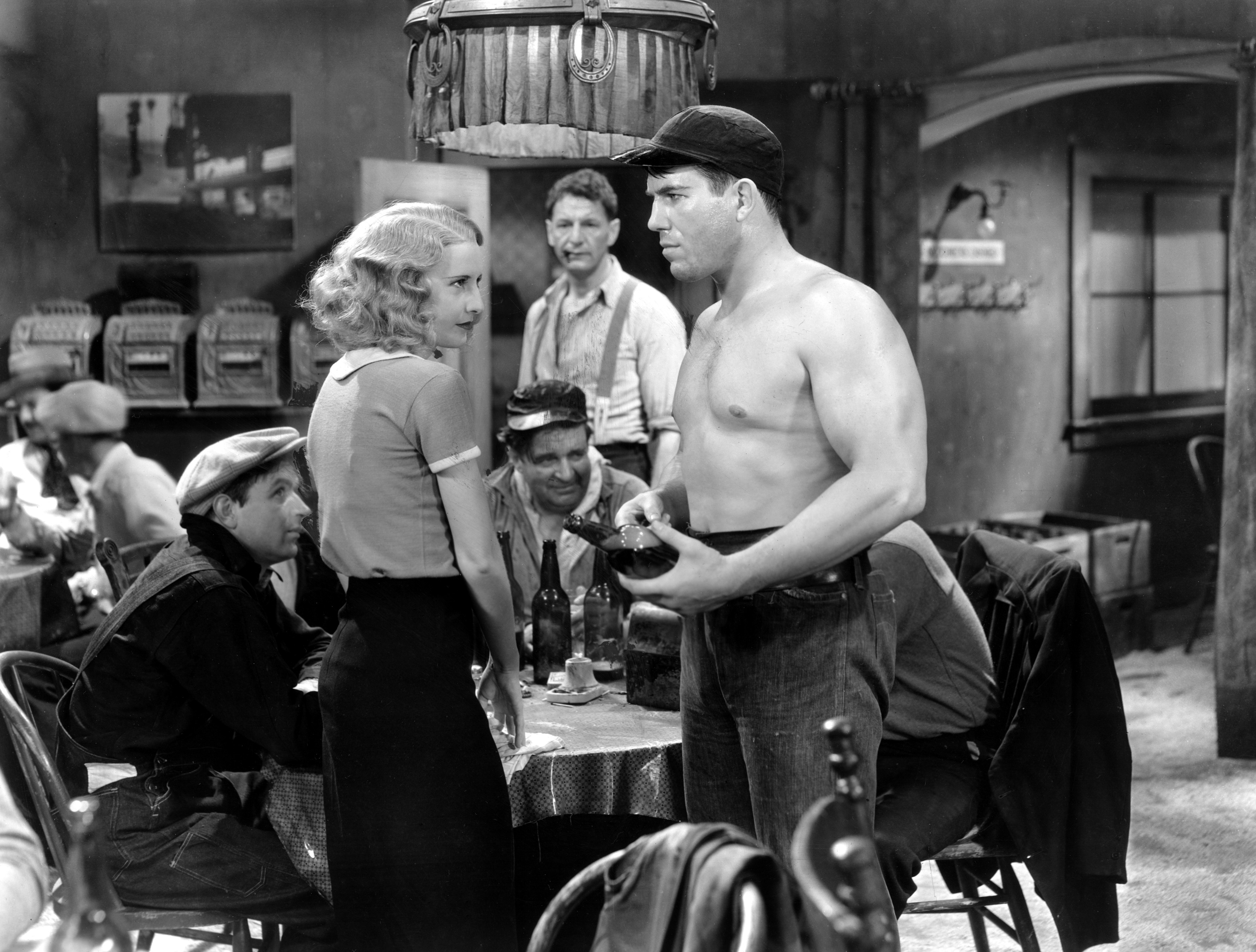
Barbara Stanwyck and her legs star in this engaging Warner Bros. pre-Code Hollywood work from a story by Daryl Zanuck writing under a pseudonym. A sort of femme fatale Horatio Alger story, Stanwyck plays a teenage tramp pimped out by her father in an Albany speakeasy who learns to use sex to exploit men. When daddy is dispatched, and under the kindly direction of a German professor-type spouting Nietzschean philosophy (“Crush out all sentiment!”), Stanwyck moves to New York City and sleeps her way to the top, floor by floor, of a major bank. She’ll have sex with anyone, anywhere, to get what she wants — a railroad bull in a filthy boxcar, a midlevel accountant in a work washroom, or her stuffy boss in his office. There’s a blink-and-you’ll-miss-him appearance by John Wayne playing her goofy boyfriend.

The sex is suggested of course, but the camera does linger lasciviously on Stanwyck’s figure and the sweaty men who all but lick their chops. A crisp 75 minutes, director Alfred Green keeps the action moving, which also includes a murder-suicide and some Parisian excursions, and even manages a couple of arty shots of Stanwyck reflected in mirrors to emphasize her two-faced duplicity. Also given that it was made in early 30s, there’s some nice Art Deco sets and costumes. The ending attempts to redeem Stanwyck but manages to eek out a note of ambiguity.

More

Posted in Movies, Sex, Women men and fashion | Tagged , , , | 6 Comments

“The Ghoul”

Fabrizio del Wrongo writes:

The-Ghoul-Poster

Starring Boris Karloff and featuring a plot derived from “The Cat and the Canary,” this British Gaumont production seems like an attempt to mimic the success of Universal’s monster series. It’s only half-way successful. Karloff’s ghoul, a combination of his mummy and Frankenstein’s monster, lacks the creepy charisma of the Universal fiends, and the production has some of the creakiness of a theatrical spook show. (Like so many early horror films, it was adapted from a stage play.) But in visual terms “The Ghoul” is just about in a class by itself. Shot by Gunther Krampf, who’d worked in Germany with the likes of Pabst, Wiene, and Murnau, the film looks both expressionistic and unfussy, deep shadows and strategically placed pools of light combining to create a velvety, charcoal look that in some ways anticipates film noir — the work of John Alton for instance. So often in these “old dark house” movies the interiors feel divorced from the fog-strewn exterior scenes: they’re afflicted with a squareness that stinks of the proscenium. But Krampf and director T. Hayes Hunter are careful to make their settings overlap. They use windows and filtered shadows to bring movement and visual interest indoors, creating the impression of a nighttime world that is continuous in both space and tone. Look for a very young Ralph Richardson giving what is probably the best performance in the picture.

Related:

  • “The Ghoul” looks so good in part because the DVD was mastered from the original  nitrate camera negative, which was rediscovered in the ’80s. For many years the picture was believed to be lost. More here.
  • A nice write-up of the movie.
  • John Willard’s 1922 play “The Cat and the Canary” must be one of the most influential pop culture things of its era. A great many early horror films stole from either it or one of the many similar stage plays that followed in its wake. The 1927 movie version, directed by Paul Leni, inaugurated the Universal cycle of horror films.
  • Though it doesn’t discuss “The Ghoul,” probably because the film was out of circulation for many years, Carlos Clarens’ “An Illustrated History of Horror and Science-Fiction Films” is one of the great books ever devoted to a single movie genre. Buyable here.
Posted in Movies | Tagged , , , , , , , | Leave a comment

Linkage

Fabrizio del Wrongo writes:

  • Shouting Thomas is having bear troubles.
  • Have you noticed how many scientific and/or academic studies are done on toys? In fact, it wouldn’t surprise me to learn that some college is offering a degree in Barbie Studies. Anyway, some group of eggheads has determined that the faces on Lego people have gotten progressively less cheery. What this is supposed to indicate, I’m not sure. One thing I feel sure of: Over the last 30 or so years, stuff aimed at kids has gotten considerably “edgier.” So I’m not at all surprised that contemporary Lego people display a bit more ‘tude.
  • It’s “1984” all over again.
  • Matt Forney entertainingly throws a bunch of bombs at a feminist writer, and at feminists in general.
  • Pretty sure you’d get tossed in jail if you recorded this today. Question: Why isn’t Lonnie Johnson as well-known as Robert Johnson and Charlie Patton? I think he’s one of the all-time greats. Anyone have an under praised blues artist they’d like to call attention to?
  • Summer camp, Hamas style.
  • The tradition of the cute animal movie goes back to Edison. But it took the film medium over a 100 years to discover the wonders of dogs plus citrus.
  • Foseti on Cormac McCarthy’s “Blood Meridian.” Some interesting discussion in the comments. I read it about 20 years ago and was both impressed and kind of bored by it. Our own Blowhard, Esq. had some fun at McCarthy’s expense back here.
  • Armond White on a couple of long-in-coming DVD releases. I love Lubitsch’s “The Merry Widow,” which is the last operetta he made and the only one he made at MGM. On the other hand, Bogdanovich’s efforts at homage-ing classical Hollywood have never done a whole lot for me. But maybe I’ll take this as an opportunity to revisit “At Long Last Love.”
  • One of the more entertaining Wikipedia bios I’ve come across. What a character Mizner was! The great Hollywood screenwriter Anita Loos, who had a bit of an affair with Mizner, claimed that Warner Brothers paid someone to follow him around and record all his wisecracks, some of which ended up in the mouths of Cagney and Bogart. His brother, Addison Mizner, was the guy who popularized the Spanish Revival style of architecture. Here’s Paleo Retiree/Michael Blowhard on his work.
  • Sandwich shaming.
  • Great Movie Scenes: With its movement through multiple planes, its crack choreography, and its wonderfully comic timing (the editing is spot on), this opening set-piece, from the 1961 “Hercules and the Captive Women,” feels a bit like something out of a Buster Keaton comedy or a MGM musical. You rarely see anything this lovingly put-together in an action movie today.
Posted in Animals, Architecture, Books Publishing and Writing, Linkathons, Movies, Music | Tagged , , , , , , , , , , , | 6 Comments