Being able to spot a fake news story is a valuable skill but truly “fake” news is a somewhat overblown issue. Media literacy nowadays is at least as much a matter of what Sherlock Holmes termed “the dog that didn’t bark.” Holmes solved The Adventure of Silver Blaze by noting that a dog ought to have barked if the racehorse was removed from its stable by an unfamiliar intruder, and the fact that it did not revealed the guilty party. The corollary to dogs not barking where the press is concerned is the decision not to cover things. We see that a lot. I think it is revealing in and of itself.
There’s something about a cool redhead like Iris. And I would describe this neatly configured, very poised Crimean as cool, though when she smiles most of that coolness melts into a kind of pearly sweetness.
She was active in the mid-2000s.
I enjoyed this bio from erotic photographer Petter Hegre’s site:
She was born and has lived all her life in Simferopol in the Crimea, the spur of land that is virtually an island in the Black Sea and holiday haunt of Eastern European and Russian playboys and millionaires. Iris has the ability to make men fall in love with her and, if you take one look, it is easy to see why: those big, wide open eyes are chasms that you plunge into, her lips look as succulent as fresh fruit, her curves are perfect. She has a wild side, but likes to keep in balance practising yoga, and even has a special tattoo on her shoulder designed to aid concentration. At present she only flies within the Ukraine, but this girl is going places and the sky’s the limit.
Playboy’s Miss May of 1975, Bridgett Rollins had a twinkly quality that I suspect couldn’t be suppressed even by a lousy photographer.
I have fond memories of most of the ’70s Playmates even though I was too young to experience them upon their publication in the pages of Playboy. The father of a childhood friend had a box filled with every centerfold issued from about 1965 through the early ’80s. Bridgett definitely made an impression.
Sadly, she passed away in 2011, from cancer. Lots of tributes and remembrances here.
The Russian Saloma, who is sometimes billed as Maxa, is currently one of the most popular nude models on the European sites. Something in her face reminds me of Rachel McAdams, though the schoolteacherish Rachel has none of Saloma’s vaguely Eastern indolence.
Her body is really something. It’s supple and unperturbed, without a hint of crudeness, like a sculpture by St. Gaudens. I’m unable to detect a flaw.
Via Robert Byrons’ “Road to Oxiana” I’ve stumbled on a rich vein of literature on Central Asia, mainly written by steely Kipling-types. But also Ancient and Medieval literature, wherever from. No personal account of travels I’ve read is more recent than 1910 and I did no reading on current conditions. I’m afraid of what I’ll learn.
At that time in the Tarim Basin, focus of my interest, contact with the West had only just begun. Ella Sykes, whose “Through Deserts and Oases of Central Asia” displays just about every good thing about the British, was only the second European woman in Kashgar. I filled this in with great wiki-feasts and many hours on Google Maps, to complete the picture. Which I found stunning, and unique.
The continuity of the culture across time is stunning, like nothing I’m aware of. Then, now and always, the great powers volleyed a great game across the court of the Tarim Basin, throwing a light and passing yoke over the dozens of oasis city states along the Silk Road. These live and die by the whim of springs and rivers, and end entombed in sand. Thus ephemera such as paper, cloth, wood and mummies are often pulled from mounds in amazing condition. Archeologist Aurel Stein found elaborately carved wooden columns and beams from ruins 2000 years old, then encountered identical carvings in newly constructed houses. Weaving patterns, farm tools, kitchen implements and household objects (a mousetrap in particular comes up a lot), identical to those currently in use were repeatedly found.
Nailed like spikes in the sand were the numerous shrines. Many showed a layer cake of repurposing for passing religions – Animist, Buddhist, Zoroastrian, Nestorian, Muslim – is Communist next? Also bearing traces of common spirit: one then a haven for Buddhist rats, 1200 years later for Islamic pigeons, in each case the animals are fed as a prayer. Stories of princesses and kings echo across ages, preserving some strange essence, detail or twist.
More continuities: an ancient Buddhist kitchen with bread oven, shelf nook for utensils, tripods for water vessels, and adjustable cauldron arm identical to those built in 1900. At Ordek’s Necropolis, featured in Rudofsky’s “Architecture Without Architects”, wooden planks were driven into the sand next to the head of the deceased. Percy Sykes in 1910 described the local burial: a slat is driven into the ground next to the head. This, 4000 years later.
The many languages and ethnicities are a thorough melange, traces of this dizzying array of peoples – invaders, merchants, immigrants, refugees – some whom passed through and stayed, marrying local women. Speaking of whom, they seem to have always had a better position here than elsewhere, especially under Islam. They went unveiled, mixed in public, owned land, property and businesses, had no fault divorce and pre-nuptial agreements, all by long tradition. I encountered no mention of sharia law. One story featured a man beating a fanatical Mullah who had struck his wife for going to the bizarre unveiled. Crowds cheered. Their proud but relaxed faces today, and the mummies of the past, betray women who could command such.
And the faces are simply amazing. The pick of the Chinese fashion industry comes from here, favored for their elusive blend of features, East and West flourishing in apparent amity on the Silk Road. Their songs celebrate the diverse beauty – and ready availability – of the women, in effusive detail.
The nearly universal consensus across the centuries is that the oasis people are a mellow lot, totally unwarlike, exceedingly pleasant, warm and welcoming. The accounts I read are chocked with tales of incredible hospitality, total strangers showing up and given the free run of a farm estate, and urged to stay on for weeks. Chinese officials insisted on throwing a multi-hour greeting feasts. Town notables road out a dozen miles into the desert to meet strangers and welcome them, often camping for days in waiting. Highway robbery was simply unknown. China secured the whole frontier and the 36 oasis towns with as few as 400 soldiers, a region 1000 miles across and 500 miles, north to south. They payed their light taxes without complaint. Irrigation water was free and agriculture wildly productive. Percy Sykes called them “lotus eaters” for their ease and indolence, preferring festivals with friends, picnics and dancing. Their musicality and grace was famous, many Europeans commenting on the engaging melodies. The country was mad about music, songs made a cycle through the oasis towns, new ones arriving fresh each spring and autumn to enjoy a few months vogue.
Ella Sykes corrects this idyllic view with complaints about the dirt and sloth of the people. Basically everything is made of mud and dust, and it’s hard to get anyone to work because they are so well fed. Some locales are plagued by goitre, which they just tolerate rather than move.
One modern detail I couldn’t avoid seeing was the presence of new Chinese skyscrapers, vast town squares, sports fields, Corbu-esque apartment blocks, dams and canals, and a vastly expanded irrigation and population in the satellite photos. Old Kashgar with it’s ancient walls has been completely demolished for this kind of thing. I won’t pretend to know their feelings about these changes. I prefer to think it’s more of the same story, another remodeling of the shrine. With certainty, whatever Globalization brings, it’ll be just another layer of dust on the Taklamakan in the end.
Fenster’s readership is, to put it nicely, narrow. But it is deep. And so in keeping with that narrow and deep theme here is a book that may appeal to some UR readers: Astral Weeks: A Secret History of 1968 by Ryan H. Walsh.
It is narrow, covering The Sixties through the lens mostly of one year, 1968, and, narrower, through the lens of one city, Boston. It is as fragmented and multi-faceted as the times though in the end, narrowing further, it is mostly about two people.
Since I know some of the lurkers on this site personally, and since I know that like me they spent time in and around Boston in 1968 they may find it appealing for that reason as well.
Me, I left my hometown 40 miles west of Boston in 1967 for college and did not move to the city until 1973, at a time when, whether we chose to face facts or not The Sixties was wheezing and bombing its way into its terminal cul-de-sac. But I was then as I am now mostly a loyal son of the Commonwealth. So Boston was much on my mind even when I was several hundred miles away. Plus, there were always the summers back in the area. I was no stranger to many of the goings on described in Walsh’s book, and neither were the others in the merry band I hung out with.
That familiarity extends to the title of the book. Astral Weeks was Van Morrison’s first solo album, written and recorded during his time in Boston and Cambridge in the late sixties. He was familiar to me back then as a member of the British Invasion band Them (Gloria, Here Comes the Night).
Them was never a first rate British Invasion band but it was, to paraphrase Richard Strauss on his composing, a first rate second rate band. Even after splitting from Them and starting a solo career Morrison himself had to deal with his place in the pecking order. This is how a nasty patron confronted him at a gig, asking if it was true he had written Brown Eyed Girl:
“When I first heard it on the radio I thought, man, the Rolling Stones have really gone downhill.”
Ouch. But Van was not deterred and he spent his time in the Boston area either perfecting his art or obsessively polishing his brand, depending on whether you see him primarily as a mystic, brooding, poetic genius or a nasty and disturbed careerist. Maybe both.
My friends and I saw him during one of his few shows on Cape Cod, performances he wrote about in the liner notes to Astral Weeks:
I saw you coming from the Cape, way from Hyannis Port all the way
When I got back it was like a dream come true.
I don’t remember a lot about the performance and think of it as I think of Woodstock: as something that burns brighter layter in life, after memory has been burnished by later tales of the thing. In Morrison’s case the trigger was to be the later release of Moondance, the album that catapulted him to fame in a way that the more introspective Astral Weeks had failed to do. “Hey”, I thought, “I saw that guy!”
Morrison figures fairly prominently in the book but there are many other stories to be told:
–the abysmal effort by record companies mimic the San Francisco sound in rock by marketing Ultimate Spinach, The Beacon Street Union and Orpheus as “the Bosstown Sound”
Yeah, I fell for it, and I own it.
–how WBCN went from a classical music station to a countercultural icon in no time
Home of “The Big Mattress”
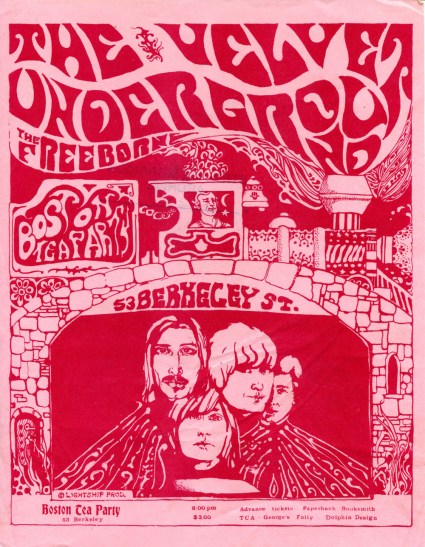
–the success and impact of underground music rock clubs, most notably the Boston Tea Party
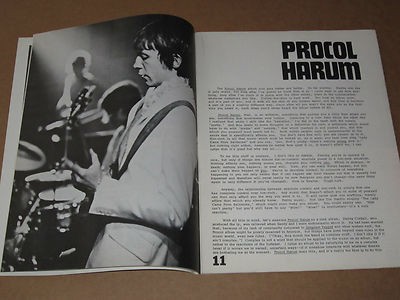
Led Zeppelin plays the Tea Party
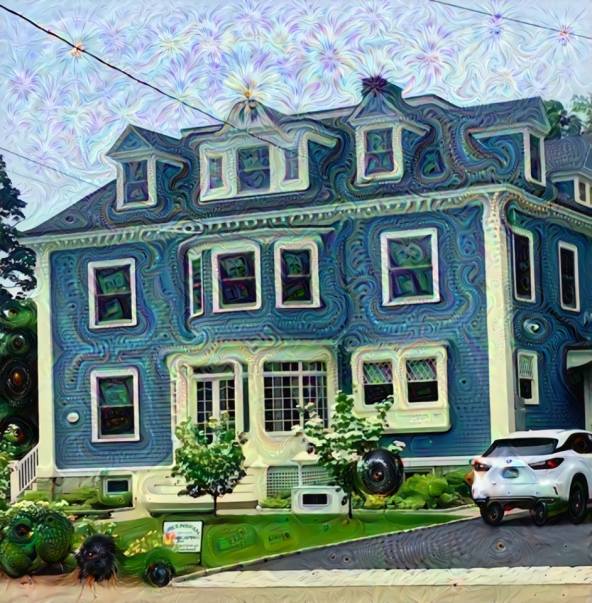
–the beginnings of psychedelic culture, with Tim Leary and Richard Alpert’s pioneering LSD experiments at Harvard and at their homes in Newton
The Leary House today, but as it looked to some circa 1966
With “swingin’ cat” Mayor Kevin White, who had been calling Brown “James Washington” all afternoon and needed a reminder about the name before going on stage.
–the success owed Boston by the Velvet Underground, which performed far more often and to more acclaim in Boston than it did in its home city of New York
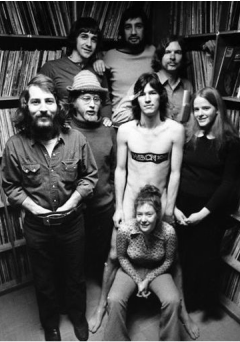
But the biggest competitor to Morrison in column inches in the book is one Mel Lyman. Indeed for the most part the book is about Morrison and Mel, even though their paths did not really cross.
The music scene from which Morrison stocked his band, and the deeply strange tale of Mel Lyman’s Fort Hill Community, suggested an incredibly rich artistic past forgotten by all but a few present day residents.
Stories about Lyman open and close the book and, unlike Morrison who kept to his artistic self, Lyman is all over the scene in chameleon fashion.
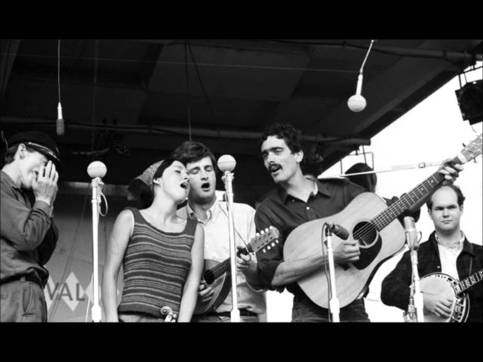
On the day Dylan went electric at Newport is was Lyman on stage at the end of the day doing an acoustic solo performance of Rock of Ages on harmonica, rallying the faithful who had felt betrayed.
Lyman was an accomplished member of the Jim Kweskin Jug Band, playing a style of music now down the memory hole, though Boston and Cambridge were hot spots during the critical period when folk music played with old forms and took on new ones.
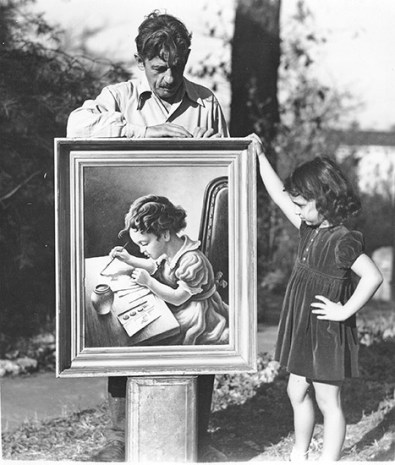
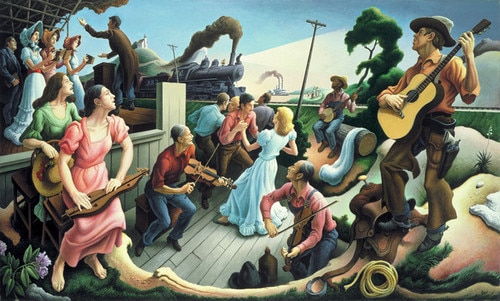
Continuing the Americana theme Lyman married the daughter of Thomas Hart Benton.
Mostly, though, Lyman is famous for founding one of the more famed communes of the era—the Fort Hill Community in the Roxbury Section of Boston.
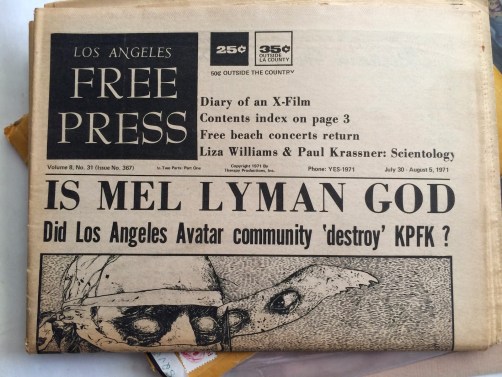
There he more or less declared himself to be God—
. . . though he was always elliptical and ambiguous about what that meant.
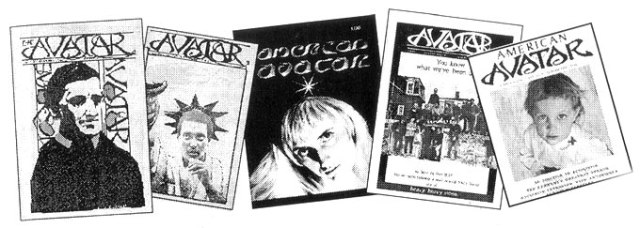
And he was the founder of one of Boston’s pre-eminent underground newspapers, Avatar.
I have a copy of the issue in the center . . . filled with Lyman worship
Lyman’s Fort Hill crowd served as models for one of Benton’s last paintings, The Sources of Country Music.
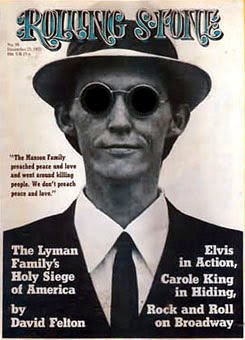
His community commanded a ton of local, and then national attention. At least until the Manson murders, which quickly cast a pall over the fascination that had been growing over what amounted to fascist mini-communities.
The Community attracted a lot of interesting (and often well-educated, talented and privileged) individuals. The pre-Rolling Stone founder of Crawdaddy magazine, Paul Williams, was a resident for a time, until he felt compelled to sneak out in the middle of the night for fear of facing Mel’s discipline.
Yeah, I have this one, too.
Then there’s the story of Mark Frechette,
With co-star and lover Daria Halprin, also a Fort Hill member for a time
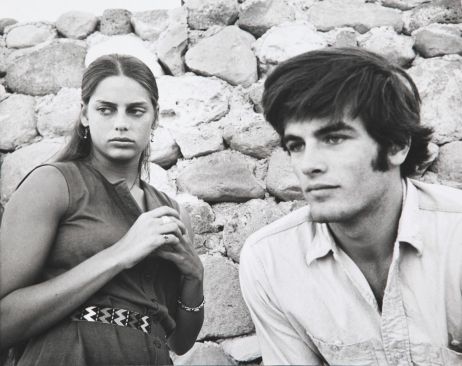
. . . .the nobody in the crowd that Antonioni cast in his wild and woolly flop about America, Zabriskie Point.
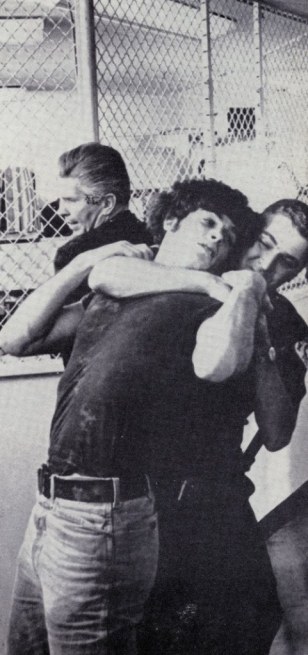
Frechette was a Lyman devotee who ended up robbing a bank while a member of the community and dying in prison several year later, giving it up to a suspicious set of heavy barbells around his neck.
During the arrest, and a preview neck-wise.
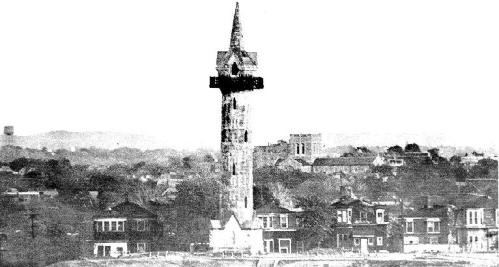
There was an ominous glow cast by Fort Hill back then. From time to time my friends and I would drive to the Community, which sat atop a hill in Roxbury, with a dilapidated tower surrounded by falling apart townhouses and Victorians. The perceived danger of going into Roxbury as lily-white college educated hippie wannabes was only reinforced by the perceived dangers of the Fort Hill crew: choose your poison. But if you wanted a heavy atmosphere you got a heavy atmosphere.
Lyman himself was no stranger to drama–as in performance and film, as opposed to the harrowing life dramas concocted daily on Fort Hill. In fact he was friendly with the experimental filmmaker and critic Jonas Mekas. With Mekas he sought to create a Boston Film Collaborative, which existed side by since in the same building as the now-legendary rock club the Boston Tea Party.
Little did I know when I moved into 53 Berkeley Street while working for the Paul Tsongas Senate Campaign in 1978 that the newly renovated building I was to live in had housed the Tea Party and the Film Collaborative just ten years before, and that my second floor apartment had been the setting for the stage for numerous concerts by the leading lights of underground music.
Lyman keeps popping up like this throughout the book. Playing the famed folk club Passim with Kweskin. Ties to the Velvet Underground via Mekas. An interview on WGBH’s groundbreaking head-trip “educational television” show What’s Happening, Mr. Silver? Links to the LSD crowd in Cambridge and Newton. A key person in the underground press, and in the fights in the community over whether Mel Worship should play a leading role in the alternative media.
Once Mel fell, as he more or less did after Manson, communes were transformed in the public mind into cults and things were never the same. And that’s what I mostly remember: the memory of Lyman as a nutty, fascistic and dangerous cult leader. Walsh’s book is if nothing else a reminder that we mostly remember our memories fixed at a given place and time, and that much of the past really is another country.
Walsh entitled the book Astral Weeks out of respect for Morrison’s talent and because Astral Weeks is his favorite album of all time. But the book itself, and 1968 in Boston, is much more the story of Mel Lyman than it is Van Morrison.
City Journal is running a short and interesting article by Ibn Warraq on the American feminist scholar Phyllis Chesler’s work on honor killings. Warraq is a critic of Islam and something of an apostate, which may account for why he writes anonymously under a pen name. And in reading the article it becomes clear that even as Chesler’s work suggests honor killing is embedded in certain kinds of tribal cultures in Asia and is not a simple product of Islam. Yet Warraq hits the Islam theme pretty hard, as though that is the central issue.
Chesler acknowledges that more honor killings are committed by Muslims than Hindus or Sikhs, especially in the West, but also points out that such killings have roots in certain tribal cultures irrespective of religious belief. But the complex interplay between religion and culture has a Rorschach quality to it, and it is not that difficult to put a spin on a desired emphasis. Here is Warraq:
It is a measure of her intellectual integrity that Chesler goes where the data lead. Thus, her conclusion, based on the empirical evidence, is that “the origin of honor killings probably resides in shame-and-honor tribalism, not necessarily in a particular religion.” And she holds each religion—Islam, Hinduism, and Sikhism—responsible for failing to abolish, or trying to abolish, honor killing or femicide.
But can Islam itself really have nothing to do with honor killings, even though Muslims have perpetuated the majority of such murders in the West? Yes, honor killings have also been found in various societies in the Balkans, the southern Mediterranean (Sicily, for example), and in India, but could these cultures not have learned from Islam, since they were all under Islamic domination for centuries?
So Warraq’s reading of the Rorschach is to acknowledge the tribal origins but emphasize Islam, and to not let it off the hook. Not only are there a lot of specifically Islamic honor killings but perhaps, Warraq hints, it was Islam that put the idea in the minds of other cultures and religions given the geographic and cultural scope of its historic influence.
That there is at least some Islam-blaming in this has prompted a fair number of Muslims to post angry notes in the article’s comments section. And so right or wrong we are once again pitched into a furious debate about Islam, one in which the issue of honor killings fades into the background, to be replaced by a debate over the merits or demerits of the creed.
In turn, readers interested in the question at hand are advised to take a look at what Chesler herself says. I expect I will track down the book Warraq reviews (A Family Conspiracy: Honor Killing, Phyllis Chesler, New English Review Press). But in the absence of that you can learn a lot from this April 2018 article by Chesler in the often-interesting journal Tablet.
This article demonstrates the intellectual integrity Warraq mentions. And that includes a more nuanced view of Islam than Warraq’s.
Now, everybody has an axe to grind I suppose, including the author of this blog post (more on which in the conclusion). No one reads, researches, reflects and writes as a computer might do, because the data are there. People are up to something. If Chesler has an axe to grind, and she acknowledges she does, it has more to do with women and feminism than religion. And so she is comfortable considering questions of religion more placidly since her main interest is elsewhere.
Even so she is remarkably fair-minded in the way she takes on the difficult topic of honor killing. While she is clearly motivated by Western feminist principles, and think them to be superior to tribal approaches to gender and culture, she is quite willing to look for the facts first and let them speak for themselves.
Read the article since I can’t do justice to the care with which she has considered the evidence and its implications. If nothing else it is a gripping and terrible tale, filled with tragedy and raising issues of high concern.
But after parsing the data fairly, as she does, one is still left with existential questions that are hard to come to grips with. Chesler herself appears hugely divided on the question of what it means for tribal cultures to have such intense norms concerning collective control of women, especially as regards their virtue and virginity.
She is aware that cultural practices have their own internal logic and are tied to specific conditions of history and conditions.
From a tribal point of view, this shame-and-honor code does enforce social stability but at the price of individual rights and personal freedom. . . Keeping money and land within one’s own family has always been seen as important. First-cousin marriage maximizes this advantage. The disadvantages of first-cousin marriage include all the consequences of inbreeding and lifelong misery in a marriage one may abhor.
The institution of polygamy, or so it is argued, allows first, second, third, and fourth wives to remain with their children and to continue family life as usual. Since divorce is unthinkable in tribal societies, this may be seen as a “kindness” to womankind.
She is aware of female complicity, and sometimes more, in the practice.
Brothers, uncles, fathers, and other male relatives usually commit the murder, although mothers have also been known to collaborate in the murders of their daughters; sometimes, they are hands-on perpetrators. . . .
At the outset, I did not understand the role that women played in honor killings as conspirators, collaborators, and as hands-on perpetrators. As the author of Woman’s Inhumanity to Woman, I should have suspected this, but since maternal filicide is such an unthinkable act, my understanding dawned slowly.
Chesler speaks of her sailing “into uncharted territory” as she undertook her research, and while she is speaking here of the dearth of good evidence she may be speaking as well of her own emotional journey, which is ongoing. It is not an easy thing to come to ready conclusions about how someone in the West is to confront honor killings, especially as regards action. How far should the West go? Should it recommend? Advise? Support? Shelter? Cajole? Humiliate? Impose? Demand? Invade-the-world-invite-the-world?
Moreover even coming to grips simply with what is actually happening is hard, since cross-cultural comprehension is always fraught with the risk of misunderstanding. Chesler’s honest and sobering conclusion:
One of the many questions with which I wrestle is this: Is an honor killer, by definition, “mentally ill” according to Western standards?
What if he or she has been extremely abused in childhood, suffers from the symptoms of Post-Traumatic Stress, including paranoia, a trigger-temper, and rage-aholism, and believes that such murder is being undertaken in “self-defense?” What if this belief system and psychological configuration is no longer possible to change? How is an honor killing, which is a family conspiracy and an act of domestic terrorism, different from an act of truck-bomb or human-bomb terrorism? Both are embedded within a system of beliefs which are not compatible with democracy or the rule of law.
My answers to these questions are still evolving.
Indeed. Seeing what is in the hearts of others requires one to first see what is in the front of one’s nose, a task that as Orwell pointed out needs a constant struggle.
So kudos to Chesler for an honest reckoning of her own axe to grind and her own struggles in understanding.
In turn, my axe to grind. I am sympathetic both with Warraq’s critique of Islam and Chesler’s feminist impulses as regards honor killings. But my identity is not so much caught up with Islam or women’s issues. At the moment I think a lot about the so-called national question. I can’t help it; that is what is going on for me at present and there is as little sense gainsaying that as there is in asking Warraq why he is preoccupied with questions of Islam or in wondering about the origins of Chesler’s feminism.
What does all this tell me? That while the West’s values are to be treasured they are fragile and specific. Universalism is itself a particular thing, having grown up in a specific place and time. Three cheers for universalism when the conditions are fortuitous such that it doesn’t back up on us. Significantly fewer cheers when universalism is forced to meet its opponents on open ground, and faces the battle nakedly, with only its own naivete for protection.
Take the diversity lottery–please. The idea that our sense of universal values and fair play obliges us to select our immigrants from all around this wonderful world is the height of folly, and that is then compounded by chain migration. To think we live in a real life version of Disney’s It’s a Small World After All expresses an almost colonial-era superiority complex over this whole complex world. Even if we do not like honor killings and even if we opt to take some action against the practice here and abroad (especially here!) it is demeaning to think we can wish other cultures away, Disney-style.
We may not respect what other cultures do but they deserve our respect if only as enduring artifacts of human struggles that persist. So there are prudential limits to what we can expect of other cultures in other places. And in turn we have a prudential obligation to our own people, and dare I say it our own culture, to be forceful in rejecting tribal values that are not congenial to our way of life.









 Blowhard, Esq.
 Callowman
 Sherbrooke
 Eddie Pensier
 Enzo Nakamura
 Epaminondas
 Fabrizio del Wrongo
 Fenster
 Brundle Guy
 Glynn Marshes
 Paleo Retiree
 Atypical Neurotic
 Question Lady
 Sax von Stroheim
 Sir Barken Hyena
 The Mistaken
 Uncouth Reflections